Temperate grassland food web
A Temperate grassland food web shows the complex relationships within the Temperate grassland ecosystems. This food web primarily operates in a region where it receives only 30 to 51 centimetres of rain a year, with most of the rain falling during the summer. Winter brings cold, dry winds and occasional snow.
The temperate grasslands of the southern Hemisphere lie closer to the ocean than their northern counterparts, allowing for milder winters and a more even distribution of rainfall throughout the year. Without the tree of mountains to block or slow the moving masses of air, temperate grasslands experience almost constant wind.
These grasslands have smaller grasses and are less than the Savannas. The temperate grassland food web basically consists of grasses or shrubs. The energy captured by these autotrophs is systematically transferred to higher trophic levels, supporting a wide range of primary and secondary consumers.
The names of different grasslands are:
- Savannas,
- Steppes,
- Prairies,
- Veld,
- Pampas,
- Downs.
Grasslands and their different Names
Grasslands are called different names in different regions. It is not just a difference in language that creates these names, but there is a difference in soil, humidity and the life of plants and animals is unique to various locations.
Producers
The different species of grasses found in temperate grasslands include purple needlegrass, blue grama, buffalo grass, and galleta. Flowers include asters, blazing stars, coneflowers, goldenrods, sunflowers, clovers, psoraleas, and wild indigos.
Consumers
The dependence of Animals upon Plants. The distribution of animals over the world is closely related to the distribution of plants. All animals depend directly or indirectly upon plants for their food. Animals can move in search of food and water, and it is less likely to die in a bad season.
The Herbivorous consumers include bison, gazelles, zebras, rhinoceroses, wild horses, etc.
The carnivores found in these regions range from lions to wolves, etc.
The other animals found in these regions are Deer, prairie dogs, jackrabbits, coyotes, snakes, foxes, owls, badgers, blackbirds, sparrows, quails, and hawks.
Temperate grassland
Temperate grasslands found in the interior of the continents are characterised by large seasonal variations. It has warm summers and cool winters.
Vegetation
The predominant vegetation in this biome is grass or shrubs.
These grasslands strongly depend on precipitation. If there is higher precipitation it leads to the tall and soft grass. If there is lower precipitation it leads to short and soft grass.
Climate
The climate is temperate and ranges from semi-arid to semi-humid. In winter, the temperature can go well beyond 0 degrees Fahrenheit and in summer, the temperature can reach above 90 degrees Fahrenheit.
The temperate grasslands produce low to moderate precipitation, ranging from 50 – 90 cm on average per year. Here, most of the precipitation falls in the form of snow in temperate grasslands in the Northern Hemisphere.
Location
This habitat type is known as Prairie in North America, Pampas in South America, Veld in Southern Africa, and Steppe in Asia.
Grasshoppers, wolves, bison, and prairie dogs are common in these areas. Temperate Grasslands are called by different names in different parts of the world.
These regions are good for wheat cultivation. Due to the lack of farm labour, mechanised agriculture is practised. The pastoral industry is the main source of occupation; animal slaughtering, meat, dairy products, etc., are industries here.
Examples of a Food Chain in a Temperate Grassland
In a temperate grassland, energy flows from plants (producers) up to top predators. Because grasslands lack large trees, the food chains rely heavily on grasses and the herbivores that eat them. Here are examples from different famous grasslands around the world:
| Grassland Region | Producer (Trophic Level 1) | Primary Consumer (Trophic Level 2) | Secondary Consumer (Trophic Level 3) | Tertiary / Apex Predator (Trophic Level 4) |
|---|---|---|---|---|
| North American Prairie | Big Bluestem Grass | Grasshopper | Western Meadowlark (Bird) | Coyote |
| South American Pampas | Pampas Grass | Pampas Deer | Geoffroy’s Cat | Puma |
| Eurasian Steppe | Feather Grass | Bobak Marmot | Steppe Eagle | Gray Wolf |
| Generic Grassland | Clover | Jackrabbit | Gopher Snake | Red-Tailed Hawk |
Temperate grassland food webs across the world
Prairies
Prairies are infinite stretches of flat grassland with moderate temperature, rainfall, and few trees. These grasslands are usually known as the golden, wheat-covered land in the middle of North America.
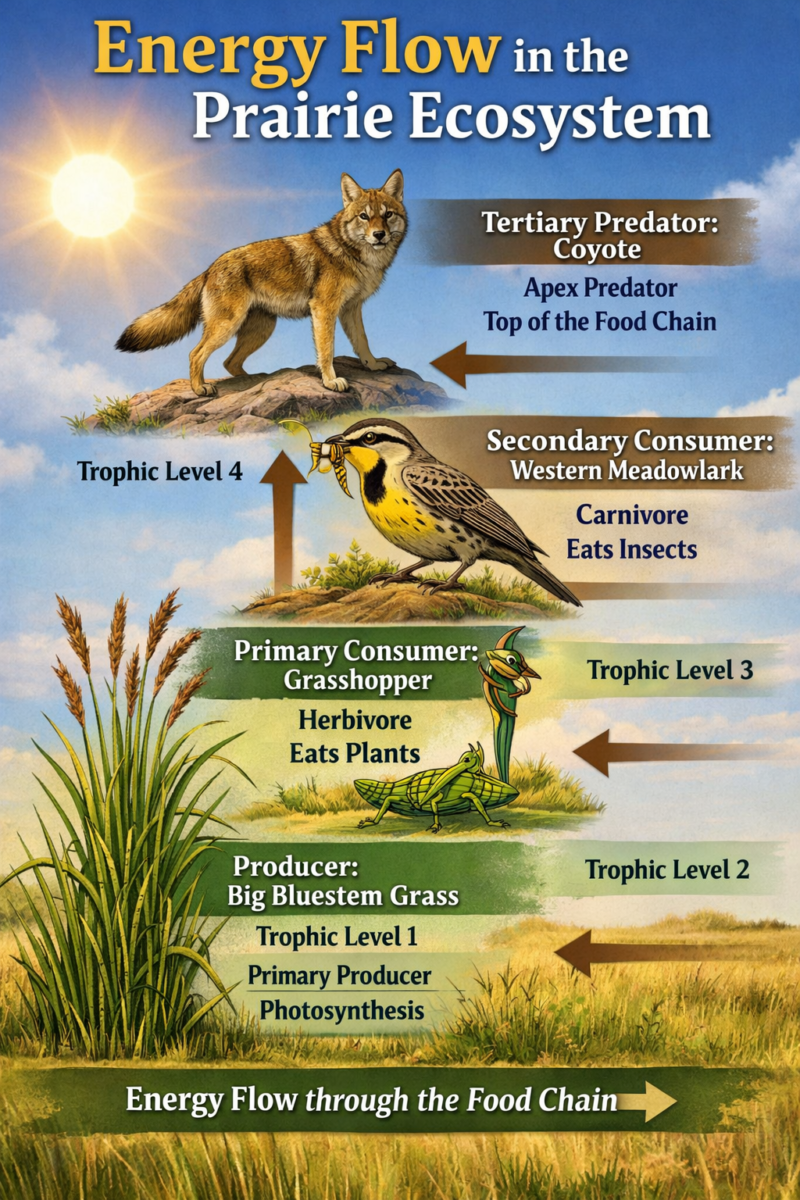
Prairies Temperate grassland food web
Steppes- Eurasia
Pampas -Argentina and Uruguay
Veld- South Africa
Down- Australia and New Zealand