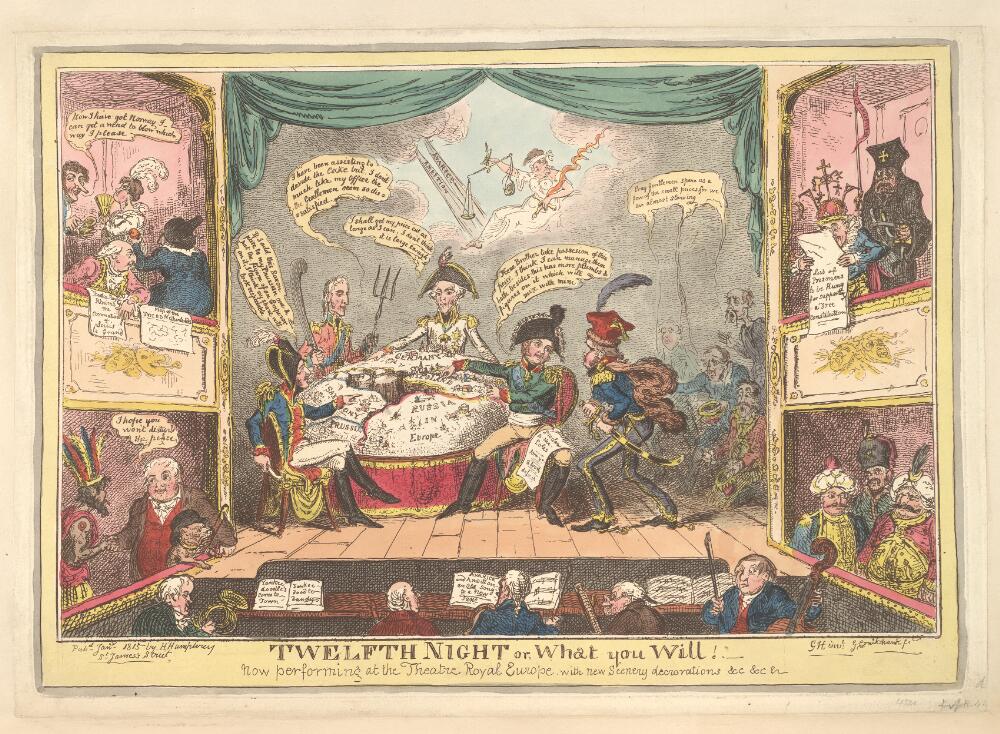
Europe in the nineteenth century was influenced by the developments in France. Klemens von Metternich, the Chancellor of Austria-Hungary, who formed a ‘Holy Alliance’ between the monarchies of Austria, Russia, Prussia and France to suppress democratic and nationalistic trends in Europe, famously said, “When France sneezes, Europe catches a cold.”
France sneezed not once, but thrice in 1789, 1830 and 1848, when revolutions broke out in France. The French Revolution of 1789 led to the emergence of the idea of liberalism expressed through its famous slogan, ‘Liberty, Equality and Fraternity’. The revolutionary energies released and ideals fostered during the Era of Revolution were destroyed by Napoleon Bonaparte. For some years, Napoleon’s reign was a career of victory.
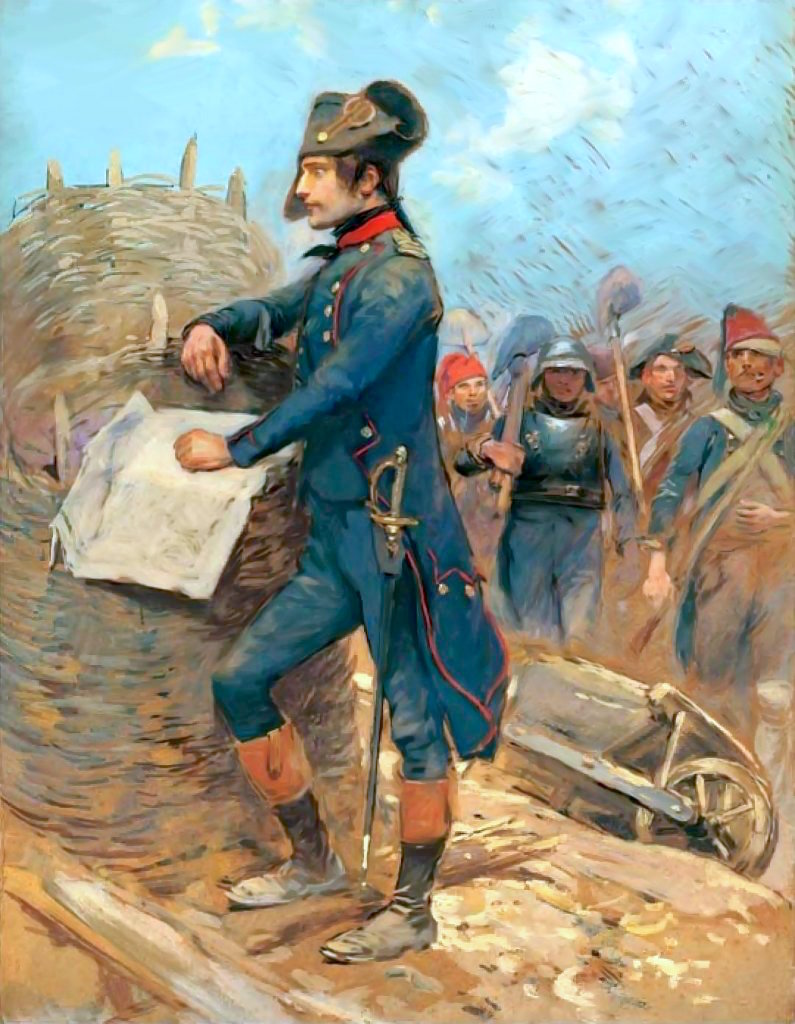
However, as he never won the command of the sea from the British, his fleets suffered a crushing defeat at the hands of the British in 1805. Spain rose against Napoleon in 1808, and then a British army under Wellington pushed the French armies out of the peninsula.
In 1812, Napoleon invaded Russia with a great army of 600,000 men, but the French army was beaten back. Napoleon abdicated (1814) and was exiled to Elba, but returned to France for one last effort to seize power in 1815. He was defeated by the allied forces of the British, Belgians and Prussians at Waterloo in Belgium. He was finally exiled to the remote island of St. Helena in the West Atlantic until his death in 1821.
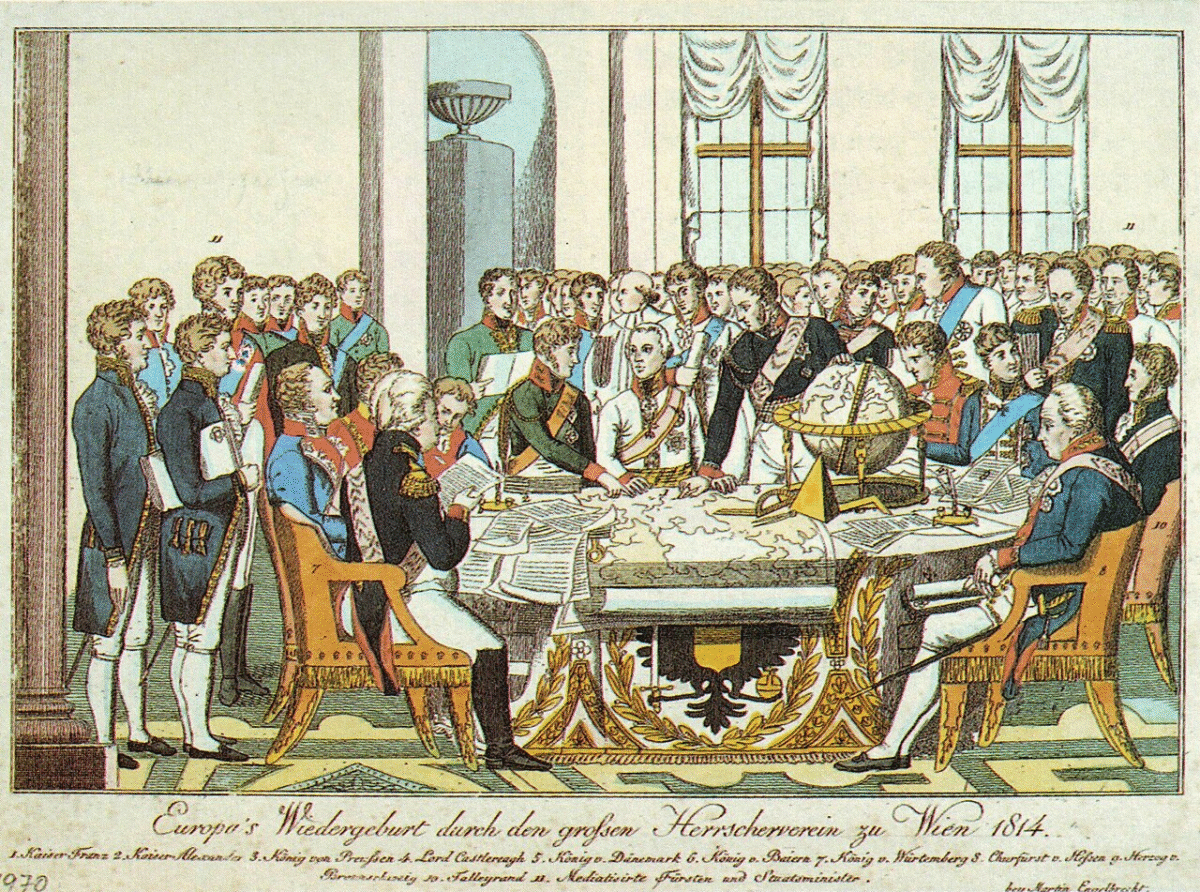
Congress of Vienna (1815)
After the fall of Napoleon, an unstable peace lasted for nearly forty years. Two factors prepared the way for the outbreak of wars between 1854 and 1871. The first one was the restoration of the monarchy and the unfair privileges abolished during the Revolution. On regaining their former position, forgetting past lessons, the rulers almost immediately aimed at absolute power once more. The second was the unworkable system of boundaries drawn by the diplomats at the Congress of Vienna (1815), disregarding the principle of nationality.
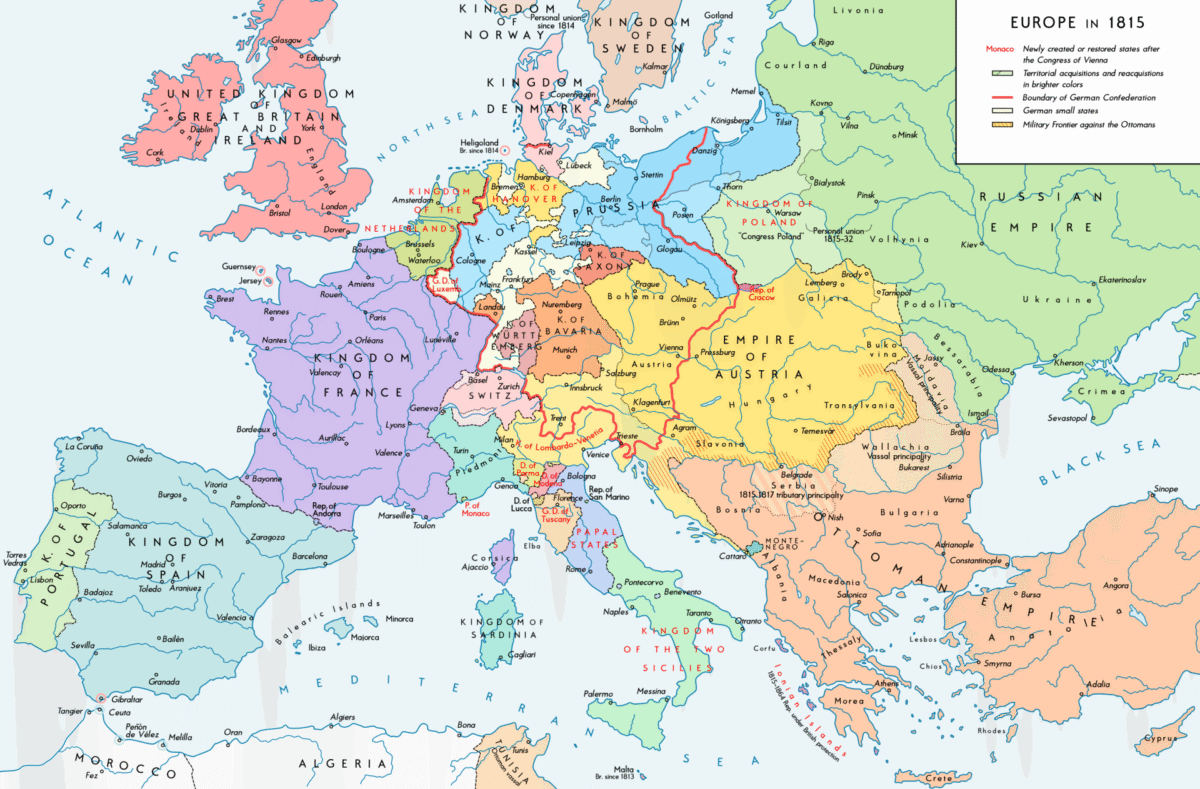
National boundaries within Europe agreed upon by the Congress of Vienna
The reactionary monarchical forces under the leadership of Metternich had begun to function despotically through the Concert of Europe. There was repression of the liberation movements. Popular revolts in Naples (1820) and Spain (1822) were suppressed with the aid of foreign troops, Austrian in the case of the former and French in the latter case.
There was little liberty in any European country. In spite of this, the American and the French Revolutions had made the ideas of democracy and political liberty known and appreciated by liberal thinkers. Progressive thinkers and liberals believed in the virtues of democracy and tried hard to achieve them. But democracy offered no solution to issues of poverty or class conflict. Europe in the nineteenth century was ‘a strange mixture of capitalism and imperialism and nationalism and internationalism and wealth and poverty’.
The Industrial Revolution ended the domestic system of industry and necessitated that the workmen live near the factories. Long rows of tenement houses were built for their accommodation. Wages were abominably low. Hours of labour were as high as fifteen or even eighteen a day. Women and children were employed in large numbers.
The factories were owned by a small class of capitalists, whose main object was unbridled profit. The working classes were initially unorganised and therefore wholly at the mercy of their employers. Many, however, soon began to feel that without organisation and unity, no permanent improvement was possible. So they strove to establish trade unions.
When trade unions arose, the government first declared these unions illegal. Many of the frontline leaders, as we have seen in the previous lesson, were imprisoned or banished. In 1824, however, labour unions were legalised. With the rise of trade unions, an alternate system to capitalism was conceived, and socialism was used as a plank by many to attack the state and defend the interests of the working class.
The working class organising into the Chartist Movement in England and later posing a serious challenge, as the Paris Commune did in France, to the capitalist order, and the unscrupulous measures adopted by the capitalists in connivance with the capitalist state to crush labour struggles are highlighted in this post.
Concert of Europe:Founded by major European Powers,Austria, Prussia,Russia and Britain, in the post-Napoleonic era, it worked for the preservation of European order and balance of power. Under the pretext of political status quo, the great powers under the aegis of Concert of Europe intervened and imposed their collective will on states threatened by internal rebellion during the socalled Metternich Era (1815–1848).
Under Napoleon, Italy had been reduced to three political divisions. This step towards unity was destroyed by the Congress of Vienna in 1815. Eight states were set up, and the whole of Northern Italy was handed over to the German-speaking Austrians. Germany was organised into a confederation of thirty-eight states, governed by a Diet presided over by Austria. But the cause of nationality was not lost either in Italy or Germany. Both Italy and Germany unified and emerged as nation-states.
Rise of Socialist Ideas and Birth of Communism
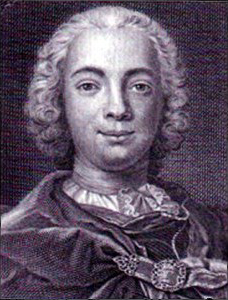
Socialist ideas in the modern sense came to be articulated by the Physiocrats or the economists who were making enquiries into the production and distribution of food and goods. Étienne-GabrielMorally, the Utopian thinker, in his Code de la Nature (1755), denounced the institution of private property and proposed a communistic organisation of society.
He was the precursor of various schools of collectivist thinkers in the nineteenth century, who are categorised as Socialists. François Babeuf, a political agitator of the French Revolutionary period, felt that the Revolution in France did not address the needs of the peasants and workers, and argued in favour of the abolition of private property and for common ownership of land.
Utopian Socialism
The earliest socialists in Europe were not revolutionaries. They proposed idealistic schemes for cooperative societies, in which all would work at their assigned tasks and share the outcome of their common efforts. The term “Utopian Socialism” was first used by Karl Marx and Friedrich Engels to describe the ideas articulated by the socialists before them.
Utopian Socialists recommended the establishment of model communities, where the means of production would be collectively owned. They promoted a visionary idea ofa socialistic society, devoid of poverty or unemployment. Their influence led to the establishment of several hundred model communes (communities) in Europe and the USA. Claude-Henri Saint-Simon, Francois-Marie-Charles Fourier and Robert Owen were some of the prominent Utopian Socialists.
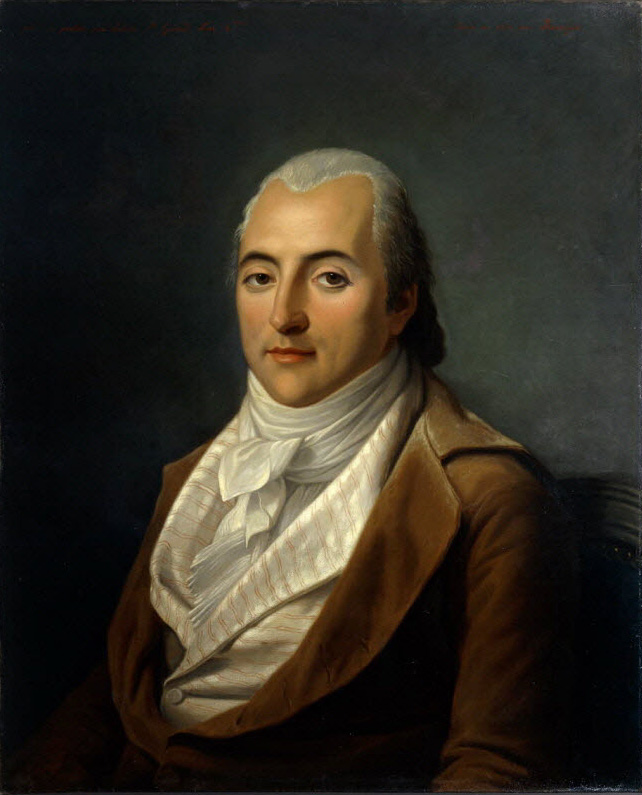
Claude Henri Saint-Simon (1760–1825)
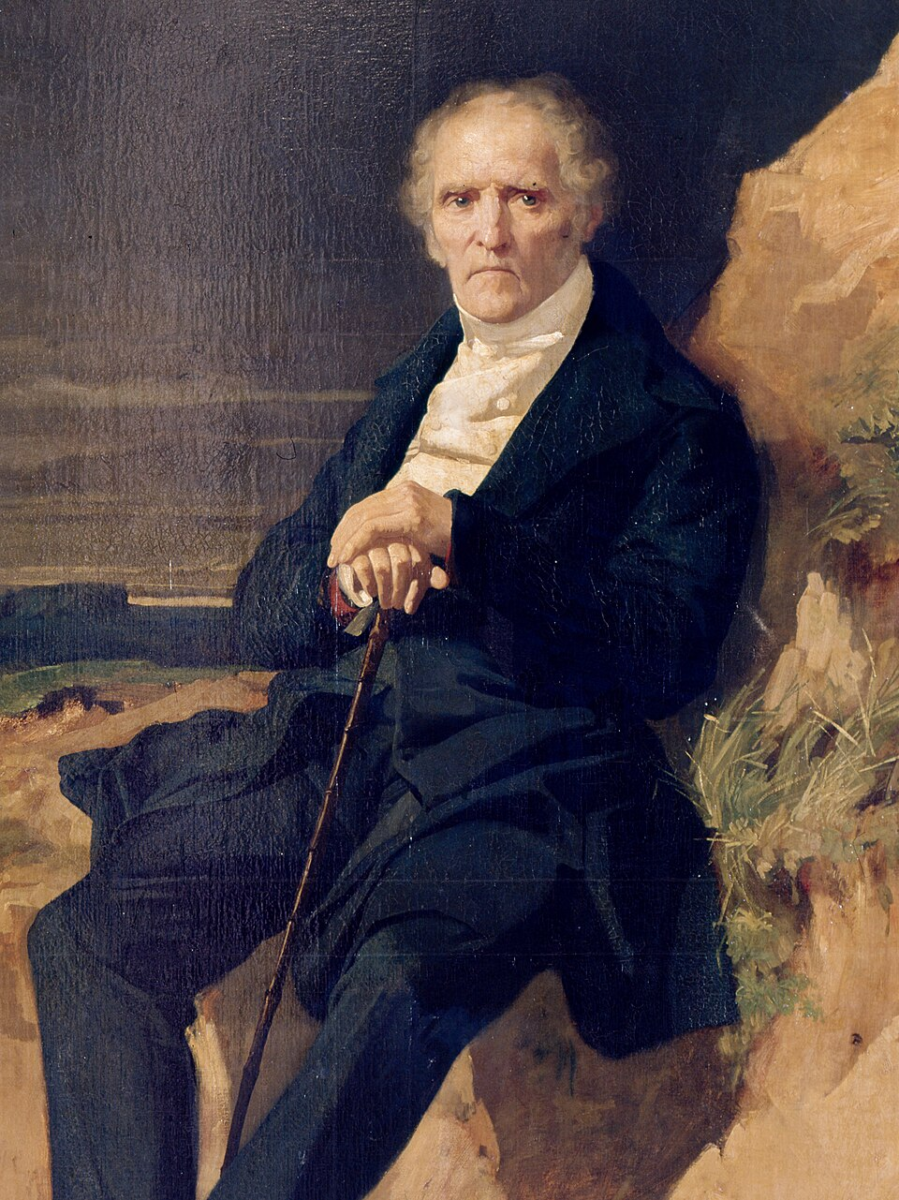
Fourier was an early Utopian Socialist. He believed that social conditions were the primary cause of human misery. Social and economic inequality could be overcome if everybody had the basic minimum. Fourier believed in the goodness of human nature and rejected the dogma of “original sin”. He saw harmony as the law of the cosmos and held that what is true for nature must be true for society. He envisioned a harmonious, self-contained cooperative society called phalansteres. It was a community where there would be equal distribution of profit and loss.
Charles Fourier (1772–1837)
Fourier was an early Utopian Socialist. He believed that social conditions were the primary cause of human misery. Social and economic inequality could be overcome if everybody had the basic minimum. Fourier believed in the goodness of human nature and rejected the dogma of “original sin”. He saw harmony as the law of the cosmos and held that what is true for nature must be true for society. He envisaged a harmonious, self-contained co-operative society called Phalanstress. It was a community where there would be distribution of profit and loss.
Robert Owen (1771–1858)
Among the factory owners of Manchester, there was a humanitarian by the name RobertOwen. Shocked by the condition of the factory workers, he introduced many reforms in his own factories and improved the condition of the workers. He did not employ children below the age of 10 in his industries. Later, he criticised private property and profit. He began to advocate the establishment of new cooperative communities that would combine industrial and agricultural production.
In his book A New View of Society (1818), he advocated a national education system, public works for the unemployed and reform of the Poor Laws. Thanks to his efforts, the British Parliament passed the Factory Act of 1819. By the mid-1820s, Owen had developed a theory of Utopian Socialism based on social equality and cooperation. His other initiatives included the formation of the Grand National Consolidated Trades Union (1834) and the Cooperative Congresses (1831-1835).
Pierre-Joseph Proudhon (1809–1865)
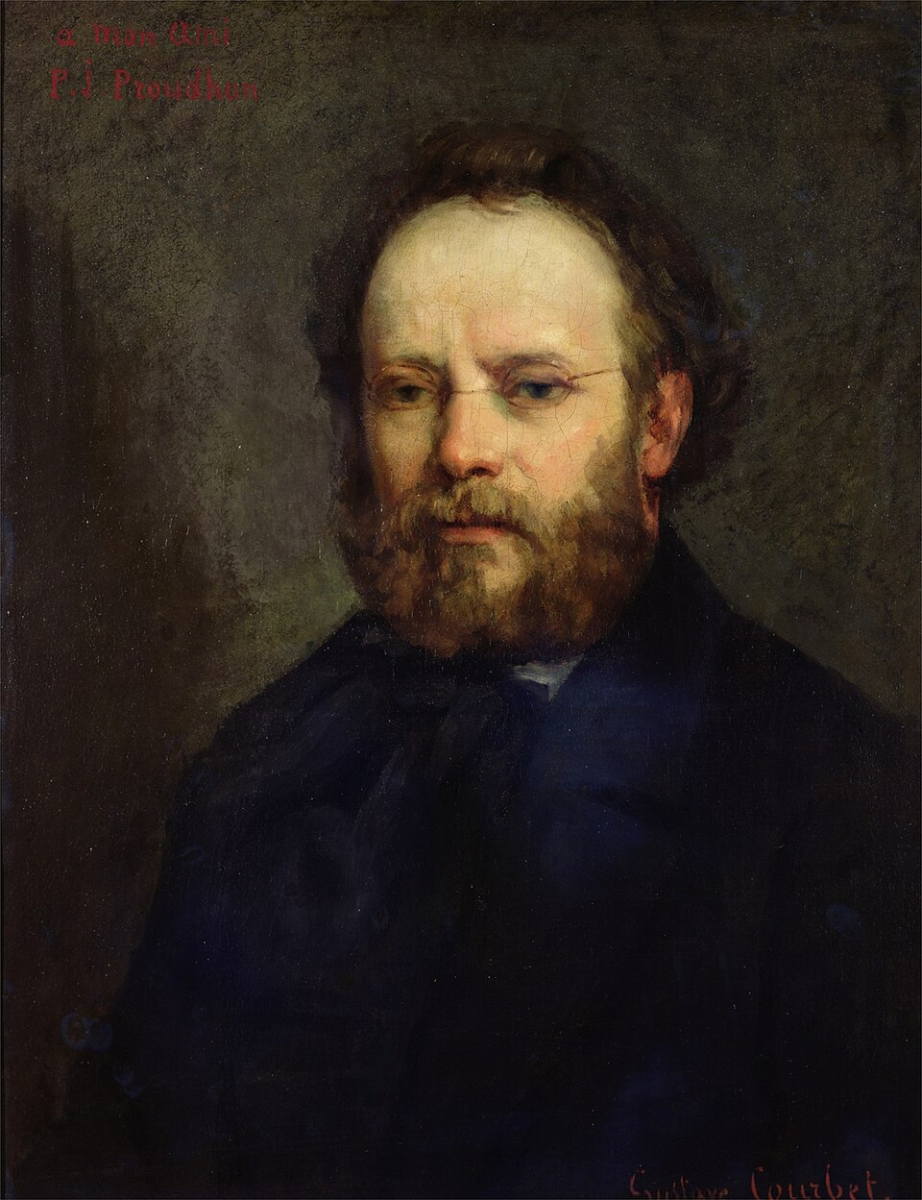
Proudhon was a French anarchist who contributed significantly to the development of socialism. Unlike the earlier Utopian socialists who were drawn from the middle class, he belonged to the working class. Drawing inspiration from the cooperative communities, he and other anarchists were opposed to the state and believed in revolution.
In his pamphlet titled “What is Property?” he wrote that “All property is theft.” Proudhon believed that labour should be the basis for social organisation and that all systems of government were oppressive. He wanted to replace the nation-state with federations of autonomous communes.
In 1848-49, he was a member of the National Assembly but was disillusioned by his experience. His ideas became popular among the working class of France by the middle of the nineteenth century. In 1864, some of the followers of Proudhon issued the Manifesto of the Sixty. The manifesto declared that the French Revolution of 1789 only brought about political equality and not economic equality.
They wanted the working class to be represented by themselves. In the 1863 elections, they unsuccessfully sponsored three working-class candidates in the parliamentary elections of France. His views, which influenced the Russian anarchist thinker Michael AlexandrovichBakunin, sought to overthrow the state by a general strike and replace it with democratically run cooperative groups.
Anarchism: Belief in the abolition of state and organisation of society on a voluntary, cooperative basis without recouse to force or compulsion.
Louis Jean Joseph Charles Blanc (1811-1882)
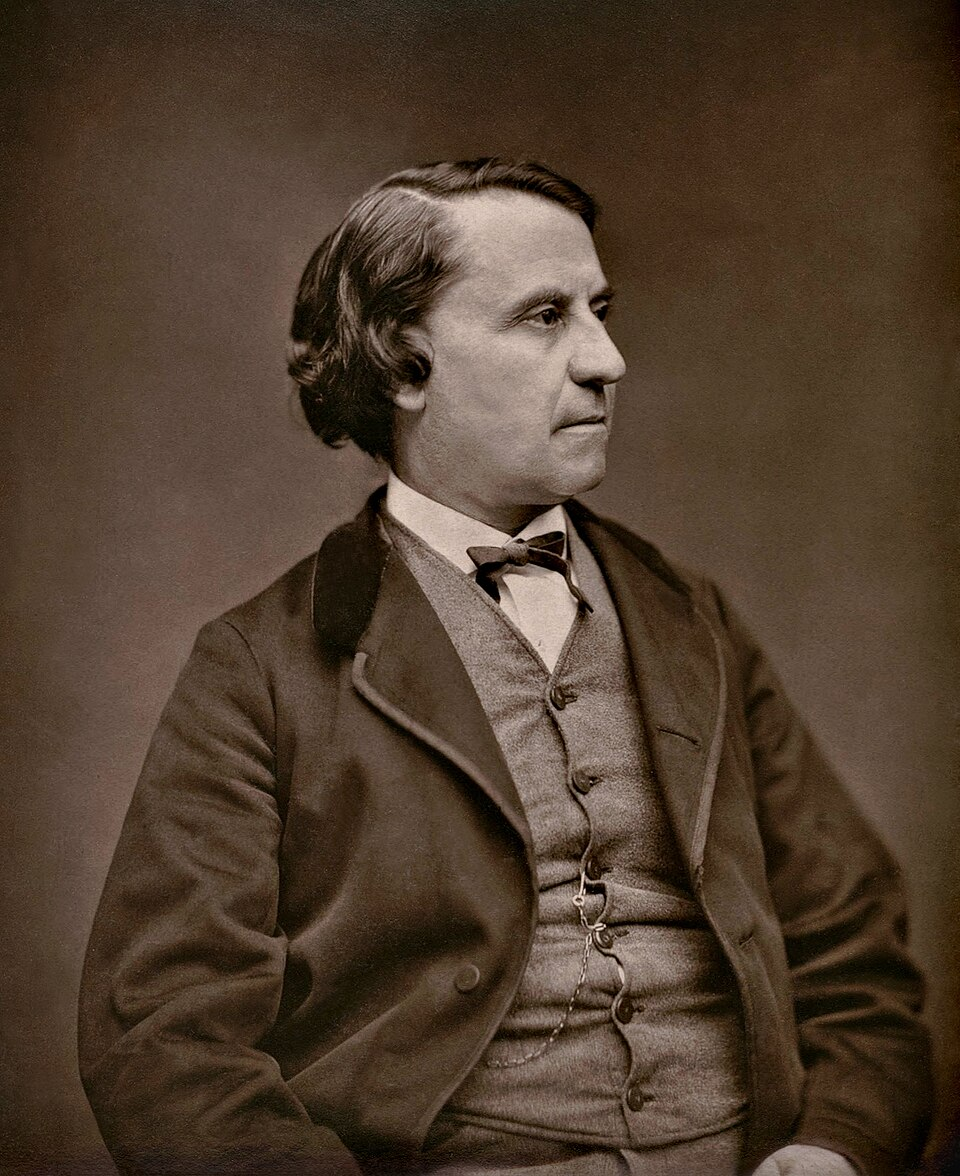
An influential French socialist, LouisBlanc, in 1839, started the Revue du Progres, a journal of advanced social thought. His most important essay, “Organisation of Labour”, serially appeared in 1839. In his writings, he proposed a scheme of state-financed but worker-controlled“social workshops” that would guarantee work for everyone and lead gradually to a socialist society.
Louis Blanc argued that socialism cannot be achieved without state power. In 1848, he became a member of the French provisional government and was able to influence it to set up workshops for the unemployed and provide employment to all who needed it.
Karl Marx and Scientific Socialism
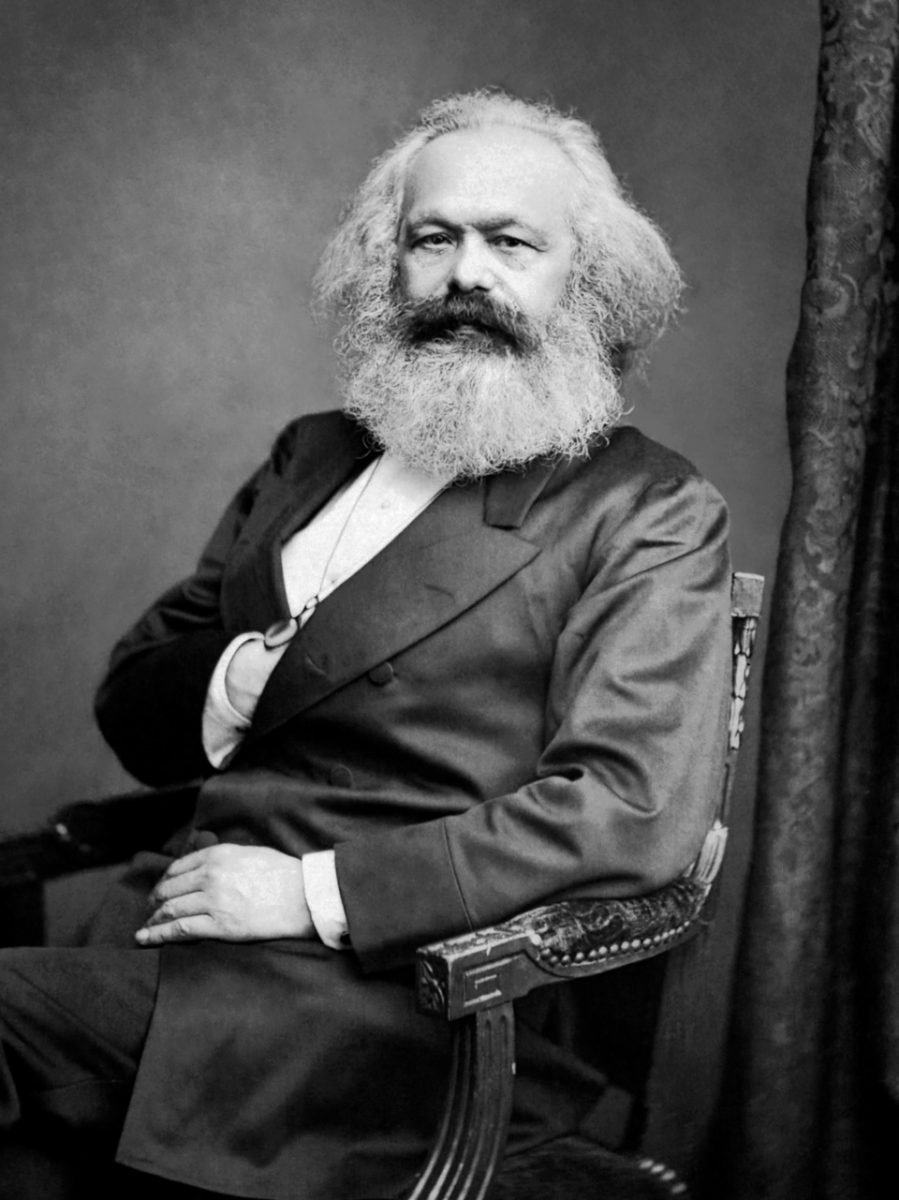
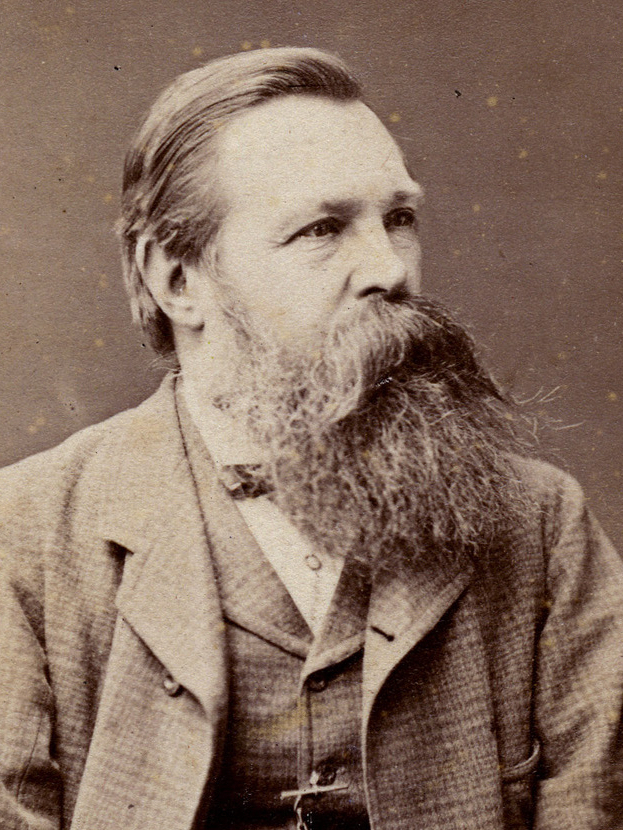
Karl Marx (1818–1883) and FriedrichEngels (1820–1895) made the most profound contribution to socialism. Eventually, their ideas came to be known as Marxism or Communism. They called their views on socialism scientific socialism. On the eve of the 1848 Revolution, Marx and Engels published The Communist Manifesto. T
The most famous rallying cry in this famous work is: “Workers of the world, unite! You have nothing to lose but your chains.”Marx believed that in just the same way as capitalism replaced feudalism, so socialism would eventually replace capitalism.
Marx built his theory on the belief that there is a conflict of interests in the social order between the prosperous employing classes of people and the employed masses. With the advance in education, this great employed mass will become more and more class-conscious and more and more firm in their antagonism to the class-conscious ruling minority.
In some way, the class-conscious workers would seize power, he prophesied, and inaugurate a new social state. In 1867, Marx published the first volume of Das Kapital, a critique of capitalism. In this work, he highlighted the exploitation of the proletariat (the working class) by the bourgeoisie(the capitalist class).
The International Working Men’s Association, founded in 1864, was influenced by his ideas. Its purpose was to form an international working-class alliance. Marx worked hard to exclude the moderates from the International and denounced other socialists, such as Ferdinand Lassalle and Bakunin. Despite his efforts to consolidate the International, it declined by 1876.
However, many socialist parties emerged in Europe: the German Social Democratic Party in 1875, the Belgian Socialist Party in 1879, the Paris Commune in 1871, and the establishment of a socialist party in 1905. The Second International was founded in Paris in 1889, which influenced the socialist movement until the outbreak of the First World War.
Chartism in England
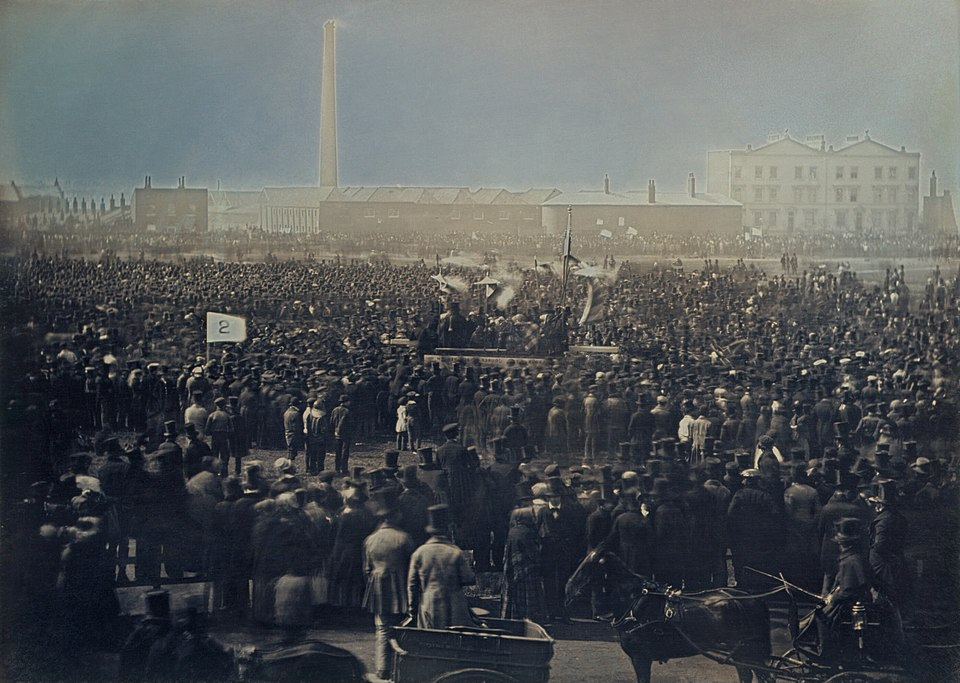
In England, the working class lined up behind the Chartist movement. The Chartist movement was not a riot or revolt. It was an organised movement. The impact of the 1830 French Revolution in England was the outbreak of militant labour agitation. Different streams of agitation converged to give rise to the Chartist movement.
The chartists propagated their ideas through newspapers such as The Poor Man’s Guardian, The Charter, The Northern Star, and The Chartist Circular. Its principal paper, the Northern Star, founded in 1837, soon equalled the circulation of the Times. Articles published in the Northern Star were read out for the illiterates in workshops and pubs in every industrial area.
Hundreds of thousands of workers attended mass meetings held during 1838–39. The People’s Charter, prepared by William Lovett of the London Working Men’s Association, detailing the six key points that the Chartists believed were necessary to reform the electoral system, was presented and deliberated in these meetings. The six key points were:
- Universal Suffrage
- Voting by ballot, to prevent intimidation
- No property qualification for candidates.
- Payment of members elected to the House of Commons, as it would enable the poor people to contend for office and contest elections.
- Equal electoral districts and equal representation
- Annual Parliaments
Panicked by rumours that there would be a popular uprising, the government sent the army to the industrial areas. In 1842, the workers struck work in Lancashire and marched from factory to factory, stopping the work, and extending and intensifying their action. In 1848, in the wake of a wave of revolutions that swept Europe, subsequent to the February Revolution of that year in France, masses of workers prepared again for confrontation.
The state stood firm with the backing of the lower middle class. The Chartist leaders also vacillated whenthe 50,000 strong crowd at Kennington, south London, began to melt away. In the meantime, the government arrested most of them and turned half of London into an armed camp.
Chartism comprised a mixture of different groups holding different ideas. Its leaders were divided between those who believed in winning over the existing rulers and those who believed in overthrowing them. Though Chartism was not successful, its main demands, which were not conceded in the 1832 Reform Act, were later incorporated in the Parliamentary Reform Acts of 1867 and 1884.
July Revolution (1830)
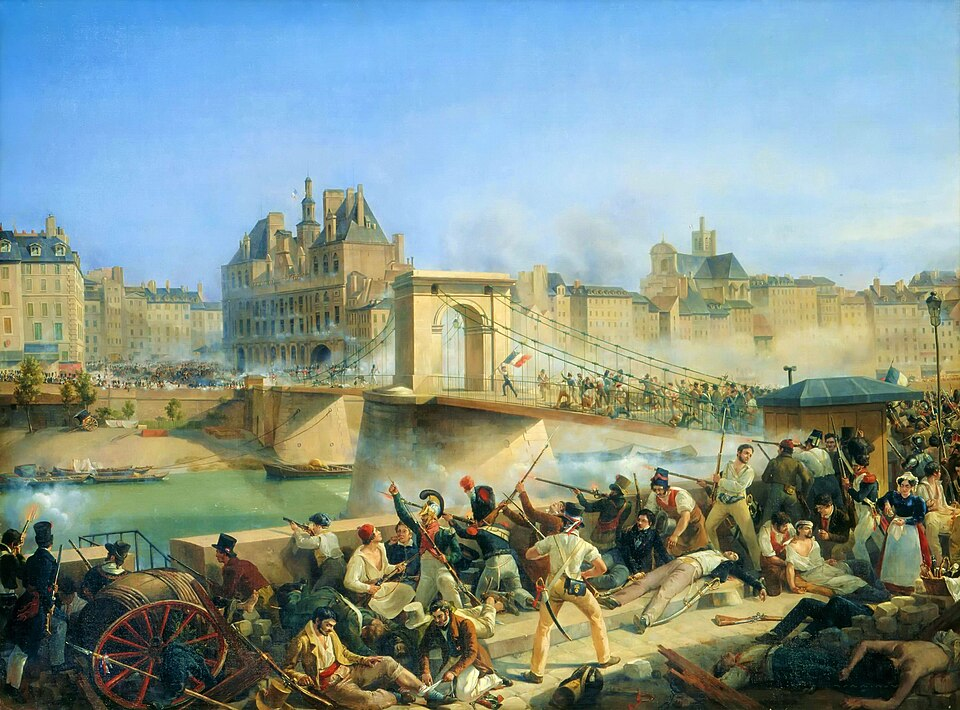
On 26 July 1830, the Bourbon king CharlesX issued four ordinances dissolving the Chamber of Deputies, suspending freedom of the press, modifying the electoral laws so that three-fourths of the electorate lost their votes, and calling for new elections to the Chamber. In protest, the Parisian masses took to the streets for the first time since
The royal forces were unable to contain the insurrection. Charles X was advised to go into exile and put in his place a relative, Louis Philip of Orleans, who had the backing of the middle class. The tactics worked in France. But in other parts of Europe, there arose a number of risings.
The revolution was successful in the Netherlands, where Belgium was separated to form an independent state. The Greeks, who had been fighting for independence from Turkish rule, attained independence in 1832, with the support of the Great Powers. But the revolt of the Poles against the Russian Tsar was suppressed.
February Revolution (1848)
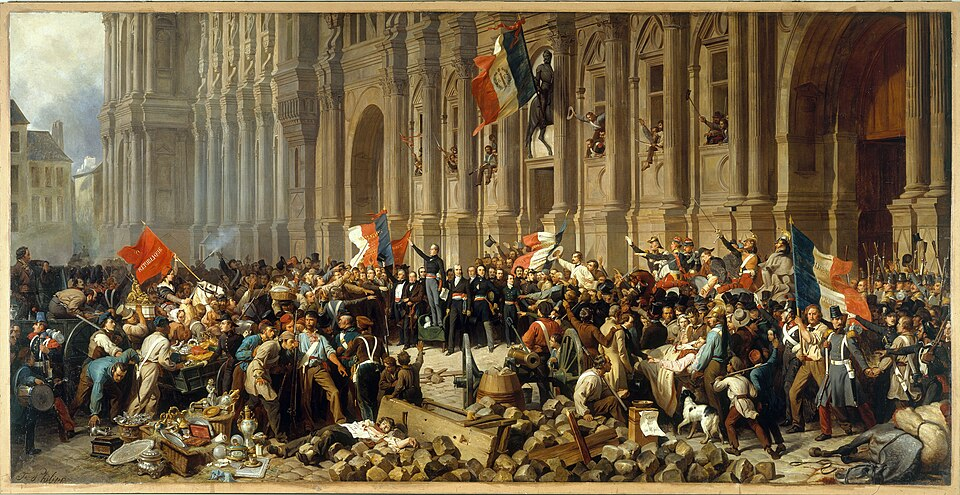
The French King, Louis Philippe, had to abdicate and flee the country in February 1848, when there was a spontaneous rising in Paris. Crowds chanting“Vive de la reforme,” an expression in French to show patriotism, stormed into the lines of troops and swarmed through the palaces and the assembly buildings. The opposition rallied behind the French revolutionary poet Lamartine.
Louis Blanc also joined. In the elections held in April 1848, on the basis of universal manhood suffrage, the moderates were elected in large numbers. Only a few socialists were elected. The newly elected Assembly decided to shut down the workshops that had been started at the initiative of Louis Blanc, as the workshops were seen as a threat to social order. The workers retaliated and braved the government repression.
Between June 24 and 26, thousands of people were killed, and eleven thousand revolutionaries were imprisoned or deported. The period came to be known as the bloody June days. The Constituent Assembly drafted a new constitution based on which elections were held. Louis Napoleon, the nephew of Napoleon Bonaparte, was elected President in December 1848. Before long, in January 1852, he crowned himself as the Emperor by holding a plebiscite.
He assumed the title Napoleon III. The year 1848 was one of the distinct triumphs for nationalism. Metternich, the arbiter of Europe and enemy of nationality, was forced to leave Vienna in disguise. Hungary and Bohemia both claimed national independence. Milan expelled the Austrians. Venice became an independent republic.
Charles Albert, King of Sardinia, declared war against Austria. Absolutism seemed dead for a while. But it was not to be. By the summer, the monarchs had begun their attacks on the revolutionaries and succeeded in crushing the democratic movements in important centres like Berlin, Vienna and Milan. In the space of a year, counter-revolution was victorious throughout the continent.
Nationalism in southern and eastern Europe
In Europe, the countries that first achieved national unity were France, Spain and England. Italy, which had made rich contributions to art and letters, was not part of this political change. Cities in Italy, like Rome, Florence, Venice, Naples and Milan, were the capitals of small states. Hence, she became the prey of powerful kingdoms.
Besides, the age of the Renaissance was an age of intellectual liberty and certainly not an age of political liberty. The petty states of Italy, though enlightened in many ways, were mostly governed by tyrants, such as the Medici in Florence, the cruel Visconti in Milan, and Caesar Borgia in central Italy. What was true of Italy was true of Germany.
The Holy Roman Empire was an empire only in name. In practice, Germany contained three of four hundred separate States. It was their kings who saved these countries from feudal anarchy and made them into nations. Conditions suitable for the rise of Italy and Germany as nation-states developed only in the nineteenth century with the spread of nationalism.
Unification of Italy
Italy before Napoleon’s time was a patchwork of little states and petty princes. Under Napoleon, Italy had been reduced to three political divisions. This step towards unity was destroyed by the Congress of Vienna. Eight states were setup and the whole of Northern Italy was handed over to the German-speaking Austrians. Italy in the nineteenth century was a ‘patchwork of about a dozen large states and a number of smaller ones.’ Metternich described Italy as “an amere geographical expression.”
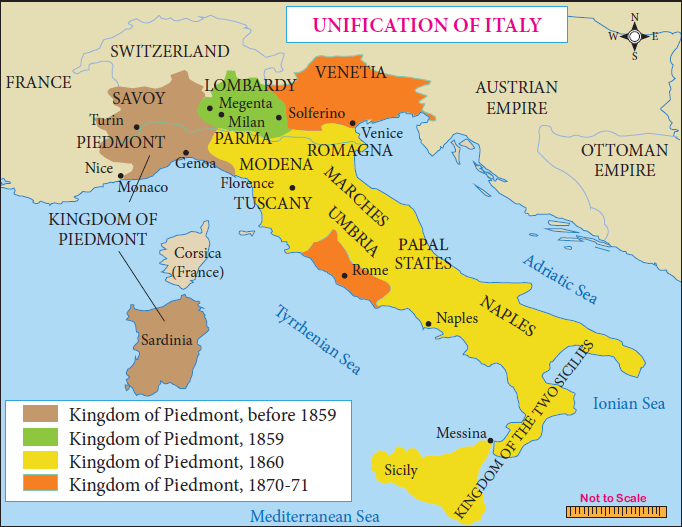
The empire of Piedmont-Sardinia, in the northwest, bordering France, played a central role in unifying Italy. To its east, Lombardy and Venetia were under the control of the Austrian Empire. It also controlled a few smaller states such as Tuscany, Parma and Modena. The Papal States were located in the middle under the control of theRoman Catholic Church. In the south was the Kingdom of the Two Sicilies, or Naples and Sicily, which was under the control of a family of the Bourbon dynasty.
The Napoleonic rule, for the first time, provided Italy with a sense of unity through uniform administration. The nationalistic aspirations of the Italians were dashed when the Congress of Vienna restored the old monarchies in the various Italian principalities. The 1820s witnessed the mushrooming of several secret societies such as the Carbonari, advocating liberal and patriotic ideas.
They kept alive the ideas of liberalism and nationalism. Revolts broke out in Naples, Piedmont and Lombardy. However, they were crushed by Austria. In the wake of the 1830 Revolution in France, similar rebellions broke out in Modena, Parma and the Papal States, which were again crushed by Austria. In 1848, following the February Revolution in France, the people again rose in revolt in several Italian states, including Piedmont-Sardinia, Sicily, Papal States, Milan, Lombardy and Venetia.
As a result, liberal constitutions were granted in Sicily, Piedmont, Sardinia and the Papal States. King Charles Albert of Piedmont-Sardinia, under the influence of the Revolution, invaded Lombardy and Venetia. However, the Austrians defeated him with the help of Russian troops . Charles Albert saved Piedmont-Sardinia from Austrian occupation by taking the blame upon himself for the war and abdicated in favour of his son Victor Emmanuel II.
However, despite the defeat of Piedmont-Sardinia and the suppression of revolution in various Italian principalities, liberal and nationalistic ideas survived. Mazzini, Count Camillo di Cavour, and Giuseppe Garibaldi were the three central figures of the unification of Italy. Cavour was considered the brain, Mazzini the soul, and Garibaldi the sword-arm of Italian Unification.
Mazzini (1805–1872)
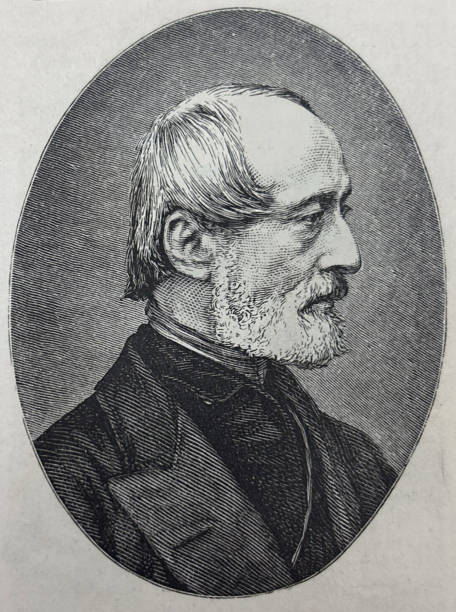
Giuseppe Mazzini laid the foundations of Italian unification. Born in Genoa in a well-to-do family, he graduated in law . Attracted to politics at a young age, he advocated for the freedom of the Italian nation. He involved himself in the insurrectionary activities of the Carbonari for which he was arrested. He soon gave up the idea of secret plotting and began to believe in open propaganda against the monarchy.
He believed that Italy was a great civilisation that could provide leadership to the rest of the world. He started the Young Italy movement in 1831 with the aim of an Italian Republic. Exiled for working for the cause of unification of Italy in 1848, when revolts were breaking out all over Northern Italy, Mazzini returned to Rome.
The Pope was driven away, and a republic was declared under a committee of three, of which Mazzini was a member. But with the failure of the 1848 Revolution and the restoration of Rome to the Pope with the support of the French, Mazzini carried on his work by propaganda and preparing for the next programme of action.
Count Cavour (1810–1861)
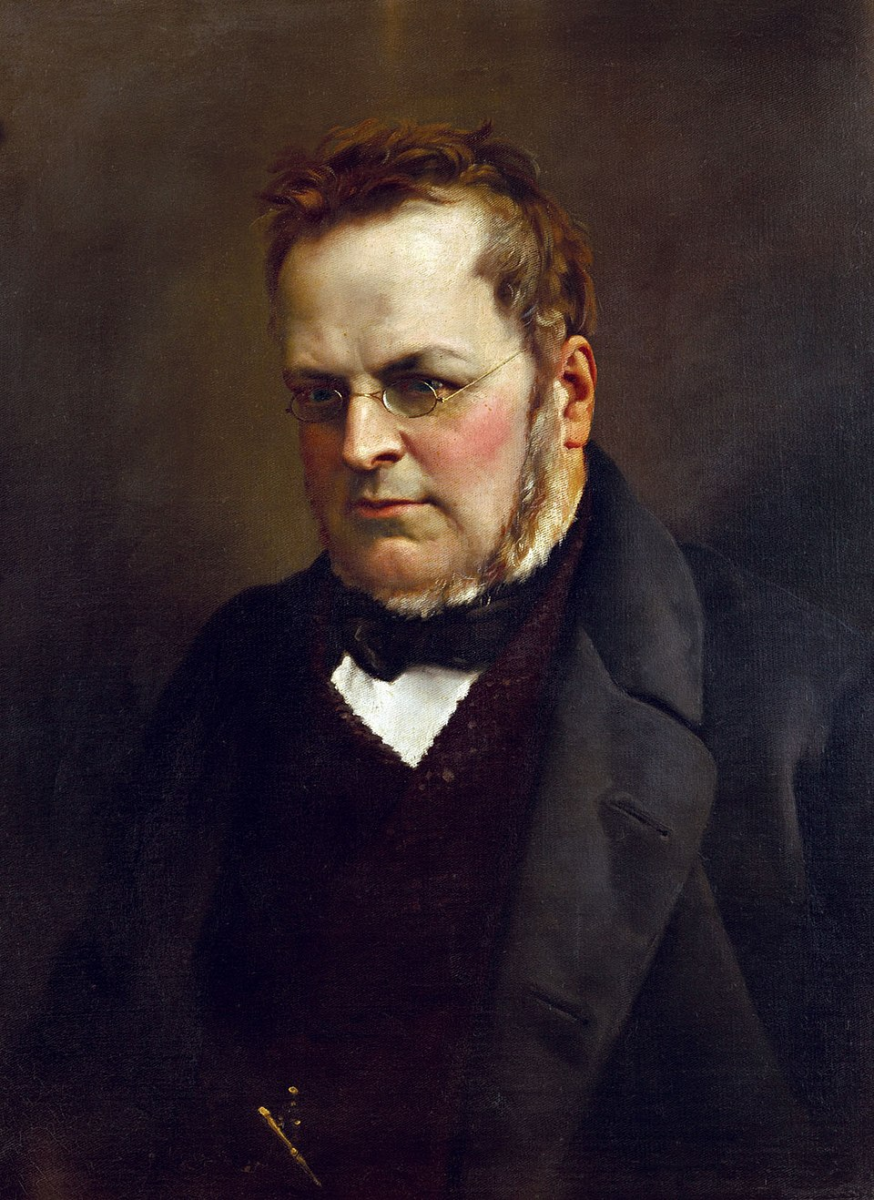
Count Cavour was one of those inspired by the idea of Italian nationalism. In 1847he started a newspaper. The Italian unification movement came to be known by the name of the newspaper as Il Risorgimento. The Risorgimento (the resurrection of the Italian spirit)was an ideological and literary movement that helped to arouse the national consciousness of the Italian people. Cavour rose to become the Prime Minister of Sardinia and played a crucial role in the unification of Italy.
He used a combination of diplomacy and war to achieve the unification under the leadership of Sardinia. Cavour realised that Italian unification could not be achieved without international support. He needed the support of other great powers to expel Austria from Lombardy and Venetia. Therefore, he involved Piedmont in the Crimean War to draw international attention and get the support of England and France. In July 1858, he struck an agreement with Napoleon III of France, who offered to support Piedmont-Sardinia in its conflict with Austria.
War with Austria, 1859
Cavour then provoked war with Austria by mobilising troops near the Austrian border. When Austria issued an ultimatum to disband the troops, he allowed it to expire. As a result, Austria attacked Piedmont-Sardinia in April
The combined armies of Piedmont-Sardinia and France defeated the Austrian armies. They won a major victory at the Battle of Solferino. Instead of continuing the war, Napoleon III of France concluded a peace agreement with the Austrian Emperor FrancisJoseph II at Villa Franca on 11 July 1859.
Cavour was disappointed at the French withdrawal and resigned. In November 1859, Piedmont-Sardinia and Austria concluded the Treaty of Zurich. Austria ceded Lombardy but retained control over Venetia. Cavour was reappointed as Prime Minister in 1860. Parma, Modena and Tuscany emerged with the Kingdom of Piedmont-Sardinia through plebiscites. Similarly, Savoy and Nice were annexed to France on the basis of plebiscites.
Garibaldi and the Conquest of Southern Italy
Giuseppe Garibaldi (1807–1882) played a key role in the unification of Italy by waging guerrilla warfare. He joined Mazzini’s Young Italy and was influenced by his ideas. Garibaldi participated in Mazzini’s rebellion in Piedmont, and he then fled to South America as an exile. He took up the cause of revolutionaries there and fought for the cause ofRio Grande and Uruguay against Argentinian occupation.
Therefore, he was called the ‘Hero of Two Worlds’. In 1843, he started the Italian Legion. This force of volunteers came to be known as the Red Shirts . Garibaldi accepted the invitation of the people of Sicily in their revolt against their monarch. He left the port of Genoa with 1000 volunteers for Sicily. Landing unnoticed on the coast of Sicily, he and his volunteers defeated the 20000-strong Neapolitan (Naples) troop without any loss of life. He then crossed intoNaples and defeated the royal troops with the help of the locals.
However, Cavour, suspicious of Garibaldi’s triumphant march, sent the Piedmontese force to stop him from invading Rome. Garibaldi submitted his conquest to King Victor Emmanuel II and retreated to lead the rest of his life in his home on the island of Caprera. Plebiscites held in Sicily, Naples and the Papal States led to their merger with Piedmont-Sardinia.
At the end of the war, Austria retained control over Venetia and the Pope held Rome. The rest of Italy was unified under Piedmont. In May 1861, King Victor Emmanuel II was proclaimed by the Parliament as the ruler of Italy. During the Austro-Prussian War in 1866, Italy had allied itself with Prussia and was rewarded with Venetia. In 1871, Italy took advantage of the Franco-Prussian War to annex Rome as the French forces withdrew. Thus,the Italian Unification was completed.
Unification of Germany
In spite of a common language and many other common features, the German people continued to be split up into a large number of states. Intellectuals such as Johann vonHerder (1744–1803) andFriedrich Schlegel (1772–1829) promoted the idea of the German nation by glorifying its past.
Herder believed that civilisation was a product of the culture of the common people, the Volk (folk) and promoted the idea of a unique German spirit, the Volkgeist. J.G. Fichte (1762–1814) delivered a series of Addresses to the German Nation. He claimed the German spirit was not just one among the many spirits but was superior to the rest. This inspired and promoted the idea of nationalism among the Germans. Before Napoleon,n Germany consisted of about 360 principalities.
Napoleon unconsciously gave an impetus to the spirit of nationalism by forming a Confederation of the Rhine. For the first time, it gave a sense of unity to Germany. However, the Congress of Vienna, which transformed it into the German Confederation consisting of 39 states, placed it under the control of Austria. At the time of Fichte’s addresses, Austria was occupying the territories of Prussia, the largest and most powerful of the Confederation of German States. It kindled in Prussia the spirit to achieve its past glory. It rebuilt and strengthened its army.
Recruitment was based on merit and not on old aristocratic standing. The zeal for liberalism and modernisation combined with nationalism in Prussia. In 1834, Prussia was successful in establishing the Zollverein (customs union). By the 1840s, it included most of the Germanic states except those under the control of Austria and provided economic unity to the Germanic states. In 1848, popular pressure led to the introduction of an elected legislative assembly.
In the same year, the Frankfurt Assembly was convened. Most of the elected members were liberals who believed that a liberal national-German state could be created. They were divided on the question of what constituted the German nation. The delegates who demanded ‘ Greater Germany’ believed that the German nation should include as many Germans as possible, including Austria, except Hungary, and the crown should be offered to the Austrian Emperor.
Some delegates put forward the idea of ‘Little Germany,’ which argued that Austria should be excluded from the German nation and the crown be offered to the King of Prussia. Eventually, Austria withdrew from the Assembly. A constitution was framed by the Assembly, and the Little Germans offered the constitutional monarchy to King FrederickWilliam of Prussia. However, the latter declined it as he did not want to accept the revolutionary notion of the Assembly offering the crown to him .Otto von Bismarck ,Chancellorof Prussia, transformed it into a powerful state with the objective of uniting the Germanic states under its leadership .He adopted a ‘blood and iron’ policy to achieve the unification. He realised that the unification of Germany was not possible without an armed conflict with Austria and France. He sparked conflict with Austria and France through diplomatic moves. Bismarck opened negotiations with Russia and ensured Russian neutrality in the event of a conflict between Prussia and Austria. Bismarck had to fight three wars to achieve the unification of Germany.
Schleswig–Holstein Question
Schleswig and Holstein were Germanic states under the control of Denmark. In 1863, the King of Denmark merged these two duchies into his kingdom. Bismarck proposed to Austria a joint action against Denmark. In 1864, the joint forces of Prussia and Austria defeated Denmark. By the Treaty of Vienna, Denmark surrendered the duchies to Prussia and Austria. Differences arose on the fate of Schleswig and Holstein .While Austria wanted them to be made part of the German Confederation, Bismarck wanted to administer them separately. By the Convention of Gastein in 1865 it was agreed that Holstein would be under the control of Austria and Schleswig under the control of Prussia. Holstein had a large German population and was located within Prussian territory, making it difficult for Austria to administer it. When Austria decided to refer the matter to the Diet of the German Confederation, it violated the Convention of Gastein. Bismarck ordered the Prussian troops to occupy Holstein.
Austro–Prussian War of 1866
Austro–Prussian War. By his diplomacy, Bismarck had ensured the neutrality of Russia and France. He also got the support of Piedmont-Sardinia, which wanted to drive Austria out of Venetia. Thus, ensuring that Austria would not receive support from any major power, he forced Austria to attack Prussia. The Austro-Prussian War is also known as the Seven Weeks’ War. Prussia defeated Austria at the Battle of Sadowa or Koniggratz in Bohemia. While the Prussian army wanted to march into Austria and capture Vienna, Bismarck opposed it. The war was brought to an end by the Treaty of Prague. Austria withdrew from the German Confederation. The northern states were formed into a North German Confederation under Prussia. Though defeated, Italy was rewarded with Venetia for its support of Prussia. The North German Confederation consisted of 22 states north of the river Maine. A new constitution came into effect on 1 July 1867. Bismarck followed a friendly policy towards the southern states in an attempt to win them over.
Franco–Prussian War of 1870–71
Franco–Prussian War: Bismarck next turned his attention to creating a rift between Prussia and France to unite the southern German states. The opportunity arose over the issue of succession to the Spanish throne. After a revolution in Spain which drove Queen Isabella out of the country, the throne was offered to Prince Leopold, a relative of the King of Prussia. France was agitated over the issue. The threat of war was averted when Prince Leopold declined the offer. Bismarck was disappointed. However, a new opportunity arose when Gramont, the French Foreign Minister, met the King of Prussia in Ems. He demanded that Prussia promise that it would not claim the throne of Spain in the future. The Prussian King sent a telegram about the discussion toBismarck. He edited it in such a manner that the French thought their ambassador had been insulted while the Prussians thought that their king had been humiliated. The Ems telegram triggered the Franco-Prussian War.
France declared war on Prussia. In the Battle of Sedan( 2 September 1870), France was defeated. French King Napoleon III surrendered. Bismarck, however, continued his march to Paris and captured it. The war was brought to an end by the Treaty of Frankfurt in 1871. Bismarck imposed harsh terms on France. France ceded Alsace-Lorraine and agreed to pay a huge war indemnity. At the Versailles Palace, King William I of Prussia was declared the Emperor of Germany, which combined both the North German Confederation and the southern states. Thus, the Unification of Germany was achieved by a combination of diplomacy and warfare.
The Founding of the Third Republic in France
After the Battle of Sedan, Napoleon III was taken prisoner, and later his government was overthrown by a group of republicans in Paris. A provisional government was set up to rule the country until a new constitution could be drafted. Elections were held in February 1871 for a National Constituent Assembly. A majority of the members were monarchists. It is not that the French people preferred a monarchy, but rather that they longed for peace. The monarchists were hopelessly divided, and hence, for almost four years a decision as to the form of government could not be taken. Finally, in January 1875, the National Assembly decided on a republican form of government. This signalled the establishment of the Third Republic in France.
Paris Commune, 1871
In its bid to exact huge financial payment and to annex French Alsace and Lorraine to Prussia, the Prussian army besieged Paris. Paris held out through five months of siege in conditions of incredible hardship, with people starving and without fuel to warm their homes in winter. Workers, artisans and their families bore the full brunt of the suffering as prices soared.
The Parisians grew bitter when larger numbers of monarchists were returned to the National Assembly. Then came the betrayal of the republic – the appointment of 71-yearoldThiers. Paris was once again armed. As the regular army had been disbanded under the terms of the agreement with Prussia, the Parisian masses kept their arms. Along with the National Guard, now overwhelmingly a working-class body, they surrounded the soldiers. One of the generals, Lecomte, gave orders to shoot at the crowd three times.
But the soldiers stood still. The crowd fraternised with the soldiers and arrested Lecomte and his officers. That dayThiers and his government fled the capital. One of the world’s great cities was in the hands of armed workers. The Commune set about implementing measures in their interests – banning night work in bakeries and handing over to associations of workers any workshops or factories shut down by their owners, providing pensions for widows and free education for every child, and stopping the collection of debts incurred during the siege.
In the meantime, the republican government was organising armed forces to suppress the commune. It succeeded in persuadingBismarck to release French prisoners of war. It gathered them in Versailles, together with new recruits from the countryside. Both the Central Committee of the National Guard and the Commune were composed of Blanquists and Proudhanists. Marx could not influence events in Paris.
Soon, the defeat of Communism was achieved by Thiers. Thereafter, there was an orgy of violence. Anyone who had fought for the Commune was summarily shot. Troops patrolled the streets, picking up poorer people at will and condemning them to death. It is estimated that between 20,000 and 30,000 were killed. Of the 40,000 communards (members of the commune) arrested, 5000 of them were sentenced to be deported and another 5,000 to imprisonment.
Karl Marx had this to say on the Commune: “It represented the greatest challenge the new world of capital had yet faced and the greatest inspiration to the new class created by capital in opposition to it.”
The Long Depression (1873–1896)
The world witnessed an unprecedented economic boom from 1865 to 1873. The unification led to a phenomenal boom in Germany between 1870 and 1873. During this period, 857 new companies were established. It was unparalleled in the history of Germany. The railway system almost doubled in size between 1865 and 1875.
Tens of thousands of Germans invested in stock for the first time to demonstrate both their patriotism and their faith in the future of the new German Empire. After the end of the Civil War, the United States too underwent an economic transformation, marked by the proliferation of big businesses and the massive development of agriculture, accompanied by the rise of national labour unions.
The period from the 1870s to 1900 in the USA came to be called the Gilded Age. The rapid expansion of industrialisation led to a real wage growth of 60% between1860 and 1890. The average annual wage per industrial worker (including men, women, and children) rose from $380 in 1880 to $564in 1890. However, the Gilded Age was also an era of abject poverty and inequality, as millions of immigrants – many from impoverished regions – poured into the United States.
The high concentration of wealth in a few hands was becoming more visible. Then came the Depression. It was signalled by the collapse of the Vienna Stock Market in May 1873. The Depression was worldwide and lasted till 1896, and is referred to as the Long Depression. It affected Europe and the US very much. American railroads became bankrupt.
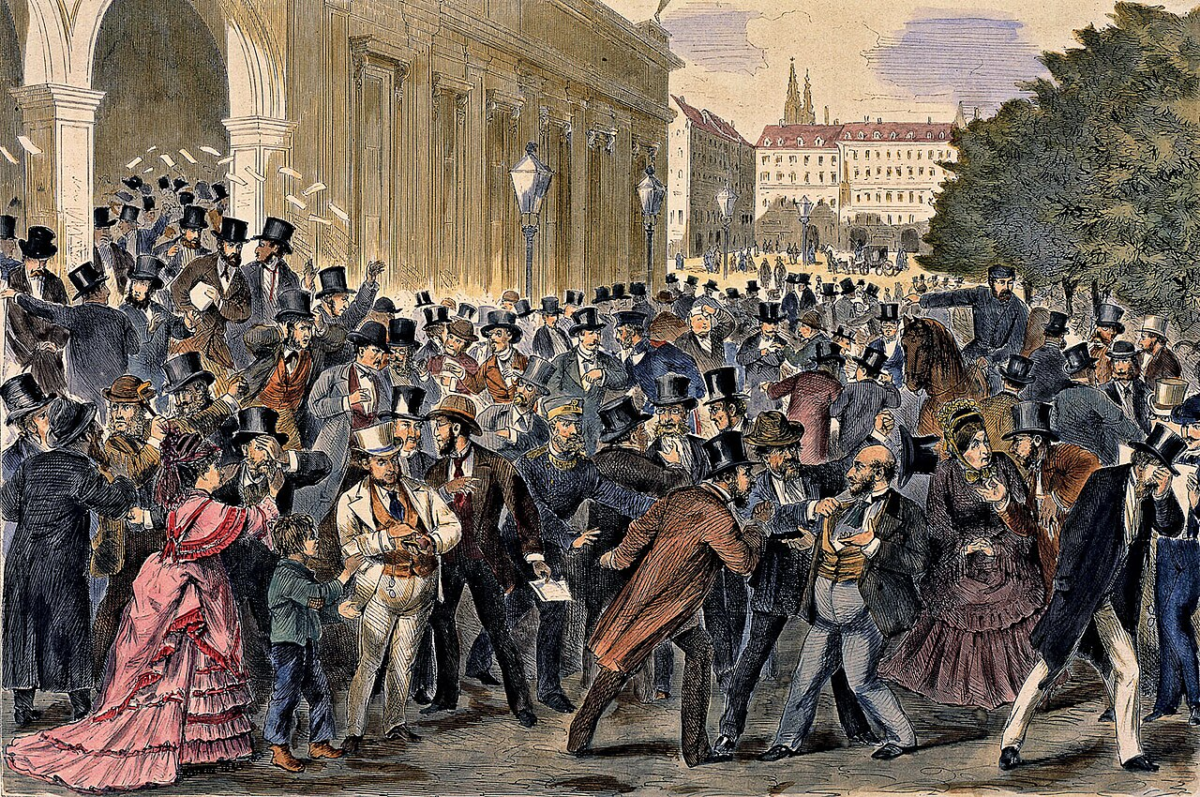
German shares fell by 60 per cent. Agriculture was most affected, as there was a fall in prices. Many countries responded by imposing protective tariffs to prevent competition. Panic of 1873. The Gilded Age was also an era of intense mass mobilisation of the working classes. Socialist
and labour movements emerged in many countries as a mass phenomenon. When industrial capitalism was at its peak in the US, nearly 100,000 workers went on strike each year. In 1892, for example, 1,298 strikes involving some 164,000 workers took place across the nation. Trade Unions, aiming at protecting workers’ wages, hours of labour, and working conditions, were on the rise . Capitalists who could not reconcile to the rise of trade unions launched a counteroffensive. The socialists suffered persecution. The strike at the Carnegie Steel Company’s Homestead Steel Works in 1892 culminated in a gun battle between unionised workers and men hired by the company to break the strike. The state supported the company management, and as a result, the steelworkers ultimately lost the strike.
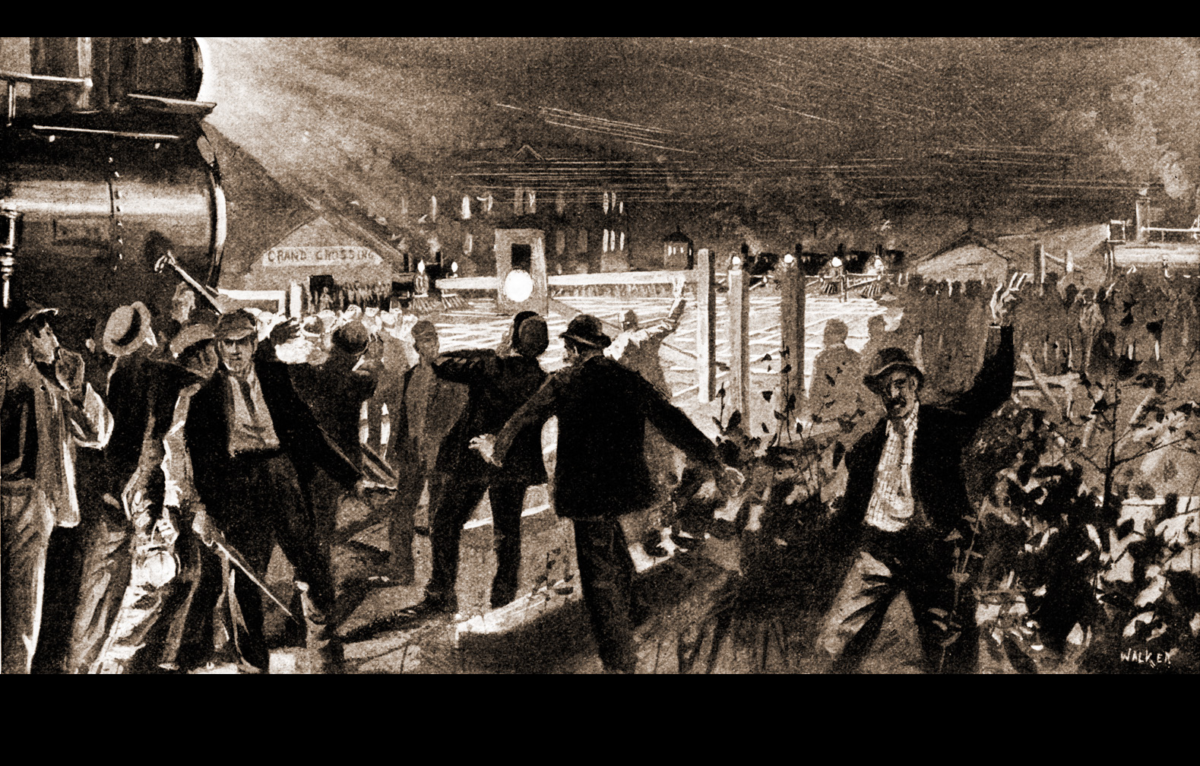
The Pullman Strike of 1894, a national railroad strike involving the American Railway Union, was smashed by armed police and Pinkerton private detectives were hired by the employers to shoot down strikers. Pullman Strike. In Germany, the Socialist Democratic Party(SDP) emerged as a popular party. However, Bismarck introduced anti-socialist legislation to check the growth of socialism.
Despite this, support for the party grew. With the repeal of the anti-socialist laws after 1890, socialist trade unions were able to function openly. SDP’s share of Reichstag seats increased from 3 percent in1887 to 20 per cent in 1903. In Britain, in the 1880s, the famous MatchGirls Strike by the women and teenage girls working in the Bryant and May Match Factory ended in the victory of the strikers. There was also a dock strike (1889) in the port of London. Cardinal Manning intervened and mediated on behalf of the strikers with the dock owners. But, in the 1890s, British employers, following the examples of their counterparts in the US, also destroyed many of the new unions through professional strike breakers, starving people back to work, lockouts and the like.
Conclusion
Liberalism and nationalism, joining hands to fight for democracy and the Industrial Revolution, leading to the rise of working-class movements and the coming of socialism, are explained.The early socialists and Marx and their contributions are discussed.The Chartist Movement in England and its tragic end without achieving its objectives are analysed.The 1830 and the 1848 revolutions and the growing aggressive nature of nationalism leaving its liberal thrust in Western Europe, are highlighted.The ascendancy of nationalism in Italy and Germany that emerged as nation states are detailed.The built-in weakness of the capitalist system during the long depression of1873-1896, and the growing militancy of the labour that was unscrupulously dealt with by the capitalists in collusion with the state are analysed.