Three great events of the fifteenth and sixteenth centuries – the Renaissance, the geographical discoveries and the Reformation – mark a transition from the Middle Ages to the Modern. The essence of the Renaissance was the centrality given to the human and the natural, with religion relegated to a subordinate place. The Renaissance had a profound impact on the making of the modern world. It stimulated the geographical imagination of Europe. The success of Columbus encouraged overseas enterprise enormously. The Reformation, a revolt against the Catholic Church, transformed the religious map and marked a major turning point in attitudes to religion. Attempts to consolidate a monarchy and to make it absolute resulted in Spain, France, and England evolving as nation-states.
Renaissance in Italy and Its Spread in Western Europe
The word Renaissance, of Latin origin, means rebirth or revival. It signifies the sudden revival of interest in the classical learning of Greece and Rome. In the course of development, however, the Renaissance became more than a mere revival of classical learning. It included an impressive record of new achievements in art, literature, science, philosophy, education, religion, and politics. The Renaissance incorporated a number of ideas. Notable among them were humanism, scepticism, individualism, and secularism. A unique aspect of the Renaissance was the contribution made not by monks and nobles, but by laypersons.
Causes of the Renaissance
(i) New experiences during the Crusades [religious wars aimed at recovering the Holy Land from Muslim rule], the rise of independent trading cities like Venice, Florence, Genoa, Lisbon, Paris, London, Antwerp, Hamburg and Nuremberg, with many visiting travellers, and the establishment of universities at Paris (France), Oxford (England), and Bologno (Italy) provided the necessary preliminary conditions for the birth of renaissance.
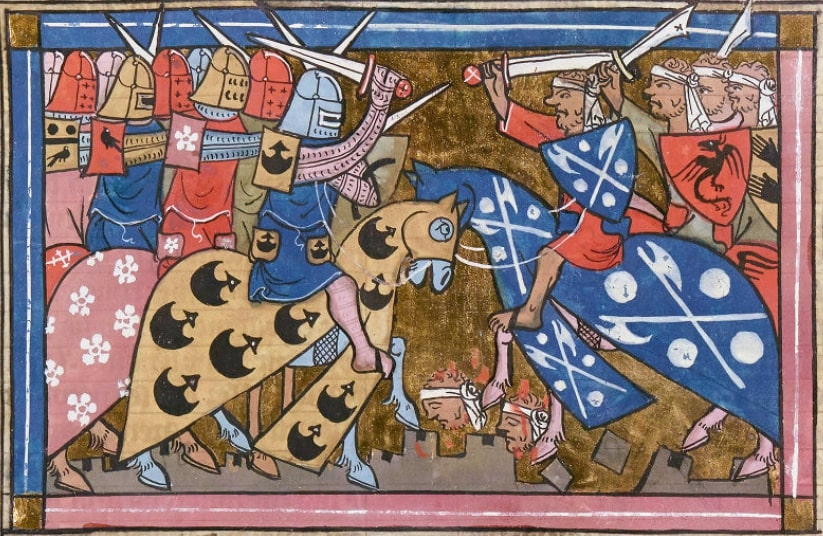
Religious wars aimed at recovering the Holy Land from Muslim rule
(ii) Philosophical discussion, which had begun as early as the eleventh century, continued to produce great minds. The most prominent among them in the thirteenth century was Roger Bacon
(1214–1294). An
English philosopher
who lived in
Oxford, Bacon is
considered the
father of modern
e x p e r i m e n t a l
science. He wanted human kind to be
ruled not by dogma and authority but
rather by reason.
(iii) In 1393, a famous scholar of
Constantinople, Manuel Chrysaloras,
arrived in Venice on a mission from the
Byzantine emperor to seek the help of
the West in the war against the Turks.
Chrysaloras was eventually persuaded to
accept a professorship of Greek classics
at the University of Florence. About the
beginning of the fifteenth century several
other Byzantine scholars migrated to
Italy. The influence of these scholars
inspired Italian scholars to make trips
to Constantinople and other Byzantine
cities in search of manuscripts. Between
1413 and 1423 one Giovanni Aurispa
brought back nearly 250 manuscript
books, including the works of Sophocles,
Euripides, and Thucydides. After the
fall of Constantinople in 1453 there was
a great exodus of classical scholars to
Western Europe which gave a fillip to
classical learning.
(iv) The Byzantine world not only gave
Christendom the stimulus of its scholars
and philosophers, it also gave it paper.
Though paper originated in China in
second century BC (BCE)., it reached
Germany only by the fourteenth century.
Thereupon, the invention of moveable
type and the printing press by Johannes
Gutenberg followed. With printing, the
intellectual life of the world entered a far
more vigorous phase. Knowledge spread swifty.
Italy as the birthplace of Renaissance
Renaissance began in Italian cities and later
spread to western Europe. Italians preserved the
belief that they were descendants of the ancient
Romans. They looked back upon their ancestry
with pride. Italy had a more secular culture than
most other parts of Latin Christendom. The
old cathedrals and paintings seemed to them
gloomy and the old traditions irksome. So in
their search for something more to their liking,
they discovered books written in Latin. They
learnt to write Latin as the ancient Romans did.
They also learnt Greek and thereby discovered
wonderful works of the Athenians of the time of
Pericles and facilitated a rebirth of the ancient
and the bygone era of Greek and Roman culture.
Italian universities were established primarily
for the study of law and philosophy.
The Medici Family: Florence is one of the city states in Italy which was influence by a powerful merchant family called Medici. Cosimi de Mesdici who was engaged in banking with many branches across Italy had indirect control over the functioning of the government between 1434 and 1464. After his death, his grandson lorenzo took over and controlled the government. He was known as Lorenzo, the Magnificent. During this period, the Medici family patronized many artist including Michelangelo and Leonardo da Vinci.
Italy was situated in the centre of the Mediterranean Sea, and hence the Italian cities were the main beneficiaries of the revival of trade with the East. By the fourteenth century, Italian cities engaged in sea-borne trade had become fabulously rich. The Renaissance movement was accelerated by two prosperous families, the Medici family in Florence and the Sforza family in Milan.
Popes such as Nicholas V, Pius II, Julius II and Leo X bestowed their patronage upon the most brilliant artist of the Italian Renaissance.
Florence as the Homes of the Renaissance
Even in the thirteenth and fourteenth centuries, Florence had produced Dante (1265-1321) and Petrarch, the two great poets of the Italian language. Dante’s Divine Comedy is a summation of medieval culture. Its dominant theme is the salvation of mankind through reason and divine grace. But it abounds with many other themes such as human love, love of country, interest in natural phenomena and even the desire for a free and united Italian nation.
Petrarch (1304-1374) produced works both in Latin and Italian. An early humanist, he is considered the father of Italian Renaissance literature. Petrarch’s inquiring mind and love of classical authors led him to travel, visiting men of learning and searching in monastic libraries for classical manuscripts. It is believed that his discovery of Cicero’s letters was a key moment in the 14th-century Italian Renaissance.
Giovanni Boccaccio (1313-1375), also a Florentine, produced Decameron, a collection of 100 stories, as told by seven young women and three young men, during their stay at a villa outside of Florence to escape the ravages of the Black Death.
Niccolò Machiavelli (1469-1527)
Niccolo Machiavelli’s The Prince became famous because of its relevance as a political guide for rulers. In his view, the supreme obligation of the ruler was to maintain the power and safety of the country over which he ruled. No consideration of justice or mercy or the sanctity of treaties should be allowed to stand in his way. Machiavelli maintained that a man prompted exclusively by motives of self-interest and the head of the state should therefore take nothing for granted as to the loyalty or affection of his subjects.
‘A Prince’ says Machiavelli, must know how to play at once man and beast, lion and fox. He neither should nor can keep his word when to do so will turn against him. I venture to maintain that it is very disadvantageous always to be honest; useful, on the other hand, to appear pious and faithful, humane and devout. Nothing is more useful than the appearance of virtue.
