Introduction and Origin
- Precedent: The American Constitution was the first to begin with a Preamble, a practice followed by many countries, including India.
- Meaning: The term “Preamble” refers to the introduction or preface to the Constitution, containing its summary or essence.
- Identity Card: N. A. Palkhivala, an eminent jurist and constitutional expert, described the Preamble as the “identity card of the Constitution”.
- Historical Basis: It is based on the “Objectives Resolution” drafted and moved by Pandit Jawaharlal Nehru on December 13, 1946, and unanimously adopted by the Constituent Assembly on January 22, 1947.
- 42nd Amendment: It was amended by the 42nd Constitutional Amendment Act (1976), which added three new words: Socialist, Secular, and Integrity.
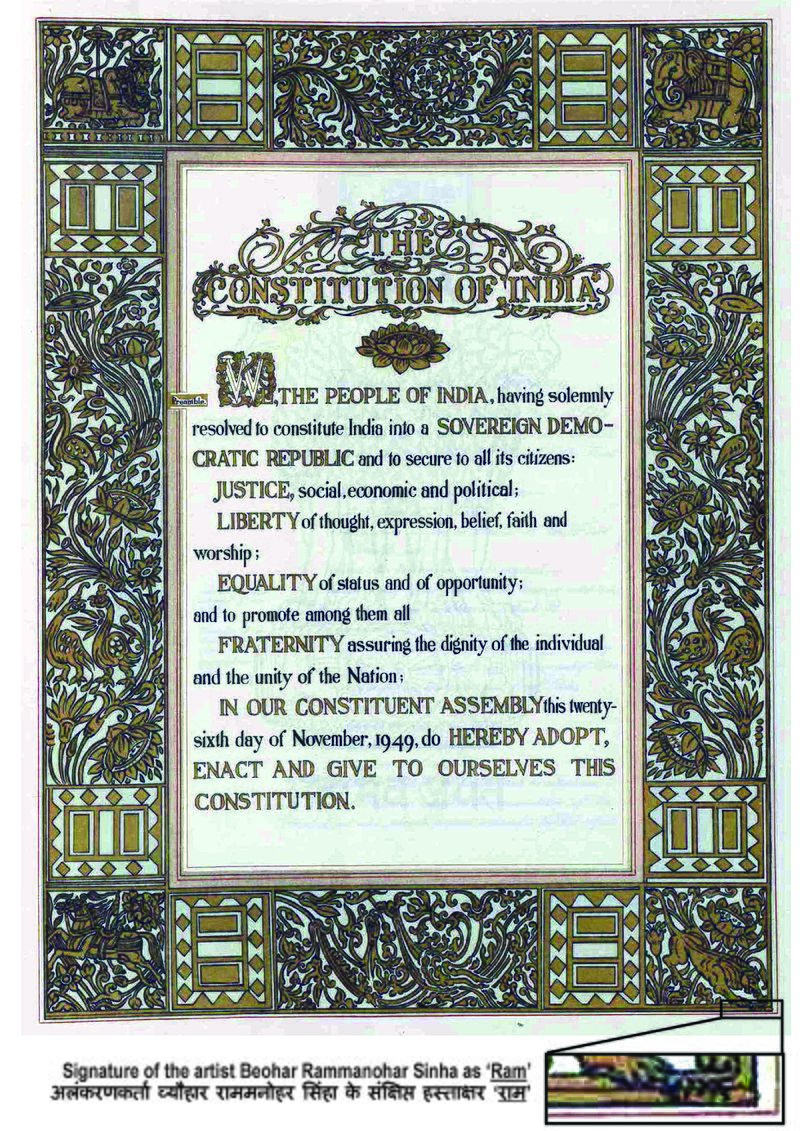
- Calligraphy and Illumination: The original Preamble was calligraphed by Prem Behari Narain Raizada and illuminated, beautified, and ornamented by Beohar Rammanohar Sinha (an artist from Shantiniketan).
Text of the Preamble
- Full Text:
“We, THE PEOPLE OF INDIA, having solemnly resolved to constitute India into a SOVEREIGN SOCIALIST SECULAR DEMOCRATIC REPUBLIC and to secure to all its citizens:JUSTICE, Social, Economic and Political;LIBERTY of thought, expression, belief, faith and worship;EQUALITY of status and of opportunity; and to promote among them all;FRATERNITY assuring the dignity of the individual and the unity and integrity of the Nation;IN OUR CONSTITUENT ASSEMBLY this twenty-sixth day of November, 1949, do HEREBY ADOPT, ENACT AND GIVE TO OURSELVES THIS CONSTITUTION”.
Ingredients / Components of the Preamble
- Source of Authority: Derived directly from the people of India.
- Nature of Indian State: Sovereign, socialist, secular, democratic, and republican polity.
- Objectives of the Constitution: Justice, liberty, equality, and fraternity.
- Date of Adoption: November 26, 1949.
Detailed Analysis of Key Words
1. Sovereign
- Definition: India is neither a dependency nor a dominion of any other nation, but an entirely independent state with no external authority above it. It is free to conduct its own internal and external affairs.
- Historical Context on Status: Prior to the Indian Independence Act, 1947, India was a dependency (colony) of the British Empire. From August 15, 1947, to January 26, 1950, it was a dominion in the British Commonwealth. It ceased to be a dominion on January 26, 1950, by declaring itself a sovereign republic (unlike Pakistan, which remained a dominion until 1956).
- Commonwealth & UN Membership: The declaration in 1949 accepting the British Crown as the head of the Commonwealth is an extra-constitutional “agreement by free will, to be terminated by free will” that does not affect India’s sovereignty. Similarly, membership in the United Nations Organisation (UNO) (joined in 1945) does not limit sovereignty.
- Territorial Powers: As a sovereign state, India can either acquire foreign territories or cede parts of its territory to a foreign state.
2. Socialist
- Implicit to Explicit: Even prior to its explicit addition by the 42nd Amendment (1976), socialist content existed in the Directive Principles of State Policy.
- Avadi Resolution: The Congress party had resolved to establish a “socialistic pattern of society” during its Avadi Session in 1955.
- Democratic vs. Communistic Socialism: Indian socialism is “democratic socialism” (relying on a mixed economy where public and private sectors coexist), not “communistic socialism” or “state socialism” (which involves nationalisation of all means of production and distribution and abolition of private property).
- Judicial Perspectives:
- Supreme Court: Democratic socialism aims to eliminate poverty, ignorance, disease, and inequality of opportunity (G.B. Pant University case, 2000).
- Blend: Indian socialism is a blend of Marxism and Gandhism, leaning heavily towards Gandhian socialism (Nakara case, 1983).
- Economic Reforms: The New Economic Policy (1991) of liberalisation, privatisation, and globalisation (LPG) diluted the socialist credentials of the Indian State.
3. Secular
- Addition and Constitutional Intent: Added by the 42nd Amendment Act (1976). In 1974, the Supreme Court stated that although the words “secular state” were not expressly mentioned earlier, Articles 25–28 clearly demonstrated the Constituent Assembly’s intention to establish one.
- Positive Concept: India practices a “positive concept of secularism,” giving equal status, respect, and protection to all religions, unlike the negative Western concept that requires complete separation of Church and State.
- Typology of States:
- Atheistic State: Anti-religion, condemns all religions.
- Theocratic State: Pro-religion, designates a state religion (e.g., Pakistan, Bangladesh, Sri Lanka, Burma).
- Secular State: Neutral, upholds no state religion (e.g., India, USA).
4. Democratic
- Etymology & Doctrine: Derived from the Greek roots Demos (people) and Kratia (rule); founded on popular sovereignty.
- Types of Democracy:
- Direct Democracy: People exercise power directly (e.g., Switzerland) using four devices: Referendum, Initiative, Recall, and Plebiscite.
- Indirect (Representative) Democracy: Elected representatives govern; sub-classified into Parliamentary and Presidential.
- Indian Model: India has an indirect, representative parliamentary democracy with an executive responsible to the legislature, universal adult franchise, periodic elections, rule of law, independent judiciary, and non-discrimination.
- Comprehensive Scope: Incorporates not only political democracy but also social and economic democracy:
- Dr. B.R. Ambedkar’s Speech (Nov 25, 1949): Political democracy cannot last without social democracy at its base. Liberty, equality, and fraternity form a union of trinity—divorcing one destroys democracy (e.g., liberty without equality leads to supremacy of the few; equality without liberty kills individual initiative).
- Supreme Court (1997): The Constitution envisions an egalitarian social order providing social, economic, and political justice in a social and economic democracy.
5. Republic
- Types of Polities: Monarchical (hereditary head, e.g., Britain) versus Republican (elected head, e.g., USA, India).
- Meaning in Indian Context:
- The head of the state (President) is elected indirectly for a fixed five-year term.
- Vesting of political sovereignty in the people rather than a monarch.
- Absence of any privileged class, keeping all public offices accessible to all citizens without discrimination.
6. Justice
- Three Dimensions:
- Social Justice: Equal treatment without discrimination based on caste, colour, race, religion, or sex; absence of privilege; uplifting backward classes (SCs, STs, OBCs) and women.
- Economic Justice: Non-discrimination based on economic factors; eliminating disparities in wealth, income, and property.
- Distributive Justice: The combined operation of social justice and economic justice.
- Political Justice: Equal political rights, equal access to public offices, and equal voice in government.
- Source: The ideal of justice (social, economic, political) was borrowed from the Russian Revolution (1917).
7. Liberty
- Definition: Absence of arbitrary restraints on individuals coupled with the provision of opportunities for individual personality development.
- Components Secured: Liberty of thought, expression, belief, faith, and worship (primarily through Fundamental Rights).
- Qualified Nature: Liberty is not absolute “licence” to act without limits; it is subject to constitutional boundaries.
- Source: The ideals of liberty, equality, and fraternity were taken from the French Revolution (1789–1799).
8. Equality
- Definition: Absence of special privileges for any group and provision of adequate opportunities for all without discrimination.
- Three Dimensions:
- Civic Equality: Enshrined in Articles 14 (Equality before law), 15 (Prohibition of discrimination), 16 (Equality in public employment), 17 (Abolition of untouchability), and 18 (Abolition of titles).
- Political Equality: Guaranteed via Article 325 (no disqualification from electoral rolls based on religion, race, caste, or sex) and Article 326 (elections based on adult suffrage).
- Economic Equality: Directives such as Article 39 secure adequate means of livelihood and equal pay for equal work for men and women.
9. Fraternity
- Definition: A sense of common brotherhood.
- Promoting Factors: Promoted through single citizenship and Article 51A(e) of Fundamental Duties (promoting harmony and common brotherhood).
- Dual Guarantees:
- Dignity of the Individual: Recognises the sacredness of human personality (supported by Fundamental Rights, Directive Principles, and Article 51A duties renouncing practices derogatory to women). K. M. Munshi noted it ensures both material betterment and democratic values.
- Unity and Integrity of the Nation: Added the word “Integrity” via the 42nd Amendment. Encompasses psychological and territorial integration, reinforcing Article 1 (“Union of States”) to make the Union indestructible and combat fissiparous forces like communalism, casteism, and regionalism.
Significance and Expert Opinions
- Basic Philosophy: Enshrines the core political, moral, and religious values, embodying the noble vision and aspirations of the framers.
- Sir Alladi Krishnaswami Iyer: “The Preamble to our Constitution expresses what we had thought or dreamt so long”.
- K. M. Munshi: Described it as the “horoscope of our sovereign democratic republic”.
- Pandit Thakur Das Bhargava: “The Preamble is the most precious part of the Constitution. It is the soul of the Constitution. It is a key to the Constitution. It is a jewel set in the Constitution. It is a proper yardstick with which one can measure the worth of the Constitution”.
- Sir Ernest Barker: Termed it the “key-note to the Constitution” and quoted it on the opening page of his book Principles of Social and Political Theory (1951).
- M. Hidayatullah (Former CJI): Stated that it resembles the US Declaration of Independence but goes beyond it; it is the soul of the Constitution, establishing the pattern of society with a resolve that “nothing but a revolution can alter”.
The Preamble as Part of the Constitution
- Berubari Union Case (1960):
- The Supreme Court acknowledged it serves as a key to open the minds of the makers and helps interpret ambiguous provisions.
- Despite this, the Court explicitly ruled that the Preamble is not a part of the Constitution.
- Kesavananda Bharati Case (1973):
- The Court rejected the Berubari opinion and ruled that the Preamble is an integral part of the Constitution.
- Emphasised that the Constitution must be interpreted in light of the vision outlined in the Preamble.
- LIC of India Case (1995):
- Reaffirmed that the Preamble is an integral part of the Constitution.
- Enactment History in Constituent Assembly:
- It was enacted after the rest of the Constitution was already passed to ensure conformity with the text.
- The Assembly adopted the motion: “The question is that Preamble stands part of the Constitution”.
- Two Legal Limitations:
- It is neither a source of power to the legislature nor a prohibition upon legislative powers.
- It is non-justiciable, meaning its provisions are not directly enforceable in courts of law.
Amendability under Article 368
- Kesavananda Bharati Case (1973):
- Addressed whether the Preamble could be amended under Article 368.
- The Supreme Court ruled that since the Preamble is a part of the Constitution, it can be amended, provided the basic elements or fundamental features forming the “basic structure” are not altered, damaged, or destroyed.
- Actual Amendment History:
- The Preamble has been amended only once so far, by the 42nd Constitutional Amendment Act, 1976.
- This amendment added three words: Socialist, Secular, and Integrity.
- The amendment was upheld as legally valid.
