1. Background and Genesis
- Context and Need:
- Prior to the INC, local associations like the Madras Native Association (formed in 1852) operated within regional boundaries and reflected elite/landed gentry interests.
- Between 1875 and 1885, sporadic and uncoordinated agitations took place across India regarding cotton import duties (1875), Indianisation of Government services (1877), the Vernacular Press Act (1878), and the Ilbert Bill (1883).
- A strong realization emerged that these protests would lack impact on policymakers unless a national political organization representing every section of society was formed.
- The Theosophical Society Meeting (December 1884):
- Allan Octavian (A.O.) Hume, a retired English ICS officer, presided over a meeting of the Theosophical Society in Madras where the formation of an all-India political organization was discussed and the idea of forming the INC emerged.
- Foundation (28 December 1885):
- Formed on 28 December 1885 in Bombay.
- Founded by A.O. Hume.
- W.C. Bonnerjee was elected the first President.
- G. Subramaniam moved the first resolution in the first session.
- Initially had fewer than 100 members (72 delegates attended the first session, of which only two were Muslims).
- One-third of the founding members were journalists.
- The Madras Mahajana Sabha (MMS) amalgamated with the INC after the first session in Bombay.
2. Core Ideology, Character, and Objectives
- Mission and Character:
- Reflected the concept of India as a nation and introduced the concept of nationalism.
- Worked to weld Indians into a nation, convinced that anti-colonial struggle required Indians to see themselves as members of one nation.
- Provided a common platform for political workers from different regions to gather and mobilize on an all-India basis.
- Maintained a secular character, rejecting communal resolutions (e.g., refusing a resolution in the 3rd session to make cow slaughter a penal offence).
- Major Early Demands:
- Constitutional: Indian representation and opportunity for participation in government.
- Economic: Reduction of oppressive land revenue, protection of peasants from zamindari exploitation, and heavy taxes on imported goods to benefit swadeshi goods.
- Administrative: Indianisation of higher administrative services through simultaneous Indian Civil Services (ICS) examinations in England and India.
- Judicial: Complete separation of the Executive and the Judiciary due to partial treatment by English judges.
3. Early Nationalist / Moderate Phase (1885–1905)
- Composition: Drawn from elite sections (lawyers, doctors, college/university teachers, journalists) across different regions.
- Methodology: Adopted constitutional methods of petitions, prayers, and memorandums, earning the moniker “Moderates”.
- Ideological Contribution: Developed an indigenous anti-colonial ideology and strategy; early leaders (like Dadabhai Naoroji in Poverty and Un-British Rule in India) formulated the “Drain of Wealth” theory.
- Journalism: Utilized the press to educate the masses and build public opinion against colonial exploitation (e.g., Naoroji’s Voice of India and Rast Goftar, Surendranath Banerjea’s Bengalee, Tilak’s Kesari and Mahratta).
4. Extremist Trend and the Surat Split (1905–1907)
- Emergence of Radicals:
- Leaders like Bal Gangadhar Tilak, Bipin Chandra Pal, and Lala Lajpat Rai (“Lal-Bal-Pal”) opposed the cautious, “mendicant policy” of prayers and petitions.
- In 1897, Tilak raised the call: “Swaraj is my birth right and I shall have it”.
- Swadeshi Movement (1905):
- Sparked by the Partition of Bengal.
- The Moderates expanded their conventional methods to accept the boycott of foreign goods and institutions alongside the radicals.
- Calcutta Session (1906):
- A split was avoided by electing Dadabhai Naoroji as President.
- Four radical resolutions were passed: Swadeshi, Boycott, National Education, and Self-Government.
- Surat Split (1907):
- Venue shifted from Poona (a militant stronghold) to Surat by moderates.
- Militants proposed Lala Lajpat Rai for President, but he declined to prevent a split; Rash Behari Ghosh was the moderate candidate.
- Dispute erupted when Pherozeshah Mehta’s group sought to drop the four 1906 Calcutta resolutions.
- The session ended in chaos, splitting the INC into Moderates and Extremists.
- The post-split organization, known as the “Mehta Congress”, held the 1908 session attended only by moderates reiterating loyalty to the Raj.
5. Reunion and the Lucknow Pact (1916)
- Re-admission of Extremists:
- In December 1915 at the Bombay session, the constitution of the INC was altered to readmit the extremist section.
- Lucknow Session (1916):
- Presided over by Ambika Charan Mazumdar, who welcomed the reunion of extremists and moderates.
- Lucknow Pact (1916):
- INC and the All India Muslim League held joint sessions and concluded the Congress-League Pact, facilitated by Tilak, Annie Besant, and Muhammad Ali Jinnah.
- Congress accepted separate electorates for Muslims in provincial council elections and weightage beyond population proportions (except in Punjab and Bengal).
- Demanded provincial administrative/financial autonomy, 4/5ths elected members in Central and Provincial Councils, half of executive council members to be Indians, and equal status with Dominions.
6. The Gandhian Era and Mass Mobilization (1917–1947)
- Transformation into a Mass Party:
- Gandhi’s entry shifted Congress from an elite platform to a mass organization.
- Nagpur Session (1920): Reorganized the party by establishing Provincial Congress Committees on a linguistic basis and reducing membership fees to 4 annas (25 paise) to recruit rural masses.
- Non-Cooperation Movement (1920–1922):
- Adopted at a special Calcutta session (September 1920) and ratified at Nagpur (December 1920).
- Combined Punjab wrongs (Jallianwala Bagh massacre), Khilafat grievances, and the demand for Swaraj.
- Suspended by Gandhi after the violent Chauri Chaura incident on 5 February 1922; ratified by the Congress Working Committee at Bardoli.
- Pro-Changers (Swaraj Party) vs. No-Changers (1922–1923):
- Swarajists / Pro-Changers: Led by Chittaranjan Das and Motilal Nehru (joined by Satyamurti in Tamil Nadu), wanted to enter legislative councils to wreck them from within; functioned as a group within the Congress.
- No-Changers: Led by C. Rajagopalachari, Vallabhbhai Patel, and Rajendra Prasad, insisted on continuing Gandhi’s constructive programme (spinning, temperance, Hindu-Muslim unity, removal of untouchability).
- Lahore Session (1929) – Purna Swaraj:
- Presided over by Jawaharlal Nehru.
- Declared complete independence (Purna Swaraj) as Congress’s goal.
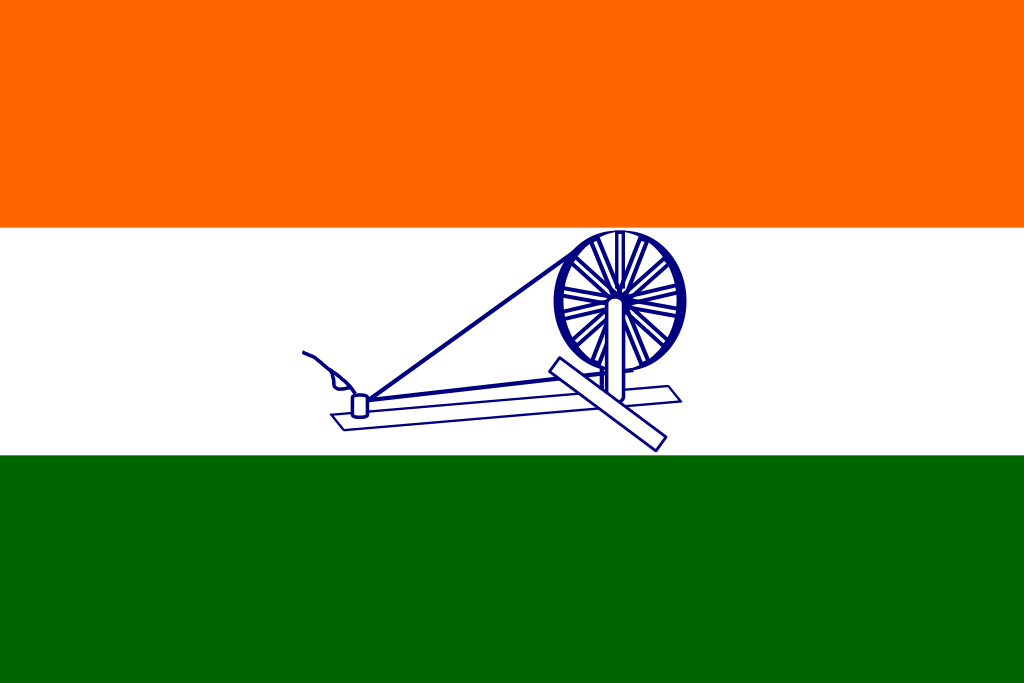
- 31 December 1929: Tricolour flag hoisted at Lahore.
- 26 January was declared to be celebrated as Independence Day every year.
- Civil Disobedience Movement & Salt Satyagraha (1930–1934):
- Launched via the Dandi March (April 1930) and Vedaranyam March led by Rajaji.
- INC boycotted the Simon Commission (1927) and the First Round Table Conference (1930).
- Gandhi-Irwin Pact signed in March 1931, ending civil disobedience; ratified at the Karachi Session (1931).
- Gandhi attended the Second Round Table Conference as the sole Congress representative; talks broke down, leading to the resumption of the struggle and the British government declaring Congress illegal.
- Karachi Session (1931):
- Presided over by Sardar Vallabhbhai Patel.
- Adopted a historic resolution on Fundamental Rights and Duties and outlined the economic programme of independent India, establishing that political and economic freedom were inseparable.
- Opposing Communal Politics & Electorates:
- Opposed separate electorates for Depressed Classes under the Communal Award (1932), leading to Gandhi’s fast and the subsequent Poona Pact, which substituted separate electorates with reserved seats.
- Barred Congress members from belonging to the Hindu Mahasabha or RSS in December 1938.
- 1937 Provincial Elections & Ministries:
- Contested elections under the Government of India Act 1935, winning in 7 out of 11 provinces and forming the largest party in 3 others.
- Resigned in late 1939 in protest against Viceroy Linlithgow declaring India at war in World War II without consulting the ministries.
- Quit India Movement (1942):
- Working Committee met at Wardha (July 1942) and resolved on a mass civil disobedience movement.
- Passed the “Quit India” resolution on 8 August 1942 in Bombay; Gandhi gave the call to “Do or Die”.
- The entire leadership was arrested on the morning of 9 August 1942, triggering nationwide strikes, parallel governments, and underground networks.
- Cabinet Mission (1946) & Partition:
- Accepted the 1946 Cabinet Mission Plan.
- Formed the Interim Government under Jawaharlal Nehru on 2 September 1946.
- Approved the Mountbatten Plan (3 June 1947), leading to the Indian Independence Act 1947 and independence on 15 August 1947.

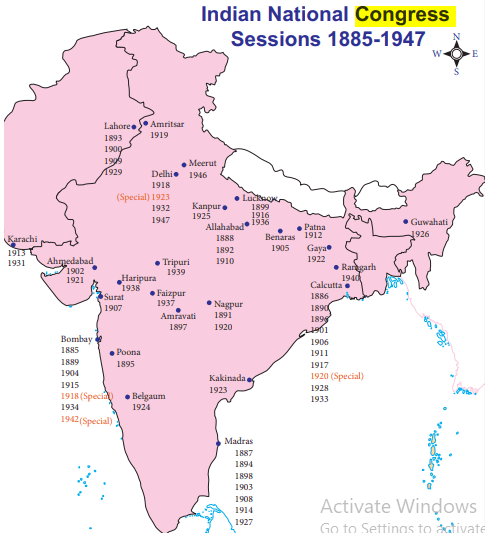
Indian national congress sessions from 1885 to 1947
| Session | Place | Date | President |
| 1st Session | Bombay | Dec. 28-30, 1885 | Womesh Chandra Bonnerjee |
| 2nd Session | Calcutta | Dec. 27-30, 1886 | Shri Dadabhai Naoroji |
| 3rd Session | Madras | Dec. 27-30, 1887 | Badruddin Tyabji |
| 4th Session | Allahabad | Dec. 26-29, 1888 | George Yule |
| 5th Session | Bombay | Dec. 26-28, 1889 | Sir William Wedderburn |
| 6th Session | Calcutta | Dec. 26-30, 1890 | Pherozeshah Mehta |
| 7th Session | Nagpur | Dec. 28-30, 1891 | P. Ananda Charlu |
| 8th Session | Allahabad | Dec. 28-30, 1892 | Womesh Chandra Bonnerjee |
| 9th Session | Lahore | Dec. 27-30, 1893 | Shri Dadabhai Naoroji |
| 10th Session | Madras | Dec. 26-29, 1894 | Alfred Webb |
| 11th Session | Pune | Dec. 27-30, 1895 | Surendranath Banerjee |
| 12th Session | Calcutta | Dec. 28-31, 1896 | Rahimatullah M. Sayani |
| 13th Session | Amraoti | Dec. 27-29, 1897 | C. Sankaran Nair |
| 14th Session | Madras | Dec. 29-31, 1898 | Ananda Mohan Bose |
| 15th Session | Lucknow | Dec. 27-29, 1899 | Romesh Chunder Dutt |
| 16th Session | Lahore | Dec. 27-29, 1900 | N.G. Chandavarkar |
| 17th Session | Calcutta | Dec. 26-28, 1901 | Dinshaw Eduljee Wacha |
| 18th Session | Ahmedabad | Dec. 28-30, 1902 | Surendranath Banerjee |
| 19th Session | Madras | Dec. 28-30, 1903 | Lal Mohan Ghosh |
| 20th Session | Bombay | Dec. 26-28, 1903 | Sir Henry Cotton |
| 21st Session | Banaras | Dec. 27-30, 1905 | Gopal Krishna Gokhale |
| 22nd Session | Calcutta | Dec. 26-29, 1906 | Shri Dadabhai Naoroji |
| 23rd Session (Suspended) | Surat | Dec. 26-27, 1907 | Rash Behari Ghosh |
| 23rd Session | Madras | Dec. 28-30, 1908 | Rash Behari Ghosh |
| 24th Session | Lahore | Dec. 27-29, 1909 | Madan Mohan Malaviya |
| 25th Session | Allahabad | Dec. 26-29, 1910 | Sir William Wedderburn |
| 26th Session | Calcutta | Dec. 26-28, 1911 | Bishan Narayan Dar |
| 27th Session | Bankipore | Dec. 26-28, 1912 | Shri Raghunath Narasinha Mudholkar |
| 28th Session | Karachi | Dec. 26-28, 1913 | Nawab Syed Mohammed Bahadur |
| 29th Session | Madras | Apr. 14-15, 1914 | Bhupendra Nath Bose |
| 30th Session | Bombay | Dec. 27-29, 1915 | Satyendra Prasanna Sinha |
| 31st Session | Lucknow | Dec. 26-30, 1916 | Ambica Charan Mazumdar |
| 32nd Session | Calcutta | Dec. 26-29, 1917 | Annie Besant |
| 33rd Session | Delhi | Dec. 26-30, 1918 | Madan Mohan Malaviya |
| (Special Session) | Bombay | Aug. 29-01, 1918 | Romesh Chunder Dutt |
| 34th Session | Amritsar | Dec. 26-30, 1919 | Motilal Nehru |
| 35th Session | Nagpur | Dec. 26-30, 1920 | C. Vijayaraghavachariar |
| 36th Session | Ahmedabad | Dec. 27-28, 1921 | Hakim Ajmal Khan (Acting President for C.R. Das) |
| 37th Session | Gaya | Dec. 26-31, 1922 | Deshbandhu Chittaranjan Das |
| Special Session | Delhi | Sep. 04-08, 1923 | Maulana Abul Kalam Azad |
| 39th Session | Belgaum | Dec. 26-27, 1924 | M.K. Gandhi |
| 40th Session | Cawnpore | Apr. 15-17, 1925 | Mrs. Sarojini Naidu |
| 41st Session | Gawahati | Dec. 26-28, 1926 | S. Srinivasa Iyengar |
| 42nd Session | Madras | Dec. 26-28, 1927 | M.A. Ansari |
| 43rd Session | Calcutta | Dec. 29-01, 1929 | Motilal Nehru |
| 44th Session | Lahore | Apr. 16-18, 1929 | Pt Jawaharlal Nehru |
| 45th Session | Karachi | Mar. 21-31, 1931 | Vallabbhai J. Patel |
| 47th Session | Calcutta | Sep. 12-14, 1933 | Mrs. Nellie Sengupta |
| 48th Session | Bombay | Oct. 24-28, 1934 | Dr. Rajendra Prasad |
| 49th Session | Lucknow | Jun. 18-20, 1936 | Pt Jawaharlal Nehru |
| 50th Session | Faizpur | Jul. 12-14, 1937 | Pt Jawaharlal Nehru |
| 51st Session | Haripura | Feb. 19-21, 1938 | Subhash Chandra Bose |
| 52nd Session | Tripura | Mar. 10-12, 1939 | Subhash Chandra Bose |
| 53rd Session | Ramgarh | Mar. 19-20, 1940 | Maulana Abul Kalam Azad |
| 54th Session | Meerut | Nov. 23-24, 1946 | J.B. Kripalani |
Indian national congress sessions from 1885 to 1947 pdf
