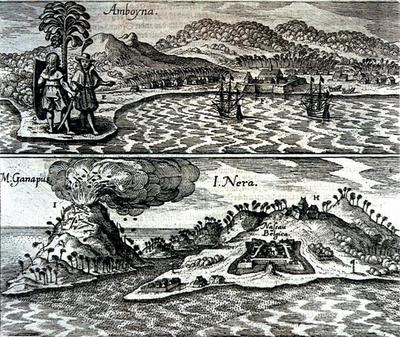
Amboyna Massacre
It was brutal torture and murder of twenty men that including ten men who were in service of the English East India Company in Ambon Island in 1623. Apart from the Ten men others were Japanese and Portuguese traders.
They were murdered by the people who worked for the Dutch East India Company. The reason for this Massacre is the result of the intense rivalry between English East India and the Dutch in the spice trade.
The Dutch East India Company (VOC) tried to monopolize the spice trade in the Indonesian Islands using the force of Arms. But it annoyed the English East India Company.
Despite several treaties, the rivalry intensified and Amboyna Massacre happened.
More on Dutch East India Company
- Arrival and Primary Focus: The Dutch arrived in India in the early seventeenth century and were exploring the possibilities of trade in the Indian Ocean. Unlike the Portuguese, they focused primarily on commercial dominance, particularly in the spice trade.
- Establishment and Trading Posts:
- They established a Dutch East India Company and set up trading posts in various parts of India.
- West Coast Posts: Surat, Bharuch, and Cochin (Kochi).
- East Coast Posts: Nagapattinam and Masulipatnam (present-day Machilipatnam).
- Regional Dominance: Their most significant presence was in the Malabar region of Kerala, where they displaced the Portuguese from several trading centres.
- Commercial Competition and Goods Traded:
- Like other European trading companies, they were drawn to India primarily because of its great wealth and were interested in buying the same commodities: fine qualities of cotton and silk, as well as pepper, cloves, cardamom, and cinnamon.
- This mutual competition pushed up purchase prices and reduced profits, leading trading companies to seek the elimination of rival competitors.
- Through the seventeenth and eighteenth centuries, European trading companies regularly sank each other’s ships, blockaded routes, prevented rival ships from moving with supplies, carried on trade with arms, and protected their trading posts through fortification.
- Social and Religious Policy: Unlike the Portuguese, the Dutch did not intervene much in the social and religious life of Indians.
- Decline and the Battle of Colachel:
- The Dutch presence in India remained ultimately limited and declined significantly after their defeat at the Battle of Colachel in 1741 (1741 CE).
- In this battle, the forces of the Travancore kingdom (located in the southern part of present-day Kerala) under King Marthanda Varma decisively defeated the Dutch both on land and at sea.
- A depiction of the surrender of Dutch forces to King Marthanda Varma after the battle is preserved at Padmanabhapuram Palace.
- The Battle of Colachel was noted as a rare historical instance of an Asian power successfully repelling a European colonial force.
Reference Ncert Notes
https://ncert.nic.in/textbook/pdf/hees104.pdf
https://ncert.nic.in/textbook/pdf/hess202.pdf
