At the beginning of the eighteenth century, political, religious, social and economic conditions began to change all over the world, due to geographical discoveries, the Renaissance, the Reformation and “the age of kings”. By the time the eighteenth century ended, there were two revolutions: The American Revolution of 1775–83 and the French Revolution of 1789–95.
These revolutions dealt a severe blow to the monarchical form of government and had a lasting impact on the subsequent history of humanity. The Industrial Revolution, beginning in the eighteenth century, engendered many changes in the lives of the people, heralding a new era that was marked by the shift from a primarily agriculture-based economy to an industry-based economy. This lesson will help us understand the aforesaid events of global importance.
War for independence America
During the Age of Discovery, adventurous seafarers explored the so-called New World and discovered new trade routes with royal support. This ensured better connectivity and profits. Though Spain and Portugal took the lead in exploring the new places, establishing trade centres first and later colonies, it was Britain that established colonies all over the world and successfully controlled them over a long period of time.
Though the English were the first to settle in North America, in due course of time, the Germans, the Swedes, the French, the Italians, and the Dutch too went to America and settled there. The colonisation of the New World absorbed the growing population of Europe at a time of rapid economic and demographic growth.
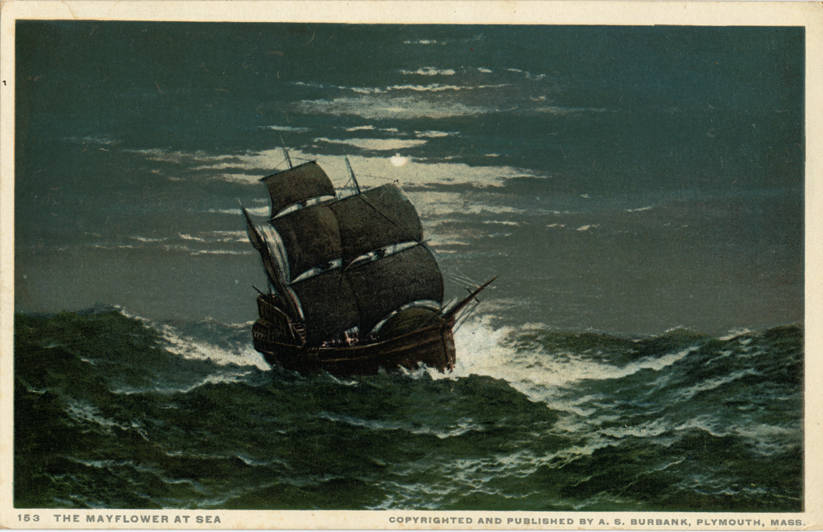
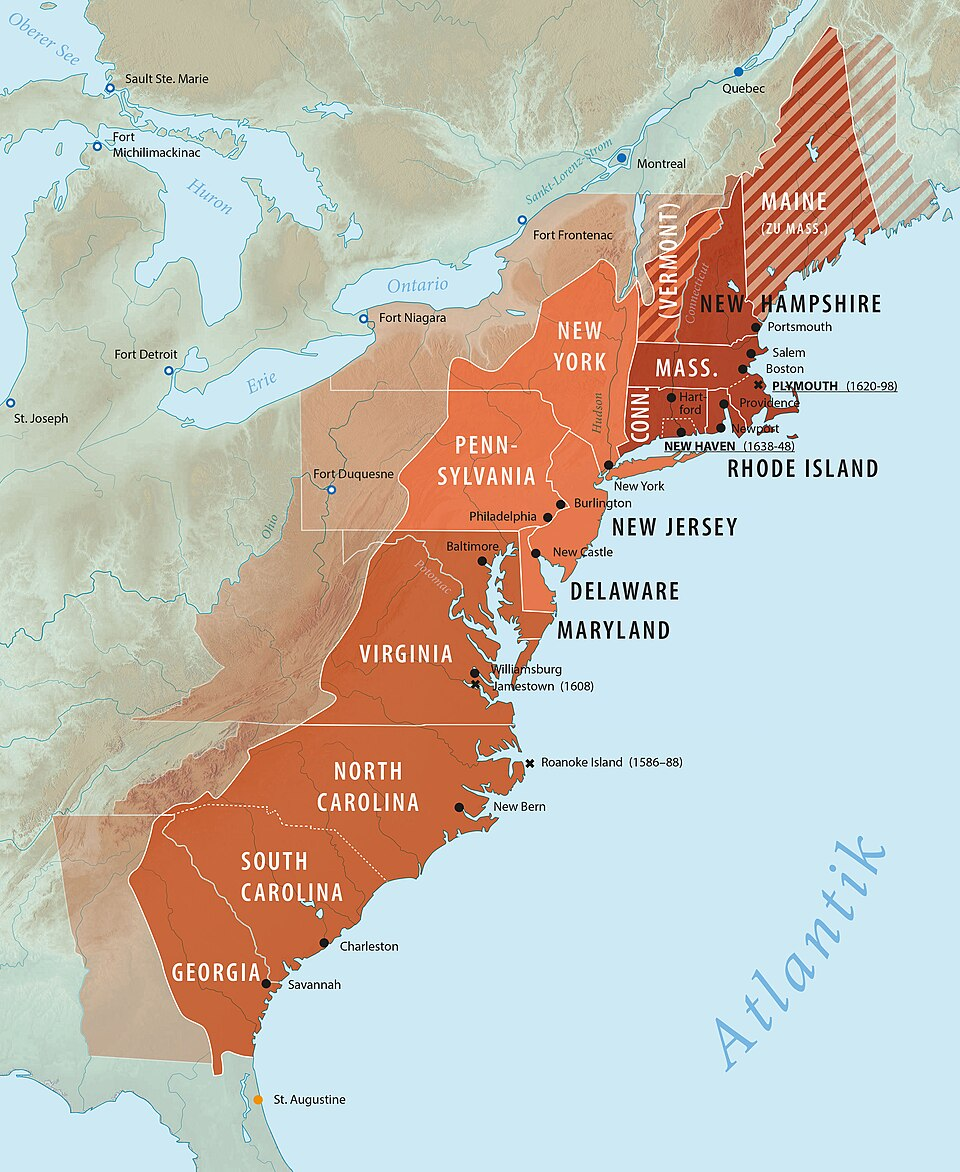
King James I sent an expedition to Virginia, where a colony was established in 1607 and named Jamestown. Then the Pilgrims from Britain sailed in a ship called the Mayflower and set up a colony at Plymouth in Massachusetts. Slowly, other colonies were established.
The Dutch set up a colony in 1624, near the mouth of the River Hudson and named it New Amsterdam. Later, the English acquired it from the Dutch and renamed it New York. In the early 1700s, enslaved Africans made up a growing percentage of the colonial population. By 1770, more than 2 million people lived and worked in Great Britain’s 13 North American colonies.
In 1587, Sir Walter Raleigh set up the first colony at Roanoke Island in North Carolina and named it Virginia after the Virgin Queen Elizabeth I. However, due to the stiff resistance put up by the native Indians some of the early settlers returned to England.
The Roanoke Island became a lost colony as there was no trace of it when the British sailors reached the island some years later.
Life in Colonial America: The Thirteen Colonies
The colonies varied much in character and the manner in which they had been acquired. They were divided into the South and the North. In the southern part, endowed with fertile land, agriculture was the primary means of subsistence.
The slaves brought from Africa worked in the farm-lands which mainly grew cotton, wheat and tobacco. The Northern states, on the other hand, were devoid of agricultural farmlands. They created mills for cutting timber, shipbuilding, and milling the grains. Iron and textiles were also manufactured. The harbour promoted sea-borne trade.
Fed up with the unsettled living conditions in Europe, people came to live in these colonies mainly to lead a free life. They also wanted to experience religious freedom and to practice the religion of their choice (for example, the Puritans).
The colonies were ruled by British representatives called Governors appointed by the British monarch. The Governors had an assembly similar to a parliament. Women had no voting rights.
Among the men, those who paid taxes and owned land alone could vote. Initially, they built a cordial relationship with the indigenous people of America, known as American Indians and Native Americans. (They were then referred to pejoratively as ‘Red Indians’)However, in due course of time, they were dispossessed of their land or liquidated.
The transatlantic slave trade is a blot in the history of humanity. The Portuguese began the African slave trade at the opening of seventeenth century.
The other nations of Christian Europe followed immediately. The first slaves to be brought to America came in a Dutch ship in 1619. The first English man who realised that lots of money could be made by seizing “unsuspecting negroes” in Africa and selling them to work on plantations in the New World (America) was John Hawkins. He was knighted by Queen Elizabeth for “his prosperous success and much gain.” It is estimated that more than 11 million Africans reached the Americas as slaves.
By the time Christopher Columbus reached the Caribbean in 1492, there were 10 million indigenous people living in U.S. territory. But by 1900, the number had reduced to less than 300,000.
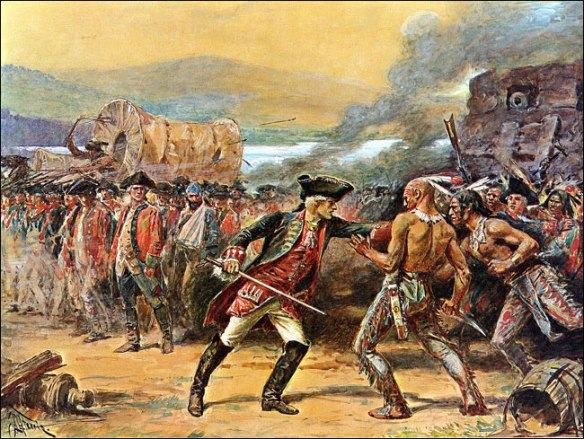
Spreading disease was one of the strategies adopted by the Europeans to exterminate the native population. In 1763, a serious uprising threatened British garrisons in Pennsylvania. Worried about limited resources, and provoked by the violence of some Native Americans, Sir Jeffrey Amherst, commander-in-chief of British forces in North America, wrote to Colonel Henry Bouquet at Fort Pitt, Pennsylvania:“You will do well to try to inoculate the Indians [with smallpox] by means of blankets, as well as to try every other method, that can serve to extirpate this execrable race.” Consequently, small pox was spread to the Native Americans by distributing blankets previously used by infected patients.
Colonists in search of gold (1848) staged violent ambushes on tribal villages. Several wars broke out between tribes and American settlers which led to large scale deaths, land dispossession, oppression and blatant racism.
Causes for the American War for Independence
Colonial Governance: Navigation Acts
England considered the colonies as part of its country and governed them for their ownbenefit, neglecting the interests of the colonies. England passed laws known as the Navigation Acts, which mandated that colonial produce should be exported only in British ships. There were also laws restricting or prohibiting the manufacture of certain articles in the colonies, such as cloth.
1756–63
The Seven Years’ War (1756–63)
The revolt of colonies against England was a direct consequence of England’s intervention in the Seven Years’ War. During the War, the colonial assemblies did not co-operate with the mother country in the way expected of them.
They voted for inadequate supplies and resisted the moves of England to impose certain duties on articles used by the Americans. The English conquest of Canada and removal of all danger from the French made the British government to feel secure. This in turn made the colonies jittery and less disposed than ever to submit to the dictates of England.
Taxes on Colonies
Taxes on Sugar and Molasses
In order to solve the financial crisis arising out of constant wars with other European powers, the British imposed new taxes on the colonies. The first tax imposed was on sugar and molasses, a by-product of sugar, in 1764. All the colonies in North America were forced to pay this tax, and the settlers protested against this by raising the slogan ‘no taxation without representation’.
1765 – Stamp Act
In 1765, a new tax was introduced on the stamps. The settlers were forced to use stamps on all legal documents and pay the tax for the use of stamps. The settlers refused to buy them, and the British traders forced the colonial government to repeal the act.
1766 – Townshend Act
Though the Stamp Act was abolished in 1766, in the very next year, an Act was passed that imposed taxes on certain goods imported from Britain. Townshend, who was the Chancellor of the Exchequer in Britain, brought this act into force and hence came to be called the Townshend Act.
1770 – Boston Massacre
In 1770, Lord North, the new prime minister of England, abolished taxes on products except tea. This was retained to assert that the British Parliament had a right to tax the colonies directly as well as indirectly. When the British forces marched on the streets of Boston, Americans criticised the British. This angered the British forces, who fired against the people.
This Boston Massacre brought to light the aggressive and autocratic nature of the British government.
1773 – Boston Tea Party
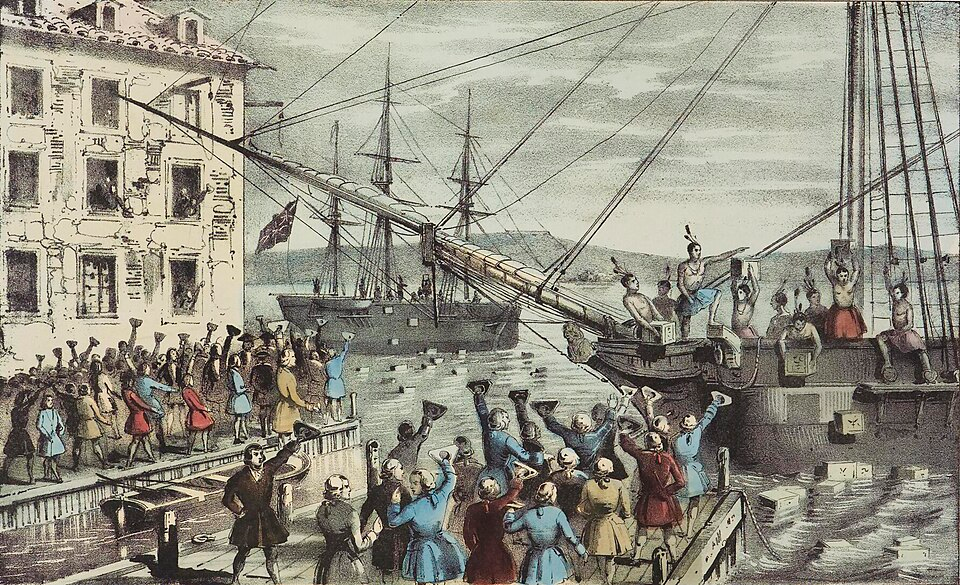
In the wake of the Boston Massacre, around 100 activists dressed like Native Americans boarded the three ships carrying tea and threw 342 boxes into the sea at Boston. This incident came to be called the Boston Tea Party.
The British Parliament retaliated with severity. General Gage was appointed Governor of Massachusetts, and troops were dispatched with instructions to bring the colony to heel.
1774 – Intolerable Acts
Angered by the Boston Tea Party, the British Parliament passed the Boston Port Bill. The Boston harbour was closed until the colonists paid for all the tea thrown into the sea. Then the Parliament passed the Massachusetts Government Act, replacing the elective local council, and enhancing the powers of the military governor Gage.
The third measure, the Administration of Justice Act, allowed British officials charged with capital offences to be tried in another colony or in England. The fourth intolerable Act, a replica of the Quartering Act, which was abolished, permitted the requisition of unoccupied buildings to house British troops. The Intolerable Acts (1774), also known as Coercive Acts, evoked a wave of outrage in colonies.
1774 – Quebec Act
The Quebec Act passed by the British government in 1774 awarded the territory between the Ohio and Mississippi rivers to the province of Quebec. The colonial governments of New York, Pennsylvania and Virginia were angered by the unilateral assignment of the Ohio lands to Quebec, which had been granted to them in their royal charters. By permitting French civil law and the Roman Catholic religion in the newly carved-out area, Britain also provoked the protestant colonies.
The Intolerable Acts of 1774 became the justification for convening the First Continental Congress at Philadelphia. The representatives of all the colonies, except that of Georgia, demanded the repeal of the Intolerable Acts.
The Congress decided to boycott British goods until then. They sent a representation with an olive branch (peace proposal) to the British King George III. This was known as the Olive Branch Petition. The king, however, refused to buy peace.
1775 – Outbreak of War
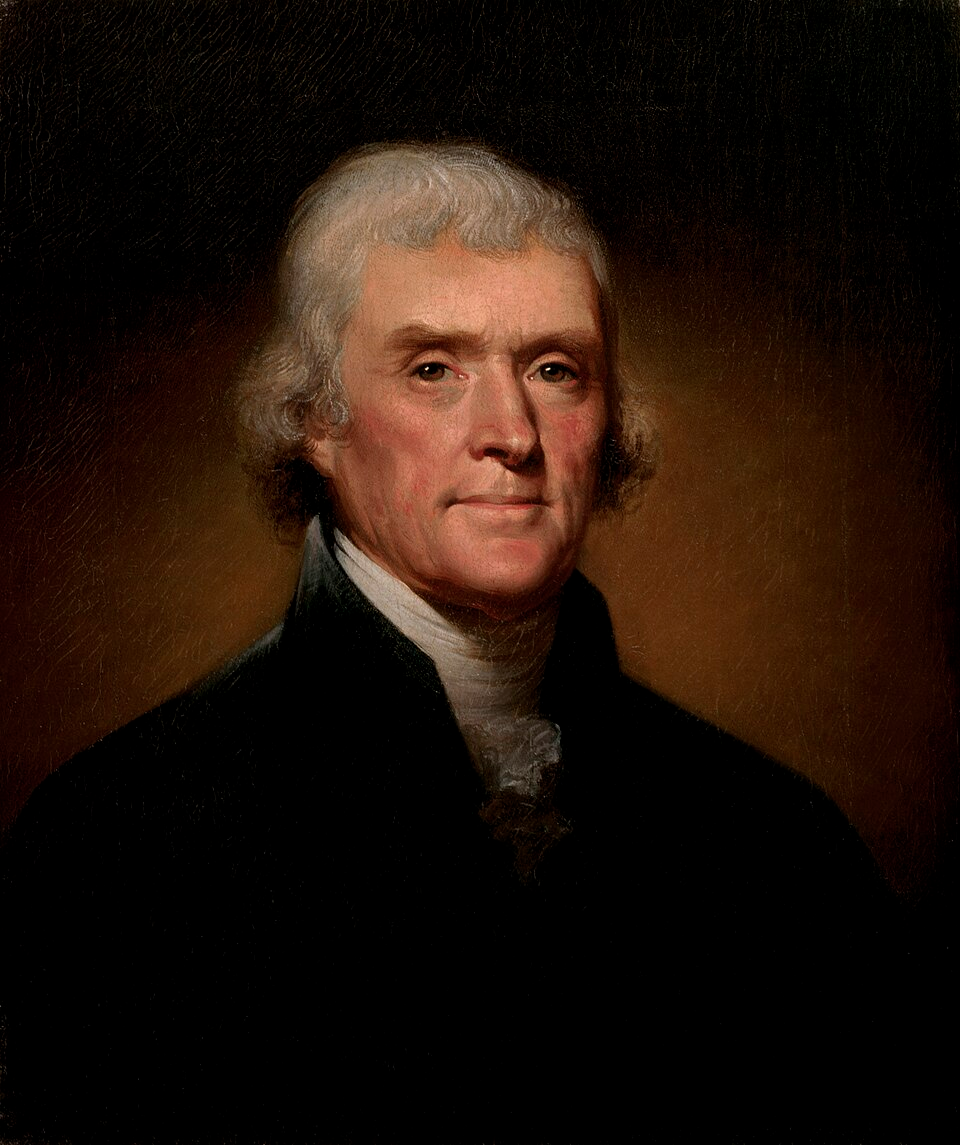
In the meantime, in 1775, at Lexington in Massachusetts, the farmers fought the British and then marched on Boston to besiege the British garrison at Bunker Hill. On 4 July 1776, all the thirteen colonies declared independence from Britain. The Declaration of Independence was essentially the work ofThomas Jefferson, which marked the beginning of the history of an independent country called the United States of America.
The Declaration of Independence (1776)
It was Richard Lee who proposed that the colonies should be independent states. A draft committee was formed to draft the declaration of independence whose members included Thomas Jefferson, Benjamin Franklin, and John Adams.
The British army was led by William Howe, while the American forces were led by George Washington. Though in the initial phases Howe made a few successful attempts by defeating Washington at Brooklyn, New York, and New Jersey, Washington, through his planned military tactics, inflicted defeat on the British army.
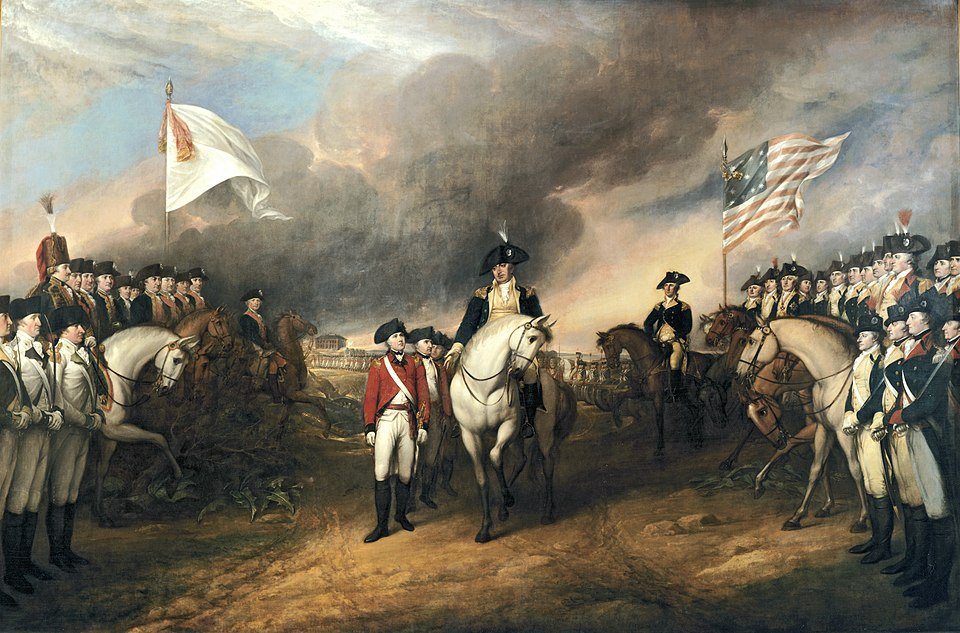
In 1777, at the Battle of Saratoga, the British General Burgoyne was forced to surrender. Finally, the British forces surrendered to the American forces in 1781 at Yorktown. With this victory, the northern colonies became free. However, Howe retained New York almost until the end of the war.
Solidarity of European Powers with Colonists
During the American War of Independence, the European powers that were not on friendly terms with the British decided to support the American colonies. The countries in Northern Europe, including Prussia, Sweden and Denmark, formed the ‘Armed neutrality’ against Great Britain. Britain was in turmoil as it had to face hostility from its enemies as well as neutral powers.
The French, followed by the Spanish and the Dutch, helped the American colonies in this war of independence. France lent support to the Americans as vengeance against the loss of Canada. The French volunteers who crossed the Atlantic to fight for the colonists returned with ideas of individual liberty which made them intolerant of the restrictions of the Bourbon monarchy.
Many of the wealthy merchants and large landowners remained loyal to the British monarchy and influenced a large section of the population, especially in New York and Pennsylvania. The colonists split into two divisions: the Patriots who wanted freedom and the Loyalists who wanted to remain loyal to the British crown. The Loyalists, called Tories, wanted the British to rule as they belonged to the Anglican Church. So a civil war in the midst of the revolution became inevitable.
1783 – Treaty of Paris
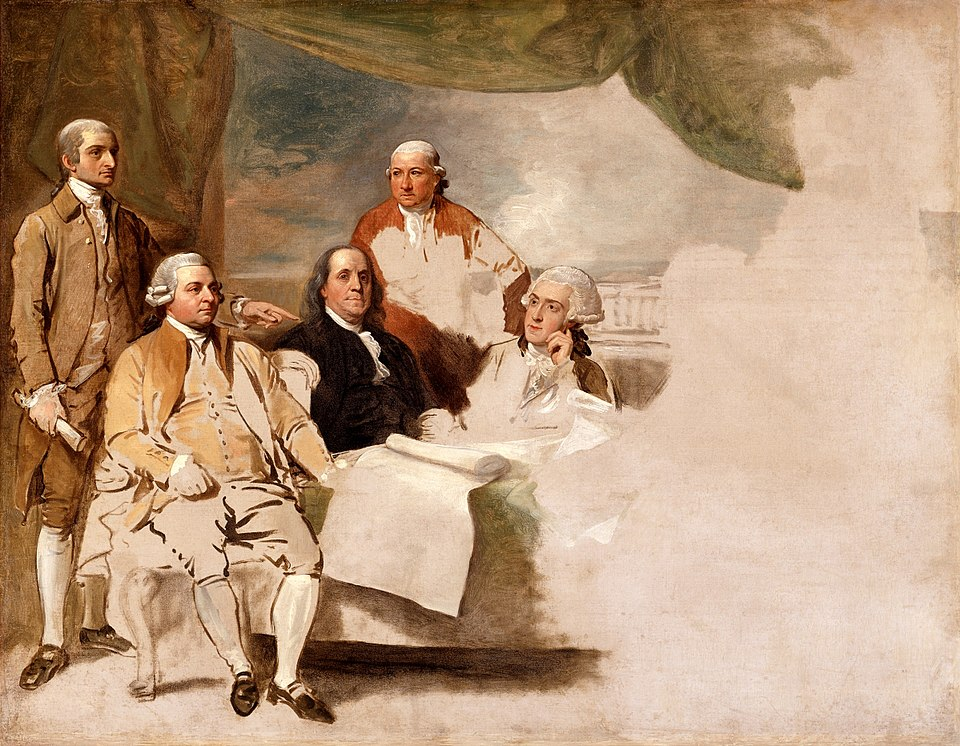
In 1783, the British Parliament decided that it was pointless to carry on the war. Lord North resigned as Prime Minister. King George lost control over the House of Commons. The new Prime Minister, Lord Rockingham, started the peace talks. A peace treaty was signed between Great Britain and America in 1783 at Paris.
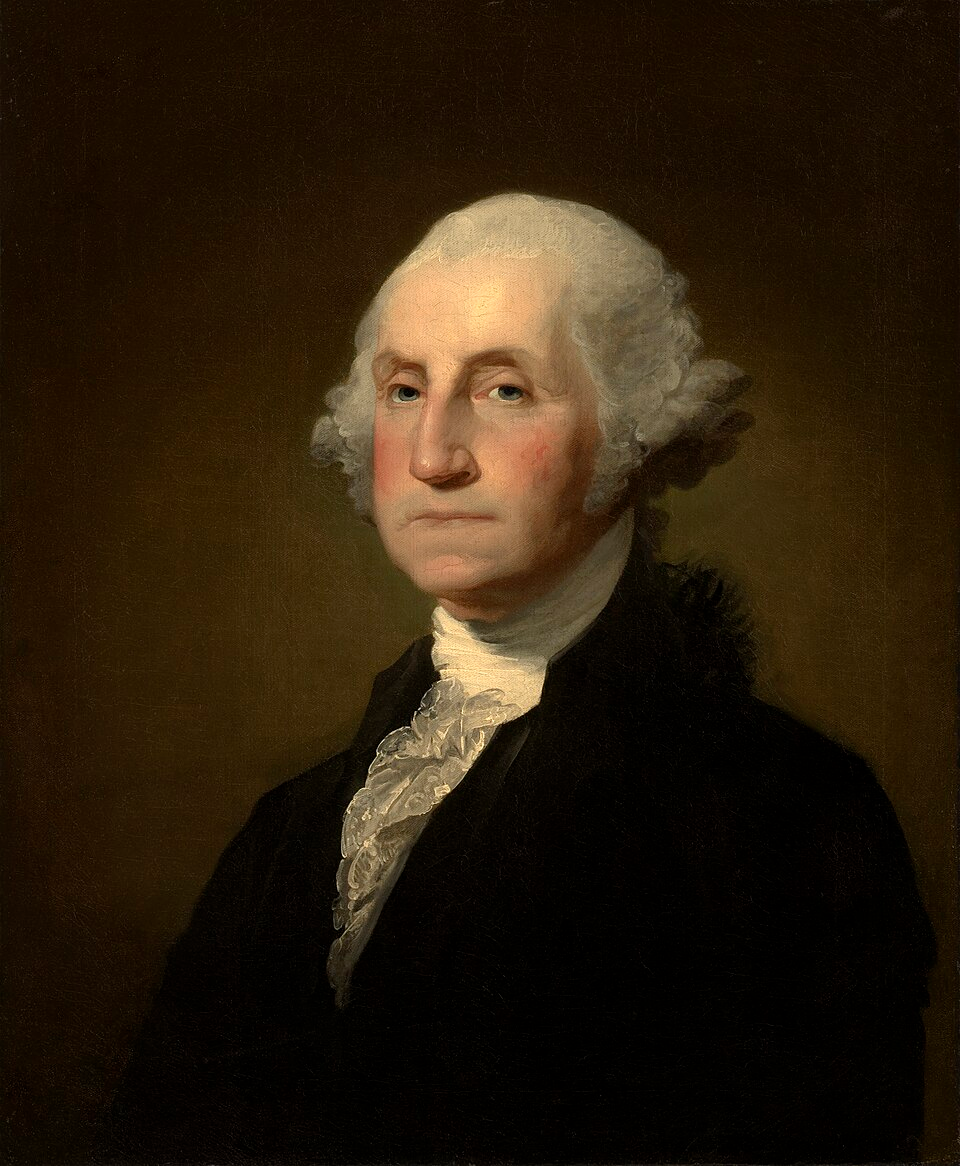
George Washington (1732–1799) became the first president of the United States of America. One of the founding fathers of America, he played a significant role in the American Revolution, first as a military officer and later as an astute politician.
Important Provisions of the Treaty
Britain recognised the freedom of the 13 colonies and the formation of a new country called the United States of America.
The area bordered by the Mississippi River on the west and the 31st parallel in the south went to the USA.
France gained certain British territories in the West Indies, India and Africa.
Spain obtained Florida from Great Britain
Holland and England maintained the status quo that prevailed before the war.
Significance of American Revolution
The American Revolution opened up many avenues in the history of the world.
The concepts of democracy and republic became widespread.
The political and social changes were along the lines of democracy and equality.
USA became a land of opportunities and freedom for all settlers.
Education gained prominence.
The principle of federalism became widespread.
The American Revolution was a setback for colonialism. The demand of the colonies for independence against their colonial masters became widespread in many parts of the world.
It paved the way for a free society where every individual was given the freedom of speech, freedom of religion and equal opportunities.
When India became independent in 1947, the economy of the country was very fragile and facing many problems. The level of poverty was very high. Nearly 80% of the population was living in rural areas, depending on agriculture for their livelihood. As the craft-based occupations had suffered during British rule, many skilled artisans had lost their livelihood. As a result, agriculture was overcrowded, and the per capita income from agriculture was very low. Agriculture was also characterised by semi-feudal relations between landowners and cultivators or peasants, who were often exploited by the land-owning classes. The industrial sector had grown in the decades before Independence, but it was still quite small. The best known heavy industry was Tata Iron and Steel. Besides this, the main manufactures were cotton spinning and weaving, paper, chemicals, sugar, jute and cement. Engineering units produced machinery for these units. However, the sector was relatively small and did not offer a significant potential for employing the surplus labour from the agricultural sector. In fact, the industry sector only accounted for 13% of the total Gross Domestic Product (GDP) in 1950. Most manufactured consumer goods were imported. T he Indian offices of major foreign companies were involved only in marketing and sales, and not in manufacturing. Thus, the new government of India was faced with the mammoth task of developing the economy, improving conditions in agriculture, widening the manufacturing sector, increasing employment and reducing poverty.
Socialistic Pattern of Society
Economic development can be achieved in many ways. One option would be to follow the free enterprise, capitalist path; the other was to follow the socialist path. India chose the latter. In fact, the Preamble to the Indian Constitution, cited in the previous lesson, stated unambiguously that India would be “a sovereign, socialist, secular democratic republic”. The objectives of this socialist pattern of development were: the reduction of inequalities, elimination of exploitation, and prevention of concentration of wealth. Social justice meant that all citizens would have an equal opportunity to education and employment. This essentially entailed the active participation of the state in the process of development.
In agriculture, social and economic justice was to be achieved through a process of land reforms which would empower the cultivator. In industry, the state would play an active role by setting up major industries under the public sector. These were to be achieved through a comprehensive process of planning under Five Year Plans. These strategies had been borrowed from the Soviet experience of rapid economic development. Nehru was a great admirer of the success of the Soviet Union in achieving rapid development, and thus the ideology on which this strategy is based is often referred to as “Nehruvian Socialism”.
Agricultural Policy
At the time of Independence, agriculture in India was beset with many problems. In general, productivity was low. The total production of food grains was not enough to feed the country, so that a large quantity of food grains had to be imported. Nearly 80 percent of the population depended on agriculture for their livelihood. This automatically reduced the income of each person to very low levels. This is a situation described as ‘disguised unemployment’. That is, even if many people shifted to other occupations, total production levels would remain the same, because this surplus population was not really required to sustain the activity, and was, in effect, unemployed. Given the high level of poverty among the rural population, most of them were heavily indebted to moneylenders.
At the time of Independence, agriculture in India was beset with many problems. In general, productivity was low. The total production of food grains was not enough to feed the country, so that a large quantity of food grains had to be imported. Nearly 80 percent of the population depended on agriculture for their livelihood. This automatically reduced the income of each person to very low levels. This is a situation described as ‘disguised unemployment’. That is, even if many people shifted to other occupations, total production levels would remain the same, because this surplus population was not really required to sustain the activity, and was, in effect, unemployed. Given the high level of poverty among the rural population, most of them were heavily indebted to moneylenders.
Land Reforms and Rural Reconstruction
Under the Constitution of India, agriculture was a ‘state subject’, that is, each state had to pass laws relating to land reforms individually. T hus, while the basic form of land reforms was common among all the states, there was no uniformity in the specific terms of land reform legislation among the states.
(a) Zamindari Abolition
Abolition of Zamindari was part of the manifesto of the Indian National Congress party even before Independence. What was Zamindari and who were the zamindars? Zamindar referred to the class of landowners who had been designated during British rule as the intermediaries who paid the land revenue to the government under a Permanent Settlement. They collected rent from peasants cultivating their land and were obliged to remit a fixed amount to the government as land taxes. There was no legal limit to these demands, and zamindars generally extorted high rents from the cultivators leaving them impoverished. In public opinion, these zamindars were considered to be a decadent, extravagant and unproductive class who were living on unearned income. Abolishing their privileges and restoring land to the cultivators was therefore a prime objective of the government.
Most provinces in India had enacted laws abolishing the zamindari system even before the Constitution was framed. By 1949, Uttar Pradesh, Madhya Pradesh, Bihar, Madras, Assam and Bombay had introduced such legislation. West Bengal, where the Permanent Settlement was first introduced, the act was passed only in 1955. Land taken away from the zamindars was distributed among the tenants. The provincial legislatures also recommended the amount of compensation to be paid to the zamindars.
Zamindars in various parts of the country challenged the constitutionality of the zamindari abolition laws in court. The government then passed two amendments to the Constitution, the First Amendment in 1951 and the Fourth Amendment in 1955, which pre-empted the right of zamindars to question the takeover of their land or the value of the compensation.
Finally, zamindari abolition was completed by 1956, and was possibly the most successful of the land reforms. About 30 lakh tenants and sharecroppers gained ownership of 62 lakh hectares of land. The total compensation actually paid to the zamindars amounted to `16,420 lakhs (which amounted to only about one-fourth of the total compensation amount due).
In sum, however, the reform only achieved a very small part of the original objective. Many zamindars were able to evict their tenants and take over their land claiming that this land was under their ‘personal cultivation’. Thus, while the institution of zamindari was dismantled, many landowners continued in possession of vast tracts of land.
(b) Tenancy Reform
Nearly half of the total cultivated land in India was under tenancy. Tenancy refers to an arrangement under which land was taken on lease from landowners by cultivators under specific terms. Not all tenants were landless peasants. Many small landowners who wanted to cultivate additional land leased out land from other landowners. Some richer landowners also took additional land for cultivation on lease. In general, the rent was paid in kind, as a share of the produce from the land.
It was common for large landowners to lease out the land to tenants. Usually these tenancy arrangements continued for long periods of time. The rents received by the landowners generally amounted to about 50% or more of the produce from the land, which was very high. Tenancy was a customary practice and agreements were rarely recorded. Thus, tenants of long-standing were almost never deprived of tenancy rights. However, tenants could also be evicted at short notice, and tenants therefore always lived under some uncertainty. Tenancy reform was undertaken with two objectives. One was to empower the cultivators by protecting them against the landowners. The other was to improve the efficiency of land use, based on the assumption that tenancy was inefficient. Landowners rarely had any incentive to invest in improving the land, and were interested only in deriving an income from their land. Tenants, who had no ownership rights and were liable to pay high rents, had neither the incentive nor surplus money to invest in land.
Tenancy reform legislation was aimed at achieving three ends: (i) to regulate the rent; (ii) to secure the rights of the tenant; (iii) to confer ownership rights on the tenants by expropriating the land of the land owners.
Legislation was passed in the states regulating the rent at one-fourth to one third of the produce. But this could never be implemented successfully. The agricultural sector had a surplus of labour whereas land was a resource in short supply. Price controls did not work in a situation when the demand exceeded the supply. All that happened was that rent rates were pushed under the table without any official record.
Laws to secure the rights of the tenant and to make tenancy heritable were equally unsuccessful. Tenancy agreements were made orally, and were unrecorded. The tenant thus always had to live with the uncertainty that their land could be resumed by the landlord any time. When tenancy reform laws were announced many landowners claimed to have taken back their land for ‘personal cultivation’ and that tenants were only being employed as labour to work the land. Tenancy reform was bound to be ineffectual in the absence of a comprehensive and enforceable land ceiling programme.
Land reform measures initiated in Kerala and West Bengal met with reasonable success. While abolition of landlordism was remarkably successful, conferment of ownership rights to tenants had mixed results.
(c) Land Ceiling
Land ceiling refers to the maximum amount of land that could be legally owned by individuals. Laws were passed after the 1950s to enforce it. In Tamilnadu it was implemented first in 1961. Until 1972, there was a ceiling on the extent of land that a ‘landholder’ could own.
After 1972, the unit was changed to a ‘family’. This meant that the landowners could claim that each member of the family owned a part of the land which would be much less than the prescribed limit under the ceiling.
Deciding the extent of land under land ceiling was a complex exercise, since land was not of uniform quality. Distinctions had to be made between irrigated and unirrigated dry land, and single crop and double crop producing land. At the same time, exemptions from the Act were granted to certain categories of land such as orchards, horticultural land, grazing land, land belonging to religious and charitable trusts, and sugarcane plantations. These exemptions were also used to evade the land cieling acts and reported cases of manipulation of land records adversely impacted the otherwise laudable initiative.
Ultimately, only about 65 lakh hectares of land was taken over as surplus land. This was distributed to about 55 lakh tenants–an average of a little over 1 hectare per tenant.
Efforts like Bhoodan started by Vinoba Bhave to persuade large landowners to surrender their surplus land voluntarily attracted much public attention.
(d) Overall Appraisal
Land reform legislation has overall not been a great success. In economic terms, the dream of an agricultural sector prospering under peasant cultivators with secure ownership rights has remained just that – a dream – and there was no visible improvement in efficiency. In more recent years, when agriculture has grown due to technological progress, a more efficient land market is seen to be operating which is more conducive for long term growth. In terms of social justice, the abolition of the semi-feudal system of zamindari has been effective. The land reform measures have also made the peasants more politically aware of their rights and empowered them.
Development of Agriculture
(a) Green Revolution
By the middle of the 1960s the scenario with regard to food production was very grim. The country was incurring enormous expenditure on importing food. Land reforms had made no impact on agricultural production. The government therefore turned to technological alternatives to develop agriculture. High Yielding Variety (HYV) of seeds of wheat and rice was adopted in 1965 in select areas well endowed with irrigation.
Unlike traditional agriculture, cultivation of HYV seeds required a lot of water and use of tractors, chemical fertilizers and pesticides. The success of the initial experimental projects led to the large-scale adoption of HYV seeds across the country. This is generally referred to as the Green Revolution. This also created an enormous demand for chemical fertilizers and pesticides, and these industries grew as well.
Finally, within twenty years, India achieved self-sufficiency in food production. Total rice production increased from 35 million tonnes in 1960–61 to 104 million tonnes in 2011–12. The increase in wheat production was even more impressive, from 11 million tonnes to 94 million tonnes during the same period. Productivity also increased. A large reserve stock of food grain was built up by the government through buying the surplus food grain from the farmers and storing this in warehouses of the Food Corporation of India (FCI). The stored food grains were made available under the Public Distribution System (PDS) and to ensure food security for the people.
Another positive feature has been the sustained increase in the production of milk and eggs. Due to this, the food basket of all income groups became more diversified. While the Green Revolution has been very successful in terms of increasing food production in India, it has also had some negative outcomes. First of all, it increased the disparities between the well-endowed and the less well-endowed regions. Over the decades, there has been a tendency among farmers to use chemical fertilizers and pesticides in excessive quantities resulting in environmental problems. There is now a move to go back to organic farming in many parts of the country. The lesson to be learnt is that development comes at a certain cost.
(b) Rural Development Programmes
By the 1970s, the levels of poverty had not declined in spite of overall development of industry and agriculture. The assumption that development would solve the problem of poverty was not realised, and nearly half the population was found to be living below the poverty line. (The poverty line is defined as the level of expenditure required to purchase food grains to supply the recommended calorie level to sustain a person.) Though the percentage of the persons below the poverty line did not increase, as the population grew, the number of persons living below the poverty line kept increasing. Poverty prevailed both in rural and urban areas. But since nearly three-fourths of the population lived in rural areas, rural poverty was a much more critical problem requiring immediate attention. Poverty levels were also much higher among specific social groups such as small and marginal farmers, landless labourers and depressed classes in resource poor regions without irrigation and with poor soil, etc. A whole range of rural development programmes was introduced by the government to tackle rural poverty. These included Community Development Programmes, reviving local institutions like Panchayati Raj, and targeted programmes aimed at specific groups such as small and marginal farmers. The thrust was on providing additional sources of income to the rural households to augment their earnings from agriculture. Two major programmes are explained in greater detail below.
Integrated Rural Development Programme (IRDP), 1980–1999
In 1980 a consolidated rural development programme called Integrated Rural Development Programme was introduced. The purpose was to provide rural households with assets which would improve their economic position, so that they would be able to come out of poverty. These could be improvements to the land, supply of cows or goats for dairying or help to set up small shops or other trade-related businesses. Introduced in all the 5011 blocks in the country, the target was to provide assistance to 600 families in each block over five years (1980–1985), which would reach a total of 15 million families. The capital cost of the assets provided was covered by subsidies (divided equally between the Centre and the States) and loans. The subsidy varied according to the economic situation of the family receiving assistance. For small farmers, the subsidy component was 25%, 33.3% for marginal farmers and agricultural labourers, and 50% for tribal households. Banks were to give loans to the selected households to cover the balance of the cost of the asset. About 53.5 million households were covered under the programme till 1999. Dairy animals accounted for 50% of the assets, non-farm activities for 25% and minor irrigation works for about 15%. The functioning and the effects of IRDP were assessed by many economists as well as government bodies. Many studies were conducted about the end result of this programme. Lack of proper selection procedures for identification of beneficiaries, insufficient investment per household, absence of post implementation audits of the scheme, regional disparities in lifting the identified beneficiaries above the poverty line was a major issue.
Considering the limited success achieved by the programme it was restructured in 1999 as a programme to promote self-employment of the rural poor.
Mahatma Gandhi National Rural Employment Guarantee Act, 2005 (MGNREGA)
Over the years, due to concerted efforts, the percentage of households below the poverty line has come down substantially in India. It is now widely recognised that eradicating rural poverty can be achieved only by expanding the scope for non-agricultural employment. Many programmes to generate additional employment had been introduced over the years. Many were merged with the employment guarantee scheme, which is now the biggest programme on this front in the country. The National Rural Employment Guarantee Act (subsequently renamed MGNREGA after Mahatma Gandhi) was passed in 2005, with the aim of providing livelihood security to poor rural households. This was to be achieved by giving at least 100 days of wage employment each year to adult members of every household willing to do unskilled manual work. This would provide a cushion to poor rural households which could not get any work in the lean agricultural season which lasted for about three months each year. In this exercise, the work undertaken would create durable assets in rural areas like roads, canals, minor irrigation works and restoration of traditional water bodies. The earlier targeted programmes of rural development were based on the identification of below poverty line families, which had led to several complaints that ineligible families had been selected. MGNREGA, however, is applicable to all rural households. The reasoning is that it is a self-targeting scheme, because persons with education or from more affluent backgrounds would not come forward to do manual work at minimum wages. The earlier employment generation programmes did not give the rural poor any right to demand and get work. The significant feature of this Act is that they have the legal right to demand work. The programme is implemented by Gram Panchayats. The applicants have to apply for this work and are provided with job cards. Work is to be provided by the local authorities within 15 days. If not, the applicant is entitled to an unemployment allowance. The work site should be located within five kilometres of the house of the applicant. No contractors are to be involved. This is to avoid the profits which will be taken by the middlemen thus cutting into the wages. The ratio of wages to capital investment should be 60:40. One-third of the workers would be women. Men and women would be paid the same wage. As with all government programmes, many studies were conducted regarding the proper implementation of MGNREGA. On the positive side, agricultural wages have gone up due to the improved bargaining power of labour. This has also reduced the migration of agricultural workers to urban areas during the lean period or during droughts. One of the most important benefits is that women are participating in the works in large numbers and have been empowered by the programme. Wages of the workers are paid directly into bank accounts or post office accounts to ensure transparency and hassle – free transfer of payments. The involvement of civil society organisations, non-governmental organisations and political representatives, and a more responsive attitude of the civil servants have improved the functioning of MGNREGA in states like Tamil Nadu, Andhra Pradesh and Rajasthan. Efficiency has increased up to 97%. Between 2006 and 2012, around `1,10, 000 crores had been distributed directly as wage payment under the programme, generating 1200 crore person-days of employment. In spite of many shortcomings, the functioning of the programme has improved due to higher levels of consciousness among the rural poor and concerned civil society organisations. Though many critics feel that the high expenditure involved in the programme increases the fiscal deficit, the programme remains popular and nearly one-fourth of all rural households participate in the programme each year.
World War II (1939–1945) was fought between the Allied and the Axis powers. Britain, France and Russia formed the allied camp; the United States joined it later in 1941 after the attack on Pearl Harbour. Germany, Italy and Japan were the Axis powers. Despite the ideological differences amongst Allies, it was Germany’s fascist and war-mongering attitude that compelled them to work together. United States and Britain were not comfortable with the Soviet Union given its communist form of government. At the end of the Second World, USSR and USA emerged as super powers. In their bid to gain ideological supremacy they entertained mutual suspicion and distrust. Both countries tried to spread their ideology either by force or by enticement. In the newly emerged bi- polar world, most of the countries had to either ally with the US or with USSR. Many Afro-Asian countries, India included, decided to remain un-aligned. This group of countries came together and formed the Non-Aligned Movement (NAM). The destruction and displacement caused by the Second World War was much greater than during the First World War and so the world leaders realised the need for a world organisation to prevent a war in the future. As a result, United Nations Organisation (UNO) was established in 1945. UNO played its role in resolving the disputes among the member states. But the cold war situation prevented the UN from functioning independently and effectively. The War had ruined European economy and devastated several cities in Western Europe. European states had to come together initially for the purpose of reconstruction of the shattered economy, paving the way for its evolution as a strong collective in course of time.
133The World affer World War II In this chapter we will be discussing the emergence of the two power blocs, strategies used by them to enlarge their spheres of influence, emergence of NAM, the role of UNO in resolving disputes, the post-war reconstruction in Europe and the establishment of European Union, and finally the end of cold war with the collapse of Soviet Union.
Post-War Conditions in Europe
The Second World War was more catastrophic than the First World War. As many as 60 million civilians were killed. In a planned genocide the Nazis killed 6 million European Jews. Millions became homeless and refugees. The War had destroyed factories and farm lands. Great cities such as Warsaw, Kiev, Tokyo and Berlin were totally devastated. Britain and France, which enjoyed prestige in international politics prior to the War, were badly undermined. The condition of post-war Europe appeared grave with shortages of food and raw materials. There was by high rates of unemployment.
The post-War material conditions challenged the laissez-faire attitude of capitalist countries. Many European countries turned into social welfare states committed to enhancing the conditions of its citizens. Not satisfied with the measures of the ruling governments the distressed masses tended to support socialist movements. This was especially so in Greece and Turkey where the communist movement was active. The USSR supported parties and movements which were left-leaning. By 1948 the Soviets had established left wing governments in the countries of eastern Europe notably in Romania, Bulgaria and Hungary. Elections held in Yugoslavia had already resulted in the formation of a communist state under Tito. As communism strengthened its grip on eastern Europe, the Americans and the British began to worry about the threat of Soviet-influenced parties coming to power in western Europe.
Emergence of a Bi-Polar World
Following the defeat of Germany, Stalin, Truman and Churchill, later replaced by Clement Attlee, met at Potsdam near Berlin in July 1945 to discuss the future of Germany. During the course of the meeting Truman informed Churchill about the invention of an atomic bomb. A few days after the conference, USA dropped atomic bombs over the Japanese cities of Hiroshima and Nagasaki. With the bombardment of Japanese cities, Japanese Emperor Hirohito announced his country’s unconditional surrender. This act of bombing Japan without informing USSR created a diplomatic void between two countries. USSR produced an atomic bomb in 1949.
M e a n w h i l e , difference of opinion had arisen on the creation of the World Bank and the International Monetary Fund between the US and the USSR. On 22 February 1946 George Kennan, the American charge d’affaires in Moscow, in an 8,000-word telegram to the Department of State, known as ‘Long Telegram,’ emphasised that the Soviet Union did not see the possibility for long-term peaceful coexistence with the capitalist world and suggested that the best strategy was to “contain” communist expansion around the globe.
In March 1946 Churchill, who was invited to speak at Fulton in Missouri, condemned the Soviet action of installing communist governments in Eastern European region. He declared “From Stettin in the Baltic to Trieste in the Adriatic, an iron curtain has descended across the continent.” He called for a western alliance which would stand firm against communism. Churchill’s speech is considered to signal the beginning of the Cold War. Stalin criticised Churchill as a warmonger. After the Iron Curtain Speech of Churchill, USSR continued to tighten its hold over Eastern Europe. By the end of 1947 except Czechoslovakia the rest of the area was brought under Communist rule.
The Berlin Blockade and Formation of East Germany and West Germany
By the Yalta and Potsdam Conference agreements, Germany, with its capital city Berlin, was divided into four zones, viz., U.S zone, U.K. zone, French zone and USSR zone. By early 1948 all the three western zones were merged together and with the Marshall Plan these zones registered rapid growth and development. USSR’s response was to put pressure on communications between West Berlin and West Germany. In June 1948 the Russians stopped all road and rail traffic between West Berlin and West Germany. The western powers decided to maintain contact with Berlin by air. For nearly eleven months West Berlin was supplied by air, and vast quantities of supplies were flown in at immense cost. In May 1949 USSR ended its ban on land traffic and the crisis ended. The western powers now went ahead and set up the Federal Republic of Germany in August 1949 (FRG, popularly known as West Germany) and USSR set up the German Democratic Republic (GDR, popularly known as East Germany) in October
If the division of Germany marked the real beginnings of the Cold War, the reunification of Germany in 1990 signalled the end of Cold War.
Cold War
On 16 April 1947 Bernard Baruch, the US Presidential adviser, in a speech at the State House in Columbia, used the term “Cold War,” (earlier coined by George Orwell, the great English writer and author of Animal Farm and 1984), to describe the relations between the United States and the Soviet Union after the Second World War. A war without weapons, the Cold War was a war of ideologies. Between 1945 and 1991, the Cold War defined the foreign policy of the super powers. During this period both the powers were in a constant state of military preparedness. The US wanted to promote open market for its goods and wanted to stop the spread of communism. On the other hand USSR wanted to spread communism and desired to have friendly governments on its borders who shared the same value systems. The powers adopted six major strategies to achieve their ends: Economic Aid, Military Pacts, Propaganda, Espionage, Brinkmanship, and Surrogate Wars.
Cold War Strategies (a) Economic Aid
Truman Plan
In 1945 a civil war broke out in Greece. Britain which had supported Greece for years, now decided to withdraw given its own economic problems. Sometime later trouble started in Turkey also, with the communists trying to take control. In 1947, Britain told the United States that it could no longer afford to fight communist insurgencies in Greece and Turkey and decided to leave it as of March 31. United States chose to act. President Harry S. Truman decided to intervene in support of Greece and Turkey. He committed to provide financial and military assistance to those countries where communism was ascendant. This laid the framework for US policy towards containing communism, known popularly as the Truman Doctrine which dominated until the end of the Cold War.
Marshall Plan
With its experience in Greece and Turkey, USA understood the value of American dollars in containing Communism. So it decided to move further in the same direction. In June 1947, George C. Marshall, the Secretary of State under President Truman, came out with an economic plan for all those European countries which were affected by war. He called it a European Recovery Programme. Marshall declared, “Our Policy is directed not against any country or doctrine but against hunger, poverty, desperation and chaos”. European states were provided with financial assistance. Over the next four years 13,000 million dollars were pumped into western Europe in the name of Marshall plan. By 1948 sixteen European states and the three Western zones of Germany set up the Organisation for European Economic Cooperation (OEEC). Marshall Aid lasted for four years (1948–52). Molotov, the soviet foreign minister dubbed the Marshall Plan as “dollar imperialism”.
In the Soviet view, Marshall Plan was little more than a ploy to spread American influence.
Molotov Plan
In response to Marshall Plan, USSR set up The Cominform (the Communist Information Bureau) in September 1947. This was an organisation in which all European communist parties were represented. It discouraged trade contact between the non-communist countries and tried to forge ideological and material linkages with its member countries. In 1949, USSR came out with its economic package known as Molotov Plan. Another organisation, known as Comecon (Council of Mutual Economic Assistance), was set up to co-ordinate the economic policies of USSR and its satellite states.
(b) Military Pacts
Forging strategic alliances by signing military pacts was another notable strategy used by both the powers to enlarge their camps. In 1948 Czechoslovakia was the only democratic state in Eastern Europe and was a buffer between the capitalist bloc and the Soviet Union. In the elections of May 1948 the Communist party swept the polls. This further alarmed the western powers.
North Atlantic Treaty Organisation (NATO)
Despite the friendship of the United States, Western European countries felt insecure. Communist victory in Czechoslovakia added to their fears.
The Western European countries were now willing to consider a collective security solution. The representatives of Great Britain, France, Belgium, the Netherlands and Luxembourg met in Brussels and signed a treaty in March 1948 which provided for military, political, economic and cultural collaboration. After sometime USA, Italy, Canada, Iceland, Denmark, Norway, Ireland and Portugal joined the five Brussels Treaty Powers resulting in the formation of NATO. Under NATO, all the member states agreed to regard an attack on any one of them as an attack on all of them and placed their defence forces under a joint NATO Command Organisation. This collective defence arrangement applied only to attacks that occurred in Europe or North America and did not include conflicts in colonial territories. In 1952, Greece and Turkey were admitted to NATO and West Germany joined in 1955.
Warsaw Treaty Organisation
When West Germany became a member of NATO, USSR saw it as a direct threat and decided to make a counter arrangement. In May 1955, a “treaty of mutual friendship, co-operation and mutual assistance” was signed by Soviet Union and seven of its European allies. It was named as The Warsaw Pact, as the treaty was signed in Warsaw, the capital of Poland. The members were Soviet Union, Albania, Poland, Romania, Hungary, East Germany, Czechoslovakia, and Bulgaria. The treaty called upon member states to come to the defence of any member if it was attacked by an outside force. A unified military command under Marshall Ivan S. Konev of the Soviet Union was set up. The Warsaw Pact remained valid till 1991, the year of collapse of Soviet Union.
South East Asian Treaty Organisation (SEATO)
In 1949 China turned into a Communist state under the leadership of Mao. Communism was spreading from China to Korea. Alarmed by the spread of communism in the Asian region, in September 1951, a tripartite military alliance was signed between the US, Australia and New Zealand (known as the ANZUS treaty). In 1954 the US signed a Mutual Defence Treaty with Nationalist China (Taiwan), providing the latter with American support in the event of an attack or invasion by Communist China.
In September of 1954, USA, France, Great Britain, New Zealand, Australia, the Philippines, Thailand and Pakistan formed the Southeast Asia Treaty Organisation (SEATO). SEATO is seen as an Asian-Pacific version of NATO. Interestingly only two south-east Asian countries, the Philippines and Thailand, had taken up membership and the rest of the countries refused to be part of it. The alliance was headquartered at Bangkok. SEATO existed only for consultation, leaving each individual nation to react individually to internal threats. SEATO was not as popular as NATO. With the end of Vietnam War, SEATO was disbanded in 1977.
Central Treaty Organisation (CENTO)
In February 1955, Iraq and Turkey signed a “pact of mutual cooperation” at Baghdad. The membership was open to all countries in the region. In April, Great Britain joined the Pact, followed by Pakistan and Iran. The aim was to check communist influence. A series of events took place in Middle East in 1958 which threatened regional stability: the Egypt–Syria union, revolution in Iraq and civil unrest in Lebanon. In response to these developments, the United States intervened in Lebanon. The members of the Baghdad Pact except for Iraq endorsed the US intervention. Iraq left the pact. As a result, the other signatories of the Baghdad Pact formed the Central Treaty Organisation (CENTO), moving its headquarters to Ankara, Turkey. United States continued to support the organisation as an associate, but not as a member. In 1979, the Iranian revolution led to the overthrow of the Shah and Iran withdrew from CENTO. Pakistan also withdrew that year after the organisation ceased to play an active role. CENTO was formally disbanded in 1979.
(c) Propaganda
During the Cold War both the US and the USSR used propaganda as effective tools to glorify their ideology, while criticising the opponents values and ideals. Pro-American values were promoted in film, television, music, literature and art. While the ideology of capitalism was promoted, communism was condemned both as a political ideology and a social and economic system by the United States. In USSR propaganda was designed in such a way that collective work and collective leadership within the socialist frame were encouraged. Democracy and market economy was dubbed as a façade to mask an exploitative capitalism.
(d) Espionage
Espionage or spying was a key ploy used by the both super powers to get information on military secrets and access government records. During the Cold War both superpowers maintained strong intelligence-gathering agencies. In the United States the Central Intelligence Agency (CIA) was established in 1947 and the Soviet Union’s Komitet Gosudarstvennoy Bezopasnosti (KGB), or ‘Committee for National Security’ was formed in 1954. The espionage wars fuelled a great amount of suspicion and hatred, and a huge amount of popular films and novels with spies as heroes and villains added to it (e.g. James Bond films).
(e) Brinkmanship
Brinkmanship was a term that was constantly used during the Cold War. The word comes from U.S. Secretary of State John Foster Dulles. In an interview to Life in 1956, he claimed that, in diplomacy, “if you are scared to go to the brink [of war], you are lost.” An example of this policy was in 1962 when the Soviet Union placed nuclear missiles in Cuba. This nearly brought about a nuclear war. The United States responded by putting a naval blockade around Cuba. Finally, after much negotiations, the missiles were removed from Cuba.
(f) Surrogate Wars
US and USSR engaged in surrogate or proxy wars as part of Cold War strategy. The Korean War of 1950–53 and the Vietnam Wars of 1955–75 were classic examples of the Cold War period. In both cases Soviet Union supported the communist government in North Korea and in North Vietnam and the United States supported South Korea and South Vietnam. These wars resulted in huge casualties and losses, and turned out to be civil wars as well. International opinion was mobilised in these wars, and anti-Vietnam protests made a profound impact on the politics, society and culture of the US and western Europe.
Third World Countries and Non-Alignment
In the aftermath of Second World War many colonial countries in Asia, Africa and Latin America got their independence from imperial rule. The newly independent countries were upset by the Cold War strategy of USA and USSR. They viewed power blocs as another form of imperialism and so decided to keep away from such politics. Calling themselves countries of Third World, a term coined by French demographer and historian Alfred Sauvy in 1952, they decided to follow an independent and neutral policy in their foreign affairs.
Non-Aligned Movement (NAM)
In 1955 the first Afro-Asian Conference was held at Bandung in Indonesia where 29 states, mostly new independent states, including Egypt, Indonesia, India, Iraq and the People’s Republic of China, gathered to condemn colonialism, apartheid and growing tensions due to Cold War. The conference adopted a ‘Declaration on Promotion of World Peace and Cooperation’ which included Nehru’s Panchsheel and a collective pledge to remain neutral in the Cold War. The ten principles of Bandung later became 139The World affer World War II the guiding principles of NAM. The term “non-alignment” was coined by V. K. Krishna Menon in 1953 at the United Nations. Based on the Ten Principles of Bandung, the First Summit of NAM was held at Belgrade, the capital of Yugoslavia in 1961. Five members played a prominent role in the foundation of NAM: Jawaharlal Nehru of India, Sukarno of Indonesia, Gamal Abdel Nasser of Egypt, Kwame Nkrumah of Ghana and Josip Broz Tito of Yugoslavia. The objective of NAM was to “create an independent path in world politics. The most important objectives included ending of imperialism and colonialism, promotion of international peace and security and disarmament, ending of racism and racial discrimination.” The statement issued at the end of the Belgrade conference also deprecated military pacts with any great power or the permission for any super power to build a military base in its territories.
First Non-Aligned Conference, Belgrade
The following goals and objectives were set by the proponents of the Non-Aligned Movement at the 1955 Bandung Conference:
Respect of fundamental human rights and of the objectives and principles of the Charter of the United Nations.
Respect for the sovereignty and territorial integrity of all nations.
The international order that emerged after the First World War, based on the concept of collective security, collapsed. In September 1939 Europe plunged into a terrible war again. The war of 1939–45 was much more of a world war than that of even 1914–18. This was partly because of the part played by Japan. In consequence the loss of life, the damage to property and the cost of the war was much greater. Following the end of the Second World War, a wave of unrest swept colonies and nationalist agitation gained greater force. This set in motion a process of decolonisation in Asia and Africa. In Southeast Asia, the Dutch fought a losing war but finally conceded independence to Indonesia, the former Dutch East Indies, in 1949. The developments in Indonesia, a Dutch colony and Philippines, an American colony are explored as case studies in this lesson. In China, people turned away from the corrupt and incompetent nationalists. A civil war in China resulted in the establishment of People’s Republic of China under Mao Tse Tung.
Second World War: Causes
In the beginning of the war, with Great Britain and France opposing Germany and with Italy remaining temporarily neutral and later joining Germany, the line-up of the two sides in both world wars was similar. The notable difference was that Japan aligned with Germany instead of with the Western powers. Russia and the USA did not enter the conflict until two years after it began. The methods of warfare had changed during the Second World War. Trench warfare gave way to aerial bombing. No distinction was made between combatants and civilians in the Second World War. Casualties in the Second World War were therefore heavy. Let us first trace the circumstances that led to the outbreak of the War.
The Unjust Nature of the Peace Treaty
The terms imposed upon Germany at the end of First World War were harsh. Stripped off its colonies, the size of the German army was drastically reduced. Germany was forced to cede Alsace and Lorraine to France and to agree to the temporary occupation by French troops of the Saar valley. Germany was also compelled to hand over to Poland large parts of the industrial area of Silesia. Further Germany was to pay an impossible sum (6600 million pounds) in reparation. These terms gave rise to a strong feeling of injustice in Germany and had much do with the subsequent success of the Nazi Politics. Italy felt aggrieved as Dalmatia, claimed to be predominantly Italian, was incorporated in the new state of Yugoslavia. Reduced to the status of a small republic, Austria was not allowed to unite with Germany as the combination would be a threat to France.
Failure of the League of Nations
The League of Nations, envisaged as an international body to avert another world war, turned out to be an alliance of the victors against the vanquished. The seeds for another war were sowed ever since the Treaty of Versailles was signed. From 1918 to 1933 a series of conferences were held to eliminate threats of war. In 1925, representatives of the chief European powers met at Locarno, a Swiss town, where Germany and France agreed to respect the Rhine frontiers, as established in the Versailles treaty. The next agreement widely appreciated was the Kellogg– Briand Pact of 1928. Though the US did not become a member of the League of Nations, it participated in this meet. The outcome of this pact was the pledge of all nations of the world to renounce war as “an instrument of national policy”. But the League of Nations was not strong enough to enforce these agreements when some countries defied them.
When Hitler came to power in 1933, a Disarmament Conference was organised by the League of Nations at Geneva. The issue was the German rearmament plan on a par with France. The French refused to agree to this proposal, while Britain was willing to concede Germany’s demand. Hitler’s response to French refusal was withdrawal of Germany from the conference and from the League of Nations. A plebiscite in Germany showed enormous support in favour of Hitler’s step. Encouraged, in March 1935, Hitler announced Germany’s intention of building up an army by conscription to over half a million men. This was the first breach of the Treaty of Versailles. The League of Nations attended by Britain, France and Italy condemned Germany’s action but took no further steps. Britain even went to the extent of negotiating a naval agreement. According to this agreement, Germany could build up to 35 per cent of Britain’s naval strength.
Italy invaded Ethiopia in 1935. Emperor Haile Selassie of Ethiopia appealed to the League of Nations, but received no help.
Economic Depression of 1930s
The most important economic cause of World War II was the Great Depression. The Depression intensified economic nationalism. Hit by the problems of unemployment and business stagnation, governments resorted to high tariffs to preserve the home market for consumption of their home products. This resulted in an expansionist policy leading to the conquest of neighboring territories as a means of solving economic problems. Japan took the lead. In 1931 it reacted to the global economic crisis by seizing the Chinese northern region of Manchuria. In the face of decline of Japanese exports of raw silk and cotton cloth, Japanese militarists came up with this idea so that Manchuria could be a market.
Aspirations of German Big Business and Grievances of German Patriots
Britain, France, the US and the USSR each controlled vast areas as colonies across the world. Germany, the most powerful industrial country in continental Europe, had no colonies. This prompted German big business to campaign vigorously to break the restraints imposed by the Treaty of Versailles. It wanted to recover German territory lost to Poland, absorb the German-speaking Austrian state and Czech border land, the Sudetenland. Under Nazi rule there was convergence between the requirements of big business and Nazi ideology. Powers like Great Britain, the United States, France and Russia had their empire extending over one fourth of land area of the earth. Germany, Italy and Japan seemed poor by comparison. German patriots openly articulated their grievance by stating that the average German citizen had only .004 of square mile of living space at his disposal, whereas the average Briton could draw upon the wealth and economic opportunities of almost three square miles of imperial territory.
Mussolini’s Expansionist Policy
Mussolini’s Italy sought to expand its colonial empire by grabbing Ethiopia to add to its colonial possessions such as Somaliland, Eritrea and Libya. It looked for an opportunity to seize Albania from Yugoslavia.The establishment of an economy based on military state capitalism encouraged the drive to armed expansion. The arms industries needed raw materials and the only way to obtain the resources required was to grab extra territory.
Britain and France condemned Mussolini’s invasion of Ethiopia and this helped Hitler to establish close relationship with Italy. This was the beginning of Rome–Berlin Axis.
Japan’s Imperial Policy
The German approach was emulated in East Asia by Japan. It had already taken Taiwan and Korea as colonies, and controlled Manchuria. The government that came up after a military coup in Japan (1936) began to cast its covetous eye over Dutch East Indies, the British colonies in Malaya and Singapore, the French colonies in Indochina and the US-controlled Philippines.
Responsibility of Hitler for the War
Incorporation of Saar into Germany
Under the terms of the Treaty of Versailles, a plebiscite was to be held in the Saar in January 1935. The people were to decide whether they wished to join Germany or France, or remain under League of Nations’ control. Ninety per cent voted for a return to Germany. In March 1935 the Saar was incorporated into Germany. This was a morale booster for Hitler. (ii) Annexation of Rhineland In 1936 Hitler flouted the peace settlement by sending troops to occupy Rhineland, the area of Germany demilitarised by the Treaty of Versailles. If the French had resisted, the Germans would have withdrawn. The French army at that time was stronger than the German, but economic distress caused by
Three great events of the fifteenth and sixteenth centuries – the Renaissance, the geographical discoveries and the Reformation – mark a transition from the Middle Ages to the Modern. The essence of the Renaissance was the centrality given to the human and the natural, with religion relegated to a subordinate place. The Renaissance had a profound impact on the making of the modern world. It stimulated the geographical imagination of Europe. The success of Columbus encouraged overseas enterprise enormously. The Reformation, a revolt against the Catholic Church, transformed the religious map and marked a major turning point in attitudes to religion. Attempts to consolidate a monarchy and to make it absolute resulted in Spain, France, and England evolving as nation-states.
Renaissance in Italy and Its Spread in Western Europe
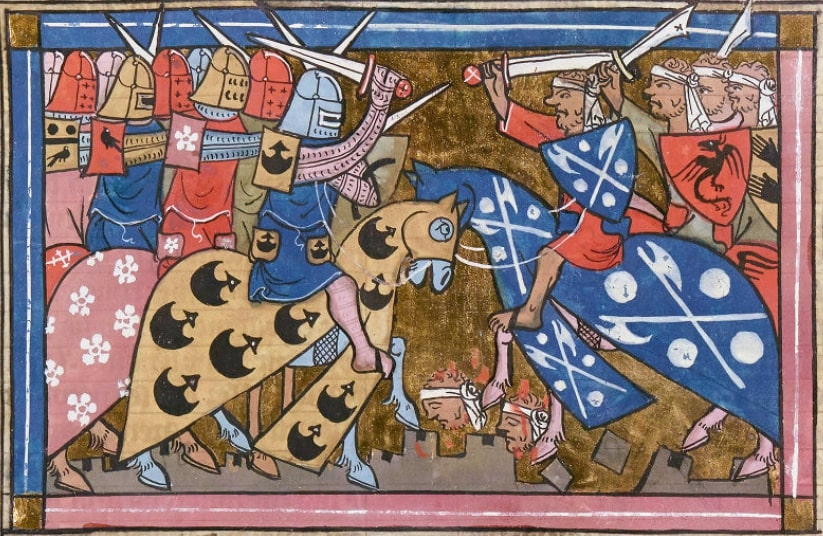
The word Renaissance, of Latin origin, means rebirth or revival. It signifies the sudden revival of interest in the classical learning of Greece and Rome. In the course of development, however, the Renaissance became more than a mere revival of classical learning. It included an impressive record of new achievements in art, literature, science, philosophy, education, religion, and politics. The Renaissance incorporated a number of ideas. Notable among them were humanism, scepticism, individualism, and secularism. A unique aspect of the Renaissance was the contribution made not by monks and nobles, but by laypersons.
Causes of the Renaissance
(i) New experiences during the Crusades [religious wars aimed at recovering the Holy Land from Muslim rule], the rise of independent trading cities like Venice, Florence, Genoa, Lisbon, Paris, London, Antwerp, Hamburg and Nuremberg, with many visiting travellers, and the establishment of universities at Paris (France), Oxford (England), and Bologno (Italy) provided the necessary preliminary conditions for the birth of renaissance.
Religious wars aimed at recovering the Holy Land from Muslim rule
(ii) Philosophical discussion, which had begun as early as the eleventh century, continued to produce great minds. The most prominent among them in the thirteenth century was Roger Bacon (1214–1294). An English philosopher who lived in Oxford, Bacon is considered the father of modern e x p e r i m e n t a l science. He wanted human kind to be ruled not by dogma and authority but rather by reason. (iii) In 1393, a famous scholar of Constantinople, Manuel Chrysaloras, arrived in Venice on a mission from the Byzantine emperor to seek the help of the West in the war against the Turks. Chrysaloras was eventually persuaded to accept a professorship of Greek classics at the University of Florence. About the beginning of the fifteenth century several other Byzantine scholars migrated to Italy. The influence of these scholars inspired Italian scholars to make trips to Constantinople and other Byzantine cities in search of manuscripts. Between 1413 and 1423 one Giovanni Aurispa brought back nearly 250 manuscript books, including the works of Sophocles, Euripides, and Thucydides. After the fall of Constantinople in 1453 there was a great exodus of classical scholars to Western Europe which gave a fillip to classical learning. (iv) The Byzantine world not only gave Christendom the stimulus of its scholars and philosophers, it also gave it paper. Though paper originated in China in second century BC (BCE)., it reached Germany only by the fourteenth century. Thereupon, the invention of moveable type and the printing press by Johannes Gutenberg followed. With printing, the intellectual life of the world entered a far more vigorous phase. Knowledge spread swifty.
Italy as the birthplace of Renaissance
Renaissance began in Italian cities and later spread to western Europe. Italians preserved the belief that they were descendants of the ancient Romans. They looked back upon their ancestry with pride. Italy had a more secular culture than most other parts of Latin Christendom. The old cathedrals and paintings seemed to them gloomy and the old traditions irksome. So in their search for something more to their liking, they discovered books written in Latin. They learnt to write Latin as the ancient Romans did. They also learnt Greek and thereby discovered wonderful works of the Athenians of the time of Pericles and facilitated a rebirth of the ancient and the bygone era of Greek and Roman culture. Italian universities were established primarily for the study of law and philosophy.
The Medici Family: Florence is one of the city states in Italy which was influence by a powerful merchant family called Medici. Cosimi de Mesdici who was engaged in banking with many branches across Italy had indirect control over the functioning of the government between 1434 and 1464. After his death, his grandson lorenzo took over and controlled the government. He was known as Lorenzo, the Magnificent. During this period, the Medici family patronized many artist including Michelangelo and Leonardo da Vinci.
Italy was situated in the centre of the Mediterranean Sea, and hence the Italian cities were the main beneficiaries of the revival of trade with the East. By the fourteenth century, Italian cities engaged in sea-borne trade had become fabulously rich. The Renaissance movement was accelerated by two prosperous families, the Medici family in Florence and the Sforza family in Milan.
Popes such as Nicholas V, Pius II, Julius II and Leo X bestowed their patronage upon the most brilliant artist of the Italian Renaissance.
Florence as the Homes of the Renaissance
Even in the thirteenth and fourteenth centuries, Florence had produced Dante (1265-1321) and Petrarch, the two great poets of the Italian language. Dante’s Divine Comedy is a summation of medieval culture. Its dominant theme is the salvation of mankind through reason and divine grace. But it abounds with many other themes such as human love, love of country, interest in natural phenomena and even the desire for a free and united Italian nation.
Petrarch (1304-1374) produced works both in Latin and Italian. An early humanist, he is considered the father of Italian Renaissance literature. Petrarch’s inquiring mind and love of classical authors led him to travel, visiting men of learning and searching in monastic libraries for classical manuscripts. It is believed that his discovery of Cicero’s letters was a key moment in the 14th-century Italian Renaissance.
Giovanni Boccaccio (1313-1375), also a Florentine, produced Decameron, a collection of 100 stories, as told by seven young women and three young men, during their stay at a villa outside of Florence to escape the ravages of the Black Death.
Niccolò Machiavelli (1469-1527)
Niccolo Machiavelli’s The Prince became famous because of its relevance as a political guide for rulers. In his view, the supreme obligation of the ruler was to maintain the power and safety of the country over which he ruled. No consideration of justice or mercy or the sanctity of treaties should be allowed to stand in his way. Machiavelli maintained that a man prompted exclusively by motives of self-interest and the head of the state should therefore take nothing for granted as to the loyalty or affection of his subjects.
‘A Prince’ says Machiavelli, must know how to play at once man and beast, lion and fox. He neither should nor can keep his word when to do so will turn against him. I venture to maintain that it is very disadvantageous always to be honest; useful, on the other hand, to appear pious and faithful, humane and devout. Nothing is more useful than the appearance of virtue.
Europe in the nineteenth century was influenced by the developments in France. Klemens von Metternich, the Chancellor of Austria-Hungary, who formed a ‘Holy Alliance’ between the monarchies of Austria, Russia, Prussia and France to suppress democratic and nationalistic trends in Europe, famously said, “When France sneezes, Europe catches a cold.”
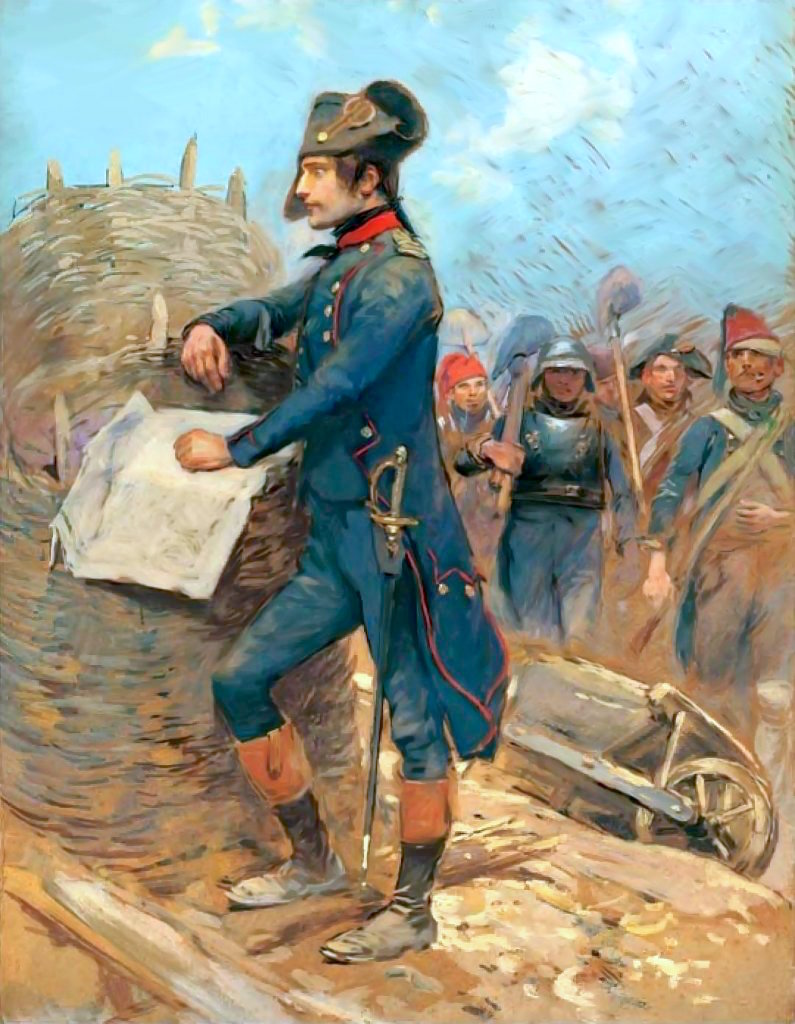
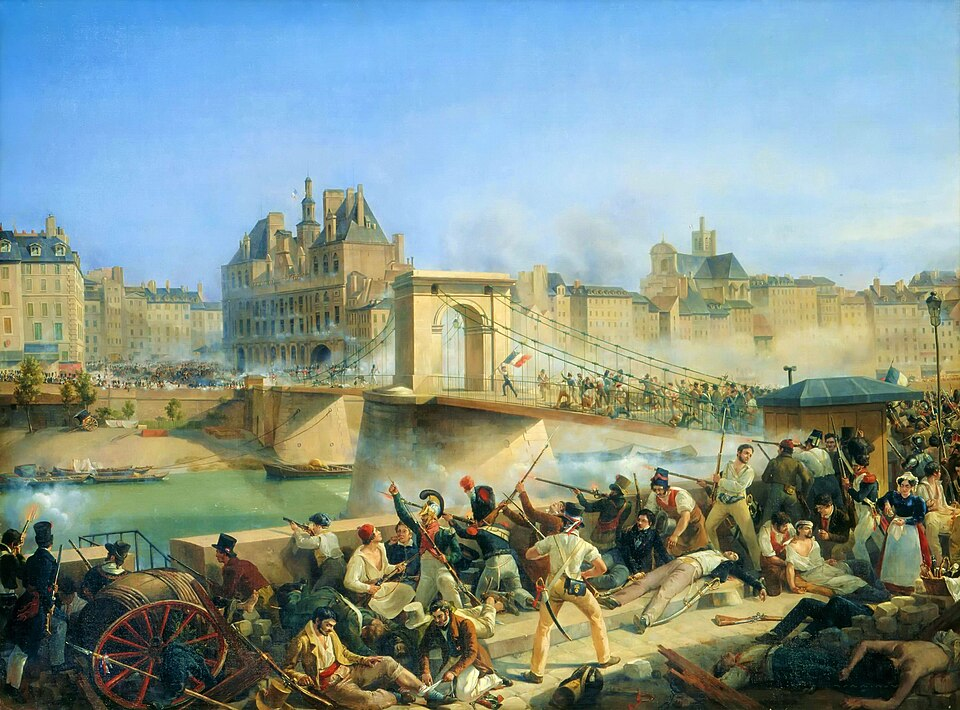
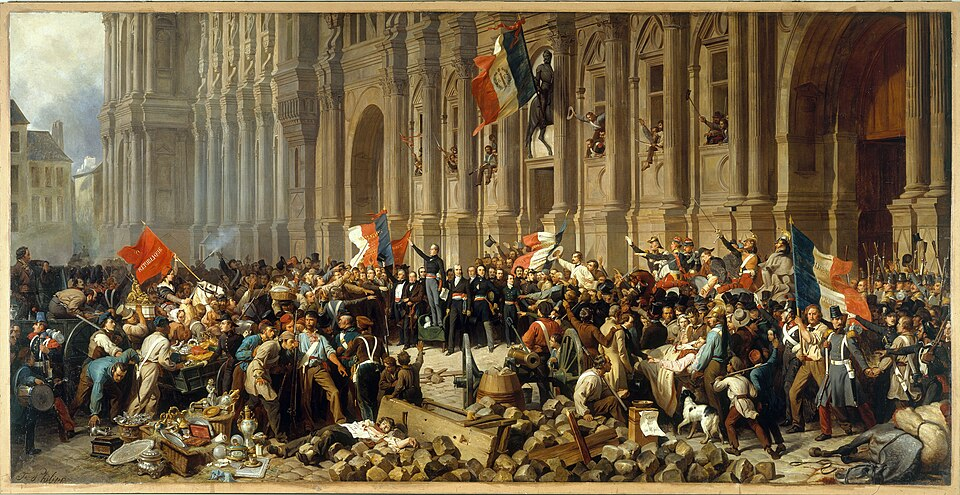
France sneezed not once, but thrice in 1789, 1830 and 1848, when revolutions broke out in France. The French Revolution of 1789 led to the emergence of the idea of liberalism expressed through its famous slogan, ‘Liberty, Equality and Fraternity’. The revolutionary energies released and ideals fostered during the Era of Revolution were destroyed by Napoleon Bonaparte. For some years, Napoleon’s reign was a career of victory.
However, as he never won the command of the sea from the British, his fleets suffered a crushing defeat at the hands of the British in 1805. Spain rose against Napoleon in 1808, and then a British army under Wellington pushed the French armies out of the peninsula.
In 1812, Napoleon invaded Russia with a great army of 600,000 men, but the French army was beaten back. Napoleon abdicated (1814) and was exiled to Elba, but returned to France for one last effort to seize power in 1815. He was defeated by the allied forces of the British, Belgians and Prussians at Waterloo in Belgium. He was finally exiled to the remote island of St. Helena in the West Atlantic until his death in 1821.
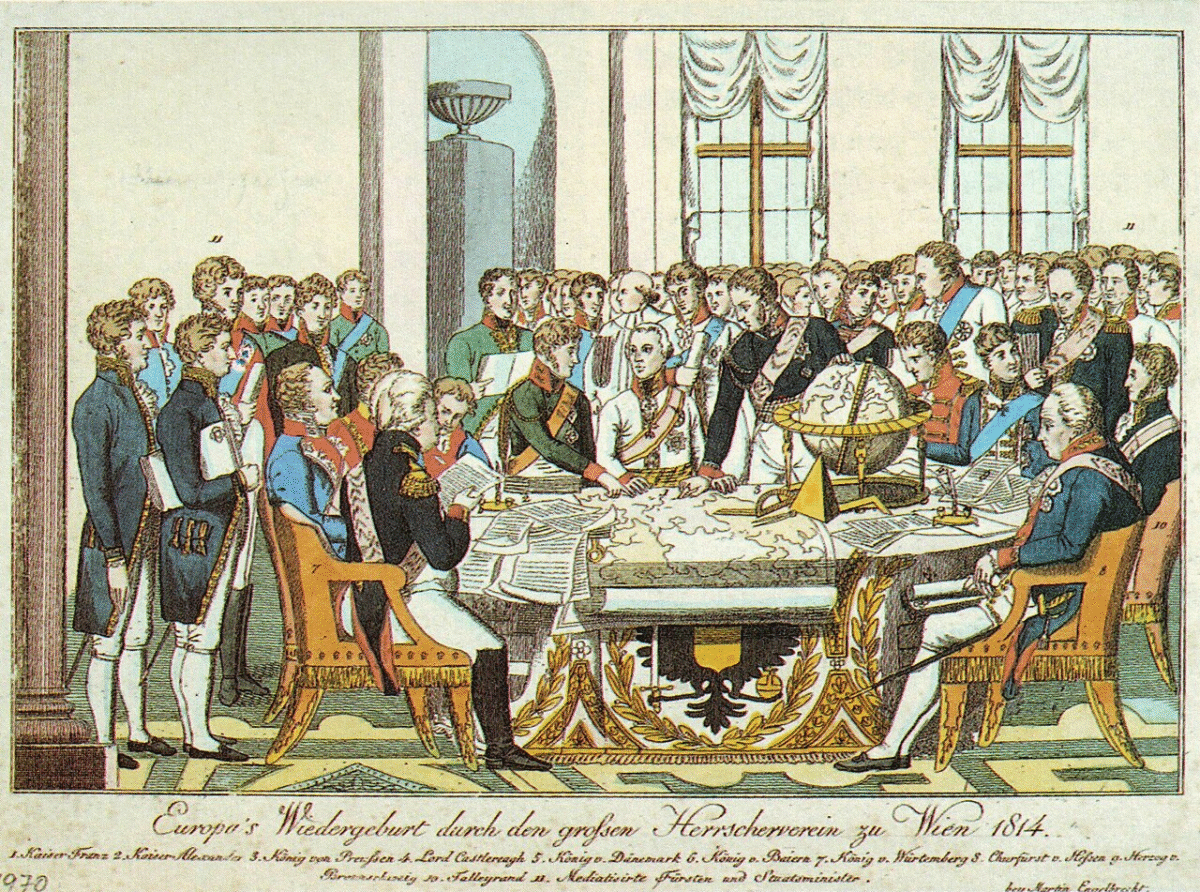
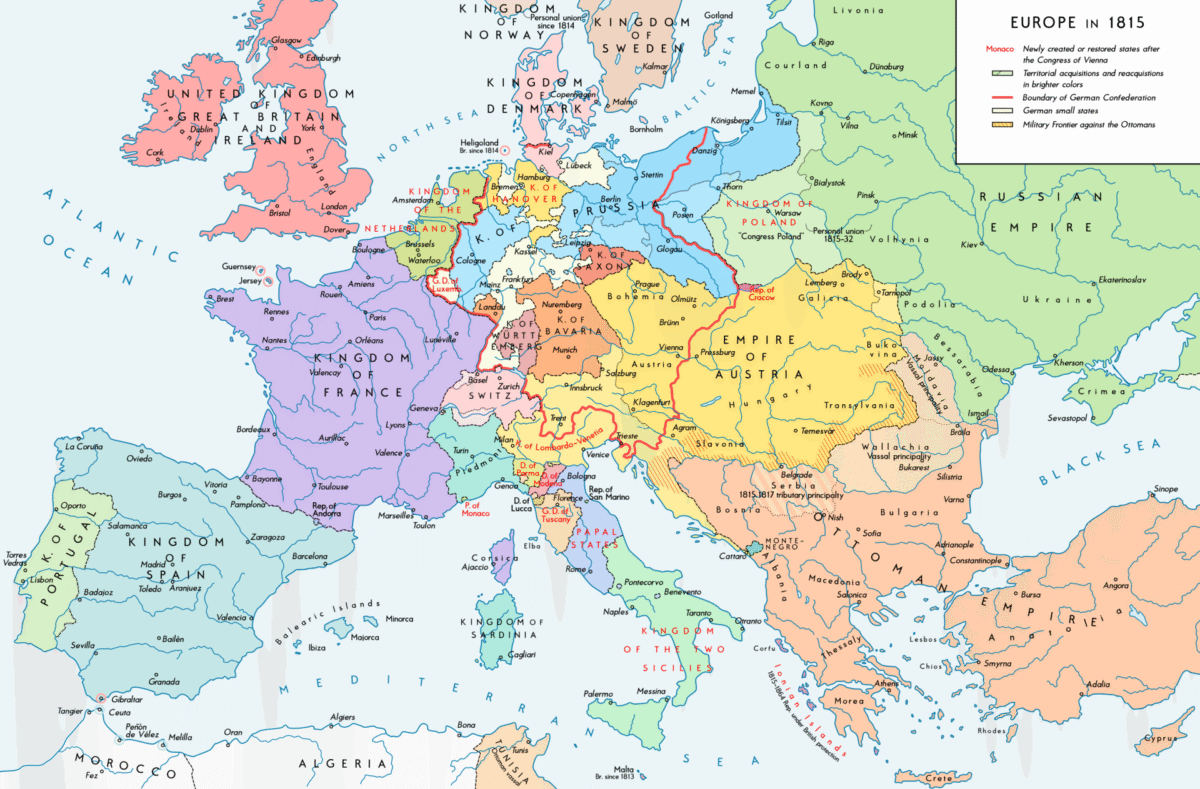
Congress of Vienna (1815)
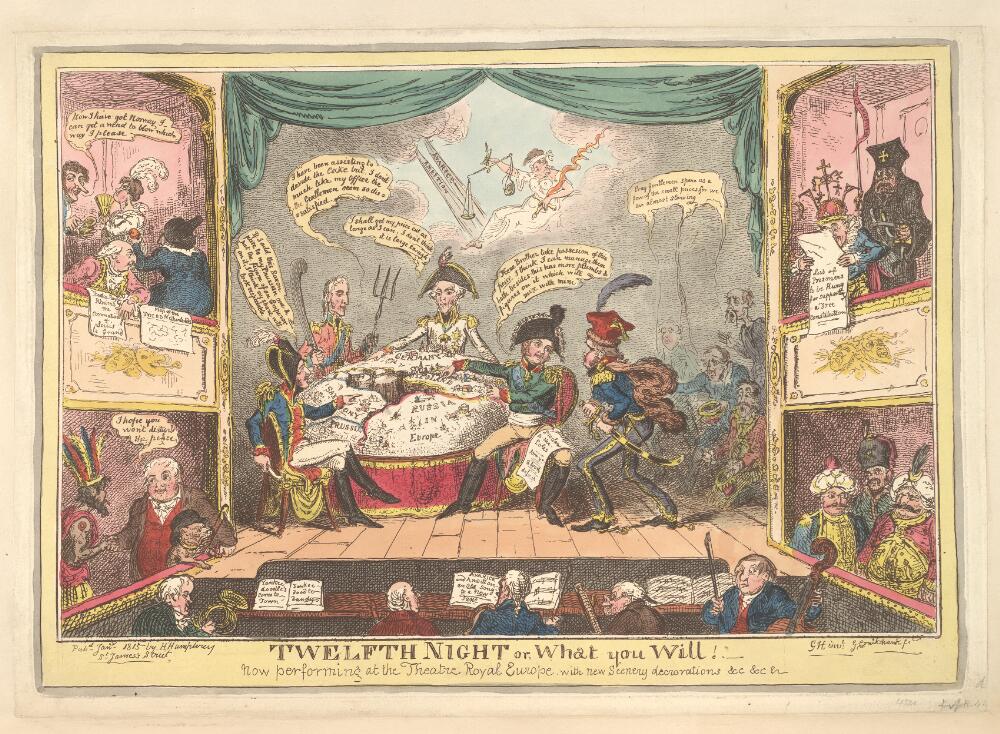
After the fall of Napoleon, an unstable peace lasted for nearly forty years. Two factors prepared the way for the outbreak of wars between 1854 and 1871. The first one was the restoration of the monarchy and the unfair privileges abolished during the Revolution. On regaining their former position, forgetting past lessons, the rulers almost immediately aimed at absolute power once more. The second was the unworkable system of boundaries drawn by the diplomats at the Congress of Vienna (1815), disregarding the principle of nationality.
National boundaries within Europe agreed upon by the Congress of Vienna
The reactionary monarchical forces under the leadership of Metternich had begun to function despotically through the Concert of Europe. There was repression of the liberation movements. Popular revolts in Naples (1820) and Spain (1822) were suppressed with the aid of foreign troops, Austrian in the case of the former and French in the latter case.
There was little liberty in any European country. In spite of this, the American and the French Revolutions had made the ideas of democracy and political liberty known and appreciated by liberal thinkers. Progressive thinkers and liberals believed in the virtues of democracy and tried hard to achieve them. But democracy offered no solution to issues of poverty or class conflict. Europe in the nineteenth century was ‘a strange mixture of capitalism and imperialism and nationalism and internationalism and wealth and poverty’.
The Industrial Revolution ended the domestic system of industry and necessitated that the workmen live near the factories. Long rows of tenement houses were built for their accommodation. Wages were abominably low. Hours of labour were as high as fifteen or even eighteen a day. Women and children were employed in large numbers.
The factories were owned by a small class of capitalists, whose main object was unbridled profit. The working classes were initially unorganised and therefore wholly at the mercy of their employers. Many, however, soon began to feel that without organisation and unity, no permanent improvement was possible. So they strove to establish trade unions.
When trade unions arose, the government first declared these unions illegal. Many of the frontline leaders, as we have seen in the previous lesson, were imprisoned or banished. In 1824, however, labour unions were legalised. With the rise of trade unions, an alternate system to capitalism was conceived, and socialism was used as a plank by many to attack the state and defend the interests of the working class.
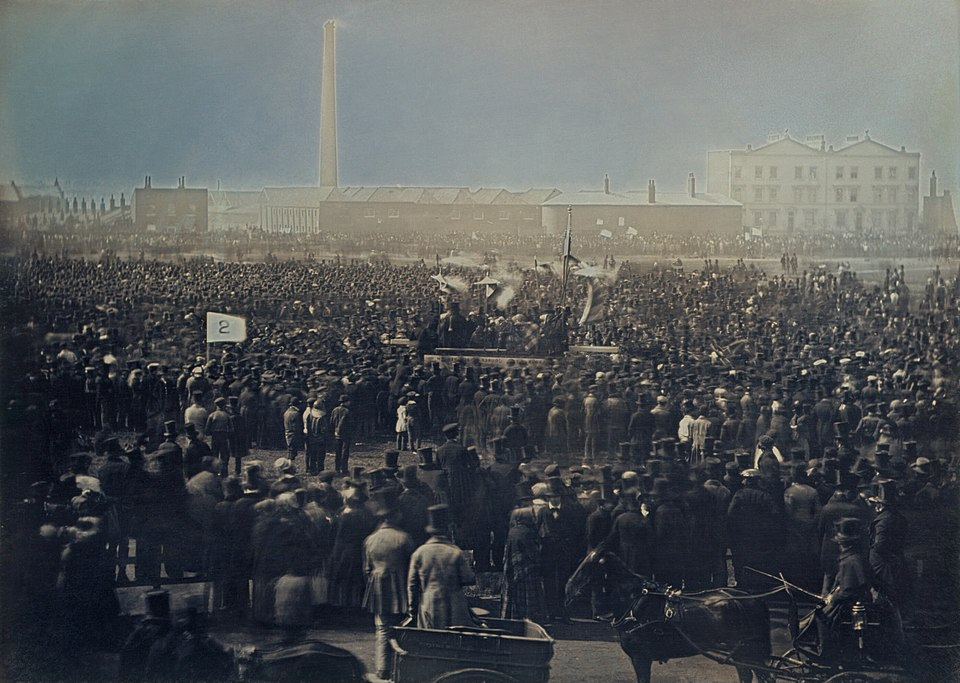
The working class organising into the Chartist Movement in England and later posing a serious challenge, as the Paris Commune did in France, to the capitalist order, and the unscrupulous measures adopted by the capitalists in connivance with the capitalist state to crush labour struggles are highlighted in this post.
Concert of Europe:Founded by major European Powers,Austria, Prussia,Russia and Britain, in the post-Napoleonic era, it worked for the preservation of European order and balance of power. Under the pretext of political status quo, the great powers under the aegis of Concert of Europe intervened and imposed their collective will on states threatened by internal rebellion during the socalled Metternich Era (1815–1848).
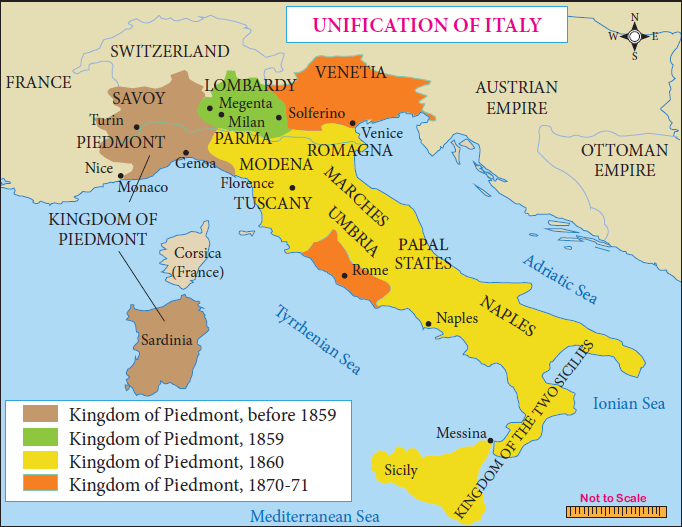
Under Napoleon, Italy had been reduced to three political divisions. This step towards unity was destroyed by the Congress of Vienna in 1815. Eight states were set up, and the whole of Northern Italy was handed over to the German-speaking Austrians. Germany was organised into a confederation of thirty-eight states, governed by a Diet presided over by Austria. But the cause of nationality was not lost either in Italy or Germany. Both Italy and Germany unified and emerged as nation-states.
Rise of Socialist Ideas and Birth of Communism
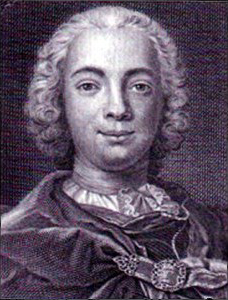
Socialist ideas in the modern sense came to be articulated by the Physiocrats or the economists who were making enquiries into the production and distribution of food and goods. Étienne-GabrielMorally, the Utopian thinker, in his Code de la Nature (1755), denounced the institution of private property and proposed a communistic organisation of society.
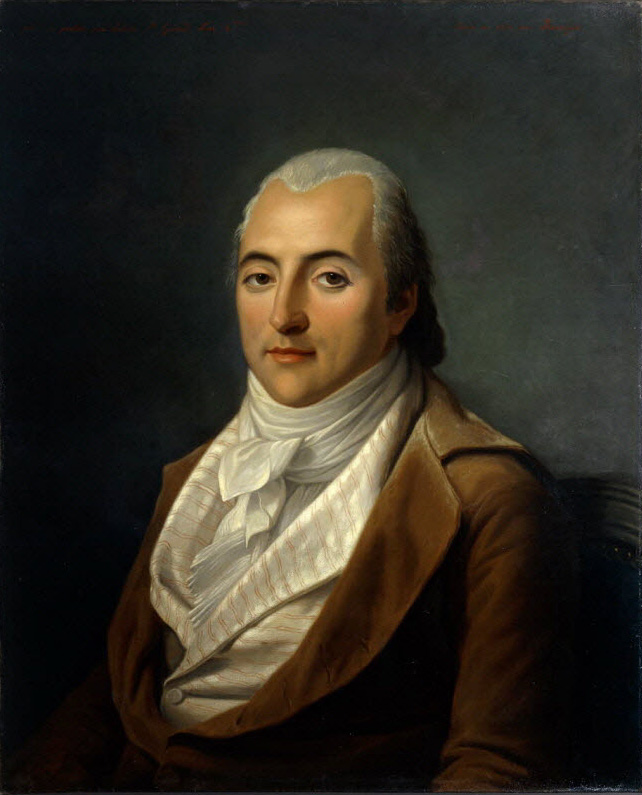
He was the precursor of various schools of collectivist thinkers in the nineteenth century, who are categorised as Socialists. François Babeuf, a political agitator of the French Revolutionary period, felt that the Revolution in France did not address the needs of the peasants and workers, and argued in favour of the abolition of private property and for common ownership of land.
Utopian Socialism
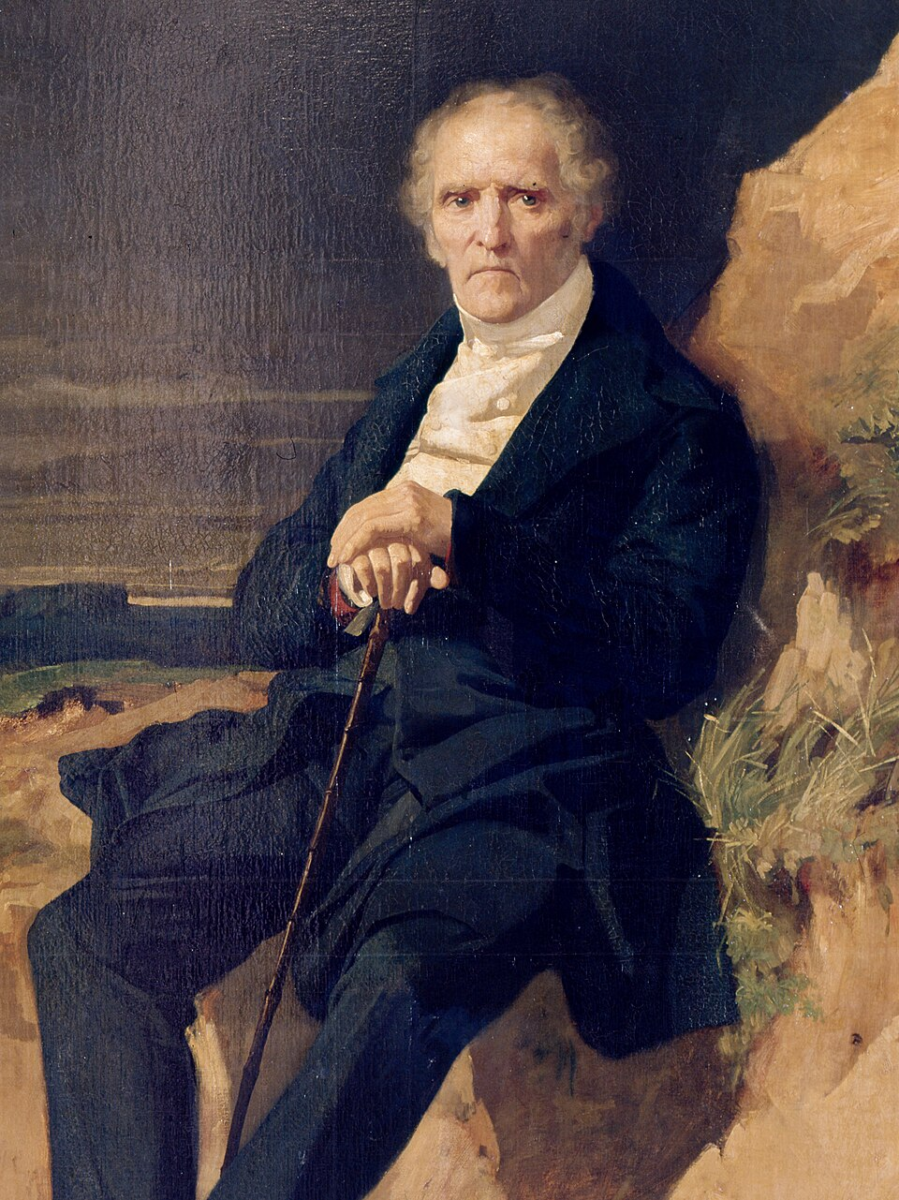
The earliest socialists in Europe were not revolutionaries. They proposed idealistic schemes for cooperative societies, in which all would work at their assigned tasks and share the outcome of their common efforts. The term “Utopian Socialism” was first used by Karl Marx and Friedrich Engels to describe the ideas articulated by the socialists before them.
Utopian Socialists recommended the establishment of model communities, where the means of production would be collectively owned. They promoted a visionary idea ofa socialistic society, devoid of poverty or unemployment. Their influence led to the establishment of several hundred model communes (communities) in Europe and the USA. Claude-Henri Saint-Simon, Francois-Marie-Charles Fourier and Robert Owen were some of the prominent Utopian Socialists.
Claude Henri Saint-Simon (1760–1825)
Fourier was an early Utopian Socialist. He believed that social conditions were the primary cause of human misery. Social and economic inequality could be overcome if everybody had the basic minimum. Fourier believed in the goodness of human nature and rejected the dogma of “original sin”. He saw harmony as the law of the cosmos and held that what is true for nature must be true for society. He envisioned a harmonious, self-contained cooperative society called phalansteres. It was a community where there would be equal distribution of profit and loss.
Charles Fourier (1772–1837)
Fourier was an early Utopian Socialist. He believed that social conditions were the primary cause of human misery. Social and economic inequality could be overcome if everybody had the basic minimum. Fourier believed in the goodness of human nature and rejected the dogma of “original sin”. He saw harmony as the law of the cosmos and held that what is true for nature must be true for society. He envisaged a harmonious, self-contained co-operative society called Phalanstress. It was a community where there would be distribution of profit and loss.
Robert Owen (1771–1858)
Among the factory owners of Manchester, there was a humanitarian by the name RobertOwen. Shocked by the condition of the factory workers, he introduced many reforms in his own factories and improved the condition of the workers. He did not employ children below the age of 10 in his industries. Later, he criticised private property and profit. He began to advocate the establishment of new cooperative communities that would combine industrial and agricultural production.
In his book A New View of Society (1818), he advocated a national education system, public works for the unemployed and reform of the Poor Laws. Thanks to his efforts, the British Parliament passed the Factory Act of 1819. By the mid-1820s, Owen had developed a theory of Utopian Socialism based on social equality and cooperation. His other initiatives included the formation of the Grand National Consolidated Trades Union (1834) and the Cooperative Congresses (1831-1835).
Pierre-Joseph Proudhon (1809–1865)
Proudhon was a French anarchist who contributed significantly to the development of socialism. Unlike the earlier Utopian socialists who were drawn from the middle class, he belonged to the working class. Drawing inspiration from the cooperative communities, he and other anarchists were opposed to the state and believed in revolution.
In his pamphlet titled “What is Property?” he wrote that “All property is theft.” Proudhon believed that labour should be the basis for social organisation and that all systems of government were oppressive. He wanted to replace the nation-state with federations of autonomous communes.
In 1848-49, he was a member of the National Assembly but was disillusioned by his experience. His ideas became popular among the working class of France by the middle of the nineteenth century. In 1864, some of the followers of Proudhon issued the Manifesto of the Sixty. The manifesto declared that the French Revolution of 1789 only brought about political equality and not economic equality.
They wanted the working class to be represented by themselves. In the 1863 elections, they unsuccessfully sponsored three working-class candidates in the parliamentary elections of France. His views, which influenced the Russian anarchist thinker Michael AlexandrovichBakunin, sought to overthrow the state by a general strike and replace it with democratically run cooperative groups.
Anarchism: Belief in the abolition of state and organisation of society on a voluntary, cooperative basis without recouse to force or compulsion.
Louis Jean Joseph Charles Blanc (1811-1882)
An influential French socialist, LouisBlanc, in 1839, started the Revue du Progres, a journal of advanced social thought. His most important essay, “Organisation of Labour”, serially appeared in 1839. In his writings, he proposed a scheme of state-financed but worker-controlled“social workshops” that would guarantee work for everyone and lead gradually to a socialist society.
Louis Blanc argued that socialism cannot be achieved without state power. In 1848, he became a member of the French provisional government and was able to influence it to set up workshops for the unemployed and provide employment to all who needed it.
Karl Marx and Scientific Socialism
Karl Marx (1818–1883) and FriedrichEngels (1820–1895) made the most profound contribution to socialism. Eventually, their ideas came to be known as Marxism or Communism. They called their views on socialism scientific socialism. On the eve of the 1848 Revolution, Marx and Engels published The Communist Manifesto. T
The most famous rallying cry in this famous work is: “Workers of the world, unite! You have nothing to lose but your chains.”Marx believed that in just the same way as capitalism replaced feudalism, so socialism would eventually replace capitalism.
Marx built his theory on the belief that there is a conflict of interests in the social order between the prosperous employing classes of people and the employed masses. With the advance in education, this great employed mass will become more and more class-conscious and more and more firm in their antagonism to the class-conscious ruling minority.
In some way, the class-conscious workers would seize power, he prophesied, and inaugurate a new social state. In 1867, Marx published the first volume of Das Kapital, a critique of capitalism. In this work, he highlighted the exploitation of the proletariat (the working class) by the bourgeoisie(the capitalist class).
The International Working Men’s Association, founded in 1864, was influenced by his ideas. Its purpose was to form an international working-class alliance. Marx worked hard to exclude the moderates from the International and denounced other socialists, such as Ferdinand Lassalle and Bakunin. Despite his efforts to consolidate the International, it declined by 1876.
However, many socialist parties emerged in Europe: the German Social Democratic Party in 1875, the Belgian Socialist Party in 1879, the Paris Commune in 1871, and the establishment of a socialist party in 1905. The Second International was founded in Paris in 1889, which influenced the socialist movement until the outbreak of the First World War.
Chartism in England
In England, the working class lined up behind the Chartist movement. The Chartist movement was not a riot or revolt. It was an organised movement. The impact of the 1830 French Revolution in England was the outbreak of militant labour agitation. Different streams of agitation converged to give rise to the Chartist movement.
The chartists propagated their ideas through newspapers such as The Poor Man’s Guardian, The Charter, The Northern Star, and The Chartist Circular. Its principal paper, the Northern Star, founded in 1837, soon equalled the circulation of the Times. Articles published in the Northern Star were read out for the illiterates in workshops and pubs in every industrial area.
Hundreds of thousands of workers attended mass meetings held during 1838–39. The People’s Charter, prepared by William Lovett of the London Working Men’s Association, detailing the six key points that the Chartists believed were necessary to reform the electoral system, was presented and deliberated in these meetings. The six key points were:
Universal Suffrage
Voting by ballot, to prevent intimidation
No property qualification for candidates.
Payment of members elected to the House of Commons, as it would enable the poor people to contend for office and contest elections.
Equal electoral districts and equal representation
Annual Parliaments
Panicked by rumours that there would be a popular uprising, the government sent the army to the industrial areas. In 1842, the workers struck work in Lancashire and marched from factory to factory, stopping the work, and extending and intensifying their action. In 1848, in the wake of a wave of revolutions that swept Europe, subsequent to the February Revolution of that year in France, masses of workers prepared again for confrontation.
The state stood firm with the backing of the lower middle class. The Chartist leaders also vacillated whenthe 50,000 strong crowd at Kennington, south London, began to melt away. In the meantime, the government arrested most of them and turned half of London into an armed camp.
Chartism comprised a mixture of different groups holding different ideas. Its leaders were divided between those who believed in winning over the existing rulers and those who believed in overthrowing them. Though Chartism was not successful, its main demands, which were not conceded in the 1832 Reform Act, were later incorporated in the Parliamentary Reform Acts of 1867 and 1884.
July Revolution (1830)
On 26 July 1830, the Bourbon king CharlesX issued four ordinances dissolving the Chamber of Deputies, suspending freedom of the press, modifying the electoral laws so that three-fourths of the electorate lost their votes, and calling for new elections to the Chamber. In protest, the Parisian masses took to the streets for the first time since
The royal forces were unable to contain the insurrection. Charles X was advised to go into exile and put in his place a relative, Louis Philip of Orleans, who had the backing of the middle class. The tactics worked in France. But in other parts of Europe, there arose a number of risings.
The revolution was successful in the Netherlands, where Belgium was separated to form an independent state. The Greeks, who had been fighting for independence from Turkish rule, attained independence in 1832, with the support of the Great Powers. But the revolt of the Poles against the Russian Tsar was suppressed.
February Revolution (1848)
The French King, Louis Philippe, had to abdicate and flee the country in February 1848, when there was a spontaneous rising in Paris. Crowds chanting“Vive de la reforme,” an expression in French to show patriotism, stormed into the lines of troops and swarmed through the palaces and the assembly buildings. The opposition rallied behind the French revolutionary poet Lamartine.
Louis Blanc also joined. In the elections held in April 1848, on the basis of universal manhood suffrage, the moderates were elected in large numbers. Only a few socialists were elected. The newly elected Assembly decided to shut down the workshops that had been started at the initiative of Louis Blanc, as the workshops were seen as a threat to social order. The workers retaliated and braved the government repression.
Between June 24 and 26, thousands of people were killed, and eleven thousand revolutionaries were imprisoned or deported. The period came to be known as the bloody June days. The Constituent Assembly drafted a new constitution based on which elections were held. Louis Napoleon, the nephew of Napoleon Bonaparte, was elected President in December 1848. Before long, in January 1852, he crowned himself as the Emperor by holding a plebiscite.
He assumed the title Napoleon III. The year 1848 was one of the distinct triumphs for nationalism. Metternich, the arbiter of Europe and enemy of nationality, was forced to leave Vienna in disguise. Hungary and Bohemia both claimed national independence. Milan expelled the Austrians. Venice became an independent republic.
Charles Albert, King of Sardinia, declared war against Austria. Absolutism seemed dead for a while. But it was not to be. By the summer, the monarchs had begun their attacks on the revolutionaries and succeeded in crushing the democratic movements in important centres like Berlin, Vienna and Milan. In the space of a year, counter-revolution was victorious throughout the continent.
Nationalism in southern and eastern Europe
In Europe, the countries that first achieved national unity were France, Spain and England. Italy, which had made rich contributions to art and letters, was not part of this political change. Cities in Italy, like Rome, Florence, Venice, Naples and Milan, were the capitals of small states. Hence, she became the prey of powerful kingdoms.
Besides, the age of the Renaissance was an age of intellectual liberty and certainly not an age of political liberty. The petty states of Italy, though enlightened in many ways, were mostly governed by tyrants, such as the Medici in Florence, the cruel Visconti in Milan, and Caesar Borgia in central Italy. What was true of Italy was true of Germany.
The Holy Roman Empire was an empire only in name. In practice, Germany contained three of four hundred separate States. It was their kings who saved these countries from feudal anarchy and made them into nations. Conditions suitable for the rise of Italy and Germany as nation-states developed only in the nineteenth century with the spread of nationalism.
Unification of Italy
Italy before Napoleon’s time was a patchwork of little states and petty princes. Under Napoleon, Italy had been reduced to three political divisions. This step towards unity was destroyed by the Congress of Vienna. Eight states were setup and the whole of Northern Italy was handed over to the German-speaking Austrians. Italy in the nineteenth century was a ‘patchwork of about a dozen large states and a number of smaller ones.’ Metternich described Italy as “an amere geographical expression.”
The empire of Piedmont-Sardinia, in the northwest, bordering France, played a central role in unifying Italy. To its east, Lombardy and Venetia were under the control of the Austrian Empire. It also controlled a few smaller states such as Tuscany, Parma and Modena. The Papal States were located in the middle under the control of theRoman Catholic Church. In the south was the Kingdom of the Two Sicilies, or Naples and Sicily, which was under the control of a family of the Bourbon dynasty.
The Napoleonic rule, for the first time, provided Italy with a sense of unity through uniform administration. The nationalistic aspirations of the Italians were dashed when the Congress of Vienna restored the old monarchies in the various Italian principalities. The 1820s witnessed the mushrooming of several secret societies such as the Carbonari, advocating liberal and patriotic ideas.
They kept alive the ideas of liberalism and nationalism. Revolts broke out in Naples, Piedmont and Lombardy. However, they were crushed by Austria. In the wake of the 1830 Revolution in France, similar rebellions broke out in Modena, Parma and the Papal States, which were again crushed by Austria. In 1848, following the February Revolution in France, the people again rose in revolt in several Italian states, including Piedmont-Sardinia, Sicily, Papal States, Milan, Lombardy and Venetia.
As a result, liberal constitutions were granted in Sicily, Piedmont, Sardinia and the Papal States. King Charles Albert of Piedmont-Sardinia, under the influence of the Revolution, invaded Lombardy and Venetia. However, the Austrians defeated him with the help of Russian troops . Charles Albert saved Piedmont-Sardinia from Austrian occupation by taking the blame upon himself for the war and abdicated in favour of his son Victor Emmanuel II.
However, despite the defeat of Piedmont-Sardinia and the suppression of revolution in various Italian principalities, liberal and nationalistic ideas survived. Mazzini, Count Camillo di Cavour, and Giuseppe Garibaldi were the three central figures of the unification of Italy. Cavour was considered the brain, Mazzini the soul, and Garibaldi the sword-arm of Italian Unification.
Mazzini (1805–1872)
Giuseppe Mazzini laid the foundations of Italian unification. Born in Genoa in a well-to-do family, he graduated in law . Attracted to politics at a young age, he advocated for the freedom of the Italian nation. He involved himself in the insurrectionary activities of the Carbonari for which he was arrested. He soon gave up the idea of secret plotting and began to believe in open propaganda against the monarchy.
He believed that Italy was a great civilisation that could provide leadership to the rest of the world. He started the Young Italy movement in 1831 with the aim of an Italian Republic. Exiled for working for the cause of unification of Italy in 1848, when revolts were breaking out all over Northern Italy, Mazzini returned to Rome.
The Pope was driven away, and a republic was declared under a committee of three, of which Mazzini was a member. But with the failure of the 1848 Revolution and the restoration of Rome to the Pope with the support of the French, Mazzini carried on his work by propaganda and preparing for the next programme of action.
Count Cavour (1810–1861)
Count Cavour was one of those inspired by the idea of Italian nationalism. In 1847he started a newspaper. The Italian unification movement came to be known by the name of the newspaper as Il Risorgimento. The Risorgimento (the resurrection of the Italian spirit)was an ideological and literary movement that helped to arouse the national consciousness of the Italian people. Cavour rose to become the Prime Minister of Sardinia and played a crucial role in the unification of Italy.
He used a combination of diplomacy and war to achieve the unification under the leadership of Sardinia. Cavour realised that Italian unification could not be achieved without international support. He needed the support of other great powers to expel Austria from Lombardy and Venetia. Therefore, he involved Piedmont in the Crimean War to draw international attention and get the support of England and France. In July 1858, he struck an agreement with Napoleon III of France, who offered to support Piedmont-Sardinia in its conflict with Austria.
War with Austria, 1859
Cavour then provoked war with Austria by mobilising troops near the Austrian border. When Austria issued an ultimatum to disband the troops, he allowed it to expire. As a result, Austria attacked Piedmont-Sardinia in April
The combined armies of Piedmont-Sardinia and France defeated the Austrian armies. They won a major victory at the Battle of Solferino. Instead of continuing the war, Napoleon III of France concluded a peace agreement with the Austrian Emperor FrancisJoseph II at Villa Franca on 11 July 1859.
Cavour was disappointed at the French withdrawal and resigned. In November 1859, Piedmont-Sardinia and Austria concluded the Treaty of Zurich. Austria ceded Lombardy but retained control over Venetia. Cavour was reappointed as Prime Minister in 1860. Parma, Modena and Tuscany emerged with the Kingdom of Piedmont-Sardinia through plebiscites. Similarly, Savoy and Nice were annexed to France on the basis of plebiscites.
Garibaldi and the Conquest of Southern Italy
Giuseppe Garibaldi (1807–1882) played a key role in the unification of Italy by waging guerrilla warfare. He joined Mazzini’s Young Italy and was influenced by his ideas. Garibaldi participated in Mazzini’s rebellion in Piedmont, and he then fled to South America as an exile. He took up the cause of revolutionaries there and fought for the cause ofRio Grande and Uruguay against Argentinian occupation.
Therefore, he was called the ‘Hero of Two Worlds’. In 1843, he started the Italian Legion. This force of volunteers came to be known as the Red Shirts . Garibaldi accepted the invitation of the people of Sicily in their revolt against their monarch. He left the port of Genoa with 1000 volunteers for Sicily. Landing unnoticed on the coast of Sicily, he and his volunteers defeated the 20000-strong Neapolitan (Naples) troop without any loss of life. He then crossed intoNaples and defeated the royal troops with the help of the locals.
However, Cavour, suspicious of Garibaldi’s triumphant march, sent the Piedmontese force to stop him from invading Rome. Garibaldi submitted his conquest to King Victor Emmanuel II and retreated to lead the rest of his life in his home on the island of Caprera. Plebiscites held in Sicily, Naples and the Papal States led to their merger with Piedmont-Sardinia.
At the end of the war, Austria retained control over Venetia and the Pope held Rome. The rest of Italy was unified under Piedmont. In May 1861, King Victor Emmanuel II was proclaimed by the Parliament as the ruler of Italy. During the Austro-Prussian War in 1866, Italy had allied itself with Prussia and was rewarded with Venetia. In 1871, Italy took advantage of the Franco-Prussian War to annex Rome as the French forces withdrew. Thus,the Italian Unification was completed.
Unification of Germany
In spite of a common language and many other common features, the German people continued to be split up into a large number of states. Intellectuals such as Johann vonHerder (1744–1803) andFriedrich Schlegel (1772–1829) promoted the idea of the German nation by glorifying its past.
Herder believed that civilisation was a product of the culture of the common people, the Volk (folk) and promoted the idea of a unique German spirit, the Volkgeist. J.G. Fichte (1762–1814) delivered a series of Addresses to the German Nation. He claimed the German spirit was not just one among the many spirits but was superior to the rest. This inspired and promoted the idea of nationalism among the Germans. Before Napoleon,n Germany consisted of about 360 principalities.
Napoleon unconsciously gave an impetus to the spirit of nationalism by forming a Confederation of the Rhine. For the first time, it gave a sense of unity to Germany. However, the Congress of Vienna, which transformed it into the German Confederation consisting of 39 states, placed it under the control of Austria. At the time of Fichte’s addresses, Austria was occupying the territories of Prussia, the largest and most powerful of the Confederation of German States. It kindled in Prussia the spirit to achieve its past glory. It rebuilt and strengthened its army.
Recruitment was based on merit and not on old aristocratic standing. The zeal for liberalism and modernisation combined with nationalism in Prussia. In 1834, Prussia was successful in establishing the Zollverein (customs union). By the 1840s, it included most of the Germanic states except those under the control of Austria and provided economic unity to the Germanic states. In 1848, popular pressure led to the introduction of an elected legislative assembly.
In the same year, the Frankfurt Assembly was convened. Most of the elected members were liberals who believed that a liberal national-German state could be created. They were divided on the question of what constituted the German nation. The delegates who demanded ‘ Greater Germany’ believed that the German nation should include as many Germans as possible, including Austria, except Hungary, and the crown should be offered to the Austrian Emperor.
Some delegates put forward the idea of ‘Little Germany,’ which argued that Austria should be excluded from the German nation and the crown be offered to the King of Prussia. Eventually, Austria withdrew from the Assembly. A constitution was framed by the Assembly, and the Little Germans offered the constitutional monarchy to King FrederickWilliam of Prussia. However, the latter declined it as he did not want to accept the revolutionary notion of the Assembly offering the crown to him .Otto von Bismarck ,Chancellorof Prussia, transformed it into a powerful state with the objective of uniting the Germanic states under its leadership .He adopted a ‘blood and iron’ policy to achieve the unification. He realised that the unification of Germany was not possible without an armed conflict with Austria and France. He sparked conflict with Austria and France through diplomatic moves. Bismarck opened negotiations with Russia and ensured Russian neutrality in the event of a conflict between Prussia and Austria. Bismarck had to fight three wars to achieve the unification of Germany.
Schleswig–Holstein Question
Schleswig and Holstein were Germanic states under the control of Denmark. In 1863, the King of Denmark merged these two duchies into his kingdom. Bismarck proposed to Austria a joint action against Denmark. In 1864, the joint forces of Prussia and Austria defeated Denmark. By the Treaty of Vienna, Denmark surrendered the duchies to Prussia and Austria. Differences arose on the fate of Schleswig and Holstein .While Austria wanted them to be made part of the German Confederation, Bismarck wanted to administer them separately. By the Convention of Gastein in 1865 it was agreed that Holstein would be under the control of Austria and Schleswig under the control of Prussia. Holstein had a large German population and was located within Prussian territory, making it difficult for Austria to administer it. When Austria decided to refer the matter to the Diet of the German Confederation, it violated the Convention of Gastein. Bismarck ordered the Prussian troops to occupy Holstein.
Austro–Prussian War of 1866
Austro–Prussian War. By his diplomacy, Bismarck had ensured the neutrality of Russia and France. He also got the support of Piedmont-Sardinia, which wanted to drive Austria out of Venetia. Thus, ensuring that Austria would not receive support from any major power, he forced Austria to attack Prussia. The Austro-Prussian War is also known as the Seven Weeks’ War. Prussia defeated Austria at the Battle of Sadowa or Koniggratz in Bohemia. While the Prussian army wanted to march into Austria and capture Vienna, Bismarck opposed it. The war was brought to an end by the Treaty of Prague. Austria withdrew from the German Confederation. The northern states were formed into a North German Confederation under Prussia. Though defeated, Italy was rewarded with Venetia for its support of Prussia. The North German Confederation consisted of 22 states north of the river Maine. A new constitution came into effect on 1 July 1867. Bismarck followed a friendly policy towards the southern states in an attempt to win them over.
Franco–Prussian War of 1870–71
Franco–Prussian War: Bismarck next turned his attention to creating a rift between Prussia and France to unite the southern German states. The opportunity arose over the issue of succession to the Spanish throne. After a revolution in Spain which drove Queen Isabella out of the country, the throne was offered to Prince Leopold, a relative of the King of Prussia. France was agitated over the issue. The threat of war was averted when Prince Leopold declined the offer. Bismarck was disappointed. However, a new opportunity arose when Gramont, the French Foreign Minister, met the King of Prussia in Ems. He demanded that Prussia promise that it would not claim the throne of Spain in the future. The Prussian King sent a telegram about the discussion toBismarck. He edited it in such a manner that the French thought their ambassador had been insulted while the Prussians thought that their king had been humiliated. The Ems telegram triggered the Franco-Prussian War.
France declared war on Prussia. In the Battle of Sedan( 2 September 1870), France was defeated. French King Napoleon III surrendered. Bismarck, however, continued his march to Paris and captured it. The war was brought to an end by the Treaty of Frankfurt in 1871. Bismarck imposed harsh terms on France. France ceded Alsace-Lorraine and agreed to pay a huge war indemnity. At the Versailles Palace, King William I of Prussia was declared the Emperor of Germany, which combined both the North German Confederation and the southern states. Thus, the Unification of Germany was achieved by a combination of diplomacy and warfare.
The Founding of the Third Republic in France
After the Battle of Sedan, Napoleon III was taken prisoner, and later his government was overthrown by a group of republicans in Paris. A provisional government was set up to rule the country until a new constitution could be drafted. Elections were held in February 1871 for a National Constituent Assembly. A majority of the members were monarchists. It is not that the French people preferred a monarchy, but rather that they longed for peace. The monarchists were hopelessly divided, and hence, for almost four years a decision as to the form of government could not be taken. Finally, in January 1875, the National Assembly decided on a republican form of government. This signalled the establishment of the Third Republic in France.
Paris Commune, 1871
In its bid to exact huge financial payment and to annex French Alsace and Lorraine to Prussia, the Prussian army besieged Paris. Paris held out through five months of siege in conditions of incredible hardship, with people starving and without fuel to warm their homes in winter. Workers, artisans and their families bore the full brunt of the suffering as prices soared.
The Parisians grew bitter when larger numbers of monarchists were returned to the National Assembly. Then came the betrayal of the republic – the appointment of 71-yearoldThiers. Paris was once again armed. As the regular army had been disbanded under the terms of the agreement with Prussia, the Parisian masses kept their arms. Along with the National Guard, now overwhelmingly a working-class body, they surrounded the soldiers. One of the generals, Lecomte, gave orders to shoot at the crowd three times.
But the soldiers stood still. The crowd fraternised with the soldiers and arrested Lecomte and his officers. That dayThiers and his government fled the capital. One of the world’s great cities was in the hands of armed workers. The Commune set about implementing measures in their interests – banning night work in bakeries and handing over to associations of workers any workshops or factories shut down by their owners, providing pensions for widows and free education for every child, and stopping the collection of debts incurred during the siege.
In the meantime, the republican government was organising armed forces to suppress the commune. It succeeded in persuadingBismarck to release French prisoners of war. It gathered them in Versailles, together with new recruits from the countryside. Both the Central Committee of the National Guard and the Commune were composed of Blanquists and Proudhanists. Marx could not influence events in Paris.
Soon, the defeat of Communism was achieved by Thiers. Thereafter, there was an orgy of violence. Anyone who had fought for the Commune was summarily shot. Troops patrolled the streets, picking up poorer people at will and condemning them to death. It is estimated that between 20,000 and 30,000 were killed. Of the 40,000 communards (members of the commune) arrested, 5000 of them were sentenced to be deported and another 5,000 to imprisonment.
Karl Marx had this to say on the Commune: “It represented the greatest challenge the new world of capital had yet faced and the greatest inspiration to the new class created by capital in opposition to it.”
The Long Depression (1873–1896)
The world witnessed an unprecedented economic boom from 1865 to 1873. The unification led to a phenomenal boom in Germany between 1870 and 1873. During this period, 857 new companies were established. It was unparalleled in the history of Germany. The railway system almost doubled in size between 1865 and 1875.
Tens of thousands of Germans invested in stock for the first time to demonstrate both their patriotism and their faith in the future of the new German Empire. After the end of the Civil War, the United States too underwent an economic transformation, marked by the proliferation of big businesses and the massive development of agriculture, accompanied by the rise of national labour unions.
The period from the 1870s to 1900 in the USA came to be called the Gilded Age. The rapid expansion of industrialisation led to a real wage growth of 60% between1860 and 1890. The average annual wage per industrial worker (including men, women, and children) rose from $380 in 1880 to $564in 1890. However, the Gilded Age was also an era of abject poverty and inequality, as millions of immigrants – many from impoverished regions – poured into the United States.
The high concentration of wealth in a few hands was becoming more visible. Then came the Depression. It was signalled by the collapse of the Vienna Stock Market in May 1873. The Depression was worldwide and lasted till 1896, and is referred to as the Long Depression. It affected Europe and the US very much. American railroads became bankrupt.
German shares fell by 60 per cent. Agriculture was most affected, as there was a fall in prices. Many countries responded by imposing protective tariffs to prevent competition. Panic of 1873. The Gilded Age was also an era of intense mass mobilisation of the working classes. Socialist
and labour movements emerged in many countries as a mass phenomenon. When industrial capitalism was at its peak in the US, nearly 100,000 workers went on strike each year. In 1892, for example, 1,298 strikes involving some 164,000 workers took place across the nation. Trade Unions, aiming at protecting workers’ wages, hours of labour, and working conditions, were on the rise . Capitalists who could not reconcile to the rise of trade unions launched a counteroffensive. The socialists suffered persecution. The strike at the Carnegie Steel Company’s Homestead Steel Works in 1892 culminated in a gun battle between unionised workers and men hired by the company to break the strike. The state supported the company management, and as a result, the steelworkers ultimately lost the strike.
The Pullman Strike of 1894, a national railroad strike involving the American Railway Union, was smashed by armed police and Pinkerton private detectives were hired by the employers to shoot down strikers. Pullman Strike. In Germany, the Socialist Democratic Party(SDP) emerged as a popular party. However, Bismarck introduced anti-socialist legislation to check the growth of socialism.
Despite this, support for the party grew. With the repeal of the anti-socialist laws after 1890, socialist trade unions were able to function openly. SDP’s share of Reichstag seats increased from 3 percent in1887 to 20 per cent in 1903. In Britain, in the 1880s, the famous MatchGirls Strike by the women and teenage girls working in the Bryant and May Match Factory ended in the victory of the strikers. There was also a dock strike (1889) in the port of London. Cardinal Manning intervened and mediated on behalf of the strikers with the dock owners. But, in the 1890s, British employers, following the examples of their counterparts in the US, also destroyed many of the new unions through professional strike breakers, starving people back to work, lockouts and the like.
Conclusion
Liberalism and nationalism, joining hands to fight for democracy and the Industrial Revolution, leading to the rise of working-class movements and the coming of socialism, are explained.The early socialists and Marx and their contributions are discussed.The Chartist Movement in England and its tragic end without achieving its objectives are analysed.The 1830 and the 1848 revolutions and the growing aggressive nature of nationalism leaving its liberal thrust in Western Europe, are highlighted.The ascendancy of nationalism in Italy and Germany that emerged as nation states are detailed.The built-in weakness of the capitalist system during the long depression of1873-1896, and the growing militancy of the labour that was unscrupulously dealt with by the capitalists in collusion with the state are analysed.
As you have seen, modern nationalism in Europe came to be associated with the formation of nation-states. It also meant a change in people’s understanding of who they were and what defined their identity and sense of belonging. New symbols and icons, new songs and ideas forged new links and redefined the boundaries of communities. In most countries, the making of this new national identity was a long process. How did this consciousness emerge in India?
In India and as in many other colonies, the growth of modern nationalism is intimately connected to the anti-colonial movement. People began discovering their unity in the process of their struggle with colonialism. The sense of being oppressed under colonialism provided a shared bond that tied many different groups together. But each class and group felt the effects of colonialism differently; their experiences were varied, and their notions of freedom were not always the same. The Congress under Mahatma Gandhi tried to forge these groups together within one movement. But the unity did not emerge without conflict.
In this post we will pick up the story from the 1920s and study the Non -Non-Cooperation and Civil Disobedience Movements. We will explore how the Congress sought to develop the national movement, how different social groups participated in the movement, and how nationalism captured the imagination of people.
In the years after 1919, we see the national movement spreading to new areas, incorporating new social groups, and developing new modes of struggle. How do we understand these developments? What implications did they have?
First of all, the war created a new economic and political situation. It led to a huge increase in defence expenditure, which was financed by war loans and increasing taxes: customs duties were raised and income tax introduced. Through the war years, prices increased – doubling between 1913 and 1918 – leading to extreme hardship for the common people.
Villages were called upon to supply soldiers, and the forced recruitment in rural areas caused widespread anger. Then in 1918-19 and 1920-21, crops failed in many parts of India, resulting in acute shortages of food. This was accompanied by an influenza epidemic. According to the census of 1921, 12 to 13 million people perished as a result of famines and the epidemic. People hoped that their hardships would end after the war was over. But that did not happen. At this stage, a new leader appeared and suggested a new mode of struggle.
1.1 The Idea of Satyagraha
Mahatma Gandhi returned to India in January 1915. As you know, he had come from South Africa, where he had successfully fought against 31 Nationalism in India, the racist regime, with a novel method of mass agitation, which he called satyagraha. The idea of satyagraha emphasised the power of truth and the need to search for truth. It suggested that if the cause was true, if the struggle was against injustice, then physical force was not necessary to fight the oppressor. Without seeking vengeance or being aggressive, a satyagrahi could win the battle through non-violence. This could be done by appealing to the conscience of the oppressor. People – including the oppressors – had to be persuaded to see the truth, instead of being forced to accept the truth through the use of violence. By this struggle, truth was bound to ultimately triumph. Mahatma Gandhi believed that this dharma of non-violence could unite all Indians.
After arriving in India, Mahatma Gandhi successfully organised satyagraha movements in various places. In 1917, he travelled to Champaran in Bihar to inspire the peasants to struggle against the oppressive plantation system. Then in 1917, he organised a satyagraha to support the peasants of the Kheda district of Gujarat. Affected by crop failure and a plague epidemic, the peasants of Kheda could not pay the revenue, and were demanding that revenue collection be relaxed. In 1918, Mahatma Gandhi went to Ahmedabad to organise a satyagraha movement amongst cotton mill workers.
1.2 The Rowlatt Act
Emboldened with this success, Gandhiji in 1919 decided to launch a nationwide satyagraha against the proposed Rowlatt Act (1919). This Act had been hurriedly passed through the Imperial Legislative Council despite the united opposition of the Indian members. It gave the government enormous powers to repress political activities and allowed detention of political prisoners without trial for two years. Mahatma Gandhi wanted non-violent civil disobedience against such unjust laws, which would start with a hartal on 6 April.
Rallies were organised in various cities, workers went on strike in railway workshops, and shops closed down. Alarmed by the popular upsurge and scared that lines of communication, such as the railways and telegraph, would be disrupted, the British administration decided to clamp down on nationalists. Local leaders were picked up from Amritsar, and Mahatma Gandhi was barred from entering Delhi. On 10 April, the police in Amritsar fired upon a peaceful procession, provoking widespread attacks on banks, post offices and railway stations. Martial law was imposed, and General Dyer took command.
General Dyer’s ‘crawling orders’ being administered by British-Indian soldiers, Amritsar, Punjab, 1919.
On 13 April, the infamous Jallianwalla Bagh incident took place. On that day, a large crowd gathered in the enclosed ground of Jallianwalla Bagh. Some came to protest against the government’s new repressive measures. Others had come to attend the annual Baisakhi fair. Being from outside the city, many villagers were unaware of the martial law that had been imposed. Dyer entered the area, blocked the exit points, and opened fire on the crowd, killing hundreds. His object, as he declared later, was to ‘produce a moral effect’, to create in the minds of satyagrahis a feeling of terror and awe.
As the news of Jallianwalla Bagh spread, crowds took to the streets in many north Indian towns. There were strikes, clashes with the police and attacks on government buildings. The government responded with brutal repression, seeking to humiliate and terrorise people: satyagrahis were forced to rub their noses on the ground, crawl on the streets, and do salaam (salute) to all sahibs; people were flogged, and villages (around Gujranwala in Punjab, now in Pakistan) were bombed. Seeing violence spread, Mahatma Gandhi called off the movement.
While the Rowlatt satyagraha had been a widespread movement, it was still limited mostly to cities and towns. Mahatma Gandhi now felt the need to launch a broader-based movement in India. But he was certain that no such movement could be organised without bringing the Hindus and Muslims closer together. One way of doing this, he felt, was to take up the Khilafat issue. The First World War ended with the defeat of Ottoman Turkey. And there were rumours that a harsh peace treaty was going to be imposed on the Ottoman emperor – the spiritual head of the Islamic world (the Khalifa).
To defend the Khalifa’s temporal powers, a Khilafat Committee was formed in Bombay in March 1919. A young generation of Muslim leaders, like the brothers Muhammad Ali and Shaukat Ali, began discussing with Mahatma Gandhi about the possibility of a united mass action on the issue. Gandhiji saw this as an opportunity to bring Muslims under the umbrella of a unified national movement. At the Calcutta session of the Congress in September 1920, he convinced other leaders of the need to start a non-cooperation movement in support of Khilafat as well as for swaraj.
1.3 Why Non-cooperation?
In his famous book Hind Swaraj (1909), Mahatma Gandhi declared that British rule was established in India with the cooperation of Indians, and had survived only because of this cooperation. If Indians refused to cooperate, British rule in India would collapse within a year, and swaraj would come. How could non-cooperation become a movement? Gandhiji proposed that the movement should unfold in stages. It should begin with the surrender of titles that the government awarded, and a boycott of civil services, army, police, courts and legislative councils, schools, and foreign goods.
Then, in case the government used repression, a full civil disobedience campaign would be launched. Through the summer of 1920, Mahatma Gandhi and Shaukat Ali toured extensively, mobilising popular support for the movement. Many within the Congress were, however, concerned about the proposals. They were reluctant to boycott the council elections scheduled for November 1920, and they feared that the movement might lead to popular violence. In the months between September and December, there was an intense tussle within the Congress. For a while there seemed no meeting point between the supporters and the opponents of the movement.
Finally, at the Congress session at Nagpur in December 1920, a compromise was worked out and the Non-Cooperation programme was adopted. How did the movement unfold? Who participated in it? How did different social groups conceive of the idea of Non-Cooperation?
Foreign cloth was seen as the symbol of Western economic and cultural domination.
Differing Strands within the Movement
The Non-Cooperation-Khilafat Movement began in January 1921. Various social groups participated in this movement, each with its own specific aspiration. All of them responded to the call of Swaraj, but the term meant different things to different people.
2.1 The Movement in the Towns
The movement started with middle-class participation in the cities. Thousands of students left government-controlled schools and colleges, headmasters and teachers resigned, and lawyers gave up their legal practices. The council elections were boycotted in most provinces except Madras, where the Justice Party, the party of the non-Brahmans, felt that entering the council was one way of gaining some power – something that usually only Brahmans had access to.
The effects of non-cooperation on the economic front were more dramatic. Foreign goods were boycotted, liquor shops picketed, and foreign cloth burnt in huge bonfires. The import of foreign cloth halved between 1921 and 1922, its value dropping from Rs 102 crore to Rs 57 crore. In many places merchants and traders refused to trade in foreign goods or finance foreign trade. As the boycott movement spread, and people began discarding imported clothes and wearing only Indian ones, production of Indian textile mills and handlooms went up. But this movement in the cities gradually slowed down for a variety of reasons. Khadi cloth was often more expensive than mass- produced mill cloth and poor people could not afford to buy it.
How then could they boycott mill cloth for too long? Similarly the boycott of British institutions posed a problem. For the movement to be successful, alternative Indian institutions had to be set up so that they could be used in place of the British ones. These were slow to come up. So students and teachers began trickling back to government schools and lawyers joined back work in government courts.
2.2 Rebellion in the Countryside
From the cities, the Non-Cooperation Movement spread to the countryside. It drew into its fold the struggles of peasants and tribals which were developing in different parts of India in the years after the war. In Awadh, peasants were led by Baba Ramchandra – a sanyasi who had earlier been to Fiji as an indentured labourer. The movement here was against talukdars and landlords who demanded from peasants exorbitantly high rents and a variety of other cesses. Peasants had to do begar and work at landlords’ farms without any payment.
As tenants they had no security of tenure, being regularly evicted so that they could acquire no right over the leased land. The peasant movement demanded reduction of revenue, abolition of begar, and social boycott of oppressive landlords. In many places nai – dhobi bandhs were organised by panchayats to deprive landlords of the services of even barbers and washermen. In June 1920, Jawaharlal Nehru began going around the villages in Awadh, talking to the villagers, and trying to understand their grievances. By October, the Oudh Kisan Sabha was set up headed by Jawaharlal Nehru, Baba Ramchandra and a few others. Within a month, over 300 branches had been set up in the villages around the region.
So when the Non-Cooperation Movement began the following year, the effort of the Congress was to integrate the Awadh peasant struggle into the wider struggle. The peasant movement, however, developed in forms that the Congress leadership was unhappy with. As the movement spread in 1921, the houses of talukdars and merchants were attacked, bazaars were looted, and grain hoards were taken over. In many places local leaders told peasants that Gandhiji had declared that no taxes were to be paid and land was to be redistributed among the poor. The name of the Mahatma was being invoked to sanction all action and aspirations.
Tribal peasants interpreted the message of Mahatma Gandhi and the idea of swaraj in yet another way. In the Gudem Hills of Andhra Pradesh, for instance, a militant guerrilla movement spread in the early 1920s – not a form of struggle that the Congress could approve. Here, as in other forest regions, the colonial government had closed large forest areas, preventing people from entering the forests to graze their cattle, or to collect fuelwood and fruits.
This enraged the hill people. Not only were their livelihoods affected but they felt that their traditional rights were being denied. When the government began forcing them to contribute begar for road building, the hill people revolted. The person who came to lead them was an interesting figure. Alluri Sitaram Raju claimed that he had a variety of special powers: he could make correct astrological predictions and heal people, and he could survive even bullet shots.
Captivated by Raju, the rebels proclaimed that he was an incarnation of God. Raju talked of the greatness of Mahatma Gandhi, said he was inspired by the Non-Cooperation Movement, and persuaded people to wear khadi and give up drinking. But at the same time he asserted that India could be liberated only by the use of force, not non-violence. The Gudem rebels attacked police stations, attempted to kill British officials and carried on guerrilla warfare for achieving swaraj. Raju was captured and executed in 1924, and over time became a folk hero.
2.3 Swaraj in the Plantations
Workers too had their own understanding of Mahatma Gandhi and the notion of swaraj. For plantation workers in Assam, freedom meant the right to move freely in and out of the confined space in which they were enclosed, and it meant retaining a link with the village from which they had come. Under the Inland Emigration Act of 1859, plantation workers were not permitted to leave the tea gardens without permission, and in fact they were rarely given such permission. When they heard of the Non-Cooperation Movement, thousands of workers defied the authorities, left the plantations and headed home. They believed that Gandhi Raj was coming and everyone would be given land in their own villages.
They, however, never reached their destination. Stranded on the way by a railway and steamer strike, they were caught by the police and brutally beaten up. The visions of these movements were not defined by the Congress programme. They interpreted the term swaraj in their own ways, imagining it to be a time when all suffering and all troubles would be over. Yet, when the tribals chanted Gandhiji’s name and raised slogans demanding ‘Swatantra Bharat’, they were also emotionally relating to an all-India agitation. When they acted in the name of Mahatma Gandhi, or linked their movement to that of the Congress, they were identifying with a movement which went beyond the limits of their immediate locality.
At Chauri Chaura in Gorakhpur, a peaceful demonstration in a bazaar turned into a violent clash with the police. Hearing of the incident, Mahatma Gandhi called a halt to the Non-Cooperation Movement.
In February 1922, Mahatma Gandhi decided to withdraw the Non-Cooperation Movement. He felt the movement was turning violent in many places and satyagrahis needed to be properly trained before they would be ready for mass struggles. Within the Congress, some leaders were by now tired of mass struggles and wanted to participate in elections to the provincial councils that had been set up by the Government of India Act of 1919. They felt that it was important to oppose British policies within the councils, argue for reform and also demonstrate that these councils were not truly democratic.
C. R. Das and Motilal Nehru formed the Swaraj Party within the Congress to argue for a return to council politics. But younger leaders like Jawaharlal Nehru and Subhas Chandra Bose pressed for more radical mass agitation and for full independence. In such a situation of internal debate and dissension two factors again shaped Indian politics towards the late 1920s. The first was the effect of the worldwide economic depression. Agricultural prices began to fall from 1926 and collapsed after 1930. As the demand for agricultural goods fell and exports declined, peasants found it difficult to sell their harvests and pay their revenue.
By 1930, the countryside was in turmoil. Against this background the new Tory government in Britain constituted a Statutory Commission under Sir John Simon. Set up in response to the nationalist movement, the commission was to look into the functioning of the constitutional system in India and suggest changes. The problem was that the commission did not have a single Indian member. They were all British.
When the Simon Commission arrived in India in 1928, it was greeted with the slogan ‘Go back Simon’. All parties, including the Congress and the Muslim League, participated in the demonstrations. In an effort to win them over, the viceroy, Lord Irwin, announced in October 1929, a vague offer of ‘dominion status’ for India in an unspecified future, and a Round Table Conference to discuss a future constitution. This did not satisfy the Congress leaders. The radicals within the Congress, led by Jawaharlal Nehru and Subhas Chandra Bose, became more assertive.
Meeting of Congress leaders at Allahabad, 1931. Apart from Mahatma Gandhi, you can see Sardar Vallabhbhai Patel (extreme left), Jawaharlal Nehru (extreme right) and Subhas Chandra Bose (fifth from right).
The liberals and moderates, who were proposing a constitutional system within the framework of British dominion, gradually lost their influence. In December 1929, under the presidency of Jawaharlal Nehru, the Lahore Congress formalised the demand of ‘Purna Swaraj’ or full independence for India. It was declared that 26 January 1930, would be celebrated as Independence Day when people were to take a pledge to struggle for complete independence. But the celebrations attracted very little attention. So Mahatma Gandhi had to find a way to relate this abstract idea of freedom to more concrete issues of everyday life.
3.1 The Salt March and the Civil Disobedience Movement
Mahatma Gandhi found in salt a powerful symbol that could unite the nation. On 31 January 1930, he sent a letter to Viceroy Irwin stating eleven demands. Some of these were of general interest; others were specific demands of different classes, from industrialists to peasants. The idea was to make the demands wide-ranging, so that all classes within Indian society could identify with them and everyone could be brought together in a united campaign. The most stirring of all was the demand to abolish the salt tax.
Salt was something consumed by the rich and the poor alike, and it was one of the most essential items of food. The tax on salt and the government monopoly over its production, Mahatma Gandhi declared, revealed the most oppressive face of British rule. Mahatma Gandhi’s letter was, in a way, an ultimatum. If the demands were not fulfilled by 11 March, the letter stated, the Congress would launch a civil disobedience campaign. Irwin was unwilling to negotiate. So Mahatma Gandhi started his famous salt march accompanied by 78 of his trusted volunteers. The march was over 240 miles, from Gandhiji’s ashram in Sabarmati to the Gujarati coastal town of Dandi.
The volunteers walked for 24 days, about 10 miles a day. Thousands came to hear Mahatma Gandhi wherever he stopped, and he told them what he meant by swaraj and urged them to peacefully defy the British. On 6 April he reached Dandi, and ceremonially violated the law, manufacturing salt by boiling sea water. This marked the beginning of the Civil Disobedience Movement. How was this movement different from the Non-Cooperation Movement?
The Dandi march. During the Salt March, Mahatma Gandhi was accompanied by 78 volunteers. On the way, they were joined by thousands.
People were now asked not only to refuse cooperation with the British, as they had done in 1921-22, but also to break colonial laws. Thousands in different parts of the country broke the salt law, manufactured salt and demonstrated in front of government salt factories. As the movement spread, foreign cloth was boycotted, and liquor shops were picketed. Peasants refused to pay revenue and chaukidari taxes, village officials resigned, and in many places forest people violated forest laws – going into Reserved Forests to collect wood and graze cattle. Worried by the developments, the colonial government began arresting the Congress leaders one by one. This led to violent clashes in many palaces.
When Abdul Ghaffar Khan, a devout disciple of Mahatma Gandhi, was arrested in April 1930, angry crowds demonstrated in the streets of Peshawar, facing armoured cars and police firing. Many were killed. A month later, when Mahatma Gandhi himself was arrested, industrial workers in Sholapur attacked police posts, municipal buildings, lawcourts and railway stations – all structures that symbolised British rule. A frightened government responded with a policy of brutal repression. Peaceful satyagrahis were attacked, women and children were beaten, and about 100,000 people were arrested.
Police cracked down on satyagrahis, 1930
In such a situation, Mahatma Gandhi once again decided to call off the movement and entered into a pact with Irwin on 5 March 1931. By this Gandhi-Irwin Pact, Gandhiji consented to participate in a Round Table Conference (the Congress had boycotted the first Round Table Conference) in London and the government agreed to release the political prisoners. In December 1931, Gandhiji went to London for the conference, but the negotiations broke down and he returned disappointed. Back in India, he discovered that the government had begun a new cycle of repression. Ghaffar Khan and Jawaharlal Nehru were both in jail, the Congress had been declared illegal, and a series of measures had been imposed to prevent meetings, demonstrations and boycotts. With great apprehension, Mahatma Gandhi relaunched the Civil Disobedience Movement. For over a year, the movement continued, but by 1934 it lost its momentum.
How Participants saw the Movement
Let us now look at the different social groups that participated in the Civil Disobedience Movement. Why did they join the movement? What were their ideals? What did swaraj mean to them? In the countryside, rich peasant communities – like the Patidars of Gujarat and the Jats of Uttar Pradesh – were active in the movement. Being producers of commercial crops, they were very hard hit by the trade depression and falling prices. As their cash income disappeared, they found it impossible to pay the government’s revenue demand. And the refusal of the government to reduce the revenue demand led to widespread resentment.
These rich peasants became enthusiastic supporters of the Civil Disobedience Movement, organising their communities, and at times forcing reluctant members, to participate in the boycott programmes. For them the fight for swaraj was a struggle against high revenues. But they were deeply disappointed when the movement was called off in 1931 without the revenue rates being revised. So when the movement was restarted in 1932, many of them refused to participate.
The poorer peasantry were not just interested in the lowering of the revenue demand. Many of them were small tenants cultivating land they had rented from landlords. As the Depression continued and cash incomes dwindled, the small tenants found it difficult to pay their rent. They wanted the unpaid rent to the landlord to be remitted. They joined a variety of radical movements, often led by Socialists and Communists. Apprehensive of raising issues that might upset the rich peasants and landlords, the Congress was unwilling to support ‘no rent’ campaigns in most places. So the relationship between the poor peasants and the Congress remained uncertain.
What about the business classes? How did they relate to the Civil Disobedience Movement? During the First World War, Indian merchants and industrialists had made huge profits and become powerful (see Chapter 5). Keen on expanding their business, they now reacted against colonial policies that restricted business activities. They wanted protection against imports of foreign goods, and a rupee-sterling foreign exchange ratio that would discourage imports.
To organise business interests, they formed the Indian Industrial and Commercial Congress in 1920 and the Federation of the Indian Chamber of Commerce and Industries (FICCI) in 1927. Led by prominent industrialists like Purshottamdas Thakurdas and G. D. Birla, the industrialists attacked colonial control over the Indian economy, and supported the Civil Disobedience Movement when it was first launched. They gave financial assistance and refused to buy or sell imported goods. Most businessmen came to see swaraj as a time when colonial restrictions on business would no longer exist and trade and industry would flourish without constraints.
But after the failure of the Round Table Conference, business groups were no longer uniformly enthusiastic. They were apprehensive of the spread of militant activities, and worried about prolonged disruption of business, as well as of the growing influence of socialism amongst the younger members of the Congress. The industrial working classes did not participate in the Civil Disobedience Movement in large numbers, except in the Nagpur region. As the industrialists came closer to the Congress, workers stayed aloof. But in spite of that, some workers did participate in the Civil Disobedience Movement, selectively adopting some of the ideas of the Gandhian programme, like boycott of foreign goods, as part of their own movements against low wages and poor working conditions.
There were strikes by railway workers in 1930 and dockworkers in 1932. In 1930 thousands of workers in Chotanagpur tin mines wore Gandhi caps and participated in protest rallies and boycott campaigns. But the Congress was reluctant to include workers’ demands as part of its programme of struggle. It felt that this would alienate industrialists and divide the anti-imperial forces.
Another important feature of the Civil Disobedience Movement was the large-scale participation of women. During Gandhiji’s salt march, thousands of women came out of their homes to listen to him. They participated in protest marches, manufactured salt, and picketed foreign cloth and liquor shops. Many went to jail. In urban areas these women were from high-caste families; in rural areas they came from rich peasant households. Moved by Gandhiji’s call, they began to see service to the nation as a sacred duty of women.
Women join nationalist processions. During the national movement, many women, for the first time in their lives, moved out of their homes on to a public arena. Amongst the marchers you can see many old women, and mothers with children in their arms.
Yet, this increased public role did not necessarily mean any radical change in the way the position of women was visualised. Gandhiji was convinced that it was the duty of women to look after home and hearth, be good mothers and good wives. And for a long time, the Congress was reluctant to allow women to hold any position of authority within the organisation. It was keen only on their symbolic presence.
3.3 The Limits of Civil Disobedience
Not all social groups were moved by the abstract concept of swaraj. One such group was the nation’s ‘untouchables’, who from around the 1930s had begun to call themselves dalit or oppressed. For long the Congress had ignored the dalits, for fear of offending the sanatanis, the conservative high-caste Hindus. But Mahatma Gandhi declared that swaraj would not come for a hundred years if untouchability was not eliminated. He called the ‘untouchables’ harijan, or the children of God, organised satyagraha to secure them entry into temples, and access to public wells, tanks, roads and schools.
He himself cleaned toilets to dignify the work of the bhangi (the sweepers), and persuaded upper castes to change their heart and give up ‘the sin of untouchability’. But many dalit leaders were keen on a different political solution to the problems of the community. They began organising themselves, demanding reserved seats in educational institutions, and a separate electorate that would choose dalit members for legislative councils. Political empowerment, they believed, would resolve the problems of their social disabilities.
Dalit participation in the Civil Disobedience Movement was therefore limited, particularly in the Maharashtra and Nagpur region where their organisation was quite strong. Dr B.R. Ambedkar, who organised the dalits into the Depressed Classes Association in 1930, clashed with Mahatma Gandhi at the second Round Table Conference by demanding separate electorates for dalits. When the British government conceded Ambedkar’s demand, Gandhiji began a fast unto death. He believed that separate electorates for dalits would slow down the process of their integration into society.
Ambedkar ultimately accepted Gandhiji’s position and the result was the Poona Pact of September 1932. It gave the Depressed Classes (later to be known as the Schedule Castes) reserved seats in provincial and central legislative councils, but they were to be voted in by the general electorate. The dalit movement, however, continued to be apprehensive of the Congress-led national movement. Some of the Muslim political organisations in India were also lukewarm in their response to the Civil Disobedience Movement. After the decline of the Non-Cooperation-Khilafat Movement, a large section of Muslims felt alienated from the Congress.
From the mid-1920s the Congress came to be more visibly associated with openly Hindu religious nationalist groups like the Hindu Mahasabha. As relations between Hindus and Muslims worsened, each community organised religious processions with militant fervour, provoking Hindu-Muslim communal clashes and riots in various cities. Every riot deepened the distance between the two communities.
Mahatma Gandhi, Jawaharlal Nehru and Maulana Azad at Sevagram Ashram, Wardha, 1935.
The Congress and the Muslim League made efforts to renegotiate an alliance, and in 1927 it appeared that such a unity could be forged. The important differences were over the question of representation in the future assemblies that were to be elected. Muhammad Ali Jinnah, one of the leaders of the Muslim League, was willing to give up the demand for separate electorates, if Muslims were assured reserved seats in the Central Assembly and representation in proportion to population in the Muslim-dominated provinces (Bengal and Punjab). Negotiations over the question of representation continued but all hope of resolving the issue at the All Parties Conference in 1928 disappeared when M.R.
Jayakar of the Hindu Mahasabha strongly opposed efforts at compromise. When the Civil Disobedience Movement started there was thus an atmosphere of suspicion and distrust between communities. Alienated from the Congress, large sections of Muslims could not respond to the call for a united struggle. Many Muslim leaders and intellectuals expressed their concern about the status of Muslims as a minority within India. They feared that the culture and identity of minorities would be submerged under the domination of a Hindu majority.
The Sense of Collective Belonging
Nationalism spreads when people begin to believe that they are all part of the same nation, when they discover some unity that binds them together. But how did the nation become a reality in the minds of people? How did people belonging to different communities, regions or language groups develop a sense of collective belonging? This sense of collective belonging came partly through the experience of united struggles. But there were also a variety of cultural processes through which nationalism captured people’s imagination. History and fiction, folklore and songs, popular prints and symbols, all played a part in the making of nationalism.
Bal Gangadhar Tilak, an early-twentieth-century print. Notice how Tilak is surrounded by symbols of unity. The sacred institutions of different faiths (temple, church, masjid) frame the central figure.
The identity of the nation, as you know , is most often symbolised in a figure or image. This helps create an image with which people can identify the nation. It was in the twentieth century, with the growth of nationalism, that the identity of India came to be visually associated with the image of Bharat Mata. The image was first created by Bankim Chandra Chattopadhyay. In the 1870s he wrote ‘Vande Mataram’ as a hymn to the motherland.
Bharat Mata, Abanindranath Tagore, 1905.
Notice that the mother figure here is shown as dispensing learning, food and clothing. The mala in one hand emphasises her ascetic quality. Abanindranath Tagore, like Ravi Varma before him, tried to develop a style of painting that could be seen as truly Indian.
Later it was included in his novel Anandamath and widely sung during the Swadeshi movement in Bengal. Moved by the Swadeshi movement, Abanindranath Tagore painted his famous image of Bharat Mata . In this painting Bharat Mata is portrayed as an ascetic figure; she is calm, composed, divine and spiritual. In subsequent years, the image of Bharat Mata acquired many different forms, as it circulated in popular prints, and was painted by different artists.
Devotion to this mother figure came to be seen as evidence of one’s nationalism. Ideas of nationalism also developed through a movement to revive Indian folklore. In late-nineteenth-century India, nationalists began recording folk tales sung by bards and they toured villages to gather folk songs and legends. These tales, they believed, gave a true picture of traditional culture that had been corrupted and damaged by outside forces. It was essential to preserve this folk tradition in order to discover one’s national identity and restore a sense of pride in one’s past. In Bengal, Rabindranath Tagore himself began collecting ballads, nursery rhymes and myths, and led the movement for folk revival.
Jawaharlal Nehru, a popular print.
Nehru is here shown holding the image of Bharat Mata and the map of India close to his heart. In a lot of popular prints, nationalist leaders are shown offering their heads to Bharat Mata. The idea of sacrifice for the mother was powerful within popular imagination.
In Madras, Natesa Sastri published a massive four-volume collection of Tamil folk tales, The Folklore of Southern India. He believed that folklore was national literature; it was ‘the most trustworthy manifestation of people’s real thoughts and characteristics’. As the national movement developed, nationalist leaders became more and more aware of such icons and symbols in unifying people and inspiring in them a feeling of nationalism. During the Swadeshi movement in Bengal, a tricolour flag (red, green and yellow) was designed.
It had eight lotuses representing eight provinces of British India, and a crescent moon, representing Hindus and Muslims. By 1921, Gandhiji had designed the Swaraj flag. It was again a tricolour (red, green and white) and had a spinning wheel in the centre, representing the Gandhian ideal of self-help. Carrying the flag, holding it aloft, during marches became a symbol of defiance.
Bharat Mata. This figure of Bharat Mata is a contrast to the one painted by Abanindranath Tagore. Here she is shown with a trishul, standing beside a lion and an elephant – both symbols of power and authority.
Another means of creating a feeling of nationalism was through reinterpretation of history. By the end of the nineteenth century many Indians began feeling that to instill a sense of pride in the nation, Indian history had to be thought about differently. The British saw Indians as backward and primitive, incapable of governing themselves. In response, Indians began looking into the past to discover India’s great achievements. They wrote about the glorious developments in ancient times when art and architecture, science and mathematics, religion and culture, law and philosophy, crafts and trade had flourished.
This glorious time, in their view, was followed by a history of decline, when India was colonised. These nationalist histories urged the readers to take pride in India’s great achievements in the past and struggle to change the miserable conditions of life under British rule. These efforts to unify people were not without problems. When the past being glorified was Hindu, when the images celebrated were drawn from Hindu iconography, then people of other communities felt left out.
Conclusion
A growing anger against the colonial government was thus bringing together various groups and classes of Indians into a common struggle for freedom in the first half of the twentieth century. The Congress, under the leadership of Mahatma Gandhi, tried to channel people’s grievances into organised movements for independence.
Through such movement, the nationalists tried to forge a national unity. But as we have seen, diverse groups and classes participated in these movements with varied aspirations and expectations. As their grievances were wide-ranging, freedom from colonial rule also meant different things to different people. The Congress continuously attempted to resolve differences and ensure that the demands of one group did not alienate another. This is precisely why the unity within the movement often broke down.
The high points of Congress activity and nationalist unity were followed by phases of disunity and inner conflict between groups. In other words, what was emerging was a nation with many voices wanting freedom from colonial rule.
After the Battle of Plassey in 1757 and the Battle of Buxar in 1764, the company became a political power. India was under the rule of the East India Company until 1858, when it came under the direct administration of the British Crown. Robert Clive was the first Governor of Fort William under the Company’s rule. He was succeeded by Verelst and Cartier.
In 1772, the Company appointed Warren Hastings as the Governor of Fort William.
Reforms of Warren Hastings
When Warren Hastings assumed the administration of Bengal in 1772, he found it in utter chaos. The financial position of the company became worse, and the difficulties were intensified by famine. Therefore, Warren Hastings realised the immediate need for introducing reforms.
Administrative and judicial reforms of Warren Hastings
1. Abolition of the Dual System
The East India Company decided to act as Diwan and to undertake the collection of revenue by its own agents. Hence, the “Dual System” introduced by Robert Clive was abolished.
As a measure to improve the finances of the company, Warren Hastings reduced the Nawab’s allowance of 32 lakhs of rupees to half that amount. He also stopped the annual payment of 26 lakhs given to the Mughal Emperor.
2. Revenue Reforms
After the abolition of the Dual System, the responsibility of collecting the revenue fell on the shoulders of the company.
For that purpose, a Board of Revenue was established at Calcutta to supervise the collection of revenue.
English collectors were appointed in each district. The treasury was removed from Murshidabad to Calcutta, and an Accountant General was appointed. Calcutta thus became the capital of Bengal in 1772 and shortly after, of British India.
The Board of Revenue farmed out the lands by auction for five years instead of one year to find out their real value.
The zamindars were given priority in the auction. However, certain good measures were taken to safeguard the interests of the peasants.
Arbitrary cesses and unreasonable fines were abolished.
Besides, restrictions were imposed on the enhancement of rent. Yet the system was a failure. Many zamindars defaulted, and the arrears of revenue accumulated.
Judicial reforms of Warren Hastings
3. Reorganisation of the Judicial System
The judicial system at the time of Warren Hastings’ ascendancy was a storehouse of abuses.
The Nawab, who was hitherto the chief administrator of justice, misused his powers. Often, his judgments were careless.
The zamindars who acted as judges at lower levels within their own areas were highly corrupt and prejudiced.
On the whole, the judicial institution suffered from extreme corruption.
Warren Hastings felt the necessity of reorganising the judicial system. Each district was provided with a civil court under the Collector and a criminal court under an Indian Judge.
To hear appeals from the district courts, two appellate courts, one for civil cases and another for criminal cases, were established at Calcutta.
The highest civil court of appeal was called Sadar Diwani Adalat, which was to be presided over by the Governor and two judges recruited from among the members of his council.
Similarly, the highest appellate criminal court was known as Sadar Nizamat Adalat, which was to function under an Indian judge appointed by the Governor-in-Council.
Experts in Hindu and Muslim laws were provided to assist the judges. A digest of Hindu law was prepared in Sanskrit by learned Pandits, and it was translated into Persian. An English translation of it – Code of Hindu Laws – was prepared by Halhed.
4. Trade Regulations and Other Reforms
Warren Hastings abolished the system of dastaks, or free passes and regulated the internal trade.
He reduced the number of custom houses and enforced a uniform tariff of 2.5 per cent for Indian and non-Indian goods.
Private trade by the Company’s servants continued, but within enforceable limits.
Weavers were given better treatment, and facilities were made to improve their condition.
He also introduced a uniform system of prepaid postage system.
A bank was started in Calcutta. He improved the police in Calcutta, and the dacoits were dealt with severely.
5. The Regulating Act of 1773
The Regulating Act of 1773 opened a new chapter in the constitutional history of the Company. Previously, the Home government in England consisted of the Court of Directors and the Court of Proprietors.
The Court of Directors were elected annually and practically managed the affairs of the Company.
In India, each of the three presidencies was independent and responsible only to the Home Government. The government of the presidency was conducted by a Governor and a Council.
The following conditions invited the Parliamentary intervention in the Company’s affairs. The English East India Company became a territorial power when it acquired a wide dominion in India and also the Diwani rights.
Its early administration was not only corrupt but notorious. When the Company was in financial trouble, its servants were affluent. The disastrous famine which broke out in Bengal in 1770 affected the agriculturists.
As a result, the revenue collection was poor. In short, the company was on the brink of bankruptcy.
In 1773, the Company approached the British government for an immediate loan. It was under these circumstances that the Parliament of England resolved to regulate the affairs of the Company.
Lord North, the Prime Minister of England, appointed a select committee to inquire into the affairs of the Company.
The report submitted by the Committee paved the way for the enactment of the Regulating Act.
Provisions of the Regulating Act of 1773
The Regulating Act reformed the Company’s Government at Home and in India. The important provisions of the Act were:
The term of office of the members of the Court of Directors was extended from one year to four years. One-fourth of them were to retire every year, and the retiring Directors were not eligible for re-election.
The Governor of Bengal was styled the Governor-General of Fort William, whose tenure of office was for a period of five years.
A council of four members was appointed to assist the Governor-General. The government was to be conducted in accordance with the decision of the majority. The Governor-General had a casting vote in case of a tie.
The Governor-General in Council was made supreme over the other Presidencies in matters of war and peace.
Provision was made in the Act for the establishment of a Supreme Court at Calcutta consisting of a Chief Justice and three junior judges. It was to be independent of the Governor-General in Council. In 1774, the Supreme Court was established by a Royal Charter.
This Act prevented the servants of the Company, including the Governor-General, members of his council and the judges of the Supreme Court, from receiving directly or indirectly any gifts in kind or cash.
Merits and Demerits of the Act
The significance of the Regulating Act is that it brought the affairs of the Company under the control of Parliament.
Besides, it proved that the Parliament of England was concerned about the welfare of Indians.
The greatest merit of this Act is that it put an end to the arbitrary rule of the Company and provided a framework for all future enactments relating to the governing of India.
The main defect of the Act was that the Governor-General was made powerless because the council which was given supreme power, often created deadlocks by overruling his decision.
Warren Hastings was known for his expansionist policy. His administration witnessed the Rohilla War, the First Anglo-Maratha War and the Second Anglo-Mysore War.
1. The Rohilla War (1774)
Rohilkhand was a small kingdom situated between Oudh and the Marathas. Its ruler was Hafiz Rahmat Khan.
He concluded a defensive treaty in 1772 with the Nawab of Oudh, fearing an attack by the Marathas. But no such attack took place.
But the Nawab demanded money. When Rahmat Khan evaded, the Nawab, with the help of the British, invaded Rohilkand.
Warren Hastings, who sent the British troops against Rohilkand, was severely criticised for his policy on the Rohilla affair.
2. First Anglo-Maratha War (1775-82)
The Marathas largely remained disunited since the Third Battle of Panipat (1761). The internal conflict among the Marathas was best utilised by the British in their expansionist policy.
In 1775, there was a dispute for the post of Peshwa between Madhav Rao and his uncle Ragunatha Rao.
The British authorities In Bombay, the Treaty of Surat was signed with Raghunatha Rao in March 1775.
Rahunatha Rao promised to cede Bassein and Salsette to the British, but later, when he was unwilling to fulfil his promise, the British captured them.
This action of the Bombay Government was not approved by Warren Hastings. In 1776, Warren Hastings sent Colonel Upton to settle the issue.
He cancelled the Treaty of Surat and concluded the Treaty of Purander with Nana Fadnavis, another Maratha leader.
According to this treaty, Madhava Rao II was accepted as the new Peshwa, and the British retained Salsette along with a heavy war indemnity.
However, the Home authorities rejected the Treaty of Purander. Warren Hastings also considered the Treaty of Purandar as a ‘scrap of paper’ and sanctioned operations against the Marathas.
In the meantime, the British force sent by the Bombay Government was defeated by the Marathas.
In 1781, Warren Hastings dispatched British troops under the command of Captain Popham.
He defeated the Maratha chief, Mahadaji Scindia, in a number of small battles and captured Gwalior.
Later in May 1782, the Treaty of Salbai was signed between Warren Hastings and Mahadaji Scindia.
Accordingly, Salsette and Bassein were given to the British. Raghunath Rao was pensioned off, and Madhav Rao II was accepted as the Peshwa.
The Treaty of Salbai established the British influence in Indian politics. It provided the British with twenty years of peace with the Marathas.
The Treaty also enabled the British to exert pressure on Mysore with the help of the Marathas in recovering their territories from Haider Ali.
Thus, the British, on the one hand, saved themselves from the combined opposition of Indian powers and on the other, succeeded in dividing the Indian powers.
3. The Second Anglo-Mysore War (1780-84)
The first Anglo-Mysore War took place in 1767-69. Haider Ali emerged victorious against the British, and at the end of the War, a defensive treaty was concluded between Haider Ali and the British.
After eleven years, the Second Mysore War broke out, and the main causes for the Second Anglo-Mysore War were:
The British failed to fulfil the terms of the defensive treaty with Haider when he was attacked by the Marathas in 1771.
There was an outbreak of hostilities between the English and the French (an ally of Haider) during the American War of Independence.
The British captured Mahe, a French settlement within Haider’s territories.
Haider Ali formed a grand alliance with the Nizam of Hyderabad and the Marathas against the British in 1779.
The War began when the British led their forces through Haider’s territory without his permission to capture Guntur in the Northern Sarkars.
Haider Ali defeated Colonel Baillie and captured Arcot in 1780. In the next year, Warren Hastings, by a clever stroke of diplomacy, divided the Confederacy.
He made peace with the Nizam, won the friendship of Bhonsle and came to an understanding with the Scindia (both Marathas). Consequently, Haider was isolated without any alliance.
He was defeated by Sir Eyre Coote at Porto Novo in March 1781. In December 1782, Haider died of cancer at the age of sixty, and his death was kept secret till his son Tipu Sultan assumed power.
The Second Mysore War came to an end with the Treaty of Mangalore. Accordingly, all conquests were mutually restored, and the prisoners on both sides were liberated.
Pitt’s India Act, 1784
The Regulating Act proved to be an unsatisfactory document as it failed in its objective.
In January 1784, Pitt the Younger (who became Prime Minister of England after the General Elections) introduced the India Bill in the British Parliament.
Despite bitter debate in both Houses, the bill was passed after seven months, and it received royal assent in August 1784. This was the famous Pitt’s India Act of 1784.
Main Provisions of Pitts India
A Board of Control consisting of six members was created. They were appointed by the Crown.
The Court of Directors was retained without any alteration in its composition.
The Act also introduced significant changes in the Indian administration. It reduced the number of members of the Governor-General’s Council from four to three, including the Commander-in-Chief.
Pitt’s India Act constitutes a significant landmark with regard to the foreign policy of the Company.
A critical review of the Act reveals that it introduced a kind of contradiction in the functions of the Company.
The Court of Directors controlled its commercial functions, whereas the Board of Control maintained its political affairs. The Board represented the King, and the Directors symbolised the Company.
The Impeachment of Warren Hastings
The Pitt’s India Act of 1784 was a rude shock and bitter disappointment for Warren Hastings.
The Prime Minister’s speech censuring the policy of the Government of Bengal was considered by Warren Hastings as a reflection on his personal character. His image and reputation were tarnished in England.
Therefore, he resigned and left India in June 1785.
In 1787, Warren Hastings was impeached in Parliament by Edmund Burke and the Whigs for his administrative excesses.
Burke brought forward 22 charges against him. The most important of them were related to the Rohilla War, the Case of Nanda Kumar, the treatment of Raja Chait Singh of Benares and the pressures on the Begums of Oudh.
After a long trial which lasted till 1795, Warren Hastings was completely acquitted. He received a pension from the Company and lived till 1818.
Estimate of Warren Hastings
He was a gifted personality endowed with ‘strong will, great energy and resourcefulness’. His long stay in Bengal, in the shadow of the Mughal cultural tradition, gave him enough opportunity to learn oriental languages such as Bengali (the local language) and Persian (the diplomatic language) and to develop ‘oriental tastes’.
Since he considered Indian culture as a basis for sound Indian administration, he patronised the learning of Indian languages and arts.
His task was a challenging one since he was surrounded by hostile forces. “He faced his external enemies with unflinching courage and unfailing resource, and his internal opponents with extraordinary patience and firmness.”
It was on the foundation which Warren Hastings laid down that others erected a ‘stately edifice’.
Ibadat Khana (House of Worship) – Interfaith debates (1575)
Abolition of Jizya (1564) – Tax on non-Muslims revoked
Pilgrim Tax removed – For Hindu shrines
Marriage Alliances – Hindu Rajput wives (e.g., Jodha Bai)
Jahangir (1605–1627) – Moderate Approach
Continued Sulh-i-Kul but less actively
Execution of Guru Arjan Dev (1606) – Sikh relations strained
Permitted Jesuit missionaries in court
Shah Jahan (1628–1658) – Orthodox Shift
Temple Destruction (e.g., Benaras temples)
Restrictions on Hindus – Barred from public offices
Aurangzeb (1658–1707) – Orthodox Extremes
Reimposition of Jizya (1679) – Tax on non-Muslims
Temple Destruction – Kashi Vishwanath (1669), Mathura’s Kesava Deo
Ban on Music & Art – Considered un-Islamic
Fatwa-i-Alamgiri – Islamic legal code based on Sharia
2. Key Religious Terms & Institutions
Jizya – Poll tax on non-Muslims (abolished by Akbar, revived by Aurangzeb)
Zakat – Alms tax on Muslims
Waqf – Religious endowments (for mosques/schools)
Madad-i-Maash – Tax-free land grants to scholars/clerics
Sufi Orders – Chishti, Naqshbandi (played advisory roles)
3. Interfaith Relations & Conflicts
Hindu-Muslim Dynamics
Akbar’s Rajput Policy – Alliances via marriages, granted autonomy
Aurangzeb’s Demolitions – Targeted major Hindu temples
Guru Tegh Bahadur’s Execution (1675) – Anti-Sikh policy
Christian Interactions
Jesuit Missions – Akbar allowed churches in Agra/Lahore
European Traders – Portuguese, British, given limited religious freedom
4. Cultural Syncretism
Persian + Indian Traditions – Urdu language emergence
Mughal Miniatures – Blended Islamic & Hindu motifs
Music – Tansen (Hindu) in Akbar’s court
Architecture – Fusion styles (e.g., Taj Mahal’s lotus motifs)
5. Impact of Policies
Ruler
Policy
Outcome
Akbar
Sulh-i-Kul
Strengthened unity, reduced rebellions
Aurangzeb
Jizya reimposed
Alienated Hindus/Sikhs, fueled revolts
Comparative Table: Akbar vs. Aurangzeb
Policy
Akbar
Aurangzeb
Jizya
Abolished (1564)
Reimposed (1679)
Temples
Protected, granted lands
Destroyed (e.g., Kashi Vishwanath)
Non-Muslims
Included in administration
Included in the administration
* * All the Notes in this blog, are referred from Tamil Nadu State Board Books and Samacheer Kalvi Books. Kindly check with the original Tamil Nadu state board books and Ncert Books.