The policy of 1956, is to give a dominant role to the public sector.
Also fair treatment to the private sector.
To encourage cottage and small scale enterprises by restricting the volume of production by large scale industries and differential taxation or by direct subsidies.
It emphasized the necessity of reducing the regional disparities in levels of development.
Also, the government recognized the need for foreign capital for progressive Indianisation of foreign concerns.
As said earlier, the Government of India, recognized the importance of industries, therefore the Government declared the Industrial Policy 1948 on 6th April 1948.
The importance of the 1948 industrial policy was it ushered the policy of a system ofmixed economy in India.
Industrial Policy 1948
The Industries were classified into four groups.
Public Sectors (Strategic Industries)
Public-Cum-Private Sector (Key Industries)
Controlled Private Sector
Private and Co-Operative Sectors.
The Industrial Policy 1948, endeavoured to protect cottage and small scale industries.
The Central and State Governments had a virtual monopoly in railroads and exclusive rights to develop minerals, irons ore etc.
The Union Government encouraged the significance of foreign capital for Industrialization, but the control should remain with Indian hands.
OBC sub-categorisation was constituted on October 2, 2017, by Article 340.
It is to examine the sub-categorization of OBC with the following terms:
To examine the extent of inequitable distribution of benefits of reservation among the castes or communities included in the broad category of Other Backward Classes with reference to such classes included in the Central List
To work out the mechanism, criteria, norms, and parameters in a scientific approach for sub-categorisation within such Other Backward Classes; and
To take up the exercise of identifying the respective castes or communities or sub-castes or synonyms in the Central List of Other Backward Classes and classifying them into their respective sub-categories
A four-member committee was formed. It was headed by G.Rohini, Retired Chief Justice of Delhi Court.
This commission will look into the issues of communities that were getting enough opportunities, representation, etc of the reservation.
Nipfp full form is the National Institute of Public Finance and Policy. It was founded in 1976. It is India’s premier economic think tank.
It is an autonomous body. It was set up by the Ministry of Finance, Planning commission, and state governments.
It advises the Central and State governments. It does research and has an independent and non-governmental character. Its governing council includes Revenue Secretary, Economic Affairs Secretary, and Chief Economic Advisor.
Urjit Patel is recently appointed as its Chairman.
Manipur was added to the Inner line permit regime by the Adaptation of Laws (Amendment) Order 2019. Manipur is the 4th state after Arunachal Pradesh, Nagaland, and Mizoram to where the ILP is applied.
ILP regime was earlier present in Manipur but it was abolished in Manipur in 1950. It is also connected with CAA 2019. By this, it excepts certain categories of the area and includes those protected by the inner line system.
What is Inner Line Permit?
It is an official travel document that is issued by the Indian Government. It allows inward travel of an Indian citizen into the restricted or protected area for a limited period.
This is document is the Indian government’s effort to regulate movement into some area located near the International border of India. It is based on Section 2 of the Bengal Eastern Regulation, 1871 Act.
Inner line permit Arunachal Pradesh
It is Protected Area Permit (PAP). It is required by Indians other than the native people of Arunachal Pradesh for entering any place in Arunachal Pradesh. It is granted to tourists.
It usually takes 24 hours to get the Inner Line Permit after one applies it online and sometimes it might take a few days. Once one uploads necessary documents, it gets processed in 24 hours. Inner line permit Arunachal Pradesh costs rupee 100 for a single traveller.
Inner Line permit is issued by Secretary (Political), Government of Arunachal Pradesh.
The Prime Minister’s Office (PMO) has said that PM Cares Fund is “Not a public authority” by Section 2(h) of RTI Act 2005.
Section 2(h) defines “Public Authority”. A Public Authority is defined as Any authority or body or institution of self-government established or constituted:
by or under the constitution
by any other law made by state legislature
by any other law made by the state legislature parliament
by a notification issued or order made by the Government and include any
body owned, controlled or substantially financed.
NGO substantially financed, directed, or indirectly by funds provided by the appropriate government.
What is PM Cares Fund?
It is expanded as Prime Minister’s Citizen Assistance and Relief in Emergency Situation Fund. It was created on 27 March 2020 following the Pandemic due to Covid-19. This fund is meant for combat, and to provide relief to covid-19 victims and people of India.
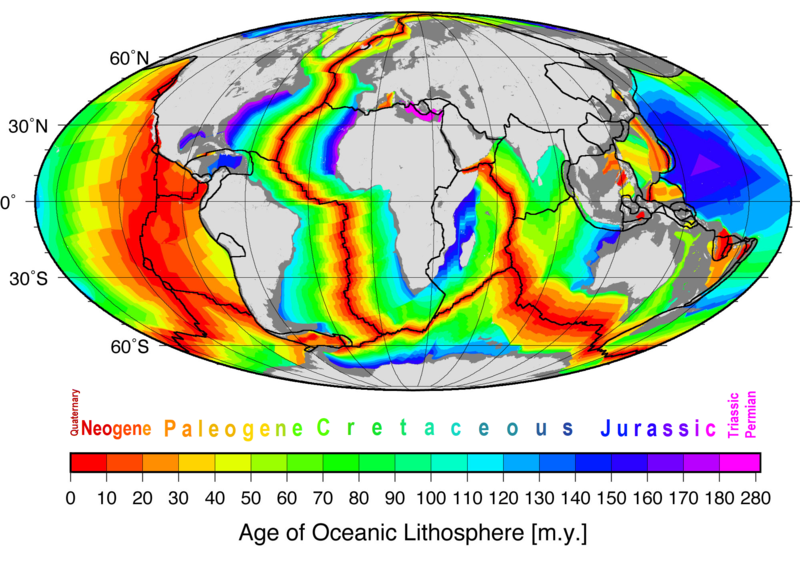
The formation of new areas of oceanic crust happens by the upcoming magma at mid-ocean ridges and its outward movement on either side.
The constant eruption by volcanoes at the crest of oceanic ridges causes cracks or ruptures of the oceanic crust. Then lava is filled into the cracks of oceanic ridges. This pushes the oceanic ridge on either side. As a result ocean floor spreads.
Seafloor Spreading diagram By Muller, R.D., M. Sdrolias, C. Gaina, and W.R. Roest (2008) Age, spreading rates and spreading symmetry of the world’s ocean crust, Geochem. Geophys. Geosyst., 9, Q04006, doi:10.1029/2007GC001743. – File:Age of oceanic lithosphere.jpg Source http://www.ngdc.noaa.gov/mgg/ocean_age/ocean_age_2008.html; National Geophysical Data Center, National Oceanic and Atmospheric Administration, U.S. Department of Commerce, http://www.ngdc.noaa.gov, CC BY 3.0, https://commons.wikimedia.org/w/index.php?curid=83751112
The seafloor spreading hypothesis was proposed by Hess in 1961. As per his hypothesis the spreading forms a successively younger ocean floor. The flow of material brings migration or drifting apart the continents. Seafloor spreading occurs at the divergent plate boundaries, as the tectonic plates slowly move away from one another.
The heat from the mantles convection current makes the crust less dense. As a result, the less dense material rises to form an elevated area or mountain on the seafloor. That makes the crust cracks and again filled by lava and move apart.
Seafloor spreadingand continental drift are believed to be caused by mantle convection.
Evidence of seafloor spreading upsc
All along the mid-oceanic ridges, volcanic eruptions are common and bring a large amount of lave to the surface. The rocks that are equidistant on either side of the crest of mid-oceanic ridges show great similarities in terms of age, chemical, and magnetic properties.
The rocks that are closer to the mid-oceanic ridges have normal polarity, these are the youngest. But the age of rocks increases as one moves away from the crest.
The age of the rocks of ocean crust (Age: About 200 million Years) is much younger than the continental rocks(3200 Million Year). The sediments on the ocean floor are unexpectedly very thin. Nowhere the sediments column found were older than 200 million years.
The deep trenches have deep-seated earthquakes occurrences on the other hand the areas of the mid-oceanic ridge, have shallow depths. These facts and a detailed analysis of magnetic properties of the rocks on either side of the mid-oceanic ridge led Hess (1961) to propose his hypothesis, known as the “seafloor spreading”.
Hess argued that constant eruptions at the crest of oceanic ridges cause the rupture of the oceanic crust and the new lava wedges into it, pushing the oceanic crust on either side. The ocean floor thus spreads.
The younger age of the oceanic crust as well as the fact that the spreading of one ocean does not cause the shrinking of the other, made Hess think about the consumption of the oceanic crust. He further maintained that the ocean floor that gets pushed due to volcanic eruptions at the crest, sinks down at the oceanic trenches and gets consumed.
Conclusion
We have discussed the definition of Ocean Floor Spreading, its causes, and evidence that support it.
The Madrasas continued to be concerned principally with Muslim theology and its vast literature.
In great learning centers like Varanasi, astrology was taught and there was no institution in India, as noted by the French traveler Bernier, to the standards of colleges and universities in Europe.
This made the imparting of scientific subjects almost impossible.
Attention was, however, given to mathematics and astronomy.
Akbar’s court poet Faizi translated Bhaskaracharya’s famous work on mathematics, Lilavati.
Despite the presence of Europeans, there was no influence on Indian society during the Mughal period.
The method of water-lift based on pin-drum gearing known as the Persian wheel had been introduced during Babur’s time.
A complicated system of water lift by a series of gear wheels had been installed in Fatehpur Sikri.
Akbar was also credited with popularizing the device of cooling water using saltpetre.
He is also the first known person in the world to have devised the ‘ship’s camel’, a barge on which the ship is built to make it easier for the ship to be carried to the sea.
Some mechanical devices like the screw for tightening, manually driven belt drill for cutting diamonds were in use.
Agricultural tools continued to be the same, made entirely of wood.
In metallurgy, the inability to produce cast iron remained an obvious drawback.
As Irfan Habib observed, India’s backwardness in technology was obvious when the matchlock remained the most common weapon in Indian armies.
In Europe, the flintlock had long come into use. Indians continued to use the expensive bronze cannon, long after these had become obsolete in Europe.
This was because of India’s inability to make cast iron even in the seventeenth century.’
Genetic engineering in agriculture in India is regulated India by Genetic Engineering Appraisal Committee (GEAC). Genetic engineering has caused intellectual property problems in India, where farmers are often trapped.
It is a statutory body under the Ministry of Environment & Forest (MoEF), established by the Environment Protection Act 1986. Genetic engineering is a modification of DNA material or genetic modification of an ‘s organism using various biotechnology methods. Or it is simply modification, manipulation and recombination of DNA.
In agriculture, the plant DNA is engineered to get desired results such as high yields, disease resistance, increased shelf life etc. GMO or Genetically modified food are part of most foods, especially our packed food. Many people are concerned about these kinds of foods but many do not understand what it is?
Genetically modified foods are made from plants where DNA is modified. These are modified to resist herbicides, pests, improve their quality etc. The rise of commercialisation of GM Crops provided economic benefits to farmers in many developing countries like India. But GM food safety is a growing concern with critics.
Genetically Modified Crops
Genetically Modified Crops or GM Crops are the Plants where their DNA has been modified using advanced genetic engineering methods. These plants’ genomes are engineered by physical methods, or by Agrobacterium for the delivery of sequences that are hosted in T-DNA vectors.
The most common Genetically modified crops in India are BT Cotton, Bt Brinjal, GM-mustard etc.
BT Cotton
In 1996, insect-resistant Genetically modified cotton was developed by CSIRO(Commonwealth Scientific and Industrial Research Organisation), using a gene owned by Monsanto.
Then ICAR has highly recognized three varieties of BT Cotton namely PAU Bt 1, F1861 and RS 2013 and it is cultivated in Punjab, Haryana, Rajasthan. There are almost 52 different varieties of BT cotton hybrids that were recognized for cultivation in India.
Vijay Atmaram Ingle, was a pioneer of BT cotton in India and he was commonly called as Father of BT cotton in India. He successfully conducted several trials from 1997 to 1998.
BT Brinjal
India Banned Bt Brinjal in 2010, but it is still in circulation. Then the Indian government in 2020 has approved field trials of indigenous Bt Brinjal varieties ‘Janak‘ and ‘BSS-793‘. Both these varieties are proprietary product of the government run Indian Agricultural Research Institute (IARI) that contains ‘Bt Cry1Fa1‘ gene.
BT Brinjal were once grown majorly in West Benal, Andhra Pradesh, Tamil Nadu, Odisha and Madhya Pradesh.
GM Mustard
Presently GM cotton is only genetically modified crop commercially allowed in India. But GM Mustard could become India’s first GM food crop.
Here’s a table summarizing genetically modified (GM) crops in India:
Crop
Trait/Modification
Purpose
Approval Status
Notes
Cotton
Bt Cotton
Resistance to bollworm
Approved (2002)
Widely cultivated, covers over 90% of cotton acreage in India.
Brinjal
Bt Brinjal
Resistance to fruit and shoot borer
Approved (2010), not commercialized
Approval was given but faced strong opposition, leading to a moratorium.
Mustard
DMH-11
Herbicide tolerance, increased yield
Approved (2022 for trials)
Developed by Delhi University, still controversial.
Potato
Enhanced starch content
Industrial use
Not approved
Tested but not commercialized.
Rice
Golden Rice
Vitamin A enrichment
Not approved
Focused on addressing malnutrition, still in trials.
Maize
Bt Maize, herbicide-tolerant varieties
Insect resistance, herbicide tolerance
Not approved
Undergoing trials, yet to gain regulatory clearance.
Tomato
Delayed ripening
Extended shelf life
Not approved
Tested in research phase
Transgenic Crops in India
Transgenic Crops is a genetically modified organism (GMO). Transgenic is a transfer of genes using recombinant DNA Technology. Usually a transgenic crop has one or more genes been inserted artificially from an unrelated plant or from different species.
Pros and Cons of genetic engineering in agriculture
The advantage of a Genetic Engineered crop has made it possible to produce foods and drugs at a low cost. As it reduced the need for the high usage of fertilizers, Pesticides. Also, its yields were skyrocketed. This made Food deficient countries Food self-sufficient and also made the countries food exporters.
And Genetically modified crops were made to provide more nutrients and resistive to various diseases and pest attacks. This ensured food security. Also, it gave scientists an opportunity to produce yields in areas such as deserts, where traditional agriculture is not possible.
Diabetic people avoided foods such as rice, because of their high sugar content. In GM Foods the nutrition level also is controlled.
On the bad side, It could produce allergic effects on certain people, New pathogens were adapted to these GM Crops and affected the yield. This forces the scientist to develop new pesticides and fertilizers to could create new health problems.
* * All the Notes in this blog, are referred from Tamil Nadu State Board Books and Samacheer Kalvi Books. Kindly check with the original Tamil Nadu state board books and Ncert Books.