Ecological succession stages and processes with examples Upsc

Ecological succession

Ecological succession

Ecological succession definition

Ecological succession is a series of steps and a continuous process where life comes back to normal, and evolves in a given area concerning changing environment.

Simply, It is the process by which the structure of a biological community evolves in a particular area.

There are two types of Succession one is Primary and another one is secondary succession.

Primary and secondary succession

Primary succession and secondary succession are related to the presence of soil and the absence of soil. Primary ecological succession is the one in which life starts primarily in a lifeless area with an absence of soil such as barren rocks, dunes, glaciers, recent lava flows, etc.

primary succession examples are areas of volcano eruption, Oil spills, Retreat of the glacier, barren rocks, Landslides, severe soil erosion caused by flood and rains, and abandoned man-made structures.

Primary succession begins with the growth of inhabitants such as lichen or plants, that can survive harsh conditions such as bare rock, and retreating glaciers.

These lichen/grasses break the rocks and modify the soil, which is then colonized by other plant communities. Thus ecological succession occurring on rocks is called Primary succession.

Primary succession in water

It is also called Hyrach. It will lead from hydric to mesic conditions. Small organisms such as Phytoplanktons will appear first. Then Zooplankton appears and feeds on the Phytoplanktons. In the next phase, the soft mud that lies on the bottom which is rich in organic matter favors the growth of rooted submerged plants such as Hydrilla, Utricularia, Vallisneria, Chara, and Ceratophyllum.

Then gets replaced by Hydrophytes (floating) such as emna, Salivina, Azolla, Wolffia, Pistia, etc.

primary succession examples

Secondary succession definition

The secondary succession happens basically in the presence of soil. That is a place affected by forest fires, floods, landslides, etc. Where everything gets affected but the soil is present in the same place. Life starts to evolve in that soil that is present in the same place.

Secondary succession is a type of succession, where the plant and animal recolonize a particular habitat or area after a major disturbance. examples of secondary succession are A habitat disturbed by forest fire, landslide, and Human activities. But soil remains intact, the species recolonize in it.

Plant Succession

Plant Succession is the series of processes of replacement of one plant community by another plant community. The plant community which is first developed in barren habitat is known as the Pioneer community and the plant community which replaces or invades the existing community is known as the climax community.

Natural succession

Succession is a natural process, where the communities of vegetation develop and evolve.

Lichens play an important role in the early stages of succession by accessing the minerals in the bare rock and helping them to weather to start the process of creating the soil.

During the process of ecological succession:

  • Species diversity decreases
  • One community replaces another until a stable, mature, climax community species is established.

Sere Ecology

  • A Sere Ecology or Seral Community is a halfway or intermediate stage found in ecological succession in a habitat progressing towards its peak community.

Types of Sere Ecology

  • Hydrosere – Community in Water
  • Lithosere – Community on rock
  • Psammosere – Community on Sand
  • Xerosere – Community in a dry area
  • Halosere – Community in Saline body

Importance of ecological succession

  • It helps in monitoring the invasion or unequal growth of any animal.
  • It helps in reforestation.
  • Without ecological succession, a disturbed or destroyed ecosystem would never recover.

Process of ecological succession

Ecological succession is the process of gradual change in the types of species that inhabit an area over time. It is a natural process that occurs in all ecosystems, and it is driven by a number of factors, including disturbances, climate change, and human activities.

Stages of Ecological Succession

There are two main types of ecological succession: primary and secondary. Primary succession occurs on bare, uncolonized areas, such as lava flows or newly exposed glacial till. Secondary succession occurs on areas that have been previously disturbed, but where some of the original soil and vegetation remain.

Both primary and secondary succession follow a similar pattern of stages:

1. Nudation

Nudation is the initial stage of ecological succession, and it occurs when an area is disturbed and cleared of all vegetation. This can be caused by a number of factors, such as fire, floods, landslides, or human activities.

Nudation in ecological succession

2. Colonization

The next stage of ecological succession is colonization, where pioneer species begin to establish themselves in the area. Pioneer species are typically hardy, adaptable plants that are able to tolerate harsh conditions. They are often small and fast-growing, and they have a wide range of tolerances for different environmental conditions.

3. Establishment

As the pioneer species grow and mature, they create a more stable environment for other species to colonize. This is called the establishment stage of ecological succession. During this stage, the number and diversity of species in the area increase as new species are able to survive and reproduce.

4. Maturation

The maturation stage of ecological succession is characterized by the presence of a few dominant species that are well-adapted to the environment. These species are typically larger and slower-growing than the pioneer species, and they form a stable community that is able to resist change.

5. Climax

The climax stage of ecological succession is the final stage, and it is characterized by a stable community that is in equilibrium with the environment. The climax community is typically made up of a mix of species that are all well-adapted to the environment.

The Role of Disturbance in Ecological Succession

Disturbance plays an important role in ecological succession. Disturbances can set back succession and create new opportunities for pioneer species to colonize an area. They can also lead to the formation of new climax communities.

Human activities can also have a significant impact on ecological succession. For example, deforestation can prevent an area from reaching its climax stage, and the introduction of invasive species can disrupt the natural balance of an ecosystem.

The process of ecological succession is a complex and dynamic one, and it is influenced by a number of factors. However, the basic pattern of change is the same in all ecosystems: an area is disturbed, pioneer species colonize the area, and over time, a stable community is formed.

Conclusion

Ecological succession is a dynamic and fascinating process that demonstrates the resilience of ecosystems. By understanding these natural patterns, we can better appreciate the interconnectedness of life and the importance of conservation efforts.

Download

1.Ecological succession upsc ncert notes pdf

National livestock mission upsc and National livestock Insurance in India

Livestock insurance in India

Livestock or cattle insurance provides comprehensive coverage against cattle loss during a pandemic, disaster, cattle dies during transportation, etc. Cattle insurance is a great initiative by the government of India to protect the farmers who depend on livestock.

It is a centrally sponsored scheme, which is now put under the sub-mission on livestock development of the National Livestock Mission. There are two types of cattle insurance provided in India, they are Death and Permanent Disability cover.

This insurance cover death due caused by Natural calamities, disease, calving during surgical operations, permanent disability such as cow’s inability to get pregnant and give birth to calves and produce milk is referred to as disability for milch cattle.

In India, Livestock Insurance is provided by both Public and Private players such as:

  • HDFC Ergo
  • Reliance General
  • ICICI Lombard
  • TATA AIG
  • Oriental Insurance
  • SBI General

National livestock mission Upsc

hen

The National Livestock Mission is implemented by the Government of India to achieve sustainable growth and development of livestock. It includes the development of poultry, increased fodder production, and skill development.

National Livestock Mission (NLM) is implemented from 2014 to 2015 by modifying seven Centrally Sponsored Schemes and seven Central Sector Schemes.

The National Livestock Mission is organized into:

  • Sub-Mission on Livestock Development
  • Sub-Mission on Pig development for the North Eastern Region
  • Sub-Mission on Feed and Fodder Development and
  • Sub-Mission on Skill Development, Technology Transfer and extension

Livestock meaning

Livestock production and management

Livestock refers to raising the domesticated animals in an agricultural setup to produce commodities such as meat, milk, egg, leather, wool, fur, etc.

What is livestock?

Live is often referred to as those bred for consumption for humans such as Milch animals. For example Sheep, Goat, Cow.

In the USA, Horses are also considered livestock.

Livestock census in India

LIVESTOCK POPULATION IN INDIA BY SPECIES (MILLION NUMBERS)

Species19511956196119661972197719821987199219972003200720122019
Cattle155.3158.7175.6176.2178.3180192.5199.7204.6198.9185.2199.1190.9192.5
Adult Female Cattle54.447.35151.853.454.659.262.164.464.464.57376.781.4
Buffalo43.444.951.25357.46269.87684.289.997.9105.3108.7109.9
Adult Female Buffalo2121.724.325.428.631.332.539.143.846.85154.556.655
Sheep39.139.340.242.4404148.845.750.857.561.571.665.174.3
Goat47.255.460.964.667.575.695.3110.2115.3122.7124.4140.5135.2148.9
Horses and Ponies1.51.51.31.10.90.90.90.80.80.80.80.60.60.3
Camels0.60.80.911.11.11.1110.90.60.50.40.3
Pigs4.44.95.256.97.610.110.612.813.313.511.110.39.1
Donkeys1.31.11.11.1111110.90.70.40.30.1
YakNCNC0000.10.100.10.10.10.10.10.1
Livestock census in India

Livestock farming

animal husbandry

Livestock farming is the management and breeding of domesticated animals such as Cow, Goat, Buffalo, Hen for Milk, Meat, Leather, etc.

The livestock sector plays a vital role in providing income generation, employment, poverty alleviation for the rural poor. Also, it gives nutrition to their children.

Livestock and poultry are a great way of improving the Indian Economy and food security.

Livestock inspector

Livestock Inspector enforces the law of the government involving sale, movement, health and sanitation, and eradication of quarantinable diseases of livestock.

In Tamil Nadu, the Livestock Inspector works under the Organisation, ‘ Animal Husbandry Directorate’ and their concerned department is Animal Husbandry, Dairy and Fisheries Department.

Livestock production and management

animal husbandry

Livestock production and management by definition is a practice that focuses on the application of various methods such as the chemical and biological process for the production and management of livestock.

Livestock production and management are generally done by the landless, marginal farmers who have less than 1/2 to 2 Acres of land.

They usually maintain, two to three animals such as Cow, Goat, and Hen. Traditionally in India, farmer maintains their livestock on grazing and on agricultural crops by-products such as Husks.

Livestock production and management Requirements

  • Quality supply of cattle feeds.
  • At least 1/2 Acres of land.
  • Good Environment Condition.
  • Good Housing, with a good supply of fresh air.
  • Clean Water supply.
  • Good knowledge about the market

Women’s rights issues today in India Upsc

Social injustice to Women

Social injustice to Women

Social injustice to Women happens every day in every place in the world. Women were subjected to discrimination and inequality. They most often face violence, abuse, and unequal treatment at the workplace, home, and public places.

In the wider and ancient communities like Indian Society, they are denied opportunities to learn, earn and lead a respectable life. This kind of treatment to women not only those who live in poverty but also happens in the upper classes.

Injustice to women seems to have no boundaries and many women shy away from reporting the crimes due to social stigma and a weak justice system.

38% of all murders of women are done by intimate partners and globally 35% of women have experienced physical or sexual violence.

Examples of Social Injustice

Some of the numerous issues faced by girls or women around the world are Women’s reproductive rights, Girl child trafficking, Sex Slave, Prostitution, Armed Conflict, Domestic Violence, Decision making, deprivation of Education and opportunities, etc.

In Countries like India, the girl child is denied an education and forced into early marriage. These injustices thus prevent them from reaching their dreams, goals, or their full potential in their career.

Social injustice to Women

 Current women’s issues

The current might include Reproductive rights such as legal abortion, effective birth control, and other Contraception. In most countries, women are denied education on reproductive health and sex.

Economic injustice includes the difference in salary for women for the same job done by men. Usually, men get more salaries. Also, most companies recruit more men than women. There is gender inequality present in most companies around women.

LGBTQIA+ Rights is a long-trending issue that women face around the world. In most countries, Homosexual relationships, lesbian, gay intercourse, and marriage are banned. The world has seen these relationships as their personal choice or preference and not to be seen as crimes.

Dowry menace

Dowry is money, gold ornaments, estates that the woman brings during a marriage. Dowry is a gift that is demanded, as per condition for marriage. It should be provided from the girl’s side to the boy’s side.

Dowry Prohibition Act 1961

In 1961, the Government of India passed Dowry Prohibition Act. By this act making the dowry demands is illegal.

Section 304 B

This act is related to death caused due to Dowry.

This section enables to provide punishment not less than 7 years when women within 7 years of marriage had burns or bodily injury due to cruelty or harassment by her husband or his relative in connection with Dowry.

It is a non-available offense. Section 406 and Section 498 A are some sections related to Dowry offense

Women

How to support women? Gender Equality is Social Justice

Women actually hold a vital role in social, economic, and political issues in society. They have achieved great success in terms of enhancing the quality of life of society by developing themselves and also developing their family, community, and their country.

The Commitment to Women’s rights will eliminate gender-based economic and social discrimination. Leaders such as Periyar fought for women’s rights in Tamil Nadu. His agitation includes giving women in the position of power, against Patriarchy, sexism, racism, and economic inequality.

Gender equality is a matter of social justice, it allows equal access to opportunities, rights, education, etc. Gender equality also makes society more secure.

Also, women’s rights are human rights. Yes, they are human beings, they have the right to live, free from violence, discrimination and to enjoy good physical and mental health, education, and the right to own their property.

Current Trends

The current trends in feminism are called Fourth-wave feminism is a feminist movement that started around 2012 and is characterized by a focus on women empowerment using internet tools and intersectionality.

Conclusion

Access to justice is important in the fight to end injustice against women. Also, women’s leadership is important and crucial in achieving a more equal society.

Medical tourism in India Tnpsc

Medical tourism

Medical tourism refers to patients traveling from their home country and another country for getting treatment.

Earlier, Patients from Poor and developing countries such as India traveled to developed foreign countries the such USA, UK, Germany, etc to get treatment.

But in recent years things have changed. People from development travel to developing countries such as India to get treatment for various reasons such as:

Low Priced Medical treatments

Unavailability of certain Medical services or non-licensed in their home country.

This is due to different Medical agencies such as FDA, EMA, etc might not have approved or licensed certain drugs.

For Example in Europe, the European Medical Agency (EMA) have their own therapy protocol Europe. But some country might have their own medical review organization such as NICE by NHS in the UK, ICMR in India might not necessarily approve just because it is approved by EMA.

For these reasons, people travel for treatment.

Medical tourism in India is a very fast-growing sector.

Medical tourism in India

Medical tourism is growing in India and India is 2nd in the world for it. Tamil Nadu, Capital Chennai, is considered as Health Capital in India also regarded as “India’s Health City“.

It is because it attracts people from around the world and within India. Chennai attracts 45% of the foreigners who travel for medical treatments.

Also 40% of domestic patients within India.

The India Government removed certain restrictions to make foreigners easily visit India for medical treatment. On such is done by the Union government in 2019, that is the foreigners can receive medical treatment without necessarily applying for a medical visa.

By 2020-2021, Medical tourism in India to reach around $9 Billion.

Another reason India attracts Foreign medical tourist is that 38 Hospitals in India are accredited by the Joint Commission International.

India’s Medical tourism is popular among Africans. Treatments in India are approved by WHO and the US Food and Drug Administration.

Many Foreign patients prefer Apollo, Headquartered in Chennai.

Abuse

The transparency in organ transplantation is always questioned in India. Chennai stands first in India in Organ donation and transplantation.

But a lot of complaints arise as local patients were not given priority over the foreign patients.

To solve complaints that arise due to organ translation Tamil Nadu government established the Transplant Authority Of Tamil Nadu in 2014.

References

Protocol breached in Tamil Nadu organ transplant case, says probe

MEDICAL TOURISM IN INDIA by Sneha Pathak

Chennai: Private hospitals favor foreigners over Indian patients for organ transplants, says report

Canons of taxation by Adam smith for Civil Services Exam

Canons of Taxation meaning

It refers to the administrative aspects of a tax, such as the amount, method of levy and collection, and rate of tax, among others. The characteristics or qualities which a good tax should have or functions. Or it can be said that the rules and principles of good tax should be posed.

Canons of Taxation
Four canons or maxims of Taxation as per Adam Smith

Canons of Taxation are described as the characteristics or qualities which a good tax should possess.

In the book The Wealth of Nations, written by Adam Smith and published in the year 1776, he argued that taxation should follow four principles. It must be remembered that cannons refer to the qualities of an isolated tax and not to the tax system as a whole. A good tax system should have a proper combination of all kinds of taxes having different cannons.

There are four canons or maxims of Taxation as per Adam Smith. They are the Canon of Ability, the Canon of Certainty, the Canon of Convenience, and the Canon of Economy.


Canon of Ability

“The Canon of Ability says that the government should impose taxes in such a way that people have to pay taxes according to their ability. That is, the rich person should pay more tax compared to a middle-class person or a poor person.”

The Canon of Ability is a principle of taxation that emphasises that individuals should be taxed according to their capacity to pay. This means that those who earn more or own more wealth should contribute a higher amount in taxes. The idea is rooted in fairness and equity, recognising that people with higher income or wealth can afford to bear a greater tax burden without affecting their standard of living, unlike lower-income individuals for whom even small taxes can be burdensome. Canon of Ability is one most important canons of taxation

Example: Suppose there are two individuals—Person A earns ₹50,000 per month, and Person B earns ₹5,00,000 per month. Under the Canon of Ability, Person B should pay more tax, not just in amount but also possibly at a higher rate (progressive taxation). For instance, Person A might pay 5% tax, while Person B pays 30%. This way, the tax system becomes more just, ensuring that public resources are collected in a way that considers people’s financial strength.


Canon of Certainty

“The second Canon of taxation is Certainty. It says that the government must ensure that there is no uncertainty regarding the rate of tax or the time of payment. If the government collects taxes arbitrarily, that is on the basis of random choice or personal whim, rather than any reason or system, then this will adversely affect the efficiency of the people and their working ability too”.

The Canon of Certainty is a principle of taxation introduced by Adam Smith, which states that the tax a person is required to pay should be clear, fixed, and certain, not arbitrary. The taxpayer should know in advance how much tax is to be paid, when it is to be paid, and in what manner. This removes confusion and prevents corruption, misuse of power, or exploitation by tax collectors. Certainty in taxation also builds trust between the government and the public.

Example: Suppose a person owns a shop and has to pay GST (Goods and Services Tax). The tax rate is clearly defined—for example, 18% on certain goods. The shopkeeper knows exactly how much tax to charge and pay, by when, and through which method (like online payment). This clarity makes the process smooth. If the rates were vague or changed without notice, it would create confusion and lead to evasion or manipulation. Hence, the Canon of Certainty ensures transparency and predictability in the tax system.


Canon of Convenience

“The third Canon of taxation is convenience, where the method of tax collection and timing of the tax payment should suit the convenience of the people. The government should make convenient arrangements for all taxpayers to pay taxes without any difficulties”.

The Canon of Convenience is a principle of taxation given by Adam Smith, which states that taxes should be collected in a manner and at a time that is most convenient for the taxpayer. The aim is to reduce the burden and difficulty of paying taxes, making it easier for people to comply. A convenient tax system encourages timely payments and reduces resistance or evasion, ultimately improving tax collection efficiency.

Example: In India, income tax is generally deducted at source (TDS) from an employee’s salary every month. This is a convenient method because the taxpayer does not have to calculate and pay the tax separately—it is automatically handled by the employer. Similarly, property taxes are often collected annually, giving enough time for planning. Such convenient methods reduce stress for taxpayers and ensure steady revenue for the government.


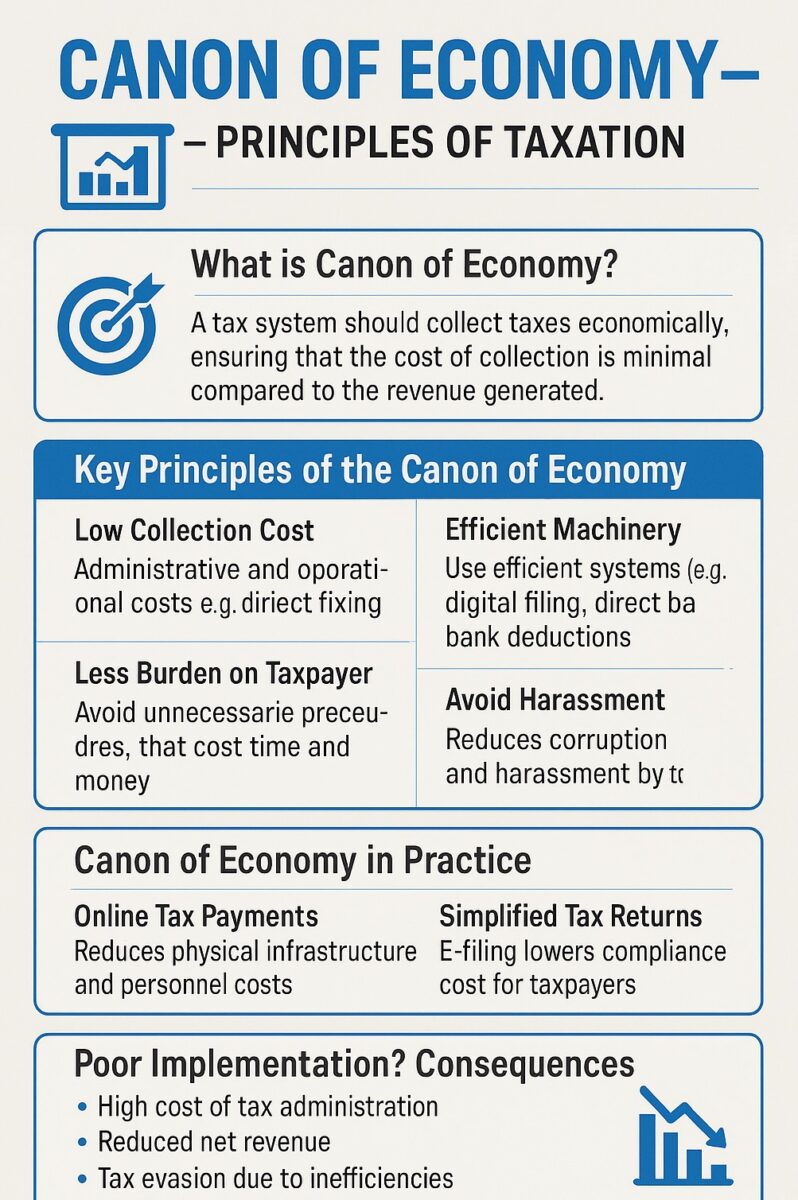
Canon of Economy

“The government needs to spend money collecting taxes. For example, salaries are given to the people who are responsible for collecting taxes. The taxes where the collection cost is more are considered as bad taxes. As per Adam Smith, the government should impose only those taxes whose collection costs are very less and cheap.“

The canon of economy is one most discussed canons of taxation. It is a taxation principle introduced by Adam Smith, which states that the cost of collecting a tax should be minimal compared to the revenue it generates. In other words, the tax system should be economical and efficient, ensuring that a large portion of the collected tax reaches the government without being spent on administration or collection processes. This helps in maximising public benefit from the tax revenue.

Example: Consider the collection of Goods and Services Tax (GST) in India. It is largely digitised and automated, reducing the need for a large workforce or complex procedures. This minimises administrative costs and human errors, making the system more economical. On the other hand, if a government spends ₹10 to collect ₹100 in tax, it would be inefficient. Thus, the Canon of Economy ensures that tax collection is cost-effective and does not waste public resources.

canon of economy

Conclusion

The Canons of Taxation, as proposed by Adam Smith, provide a strong foundation for designing a fair, efficient, and effective tax system. The principles of Ability, Certainty, Convenience, and Economy ensure that taxation is just, predictable, easy to comply with, and cost-effective. When these canons are properly implemented, they help build trust between the government and citizens, encourage voluntary compliance, and ensure that public revenue is collected in a manner that supports economic growth and social welfare. A well-balanced tax system guided by these canons is essential for the stability and development of any nation.

Advantages and disadvantages of Nuclear energy Upsc

Nuclear energy pros and Cons

This is a nuclear energy pros and cons essay for Upsc exams.

This article explains briefly the nuclear power advantages and disadvantages, how nuclear energy works? how is nuclear energy made?

Nuclear Power

Nuclear Power generates electricity using atomic chains reactions. It is currently used in many countries and also many countries banned it. Over several years it method of generating electricity is widely criticized or acknowledged.

Nuclear energy pros and Cons is discussed for several decades. But the discussions intensified only after the explosion of the Japans Fukushima Atomic reactor disaster.

As more people get educated they come to know about the environment and they start to care more about nature. Today People are more concerned about their environment and most people give a green signal to clean and green energy like a windmill, solar, etc.

But there are so many limitations to these green energies.

How does nuclear energy work? The atomic reactors to produce electricity it works by the process called Nuclear Fission. It is split up of uranium atoms that generate an enormous amount of heat which is to boil water and its steam is used to rotate the turbine in order to produce electricity.

Atomic power plant locations in India are Kalpakkam, Tarapur, Kudankuma, Kaiga, Kakrapar Narora etc. Atomic energy advantages and disadvantages are as follows

Nuclear energy Pros and Cons

10 benefits of nuclear power: Pros

The Benefits of nuclear power is:

Nuclear energy emits low carbon. Whereas traditional fossil fuels like petroleum and coal will produce a lot of carbon dioxide, smoke, and Ash. It will not produce any greenhouse gases such as carbon dioxide, Methane, etc.

Nuclear energy emits low carbon
Nuclear energy emits low carbon By Gretar Ívarsson – Edited by Fir0002 – Gretar Ívarsson, geologist at Nesjavellir, Public Domain, https://commons.wikimedia.org/w/index.php?curid=2523755

It is not intermittent, meaning it will stop producing electricity when there is a shortage of wind or sunlight. It is low-cost energy even though its initial setup cost is high, its operating cost is very low.

Nuclear energy is a highly reliable source as there is a lot of atomic fuel available. It is used for making Atomic medicine and making medicinal equipment.

The developing countries like India, where the population is growing at a rapid rate, that demands a lot of power, and this puts too much pressure on fossil fuel which in turn affects the environment. In such cases as in India, China, etc, Atomic energy is the best option.

It works in all conditions and even during cold winter, storms, etc. However, it is closed or shut down during natural disasters as a safety measure. It is used for finding answers to rare medical conditions by Applications of Radiation in Health Care and atomic medicine techniques.

In order to understand its advantages, we need to understand the wind power pros and cons.

Cons

The disadvantages of Atomic power plants are:

  1. When there is leakage of radiation from the atomic reactor it causes of lot health hazards like leucoma, Cancer, etc.
cancer caused due to nuclear radiation leakage
Cancer caused due to nuclear radiation leakage By Blausen Medical Communications, Inc. – see ticket for details, CC BY 3.0, https://commons.wikimedia.org/w/index.php?curid=27639260

2. If a disaster happens like what happened in past in Chernobyl, Three-mile Island, SL-1, and Fukushima, the after-effects will be horrible with loss of life and several miles of land and vegetation will get permanently damaged.

 Fukushima Nuclear Reactor disaster
Fukushima Nuclear Reactor disaster By IAEA Imagebank – https://www.flickr.com/photos/iaea_imagebank/5765324940/, CC BY-SA 2.0, https://commons.wikimedia.org/w/index.php?curid=56372031

The initial cost of building such a reactor is expensive.

It produces Radioactive waste which is difficult to handle. These Radioactive wastes much are buried under deep mines to prevent any radiation from leaking out of them.

Atomic reactors possess a security threat, these are prone to terrorist attacks. Such as the Perry Nuclear Power Plant incident where the Michigan man was arrested after allegedly claiming to have a bomb in a trailer at Perry Nuclear Power Plant, etc

Similarly, the disadvantages of nuclear power can be understood only after understanding the solar power pros and cons and how good it is.

Nuclear power in the wrong hands is another disadvantage. For Example, Most countries have fear of some countries such as North Korea, Iran, etc.

The only question that arises is Does Iran has nuclear power or Nuclear and so as North Korea and what will they do with it. Do they use it for only power production or do they use it to manufacture Nuclear weapons?

Is it an environmentally friendly?

This is a critical question. Atomic power generation is mostly eco-friendly as it does not release any harmful gas such as Green House Gas.

But it is harmful some way around as it produces harmful radiation and waste which is difficult to handle.

Is nuclear energy renewable?

It is considered as another non-renewable energy. But it is a renewable source of energy because the material used in atomic power plants is not renewable. Although these fuels exist abundant in nature, they are finite. Where wind or solar is renewable because its source is infinite.

What is nuclear energy used for?

The benefits of nuclear power plants are, generally, it is used to create electricity. By using a controlled fission reaction, inside the Power plant, electricity is produced. 

However, it is also used to power other things such as Powering a nuclear submarine or ship. Such as Akademik Lomonosov , etc. These ships are used to produce electricity and power an entire city, in case of power failure in cities, towns during natural disasters or war, etc.

Also, it powers nuclear submarines, which gives an extra advantage over normal submarines as it provides long-lasting power.

These are some of the benefits of nuclear power.

Conclusion

If more care is given to handling it, It is a safe, clean, and green energy

Nuclear energy pros and Cons will, even more, be discussed in the future as the world started moving toward E-vehicles especially after the corona pandemic.

If we use E-Vehicles, then we need more electricity, and the reliability of Wind and Solar is currently low. Then again we have to depend on fossil fuel to support increased power usage due to E-Vehicles which will harm the environment and the main idea of E-Vehicles is spoiled.

Nuclear energy pros and Cons are almost equal from both ends.

Regulating Act 1773 Upsc

Regulating Act of 1773

Regulating Act of 1773 was the first step by the British Crown to laid laws to regulate the affairs of the East India Company in India.

It also laid the foundation of central administration in India.

Feature of Regulating Act 1773

  • The Governor of Bengal was designated as Governor-General of Bengal.
  • Executive Council of four members was created to assist the Governor-General of Bengal.
  • Lord Warren Hastings was the first Governor-general of Bengal.
  • Earlier, the three presidencies were independent, but now the Governor of Madras and Bombay presidencies were made subordinate to Governor-General of Bengal.
  • The Supreme court of Calcutta was establishment in1774 with one chief justice and three other judges.
  • Prohibited the Worker of the company to do private trade.
  • Also Prohibited the workers of the company to accept Gifts, Bribes from the native people.
  • British control over the company was strengthened, by making the Court of Directors report its affairs such as revenue, civil and military affairs to the British Government.

Here is a table summarizing the Features of the Regulating Act, 1773:

FeatureDescriptionSignificance
ObjectiveFirst attempt by the British Parliament to regulate the affairs of the East India Company.Marked the beginning of Parliamentary control over Company administration in India.
Governor-General of BengalEstablished the position of the Governor-General of Bengal. Warren Hastings was the first appointee.Made Bengal the central authority, subjugating Madras and Bombay under its control.
Executive CouncilCreated a four-member council to assist the Governor-General in decision-making.Ensured collective decision-making, though it often led to conflicts.
Supreme CourtEstablished the Supreme Court at Calcutta in 1774.Provided for the first British judicial institution in India, ensuring rule of law.
Prohibition of Private TradeRestricted East India Company officials from engaging in private trade.Attempted to curb corruption and exploitation by Company officials.
Reporting to ParliamentMandated the Company to submit reports on its revenue, civil, and military affairs to the British Parliament.Increased accountability of the East India Company to the British government.
Regulation of DividendsRestricted the Company from paying dividends above 6% unless permitted by the British Parliament.Controlled financial mismanagement by the Company.
Jurisdiction IssuesThe jurisdiction of the Supreme Court led to conflicts with Company officials and Indian residents.Highlighted the need for clearer separation of powers between judiciary and executive.

This Act laid the foundation for further legislative measures to regulate and control British administration in India.

Conclusion: A Pioneering Step in Governance

The Regulating Act of 1773 marked a watershed moment in the history of British rule in India, as it was the first instance of Parliamentary intervention in the affairs of the East India Company. While its immediate aim was to address the financial mismanagement and corruption within the Company, its long-term impact went far beyond. The Act laid the groundwork for a centralized administrative structure, introduced the concept of judicial oversight through the Supreme Court, and established accountability to the British Parliament.

Though it had its limitations, such as unclear jurisdiction and frequent conflicts between the executive and judiciary, the Regulating Act set the stage for subsequent reforms like the Pitt’s India Act of 1784. It was not just a regulatory measure but also the beginning of a political transformation that would eventually lead to the complete dominance of the British Crown over India.

In hindsight, the Act symbolizes the first step in India’s gradual transition from mercantile exploitation to colonial governance, shaping the framework of administration that influenced India’s future.

UPSC Polity Syllabus for Prelims

UPSC Exam syllabus

Paper I -(200 marks)

  • Current events of national and international importance.
  • History of India and Indian National Movement.
  • Indian and World Geography-Physical, Social, Economic Geography of India and the World.
  • Indian Polity and Governance-Constitution, Political System, Panchayati Raj, Public Policy, Rights Issues, etc.
  • Economic and Social Development-Sustainable Development, Poverty, Inclusion, Demographics, Social Sector Initiatives, etc.
  • General issues on Environmental ecology, Bio-diversity and Climate Change -that do not require subject specialization.
  • General Science.

Paper-II (200 marks)

  • Comprehension; Interpersonal skills including communication skills;
  • Logical reasoning and analytical ability;
  • Decision making and problem-solving;
  • General mental ability;
  • Basic numeracy (numbers and their relations, orders of magnitude, etc.) (Class X level),
  • Data interpretation (charts, graphs, tables, data sufficiency etc. —Class X level);

Mains

PAPER-II

General Studies-I : Indian Heritage and Culture, History and Geography of the World and Society.

  • Indian culture will cover the salient aspects of Art Forms, literature and Architecture from ancient to modern times.
  • Modern Indian history from about the middle of the eighteenth century until the present significant events, personalities, issues.
  • The Freedom Struggle —its various stages and important contributors/contributions from different parts of the country.
  • Post-independence consolidation and reorganization within the country.
  • The history of the world will include events from 18th century such as industrial revolution, world wars, redrawal of national boundaries, colonization, decolonization, political philosophies like communism, capitalism, socialism etc.—their forms and effect on the society.
  • Salient features of Indian Society, Diversity of India.
  • Role of women and women’s organization, population and associated issues, poverty and developmental issues, urbanization, their problems and their remedies.
  • Effects of globalization on Indian society.
  • Social empowerment, communalism, regionalism & secularism.Salient features of world’s physical geography.
  • Distribution of key natural resources across the world (including South Asia and the Indian sub-continent); factors responsible for the location of primary, secondary, and tertiary sector industries in various parts of the world (including India).
  • Important Geophysical phenomena such as earthquakes, Tsunami, Volcanic activity, cyclone etc., geographical features and their location-changes in critical geographical features (including water-bodies and ice-caps) and in flora and fauna and the effects of such changes.

PAPER-III

General Studies-II: Governance, Constitution, Polity, Social Justice and International relations.

  • Indian Constitution—historical underpinnings, evolution, features, amendments, significant provisions and basic structure.
  • Functions and responsibilities of the Union and the States, issues and challenges pertaining to the federal structure, devolution of powers and finances up to local levels and challenges therein.
  • Separation of powers between various organs dispute redressal mechanisms and institutions.
  • Comparison of the Indian constitutional scheme with that of other countries.
  • Parliament and State legislatures—structure, functioning, conduct of business, powers & privileges and issues arising out of these.
  • Structure, organization and functioning of the Executive and the Judiciary—Ministries and Departments of the Government; pressure groups and formal/informal associations and theirrole in the Polity.
  • Salient features of the Representation of People’s Act.
  • Appointment to various Constitutional posts, powers, functions and responsibilities of various Constitutional Bodies.
  • Statutory, regulatory and various quasi-judicial bodies.
  • Government policies and interventions for development in various sectors and issues arising out of their design and implementation.
  • Development processes and the development industry —the role of NGOs, SHGs, various groups and associations, donors, charities, institutional and other stakeholders.
  • Welfare schemes for vulnerable sections of the population by the Centre and States and the performance of these schemes; mechanisms, laws, institutions and Bodies constituted for the protection and betterment of these vulnerable sections.
  • Issues relating to development and management of Social Sector/Services relating to Health, Education, Human Resources.
  • Issues relating to poverty and hunger.
  • Important aspects of governance, transparency and accountability, e-governance- applications, models, successes, limitations, and potential; citizens charters, transparency & accountability and institutional and other measures.
  • Role of civil services in a democracy.India and its neighborhood-relations.
  • Bilateral, regional and global groupings and agreements involving India and/or affecting India’s interests.
  • Effect of policies and politics of developed and developing countries on India’s interests, Indian diaspora.
  • Important International institutions, agencies and fora-their structure, mandate.

PAPER-IV

General Studies-III: Technology, Economic Development, Bio diversity, Environment, Security and Disaster Management

  • Indian Economy and issues relating to planning, mobilization, ofresources, growth, development and employment.
  • Inclusive growth and issues arising from it.
  • Government Budgeting.
  • Major crops-cropping patterns in various parts of the country, -different types of irrigation and irrigation systems storage, transport and marketing of agricultural produce and issues and related constraints; e-technology in the aid of farmers.
  • Issues related to direct and indirect farm subsidies and minimum support prices; Public Distribution System-objectives, functioning,limitations, revamping; issues of buffer stocks and food security; Technology missions; economics of animal-rearing.
  • Food processing and related industries in India-scope’ and significance, location, upstream and downstream requirements, supply chain management.
  • Land reforms in India.
  • Effects of liberalization on the economy, changes in industrial policy and their effects on industrial growth.
  • Infrastructure: Energy, Ports, Roads, Airports, Railways etc.
  • Investment models.Science and Technology-developments and their applications and effects in everyday life.
  • Achievements of Indians in science & technology; indigenization of technology and developing new technology.
  • Awareness in the fields of IT, Space, Computers, robotics, nano-technology, bio-technology and issues relating to intellectual property rights.
  • Conservation, environmental pollution and degradation, environmental impact assessment.
  • Disaster and disaster management.
  • Linkages between development and spread of extremism.
  • Role of external state and non-state actors in creating challenges to internal security.
  • Challenges to internal security through communication networks, role of media and social networking sites in internal security challenges, basics of cyber security; money-laundering and its prevention.
  • Security challenges and their management in border areas -linkages of organized crime with terrorism.
  • Various Security forces and agencies and their mandate.

PAPER-V

General Studies-IV: Ethics, Integrity and Aptitude

This paper will include questions to test the candidates’ attitude and approach to issues relating to integrity, probity in public life and his problem solving approach to various issues and conflicts faced by him in dealing with society. Questions may utilise the case study approach to determine these aspects. The following broad areas will be covered :

  • Ethics and Human Interface: Essence, determinants and consequences of Ethics in-human actions; dimensions of ethics; ethics -in private and public relationships. Human Values -lessons from the lives and teachings of great leaders, reformers and administrators; the role of family society and educational institutions in inculcating values.
  • Attitude: content, structure, function; its influence and relation with thought and behaviour; moral and political attitudes; social influence and persuasion.
  • Aptitude and foundational values for Civil Service, integrity, impartiality and non-partisanship, objectivity, dedication to public service, empathy, tolerance and compassion towards the weaker-sections.
  • Emotional intelligence-concepts, and their utilities and application in administration and governance.
  • Contributions of moral thinkers and philosophers from India and world.
  • Public/Civil service values and Ethics in Public administration: Status and problems; ethical concerns and dilemmas in government and private institutions; laws, rules, regulations and conscience as sources of ethical guidance; accountability and ethical governance; strengthening of ethical and moral values in governance; ethical issues in international relations and funding; corporate governance.
  • Probity in Governance: Concept of public service; Philosophical basis of governance and probity; Information sharing and transparency in government, Right to Information, Codes of Ethics, Codes of Conduct, Citizen’s Charters, Work culture, Quality of service delivery, Utilization of public funds, challenges of corruption.
  • Case Studies on above issues.

Major language families of the world Upsc

Identifying Language

language groups

Language is an identification for different cultures, as it is essential for communication. It influences the political, social, and economic.

As a result, the economic and religious system frequently follows patterns of language and distributions. And also political borders quite often parallel linguistic boundaries.

In the Modern Age, linguistic diffusion is influenced by trade, tourism, media, and international organization. This developed linguistic pluralism. Heterogeneous societies attribute the greatest linguistic diversity.

Language families

The classification by languages origins and historic development is known as a genetic classification. The languages which are the descendants of common ancestral language are called Proto-Language.

G.L. Trage classified the world into 7 linguistic phylum and 30 linguistic families. Language families are further classified into several subfamilies.

Major Language families and language groups

1.Indo-European

The Indo-European language family is the most widely spoken language group in the world, encompassing languages used by approximately half the global population. Originating from a hypothetical Proto-Indo-European language spoken more than 5,000 years ago, likely in the steppe regions north of the Black Sea, these languages spread across Europe, the Americas, and parts of Asia.

Key Characteristics

  • Descended from a single unrecorded language believed to have been spoken around 3000 BCE
  • Carried by migrating tribes to Europe and Asia
  • Discovered and proposed as a language family by Sir William Jones in 1786

Major Indo-European

Indo-Iranian, Latin, Romantic, Germanic, Balto-Slavic, Celtic, Hellenic

2. Sino-Tibetan

The Sino-Tibetan language family is one of the world’s largest and most diverse language groups, encompassing over 400 languages spoken by approximately 1.4 billion people across China, India, Burma, and Nepal.

Origin and Characteristics
Phylogenetic research suggests the language family originated around 7,200 years ago in North China, linked to Neolithic millet-farming cultures of the Cishan and Yangshao periods. The family is renowned for its linguistic diversity, ranging from isolating languages like Chinese and Burmese to more complex polysynthetic languages.

Major Branches
The family traditionally divides into four primary branches:

  • Sinitic (Chinese languages): Including Mandarin, Wu, Yue, and other Chinese dialects
  • Tibetic: Approximately 40 languages spoken in Tibet, western China, Bhutan, and Nepal
  • Burmese: Languages spoken in Burma and southwestern China
  • Karen: A smaller group of languages in southern Burma and western Thailand

Linguistic Significance

While the higher-level structure remains unclear, the Sino-Tibetan family represents a crucial linguistic group in understanding the prehistoric human migrations and cultural developments of East Asia. Its complexity continues to challenge linguists in fully reconstructing its proto-language and intricate evolutionary pathways.The language family’s expansion likely involved an initial separation between Eastern (Chinese) and Western language groups, spreading across a vast geographic region.

Afro-Asiatic

Semitic, Egyptian, Cushitic, Chadic

African

Niger-Congo (Atlantic, Voltaic, Benu-Nagar), Sudanic (Chari-Nile, Saharan), Click Languages (Khoisan)

Ural-Altaic

Finno-Igric, Turkic, Mangolic, Tunguzic

Dravidian

Malayo, Polynesian, Malayan, Melanesian, Micronesian, Polynesian, Austro-Asiatic

Palaeo Asiatic

Yukaghir

Major languages in India

It has its own language and dialects. As per the 1961 census of India, it is estimated to have 187 languages. About 97% of people of India speak 23 major languages excluding English.

India follows Kashmiri, Punjabi, Hindi, Urdu, Bengali, Assamese, Gujarati, Marathi, Kannada, Tamil, Telugu, Malayalam, Sindhi, Sanskrit, Oriya, Nepali, Kongani, Manipuri, Bodo, Dogri, Maithili, and Santali.

Austric

Munda, Mon-Khmer

Dravidian

Tamil, Telugu, Kannada, Malayalam, Gondi, Kurukh, Orean etc

Sino-Tibetan

Bodo, Karen, Manipuri

Indo-Aryan

Hindi, Urdu, Sans

* * All the Notes in this blog, are referred from Tamil Nadu State Board Books and Samacheer Kalvi Books. Kindly check with the original Tamil Nadu state board books and Ncert Books.