Do nuclear reactions take place in the Sun?

Yes, a Nuclear reaction known as Nuclear Fusion reaction takes place in the Sun.

The sun provides both heat and light energy. These two energy arises due to the Nuclear fusion reaction that happens inside the core of the Sun. This specific type of reaction that occurs insides the sun is called Proton-Proton Fusion Reaction.

Nuclear Fusion in the Sun

In the core, hydrogen is converted into helium by nuclear fusion. As it takes four hydrogen atoms to fuse into each helium atom.

In this reaction, the Photons in the proton-proton reaction. The hydrogen nuclei are transformed to helium nuclei by a number of chain reactions.

During this process, some of the mass is converted into energy.

A nuclear reaction in the Sun

Sun fuses about 620 Million metric tons of hydrogen every second and produces 3.8 x 1026 J of energy per second.

This energy gets decreases when it reaches the earth. The Sun intensity on earth is about 1.4 kilojoule per unit area in unit time.

Radioactivity Unit of Measurement and Types of Radioactivity Upsc

Units of Radioactivity

There are four common units of measurement in Radioactivity in nuclear Physics. They are Curie, Rutherford, Becquerel, and Roentgen.

Curie

It is defined as the quantity of a radioactive substance that undergoes 3.7 x 10 10 disintegrations per second. Referred from 1 gm of radium 226.

Rutherford (RD)

It is defined as the number of radioactive substances that undergoes 10 6 disintegrations per second.  1RD = 10 6 disintegrations per second.

Becquerel (Bq)

SI unit of Radioactivity is Becquerel. It is the number of disintegrations per second.

Roentgen (R)

The radiation exposure of Gamma and X-Rays is measured by a unit called Roentgen. We define one Roentgen as the quantity of the radioactive substance that generates a charge of 2.58 x 10 -4 coulomb in 1 kilogram of air under a standard condition of pressure, temperature, and humidity.

What is Radioactivity?

For some elements, the Nucleus is unstable. These unstable Nuclei undergo nuclear decay to become stable nuclei.

During this process called Nuclear reaction, these elements emit harmful radiations and some elementary particles.

This phenomenon of elements that undergo a nuclear reaction to make unstable nuclei into more stable nuclei, with the emission of alpha, beta, and gamma rays is called Radioactivity.

The elements that show such Radioactive properties are called Radioactive elements.

Natural Radioactive

Some elements show radioactive properties naturally, with the human touch. We call this phenomenon Natural Radioactivity.

This element that shows natural radioactivity usually has an atomic number of 83. Example: Uranium, Radium, etc.

Only two elements below the atomic number of 83 identified so far show Natural Radioactivity. That is Technetium (Tc) with atomic number 43, and Promethium (Pm) with atomic number 61.

 As of now, we identified 29 radioactive substances, most it is rare metal and transition metals.

Artificial Radioactivity or Induced Radioactivity

The phenomenon in which lighter elements such as Boron, Aluminium is made radioactive element by induced methods or with man-made methods is called Artificial Radioactivity or Induced Radioactivity.

This kind of nuclear reaction was found by Irene Curie and F.Joliot in 1934. When radiation such as Alpha rays from Uranium allowed emitting on the lighter elements such as Aluminium. The bombarding takes place.

This makes Aluminium emit elementary particles naturally in Uranium. The nucleus that undergoes reaction and disintegration is the Parent Nucleus, and the result of disintegration is the Daughter Nucleus.

We call the practice that is used to induce or start the radioactivity in the lighter element called Projectile. Here Uranium is the projectile.

The particle that is produced because of disintegration from the parent nucleus is called the Ejected Particle.

Conclusion

In this post, we have discussed the Radioactivity Unit of Measurement and types of radioactivity such as Natural or Induced Radioactivity. This is useful for Upsc, Tnpsc and other state service exams.

Radioactive displacement law in nuclear chemistry

Radioactive Displacement Law

Soddy and Fajan proposed displacement laws concerning the daughter nucleus produced during an alpha and beta decay. We state them below:

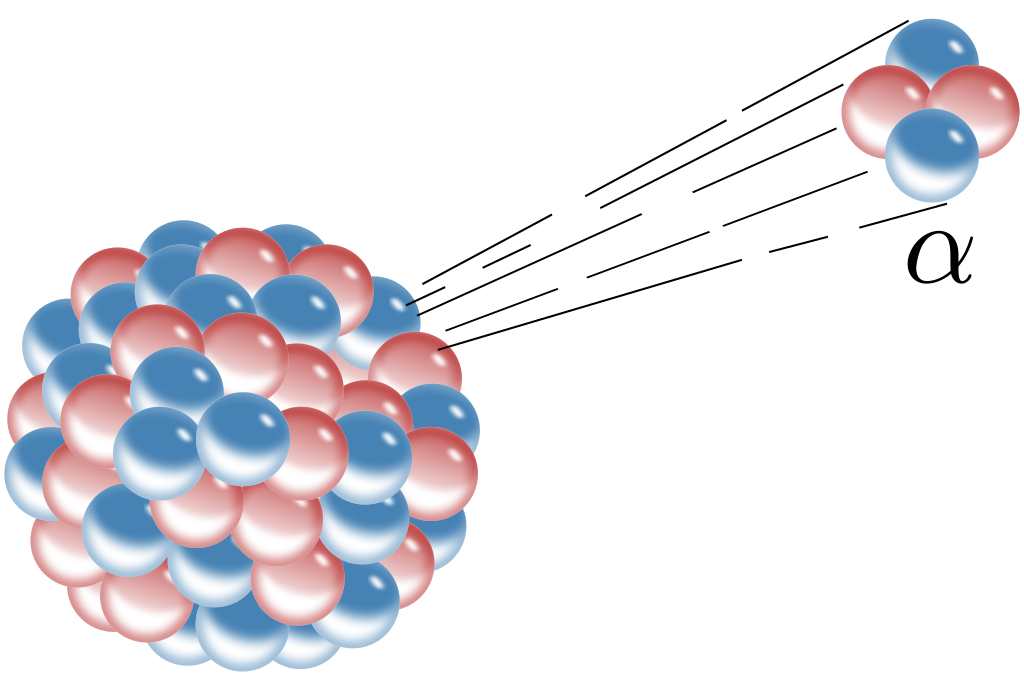
It emits the alpha particle when the daughter nucleus is formed. The atomic number is less by 2 units and the mass number is less by 4 units than the parent nucleus.

The beta particle is emitted, when the daughter nucleus is formed, where the mass number is the same as the parent nucleus and the atomic number is more by 1 unit than the parent nucleus.

Kindly note that in a Nuclear reaction, the element formed by radioactivity identified a change in atomic number, not by the mass number.

Alpha Decay

Radioactivity in which an unstable parent nucleus emits an alpha particle by daughter nucleus formation is called ‘Alpha Decay’.

Example: Decay of Uranium (U238 ) to thorium ( Th234) with the emission of an alpha particle.

92 U 238  à90 Th 234  + 2 He 4

From the above, we see, in alpha decay, mass number decrease by 4 and atomic number decreases by two.

Beta Decay

Radioactivity in which an unstable parent nucleus emits a Beta particle by daughter nucleus formation is called ‘Beta Decay’.

Example: Beta decay of Phosphorus.

15 P 32  à16 S 32  + -1 e 0  (Beta Decay)

In the beta decay, there is no change in the mass number but there is a change in atomic, the atomic number increased by one.

Gamma Decay

In gamma decay, the energy level of the nucleus only changes. The atomic number and mass number remain the same.

Properties of Alpha, Beta, and Gamma rays

Alpha, Beta and Gamma Rays

Alpha, Beta, and Gamma Rays are emitted when a radioactive nucleus undergoes disintegration naturally or induced.

Properties of Alpha (α)

It is the Helium Nucleus 2 He 4  that has two protons and two neutrons.

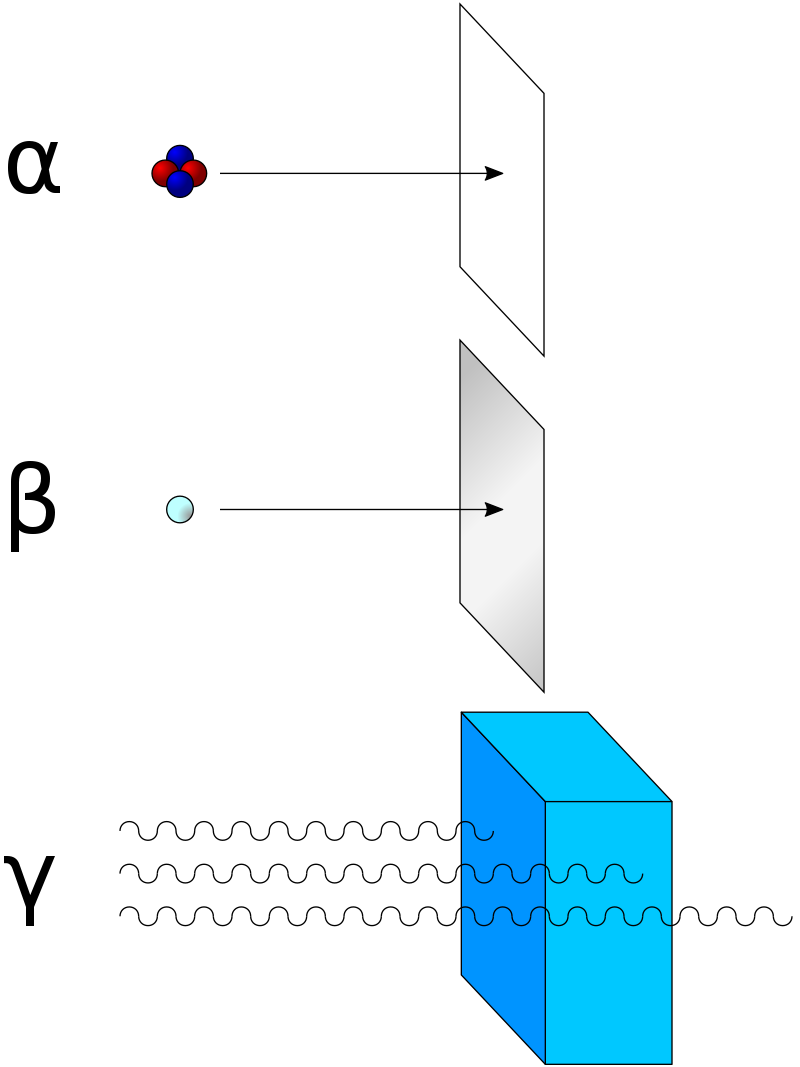
It is a positively charged particle, the charge of each particle is +2e. The Ionising power is 100 times greater than Beta Rays and 10,000 times greater than Gamma Rays.

It has low penetration power, a thick paper will stop it.

It is deflected by both the electric field and magnetic field, by Flemings left-hand rule. The speed of alpha rays ranges from 1/10 to 1/20 of the speed of light.

Properties of Beta(β)

It is electrons (-1 e 0 ), it is a basic elementary particle in all atoms. It is negatively charged particles. The charge of each beta particle = -e

The ionization power of Beta rays is comparatively low. The penetration power of Beta rays is greater than the alpha rays, they penetrate a thin metal foil.

It is defected by magnetic and electric fields. The direction deflection is opposite to the alpha rays. The speed of beta rays is as much as 9/10 of the speed of light.

Properties of Gamma Rays (γ)

Gamma rays are electromagnetic waves that comprise photons. The charge is neutral. That is the charge of each gamma particle = 0.

It has very little ionization power. Gamma rays have the highest penetration power. It can penetrate even thick metal blocks.

It is not deflected by both the electric and magnetic fields. Gamma rays travel at the speed of light.

3 types of heat transfer examples

Conduction

Figure 2:Conduction

The molecules in the solids are tightly packed.

When heated at one end, the molecule absorbs heat and it vibrates in its position, and the molecule at the other gets heated.

These heated molecules, in turn, heat other molecules, till everything gets heated.

“The process of heat transfer in solids from an area of higher temperature to an area of lower temperature without the actual displacement of the molecule is called Conduction”

Conduction in Daily Life

Good conductors of heat

Metal is a good conductor of heat and as a result cooking utensils are made of metals.

Mercury, which liquid metal is a good conductor of heat. That’s why it is used in thermometers.

Poor conductors of heat

We wear woolen clothes during winter to stay warm from the cold. Because woolen has a lot of air locked inside, as the air is a bad conductor, it does not allow heat from the body to escape outside. Thereby it keeps us warm.

Snow is used to building Igloo as snow is a poor conductor, it keeps people inside warm. Also, animal skins are used as door flaps to allow warm air inside.

Ice beds are made inside the igloo which is made of Ice and Caribou furs.

Convection

When the air is heated the air molecules gain heat energy allowing them to move further apart. Warm air is light, less dense than cold air, and will rise.

Cooler air heavy than the warm air, and go down. Cooler then gets heated and rises above.

Similarly, warm air gets cooled and goes down. This process creates a circular flow.

Figure 3: Convection

“Convection is the flow of heat via a fluid from places of higher temperature to a place of lower temperature by the movement of the fluid itself”.

Convention in Daily Life

Hot Air Balloon

In Hot Air Balloon, Air is heated. The heated air is allowed to fill the balloon. As hot air is less dense, the Hot air balloon rises high.

Figure 4: Hot Air Balloon

Breezes

During daytime air in the land gets heated and rises above. Now cool air from the sea replaces the space previously occupied by the hot air.

It is called Sea breeze. During the nighttime, the land gets cooler fast and cools the air. Sea does not cool faster, as result air above the sea is warmer. The warmer air rises high.

The cold air from the land replaces the space above the sea. This is called Land Breeze.

Figure 5: Land Breeze and Sea Breeze

Winds

Air flows from the area of high pressure to the area of low pressure. The warmer air rises create a low pressure.

The cooler air with high pressure flows toward the low-pressure area. This is how Winds are formed.

Chimneys

Chimneys are kept in industrial furnaces, kitchens, etc as hot gases and smoke are lighter and rise to the atmosphere.

Radiation

Radiation is a method of heat transfer without the involvement of particles. Radiation employs waves to transfer heat.

The waves are transferred in all directions. Radiation can transfer heat even in a vacuum, where conduction and convection cannot take place.

Radiation comprises electromagnetic waves that travel at light speed (3 x 10⁶ m/s). Thus radiation is transferred heat by electromagnetic waves.

The heat from the sun reaches the earth in the form of radiation. Radiation is emitted by all the bodies above 0 K. Some things reflect radiation and some absorb radiation.

Radiation in Daily Life

White or light-colored clothes are good reflectors of heat and feel cool during summer. The base of cooking utensils is blackened because it absorbs more heat.

The surface of the Airplane is polished to reflect radiation from the Sun.

Types of thermometers and how they work

Types of thermometers

Clinical Thermometers, Laboratory Thermometers, and Digital Thermometers

Clinical Thermometers

These thermometers are used in hospitals, clinics, and also in the home. These thermometers will have a Kink.

Kink meaning in a thermometer – It is used to prevent mercury from falling back into the bulb immediately.

This is done for convenience for noting the temperature when the thermometer is taken out from the patient’s mouth.

The clinical thermometer has two scales on either side. One side is of the scale is Fahrenheit and another side is in Celsius.

Since Fahrenheit is more sensitive, for measuring the temperature of patients, only Fahrenheit is taken.

The temperature range of clinical thermometer is 35°C (94°F) to 42°F or 108°F.

Precaution while using the Clinical Thermometer

The thermometer should be kept clean before and after use and sanitized using an antiseptic solution.

Shake the thermometer a few times to make the mercury level down. The mercury level before usage must be 35°C (94°F).

Do not hold on to the thermometer bulb. Need the mercury level straight to your line of sight and take the reading. This is done for accuracy.

The thermometer is made of glass while is fragile, use it with care. It may break and may cause injuries. Do not keep the thermometer hot object or in direct sunlight.

Laboratory Thermometers

The Laboratory Thermometers are one which is used in industries, schools, or college labs. Laboratory Thermometer has a temperature range greater than the clinical thermometer.

As a result, the stem and bulb of the Laboratory are longer. The Laboratory Thermometer is used for industrial applications due to its wide temperature range.

There is no Kink in the Clinical thermometer. The temperature range of the clinical thermometer is -10°C to 110°C

Precautions while using a Laboratory Thermometer

Place the thermometer upright and do not tilt the thermometer. The reading is only taken when the bulb is surrounded by the substance from all sides.

Digital Thermometer

These day mercury thermometers are not used due to toxicity. As mercury is not easily disposable when the thermometer breaks.

The digital thermometer is currently widely used due to its simplicity. It uses an electronic sensor that accurately measures body temperature.

The digital thermometer is usually kept in the mouth, bottom, or under the armpit. It usually takes 30 seconds to note the readings.

Caution while using Thermometer

The clinical thermometer should not be used other than measuring body temperature.

As these thermometers are made to measure small temperatures, they will break due to thermal expansion and pressure created inside when exposed to high temperatures.

It should be kept in a cool place and it should not be used to measure hot substances such as boiling water, not to be kept in Sunlight, etc.

Scales of Thermometers

Celsius Scale

It is termed after Swedish Astronomer Anders Celsius in 1742. Before Anders Celsius, it was called Centigrade.

These thermometers use Centrigrade as Scale because these were calibrated from 0°C to 100°C such 0°C is Freezing point and 100°C as boiling point.

Centi means 100 and Gradus means Steps in Greek. Celsius is the most used unit of measurement

Why Mercury or Alcohol is used in thermometers?

Mercury and Alcohol are used in the thermometer because they remain in liquid form with temperature change.

The best conductor of heat among liquids is mercury and also it does not stick to any surface, so it is widely used in thermometers

Even a small change in temperature changes the volume of the Alcohol or Mercury. By calculating the expansion of the liquid, the temperature is measured.

Properties of Mercury

  • The expansion of mercury is uniform in that is equal amounts of heat it expands by an equal length.
  • Mercury is opaque or non-transparent and shining or glossy.
  • Mercury does not stick to any surface, that is the glass surface of the thermometer.
  • It is a good conductor of heat.
  • It has a high boiling point of about 357° C and a low freezing point of about -39°C.
  • It has a wide range of temperatures.

Properties of Alcohol

  • The alcohol’s freezing point is less than -100° C. As a result, alcohol is used to measure very low temperatures.
  • Its expansion per degree Celsius rise is high.
  • It can be coloured brightly for visibility.

FAQ

  1. Mercury is used in thermometers because?

Mercury is used in thermometers because it is a metal that stays liquid in the room. As you know metals are good conductors of heat. Also, it has the property of a high coefficient of expansion. Even there is the slightest variation in temperature is noted by mercury so shows an immediate change. Also, it does not stick to any surface.

Input transducer in communication system

Input Transducer

A transducer is a device that converts the change in a physical quantity such as pressure, temperature, sound to an electrical signal or vice versa.

The transducer converts the information which is in the form of sound, music, pictures or computer data to electrical signals.

The microphone is an example of a transducer that converts sound energy into electrical energy.

Transducer in communication system

The transducer is simply a device that converts energy from one form to another. It is used in automation, control systems, measurements, etc.

The process of converting the energy of one form to another form is called transduction.

Antennae

It converts propagating electromagnetic waves to and from conducted electrical signals.

Tape Head, disk read and Write Heads

It covers the magnetic field on tape or cd/DVD to and from electrical signals.

Microphone

It converts sound into an electrical signal.

Speaker

It converts the electrical signal into sound.

Nuclear power plants in India Upsc

Nuclear power plants in India

India’s Nuclear programme had its origin in March 1944, which was started by Homi Jehangir Bhabha who founded the Nuclear research centre, at the Tata Institute of Fundamental Research.

As of October 2021, there are 7 nuclear power plants in India and 23 nuclear reactors are operational. Its total installed capacity of 7480 MW.

The 7 Nuclear power plants in India are:

  • Kudankulam Nuclear Power Plant, Tamil Nadu
  • Tarapur Nuclear Reactor, Maharashtra
  • Maras Atomic Power Station, Tamil Nadu
  • Narora Nuclear Reactor, UP
  • Kaiga Nuclear Power Plant, Karnataka
  • Rajasthan Atomic Power Station, Rajasthan
  • Kakrapar Atomic Power Station, Gujarat

The largest nuclear power generation facility is KKNP, Tamil Nadu. That consists of 6 units of a Light water reactor with each of 1000 MW capacity.

Tamil Nadu has more nuclear power plants in India, in two different towns one at Kalpakkam and the other at Kudankulam.

India’s first nuclear reactor is Apsara which was designed by Bhabha Atomic Research Center (BARC) with the assistance of the United Kingdom. The Apsara nuclear reactor is situated in BARC Mumbai.

Source of Fuel

India currently imports uranium from Russia, Kazakhstan, France, Uzbekistan, and Canada.

Nuclear fission and Fusion Upsc

What are two types of Nuclear Reaction?

Basically, there are two types of reactions in nuclear energy production they are Fission and Fusion reactions.

Nuclear fission

German scientists, Otto Hahn, and F.Strassman in 1939 discovered that when Uranium Nucleus is bombarded with a neutron, it splits into two smaller Nuclei among with emission of neutrons and energy.

Nuclear fission is the phenomenon of splitting the heavier nucleus into two smaller nuclei with the release of an enormous amount of energy and a few neutrons are called Nuclear Fission.

Example: Nuclear fission of a Uranium Nucleus (U235).

92 U 235  +  0  n 1   à56 Ba 141 + 36 Kr 92 + 3 0 n 1  + Q (Energy)

The average energy released in fission is 3.2 x 10 -11 J.

We can perform nuclear Fission at room temperature. Alpha, Beta, and Gamma radiations are emitted. Fission reaction that emits Gamma radiation, creates mutation in the human gene and causes genetic diseases.

Fissionable Materials

A Fissionable material also called Fissile Material, is a radioactive element, that goes through fission in a constant process when it is hit by a neutron. Example: U235, Plutonium (Pu 239, Pu 241 ). All isotopes of Uranium do not go through Nuclear fission when hit by a neutron.

Example U235 is fissionable, U 238 is not fissionable.

We can convert some radioactive material into fissionable material. They are called Fertile Material. Example of Fertile material is Uranium-238, Thorium-232, Plutonium-240.

Chain Reaction

A Uranium nucleus U-235, when bombarded with a neutron, goes through fission by producing three neutrons. These three neutrons again react with the three other nuclei of Uranium producing nine neutrons. Then these nine neutrons react with the

Uranium nucleus similar producing 27 Neutrons. In process continuous and rapidly multiplying Neutrons in a geometrical progression. This process is called a Chain Reaction. A Chain reaction is a process in which the number of neutrons multiplies rapidly.

There are two types of chain reactions. One is a Controlled Chain Reaction, and Another one is an Uncontrolled Chain reaction.

Controlled Chain Reaction

In the controlled chain reaction, Only one neutron is allowed to release. Only one neutron is allowed to do the chain reaction. The excess neutron produced in the nuclear reaction is absorbed by the Neutron absorber.

Thus the chain reaction is controlled. This controlled chain reaction is used for a constructive purpose such as Nuclear Power Generation.

Uncontrolled Chain Reaction

In the Uncontrolled Chain Reaction, it does not control the neutrons released. There the Neutron release allowed to multiply rapidly with no control. As a result, enormous Neutrons were produced and continued to multiply at a very rapid rate resulting in the release of an enormous amount of energy.

We employ this process in Atom Bombs.

Critical Mass

During the fission process, it releases about 2 to 3 neutrons. Not all the neutrons are released to go for a chain reaction. Some neutrons are lost called leakage of neutrons, and some are absorbed by the non-fissionable materials. If it loses these neutrons, the chain reaction cannot continue further.

To maintain the chain reaction the number of neutrons produced must be greater than the number of neutrons lost. This can be done only when the size of the fissionable material is at a certain optimum range. This value is called Critical Mass (Mc).

As per the above statement, Critical Mass is the minimum mass of the fissile material to maintain the chain reaction. If the fissile material is less than the Critical Mass, we call it Subcritical.

If the fissile material is more than the critical mass, we call it Supercritical.

Atom Bomb or Nuclear bomb

Atom Bomb is the classical example of an uncontrolled chain reaction that happens in a small interval of time leading to a huge explosion. The Nuclear bomb dropped in Hiroshima is called the Little Boy of Gun Type bomb that used Uranium Core.

The Nuclear bomb dropped in Nagasaki was called Fat Man, it was an explosion-type bomb that used Plutonium core.

Nuclear Fusion

If two lighter nuclei joined to create a heavier nucleus. This phenomenon is called Nuclear Fusion. Example: 1 H 2 + 1 H 2 à 2 He 4 + Q (Energy). 1 H 2 represents an isotope of hydrogen called ‘Deuterium’. The average energy released in each fusion reaction is 3.84 x 10 -12 J.

Alpha rays, positrons, and Neutrino are emitted. It emits only light and heat energy. The mass of the daughter nuclei formed during fission and fusion reaction is less than the sum of the masses of the two-parent nuclei.

This difference is mass is called Mass Defect. This mass is converted to energy, as per the mass-energy equivalence. Einstein proposed this concept in 1905. This can be converted into energy and vice versa.

The relation between energy and mass proposed by Einstein is E = MC2.

Where M–Mass, E–Energy, C–Velocity of light (3 x 10 8 ms -1 ).

Conditions Necessary for Nuclear Fusion

Nuclear fusion only takes at high temperature in the order of 107 to 109 K and high pressure to push hydrogen nuclei closer to fuse. It is also called a Thermonuclear reaction. The two charges are positive. According to the electrostatic theory, when two nuclei come together it gets repelled.

This repulsive force will be overcome by the Kinetic energy of the nuclei at high temperatures at an order of 107 to 109.

Stellar Energy

The fusion reaction takes place in the sun and star results in the release of enormous light and heat which is called ‘Stellar Energy’. This high surface temperature is enough to induce the fusion of the hydrogen nuclei.

Thus, nuclear fusion or thermonuclear reaction is the source of light and heat energy in the Sun and stars.

Hydrogen Bomb

A hydrogen bomb is working on the principle of Nuclear Fusion. There is an inbuilt atom bomb that explodes that creates high temperature and pressure that is required for a fusion reaction.

Once the atom bomb explodes, then the fusion reaction takes place in the hydrogen core. The energy released by the Hydrogen bomb (Nuclear Fusion) is much higher than the atom bomb (fission bomb).

* * All the Notes in this blog, are referred from Tamil Nadu State Board Books and Samacheer Kalvi Books. Kindly check with the original Tamil Nadu state board books and Ncert Books.