The Rationale behind Reservation Policy Tnpsc

Rationale behind Reservation Policy

This article is written for Tnpsc for the topic “Rationale behind Reservation Policy and Access to Social resources“.

This article explains why the reservation is provided to a certain class of people in job and education. Why is not everyone treated equally? Why there is partiality is done by the government?

To get the answer to the above questions one should learn the history and society of India.

Until 20th Century, almost every Philosophical discussion of Justice and equality are just limited to a single society. Also, even Rawls’s theory of Justice mentioned nothing about the distribution of wealth between the societies.

But it in the 1990s, Philosophical discussions was about the distribution of wealth between the developed, developing countries and underdeveloped countries. These philosophers pointed out that there is inequality in the distribution of wealth between the developed countries and others.

Also found out that the poor and developing countries face widespread disease and famines that results in millions of death.

Thomas Pogge, a German Philosopher pointed out that the developed countries are responsible, all the miseries in the developing and poor countries.

Let’s learn about the society of India and why there is a need for reservations? To know about this one should know about the term ‘Social Justice’.

Social Justice

It is a justice in terms of the distribution of wealth, opportunities, and privileges within a society”.

There is inequality among people in all the societies which have developed due to some negative values or practices of regions and customs.

The inequality includes race, gender, class, color, etc.

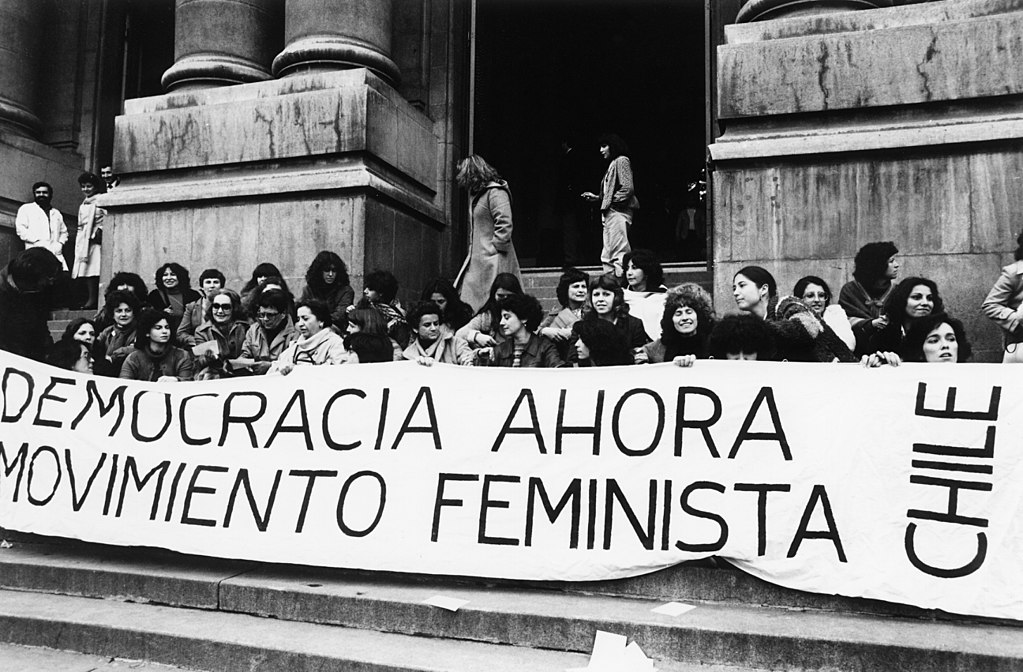
Gender Inequality

Gender Inequality
Gender Inequality By Kena Lorenzini – Museum of Memory and Human Rights, CC BY-SA 3.0, https://commons.wikimedia.org/w/index.php?curid=20138154

But the women are portrayed as a weaker one over several thousand. Also, they are suppressed all over the world and this suppression is supported in several religious books.

As a result, women are subjugated and exploited without given opportunities in education and jobs, all over the world. Most importantly the religions all over the world, say Women are inferior to men.

Racial Inequality

The Europeans have developed a superiority complex against the blacks and treated them as mere slaves. They were even treated much worse than animals. The blacks were denied opportunities in jobs and education.

The Europeans considered them as Knowledge-less people.

Caste Inequality

The same racial inequality that is practiced even today in India is the Caste system. This same where people were denied opportunities in the name of Caste. In India, a particular race dominated the entire resources and took absolute control over the lower caste people.

The above-mentioned inequalities are against social justice. The one that preaches and practices equality is called Social Justice

India is a nation where Plural Society and culture exist. Here the dominance of a single community is unfair and it’s against social justice.

These dominant groups trigger racial, caste, lingual, religious, and cultural feelings and create trouble for the rights of other communities. Also, this created never-ending enmity among the groups.

The various struggle taken by the weaker section or groups in order to establish social equality is known as Social Justice.

The Government plays a very important role in establishing Social Justice using several tools and one such tool is called Reservation.

UN Proclamation for Reservation

Salient Features of Race, religion and lingual minorities UN proclamation – December 18, 1992

  • All the minorities have the equal right without discrimination and intervention to exercise their freedom in following hereditary values, to cling to religion, to propagate, and to use their language.
  • All minorities can make their own organization and has every right to maintain it.
  • The Minority has the right to upgrade their knowledge related to their history, conventions, language, and other hereditary values.
  • The minorities should be provided with the opportunity to learn about the entire society to which they belong.
  • This declaration may not affect the basic freedom which is stipulated in the declaration of the existing rights.

Article 29 (2) may not act as an obstacle in making special policy decisions for socially and educationally backward communities or SC/ST people.

Article 15 (4) of the Indian Constitution

Caste reservation in India

Nothing in this article shall prevent the State from making any provision for the reservation of appointments or posts in favour of any backward class of citizens which, in the opinion of the State, is not adequately represented in the services under the state.”

Article 16 (4) of Indian Constitution

Concept of equality

People accept equality as an essential phenomenon. But still, inequality and discrimination are serving as distributing factors.

Inequality prevails everywhere like opportunities, comforts, and a working atmosphere. This kind of inequality and discrimination are permanent and unavoidable.

What we are going to do for the people, who do not have opportunities to work for the development of our nation? How far cultural values are responsible for this kind of inequality.

This discrimination happens across the globe, It is for this reason, social equality stood in the primary place in the socio-political principles.

Some common questions arise due to Reservation:

  • Equality as a principle indicates what?
  • What do you mean by “equal society”.
  • How do we assure equality?
  • With that assurance, what we are going to achieve?
  • Do we try to resolve inequality only in our income?
  • What type of equality has to be established?
  • To whom do we have to provide equality?

To continue reading, kindly click the below link…

Rajaji Tnpsc Notes – C Rajagopalachari history, Politics and His Significance

C. Rajagopalachari alias Rajaji led the first elected ministry in Madras Presidency, under Republican Constitution. He introduced a total prohibition on liquor.

Rajaji abolished the Zamindari system. Introduced legislation removing the restriction on temple entry for the depressed classes.

He closed a large number of schools. But he tried to impose Hindi in Schools and also introduced the modified scheme of elementary education that provided part-time learning of hereditary occupation called Kulakalvi.

Tamil Nationalists like Mariamalai Adigal organized the ‘Anti Hindi Movement’ in 1937. Thousands of agitators including E.V.Ramaswamy arrested, and a number of agitators died in prison.

Dravidian leaders launched a statewide protest. Even a section of Congress was against Rajaji because of the Kulakalvi scheme. This led to a change in Chief Ministership.

He was senior leader of Congress, writer and a close associate of Mahatma Gandhi. Also a member of Constituent Assembly. He was first Indian to be the Governor Gerneral of India (1948-1950). He was minister in Union Cabiner. Also he was Chief Minister of Madras State.

He was first recipient of Bharat Ratna Award.

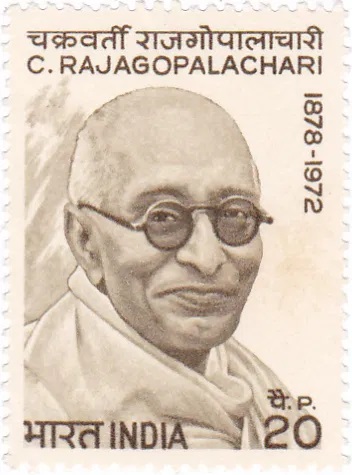
C.Rajagopalachari (1878-1972)
Rajaji Tnpsc

Gandhi’s Influence

The Growth of Gandhi Influence is Phenomenon from 1917 to 1922, this growth is commonly referred to as “Gandhian nationalism“. A group of very talented individuals attached themselves with Gandhiji, C. Rajagopalachri is one amount them. Other are Mahadev Desai, Vallabhai Patel, J.B. Kripalani, Subhas Chandra Bose, Abul Kalam Azad, Jawaharlal Nehru, Sarojini Naidu, and Govind Ballabh Pant.

Non-Cooperation Movement

As the Non-Cooperation movement gained momentum during 1921-22, several thousand students left the government-controlled schools and colleges. Also, many lawyers gave up their practices. One Such lawyer who gave up practicing Lawyer is C.Rajagopalachari. Other famous lawyers are C.R.Das, Motilal Nehru, and Asaf Ali.

Rajaji Formula

Rajagopalachari proposed a plan to resolve the political deadlock between the Indian National Congress and India Muslim League on Independent India. It is also called C.R.Formula.

Swatantra Party

Swatantra Party was formed in August 1959 after the Nagpur resolution of Congress. The Nagpur resolution of Congress called for the land ceilings, the take over of food grains by the state, and also the adoption of cooperative farming. This party was led by C.Rajagopalachari, K.M.Munshi, N.G.Ranga and Minoo Masani.

This party differed from other political parties in terms of policies for economic issues.

Critisim of Rajaji led Swatantra Party

This party wants the government to be less involved in controlling the economy. It belied in individual freedom. It favored the expansion of the free private sector and was against the land ceiling in agriculture. Also opposed cooperative farming and state trading.

Swatantra party also opposed the progressive tax regime and demanded the dismantling of the licensing regime. This party advocated the need for India to have friendly relations with the Soviet Union and to maintain closer ties with United States.

The Swatantra Party has grown in different parties across India and has alliances with different regional parties across India. During which the party has attracted the landlords and princesses who wanted to protect their lands which were threatened by the land reforms legislation.

The elite class such as industrialists or business class, who were against nationalization and licensing policies supported the party. Rajaji’s, Swatantra party failed to get long-term success due to narrow social-based and lack of dedicated cadre of party members.

Helped DMK to Form First Government

In 1967, DMK came to power in Madras Province and DMK is the single non-Congress party that achieved party majority.

The defeat of a strong Congress by DMK was achieved by DMK, and the non-congress party formed an electoral fusion along with Rajaji’s Swatantra Party.

Rajaji played an important role in the formation of the Electoral alliance against the Mighty Congress.

His efforts played a vital role in bringing DMK into power for the first time.

Conclusion

Mootharignar Rajaji (Rajaji, the Scholar Emeritus), was an Indian statesman, writer, lawyer, and Indian independence activist. He lost his place in politics due to some controversial decisions and the rise of the DMK party.

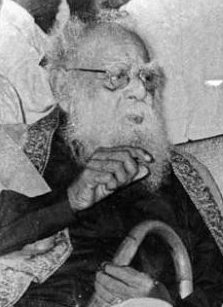
Periyar notes for Tnpsc

E.V.Ramasamy is famously called Periyar. He was born in 1879 in a rich family that does business in Erode.

Periyar questioned superstitious beliefs even in his young days. He became Chairman of Erode Municipality. E.V.Ramasamy fought against various social evils and superstitious beliefs such as the enslavement of women.

As he fought against the social evil and his wisdom he was called “Thanthai Periyar”. He was a follower of Mahatma Gandhi and joined the congress and actively participated in various social reform activities and freedom movements.
E.V. Ramasamy found that the congress was dominated by Brahmin in the 1920s. And he took the Congress to every class of people such as down trod and organized temple entry movements.

He criticized the congress that practised Varnashrama and left the congress party. Then he went on to join the Justice Part and created the Self Respect Movement. He then went on to become inseparable from the Politics of India and Tamil Nadu.

Periyar Quotes on Nationalism

In the name of the nation, if a group of people exploit other groups that are not the real freedom which a nation fought for“, said Periyar.

He was strongly against Nationalism, Race, the Concept of Nation, etc. According to Periyar, all the Nation, Nationality, and Nationalism are the same concepts, one who differentiates from these concepts indicates “Self Respect“.

If anybody speaks about nationalism in Tamil Nadu, I wonder, that will they think about welfare or botheration about people” said Periyar.

Those people who nationalism was not bothered about the Indians, Tamilians, and the self-respect of the people, they make people believe in Nationalism for their own welfare“.

If self-respect is submerged in the name of nation and nationalism that will be the crime against India“, stated Periyar.

Periyar a Social Reformer

Periyar today is an ideology, Dravidian Ideology. He is the Idol of Dravidian Politics in Tamil Nadu. These Dravidian Politics championed Social Equality, Self-Respect, and Linguistic pride in the country.

Periyar as the social reformer made reforms on social, cultural, and gender inequalities and questioned religious things such as faith, gender, and tradition. He asked people to question religions and customs.

Periyar Feminism

Periyar is mainly a feminist, who argued that Women should be Independent, not mere Child Bearers. Periyar fought for Women, to give equality in employment.

Fought for property rights from Parents and as well from the Husband in case of divorce. Fought for Divorce rights for women.

Self Respect Movement and Idea Behind the Movement

Periyar asked people to give up the caste suffix in their names. He encouraged inter-dining, that is different caste and different religious people are made to eat food in the same place.

Periyar promoted marriages without rituals and dowry. Dalits and Muslims were made to cook food in public conferences.

Due to his social reforms in Religion, Caste, and voice for Feminism, he is famously called Thanthai Periyar, the father figure of Modern Tamil Nadu.

Periyar views about Nationalism

Periyar said that Nationalism is a fake feeling, it is because Nationalism is a conspiracy by rich and power-centred people, who create negative emotions in people and propagation to control the rights of the poor people.

For example, If the people in power, constantly speak about Chinese and Pakistan’s aggression on the border, nobody or no media will care about poor people who do not even have food to eat.

“Nationalism has become a buzzword of addictiveness and emotionalism for the people”, he exclaimed. He made a speech in Sri Lanka, where he strongly opposed Nationalism. Nationalism made people scapegoated by capitalist people and misused their feeling of people.

For example, If business class people in the USA, have clashed with UK businessmen in their country, then US people say, Oh People because of Britons our country is under threat. Such kind of false words is only for their economic advancement and not for the poor communities.

He saw Russia, where there are many Races and cultural groups but there is no discrimination in that nation. He also supported the communist revolution. These nations were free of Nationalism, religion, and God. Also, may not be affected by luxurious lifestyles, poverty, and exploitation by the rich community.

Also, people from developed countries may not stick with national and godly attachments. Equality and egalitarian society is the only priority of that place, there is no discrimination between rich-poor, owner-worker, powerful-powerless in that region.

He also found that those people of high value and egalitarian-longing are not equal to the nation which gives priority to God and Nationalism. By showing other nations as evidence, Periyar also criticized Indian Nationalistic feelings and Patriotism Because these feelings are exploited as weapons by certain dominant groups.

Periyar on Dravidanadu

Whether “Nation” a concept suitable for India? Periyar raised a pertinent question and answer as well.

Madras is not a separate nation and cannot function separately,” says some of our friends. Once ‘Madras’ as a nation, Also now, “Dravidam” it is. The culture and other practices are different from Bengal and Mumbai. The English language is the main base for familiarity among these different nations in India.

If the British Empire and its language are relieved from India, Hindi may become the national language. Instead of calling India a nation, Dravida Nadu, Andhra, and Bengal can be separately called nations respectively.

For example, the Dravidian nation had its culture, language, civilization, and rule for thousands of years in accordance with historical facts. Undoubtedly it is known to all the people. “Dravidian Nationalism”, proposed by Periyar was to a large extent against religious domination.

Periyar Stand on Languages

Each and everyone has their own right to protect their language. These rights can be protected and provided under Dravida, Socialist Republic Rule. No language can be enforced. Language should not be misused as a weapon for separatism. If people are dependent upon Central rule for all kinds of amenities, there is no outcome in it.

If languages are officialized at the Central level, with the poor people be relieved of hunger? To put it in a clear way, are Tamil Labourers exploited only by the Tamil Speaking owner class?

Periyar on Casteless Society

Periyar’s protests and speeches always centre around, “Tamilnadu for Tamils and Dravidian nation for Dravidians.” His ideologies include a Common plan, a common work plan, Islamic conversion, separate Dravidian nation for which he fought against the dominant communities.

His argument was that the dominant communities misused Tamil, Tamil nationalism, and the Tamil race for sustaining the power in Tamilnadu. It is with the help of Tamil leaders, that they injected Tamil nationalism into the minds of the people for holding the power for a long time he said.

Consequently, Periyar put an end to the demand for separate Tamilnadu and upheld the idea of a casteless society. Thus, casteless society has become the topmost priority for Periyar. Other ideals like the separate Dravidian nation, abounding dominant communities, and distortion of capitalist class became secondary priorities for Periyar.

This may be the only ambition and goal for Dravida Kazhagam, claimed Periyar. “The caste feeling, thus divided the Dravidian race and Dravidians became slaves for Aryans” stated Periyar in his writings published in the 1950s in Tamilnadu.

Tnpsc Group-I Syllabus for Prelims along with Reference and Notes

Tnpsc Group-I Syllabus with links to reference and notes for easy navigation to notes for quick reference for final day revision

This page provides links to Notes as per the latest syllabus. This page covers most of the topics. Some topics are merged together, and as a result, some topics might have links to them.

We have provided links to the standard book to score high, at the end of this page. Kindly check and buy through our links, and you will get an additional discount.

UNIT-I: GENERAL SCIENCE

(i) Scientific Knowledge and Scientific temper – Power of Reasoning Rote Learning Vs Conceptual Learning Science as a tool to understand the past, present and future.

(ii) Nature of UniverseGeneral Scientific Laws – Mechanics -Properties of Matter, Force, Motion and Energy – Everyday application of the basic principles of Mechanics, Electricity and Magnetism, Light, Sound, Heat, Nuclear Physics, Laser, Electronics and Communications.

(iii) Elements and Compounds, Acids, Bases, Salts, Petroleum Products, Fertilizers, Pesticides.

(iv) Main concepts of Life Science, Classification of Living Organisms, Evolution, Genetics, Physiology, Nutrition, Health and Hygiene, Human diseases.

Environment and Ecology

UNIT-II: CURRENT EVENTS

(i) HistoryLatest diary of eventsNational symbols – Profile of States – Eminent personalities and places in news – Sports – Books and authors.

(ii) Polity – Political parties and political system in India – Public awareness and General administration – Welfare oriented Government schemes and their utility, Problems in Public Delivery Systems.

(iii) Geography – Geographical landmarks.

(iv) Economics – Current socio – economic issues.

(v) Science – Latest inventions in Science and Technology.

UNIT- III: GEOGRAPHY OF INDIA

(i) Location – Physical featuresMonsoon, rainfall, weather and climateWater resourcesRivers in India Soil, minerals and natural resourcesForest and wildlifeAgricultural pattern.

(ii) TransportCommunication

(iii) Social geography – Population density and distributionRacial, linguistic groups and major tribes.

(iv) Natural calamity – Disaster Management Environmental pollution: Reasons and preventive measuresClimate changeGreen energy

UNIT – IV: HISTORY AND CULTURE OF INDIA

(i) Indus Valley civilizationGuptas, Delhi Sultans, Mughals and MarathasAge of Vijayanagaram and Bahmani KingdomsSouth Indian history.

(ii) Change and Continuity in the Socio-Cultural History of India.

(iii) Characteristics of Indian culture, Unity in diversity – Race, language, custom.

(iv) India as a Secular State, Social Harmony

UNIT-V: INDIAN POLITY

(i) Constitution of IndiaPreamble to the ConstitutionSalient features of the Constitution – Union, State and Union Territory.

(ii) Citizenship, Fundamental Rights, Fundamental Duties, Directive Principles of State Policy.

(iii) Union Executive, Union legislatureState Executive, State LegislatureLocal governments, Panchayat Raj.

(iv) Spirit of Federalism: Centre – State Relationships.

(v) Election – Judiciary in IndiaRule of law.

(vi) Corruption in public lifeAnti-corruption measures – Lokpal and Lokayukta – Right to Information – Empowerment of women – Consumer protection forums, Human rights charter.

UNIT-VI: INDIAN ECONOMY

(i) Nature of Indian economyFive year plan models – an assessmentPlanning Commission and Niti Ayog.

(ii) Sources of revenueReserve Bank of India Fiscal Policy and Monetary PolicyFinance Commission Resource sharing between Union and State Governments Goods and Services Tax.

(iii) Structure of Indian Economy and Employment Generation, Land reforms and Agriculture Application of Science and Technology in agricultureIndustrial growthRural welfare oriented programmes – Social problems – Population, education, health, employment, poverty.

UNIT-VII: INDIAN NATIONAL MOVEMENT

(i) National renaissanceEarly uprising against British ruleIndian National CongressEmergence of leadersB.R.Ambedkar, Bhagat Singh, Bharathiar, V.O.Chidambaranar, Jawaharlal Nehru, Kamarajar, Mahatma Gandhi, Maulana Abul Kalam Azad, Thanthai Periyar, Rajaji, Subash Chandra Bose and others.

(ii) Different modes of Agitation: Growth of Satyagraha and Militant movements.

(iii) Communalism and partition.

UNIT- VIII: History, Culture, Heritage and Socio-Political Movements in Tamil Nadu

(i) History of Tamil Society, related Archaeological discoveries, Tamil Literature from Sangam age till contemporary times.

(ii)Thirukkural :

(a) Significance as a Secular literature
(b) Relevance to Everyday Life
(c) Impact of Thirukkural on Humanity
(d) Thirukkural and Universal Values – Equality,
Humanism, etc
(e) Relevance to Socio – Politico – Economic affairs
(f ) Philosophical content in Thirukkural

(iii) Role of Tamil Nadu in freedom struggleEarly agitations against British RuleRole of women in freedom struggle.

(iv) Evolution of 19th and 20th Century Socio-Political movements in Tamil Nadu – Justice Party, Growth of Rationalism – Self Respect Movement, Dravidian movement and Principles underlying both these movements, Contributions of Thanthai Periyar and Perarignar Anna.

UNIT – IX: Development Administration in Tamil Nadu

(i) Human Development Indicators in Tamil Nadu and a comparative assessment across the Country – Impact of Social Reform movements in the Socio-Economic Development of Tamil Nadu.

(ii) Political parties and Welfare schemes for various sections of people – Rationale behind Reservation Policy and access to Social ResourcesEconomic trends in Tamil Nadu – Role and impact of social welfare schemes in the Socio-economic development of Tamil Nadu.

(iii) Social Justice and Social Harmony as the Cornerstones of Socio-Economic development.

(iv) Education and Health systems in Tamil Nadu.

(v) Geography of Tamil Nadu and its impact on Economic growth.

(vi) Achievements of Tamil Nadu in various fields.

(vii) e-governance in Tamil Nadu.

UNIT-X: APTITUDE AND MENTAL ABILITY

(i) Simplification – Percentage – Highest Common Factor (HCF) – Lowest Common Multiple (LCM).

(ii) Ratio and Proportion.

(iii) Simple interest – Compound interest – Area – Volume – Time and Work.

(iv) Logical Reasoning – Puzzles-Dice – Visual Reasoning – Alpha numeric Reasoning – Number Series.

Standard Books for Tnpsc Group-I

  1. SURA`S TNPSC Group 1 Exam CCSE-1 (Graduate Level) General Studies Preliminary Exam Book in English Medium (TNPSC New Syllabus) – LATEST EDITION 2022
  2. SURA’S TNPSC Group-I Preliminary Exam Q-Bank (7 Previous Year’s Original Question Papers Included) Book – 2022 Latest

Social Geography of India, Population density, and distribution Upsc

Social Geography

Social Geography is the branch of human geography. It studies the relationship between society and space. Also, it is related to sociology, social phenomena, and their components.

Social geography includes settlement patterns, human development, population composition, etc. It also consists of primary, secondary, and tertiary activities. Fitzgerald first tried to define social geography in 1946 and equated it with the whole of human geography.

Also, J.W. Watson defined it as the identification of different regions of the earth according to associations of social phenomena related to the total environment’.

The branches of social geography include ‘Human Geography‘ and ‘Physical Geography’.

Population density

Currently, 3,60,000 babies are born every day in the world, that is 4 babies every second.

Stephen Hawking thinks that as per current rate human beings need a new planet 100 years if it is to survive, and this was also confirmed by BBC.

With climate change, overdue asteroid strikes, epidemics and population growth, our planet is increasingly precarious’, the news company continued.

The human being is the latest occupant of the planet earth, as its evolution took place less than two million years ago.

But the distribution and growth of Humans are greatly influenced by the physical environment.

Also, humans have great potential to modify the physical environment. Demography is the statistical study of the human population.

It includes the study of the size, structure, and distribution of population, as well as changes in time and location in response to birth, migration, aging, and death.

Population explosion is one of the greatest challenges that we face today.

World Population Density and Distribution

Human numbers remained limited even though they have inhabited the earth for every thousand years.

But that situation has changed in the recent century, the human population has increased and increased at an alarming rate.

But the population distribution is unevenly spread across the continents.

The concentration of people is limited to only a few areas, but a large number of areas support only a few people. This is because there are different factors that influence population distribution.

The patterns of Population Distribution

The analysis of the pattern of population distribution and population density is fundamental to the study of the demographic characteristics of any area.

The population distribution is how the people are spread over the earth’s surface. The population distribution is uneven throughout the world.

The top 10 most populous countries together make up 60% of the population of the world.

Density of Population

The number of persons living per unit of land areas gives a good indication of the impact of population on land and its resources. This is expressed in the form of density of population per sq. km of land area.

The density of population = Total population/Total area of the country

The population is obtained by dividing the total land area by the total population, the quotient being the number of people per square kilometre.

Compared with simple arithmetic density, physiological or nutritional density is a more refined method of calculating man-land ratios. The population density of the world is 25 people per km sq.

Physiological or Nutritional density is the ratio between total population and total cropped area.

  • The total arable land in the world is 13.3%.
  • The nutrition density of the world is 325 per sq.km of land.
  • Singapore has the highest nutritional density of population of 4,40,998 per sq.km of land of the world.

The areas of the density of population can be divided into three as follows:

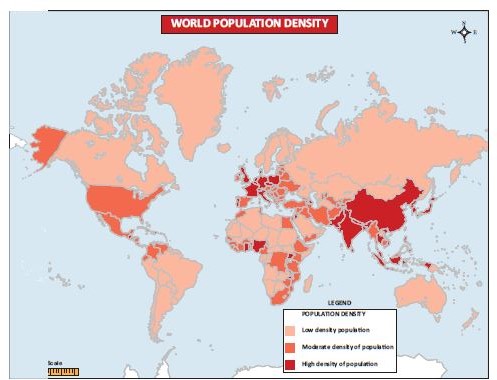
1.High density areas of population

Fertile plains with good climate, industrialization, and urbanized areas are generally densely populated.

There are four major areas of the high density of population with more than 100 persons per sq. km.

Areas include:

Eastern Asia, including China, Japan, and the Republic of Korea.

Southern Asia, including India, Bangladesh, and Sri Lanka

The north-Eastern part of the United States of America

Central and North-Western Europe

Of the four regions above, Eastern Asia and South Asia have a high density of population because of the favorable environment and conditions such as climate, fertile soil, and large areas of plains for agriculture.

The plains and river valleys of India and China are densely populated. In North Eastern United States of America and North-Western Europe which are densely populated due to the concentration of manufacturing industries.

2. Moderate density areas of population

The areas of the moderate density of population have between 10 to 80 persons per sq. km.

The areas of the moderate density of population include the Central part of the United States of America, Tropical Western Africa, Western Block of Russia, Eastern Europe, Deccan Plateau of India, Central China, Southern portion of the plateau of Mexico, North-Eastern Brazil, and Central Chile.

The areas above are characterized by well-developed agricultural activities, favorable climate, fertile soils, fishing, etc.

3.Low density areas of population

About half the area of the world has a population of fewer than 10 persons per sq. km. Some vast areas remain completely uninhabited.

The uninhabited areas are:

Amazon forest region of South America and Congo forest region of Africa.

Arctic area of Canada, Greenland, and the Polar regions

Great deserts of the world such as Sahara, Kalahari, Arabia, Great Desert of Australia, Atacama Desert of South America, Desert regions of the Western United States, and Thar Desert of India.

High mountainous regions in all continents.

Antarctica

world population density map
World population distribution map

Australia with an average density of population of 2 persons per sq. km is one of the most sparsely populated countries in the world.

However, inhabitants of these areas have a high standard of living.

The reasons for the low density of population are

  • A Bad and unfavourable environmental conditions for Human settlement
  • Less economic activities
  • Bad Transport and communication
  • Bad Government Policy

Conclusion

Overall social geography focuses on the study of the relationship of social and its spatial components.

Disaster management in India Upsc

India, a diverse nation with its varied geographical terrain, faces numerous natural and man-made disasters each year. From floods and cyclones to earthquakes and droughts, the country’s susceptibility to these calamities underscores the need for robust disaster management strategies. Over the years, India has evolved significantly in its approach to managing disasters, emphasizing preparedness, mitigation, response, and recovery.

The Landscape of Disasters in India

India’s geographical diversity is both a blessing and a challenge. The Himalayan region is prone to earthquakes and landslides, the coastal areas frequently face cyclones and tsunamis, while vast river basins often experience devastating floods. Additionally, heatwaves and droughts impact many parts of the country during peak summer months, affecting millions.

Man-made disasters, including industrial accidents, fires, and chemical spills, also present significant risks. The Bhopal Gas Tragedy of 1984 stands as a stark reminder of the catastrophic consequences of industrial negligence.

Institutional Framework for Disaster Management

The government of India has developed a structured framework to address these challenges. The Disaster Management Act, enacted in 2005, was a pivotal moment that established the National Disaster Management Authority (NDMA) as the primary agency for policy formation and coordination. The NDMA, chaired by the Prime Minister, focuses on a proactive and holistic approach to disaster management.

At the state and district levels, State Disaster Management Authorities (SDMAs) and District Disaster Management Authorities (DDMAs) ensure localized response and preparedness. The National Institute of Disaster Management (NIDM) plays a crucial role in training and capacity-building efforts.

Key Strategies and Programs

1. Early Warning Systems

To minimize the impact of disasters, India has invested heavily in early warning systems. The Indian Meteorological Department (IMD) and other agencies provide timely forecasts for cyclones, floods, and heatwaves, allowing authorities to take preemptive measures.

2. Community-Based Disaster Management (CBDM)

Engaging local communities is vital for effective disaster management. Programs that educate and involve communities help build resilience, ensuring that response efforts are swift and well-coordinated.

3. National Disaster Response Force (NDRF)

Formed in 2006, the NDRF is a specialized force equipped for search, rescue, and relief operations. With teams strategically stationed across the country, they provide immediate response during emergencies.

4. Technology and Innovation

The use of technology, such as GIS mapping, satellite monitoring, and mobile apps, has enhanced disaster preparedness and response capabilities. Initiatives like the “India Disaster Resource Network” (IDRN) support better coordination by providing information on available resources.

Successes and Ongoing Challenges

India has seen considerable success in managing disasters, notably during Cyclone Phailin in 2013, where early warnings and mass evacuations significantly reduced casualties compared to similar events in the past. However, challenges remain, such as infrastructure vulnerabilities, rapid urbanization, and climate change, which exacerbate the frequency and intensity of natural disasters.

Building a disaster-resilient nation involves continuous improvement, strong political will, and active participation from all sectors of society. While the existing frameworks and initiatives mark substantial progress, sustained efforts and adaptive strategies are essential for facing future challenges effectively.

Conclusion

Disaster management in India has made commendable strides over the past decades, transitioning from reactive to proactive measures. Strengthening community involvement, leveraging technology, and fostering inter-agency coordination remain key areas for growth. By investing in resilience and sustainability, India can better safeguard its people and assets from the ever-present threats of disaster.

Marathas Tnpsc

Marathas rise and Shivaji’s contribution to the Maratha kingdom and administration. The Peshwa rule and administration and Maratha rule in Tamilnadu

Marathas

The Marathas are from Maharashtra. They are a group of castes that comprises peasants, landowners and warriors. The top layer of Marathas has surnames like Deshmukh, Bhonsle, More, Shirke, and Jadhave, and these were from the Warriors class called Kshatriyas.

The Rise of Marathas

There were different factors that contributed to the rise of Marathas in the 16th and 17th centuries. These include the physical environments of the Maratha country that gave peculiar qualities to the Marathas.

  • The Maratha Empire played a significant role in weakening and displacing the Mughal Empire by the 18th century.
  • Maratha general Venkoji who is the half brother of Shivaji established Maratha rule in Thanjavur by using Bijapur forces.
  • Their rule in Tamilnadu continued from 1674 to 1832 until the death of Serfoji-II.

Factors that made Marathas a great soldiers:

  • Marathas built forts on mountains.
  • The mountainous region and dense forest made them adopt guerilla tactics.
  • The spread of the Bhakti movement in Maharashtra created a spirit of religious unity among them.
  • The spiritual leaders such as Tukkaram, Ramdas, Vaman Pandit and Eknath fostered social unity.
  • Shivaji fostered political unity.

Due to the above factors, they held important positions in the military and administration of the Deccan Sultanates of Bijapur and Ahmadnagar.

  • Also, there were a number of influential Maratha families such as Mores and Nimbalkers.
  • But the credit establishment of the powerful Maratha empire goes to Shaji Bhonsle and his son Shivaji.

Shivaji

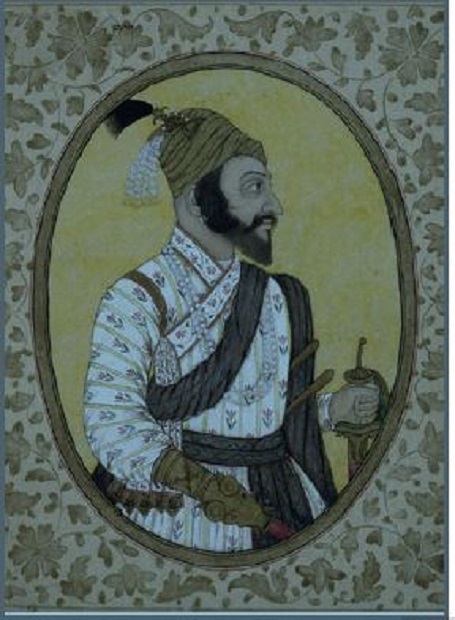
Shivaji was born at Shivner in 1627 to Shaji Bhonsle (Father) and Jija Bai (mother).

Conquest of Shivaji

  • Shivaji inherited the jagir of Poona from his father Shaji Bhonsle in 1637.
  • He assumed full charge of his Jagir after the death of his guardian, Dadaji Kondadev in 1647.
  • Even before taking charge of his Jagir, he conquered Raigarh, Kondana and Torna from the ruler of Bijapur.
  • He also captured Javli from a Maratha chief, Chanda Rao More, which made him the master of Mavala Region.

Then in, 1657, he attacked Bijapur Kingdon and captured a number of hill forts in the Konkan region.

  • After that incident, the Sultan of Bijapur sent Afzal Khal against Shivaji. But Afzal Khan was murdered by Shivaji in 1659.
  • Then Shivaji became popular and that invited attacks from Mughal emperor Aurangzeb.

Aurangzeb vs Shivaji

  • Aurangzeb sent the Mughal governor of Deccan, Shaista Khan. Shivaji was defeated to the Mughal forces and lost Poona.
  • But Shivaji attached Shaista Khan’s military camp at Poona in 1663 and killed his son. Also wounded Shaista Khan.
  • Then Shaista Khan was recalled by Aurangzeb.

Treaty of Purander

In 1664 Shivaji attacked Surat, an important port of the Mughal and plundered it.

Then Aurangzeb sent Raja Jai Singh of Amber. Raja Jai Singh defeated Shivaji and succeeded in besieging the Purander fort, where Shivaji lodged his family and treasure.

Then Shivaji opened negotiations with Jai Singh and the Treaty of Purander was signed.

  • According to the treaty, Shivaji had to surrender 23 forts to the Mughal out of 35 held by him.
  • The remaining 12 forts were to be given to Shivaji on condition of service and loyalty to the Mughal Empire.
  • Also, the Mughals recognized the right of Shivaji to have certain parts of the Bijapur Kingdom, as Shivaji asked to exempt him from personal service to the Mughals.
  • Also, his son Shambaji was granted a mansab of 5000.

Imprisonment of Shivaji and its consequences

  • Shivaji visited Agra in 1666 and he was imprisoned. He then escaped from prison and made military preparations for another four years.
  • He plundered Surat for the second time in 1670 and captured all the lost territories.
  • In 1674, he crowned himself at Raigarh and assumed the title Chatrapati. He then went into the Carnatic region and captured Ginjee and Vellore.
  • After the expedition of the Carnatic region, he died in 1680.

Administration of Shivaji

Shivaji was a great administrator. He was assisted by a council of ministers called Ashtapradhan.

  • Peshwa – Finance and general administration. Later he became the prime minister.
  • Sar-i-Naubat or Senapati – Military commander, a honorary post.
  • Amatya – Accountant General.
  • Waqenavis – Intelligence, posts and household affairs.
  • Sachiv – Correspondence.
  • Sumanta – Master of ceremonies.
  • Nyayadish – Justice.
  • Panditarao – Charities and religious administration

The administrative reform of Shivaji was in the Deccan Sultanates. For example, Peshwas was the Persian title.

  • The revenue system of Shivaji was based on Malik Amber of Ahmadnagar. Lands were measured using a measuring rod called Kathi.
  • Lands were classified into three categories – Paddy field, garden lands and hilly tracks.

Shivaji reduced the powers of the Deshmuks and Kulkarni.

Chault and Sardeshmukhi

  • Chaut and Sardeshmukhi were the taxes collected in the neighbouring territories such Mughal Empire or Deccan sultanates.
  • Chauth was one-fourth of the land revenue paid to the Marathas to avoid the Maratha raid.
  • Sardeshmukhi was an additional levy of ten per cent on those lands for which Marathas claimed hereditary rights.

Military of Shivaji

  • The regular army consisted of about 30,000 to 40000 cavalry supervised by Havaildars.
  • Malvi – foot soldiers played an important role.
  • Soldiers were given fixed salaries.

There were two divisions in the Maratha cavalry:

  1. Bargirs – equipped and paid by the state.
  2. Silahdars – Maintained by the nobles.

Forts played important role in military operations of the Marathas. Shivaji has about 240 forts.

Successors of Shivaji

There was war of succession after the death of Shivaji between his son Shambaji and Rajaram. Shambaji was successful and Rajaram was executed the Mughals.

  • Rajaram succeeded the throne but the Mughals made him flee to the Ginjee fort. He died at Satara.
  • Rajaram was succeeded by his minor son Shivaji -II with his mother Tara Bai as regent.
  • The next ruler was Shahu in whose reign the Peshwas rose to power.

Peshwas (1713-1818)

  • Balaji Viswanath (1713-1720)
  • Baji Rao-I (1720-1740)
  • Balaji Baji Rao (1740-1761)

Balaji Viswanath

  • Balaji Viswanath started as a small revenue official and became Peshwa in 1713.
  • He made his position the most important and powerful as well as hereditary.
  • He made Shahu as Maratha ruler after the civil war.
  • Balaji Vishwanath sought the support of all Maratha leaders for Shahu.
  • In 1719, he got certain rights from the Mughal emperor, Farukh Siyar. Then Mughal emperor recognized Shahu as the Maratha King.
  • Also allowed to collection of Chauth and Sardeshmukhi from the six Mughal provinces of Deccan including the Carnatic and Mysore.

Baji Rao I (1720-1740)

  • Baji Rao was the eldest son of Balaji Viswanath. The Maratha power reached its zenith under him.
  • He initiated the system of confederacy among the Marath chiefs.

System of confederacy

  • Under the system of the confederacy, each Maratha chief was assigned a territory, which could be administered autonomously.
  • This resulted many Maratha families became prominent and established their authority in different parts.
  • Prominent Maratha families of those include:
    • Gaekwad at Baroda
    • Bhonsle at Nagpur
    • Holkars at Indore
    • Scindias at Gwalior
    • Peshwas at Poona

Balaji Baji Rao (1740-1761)

  • Balaji Baji Rao succeeded his father as Peshwa at the young age of nineteen. The Maratha king Shahu died in 1749 without issue. His nominated successor Ramraja was imprisoned by the Peshwa Balaji Baji Rao at Satara.
  • The full control of the Maratha kingdom came under the Peshwa. Then Peshwa entered into an agreement with the Mughal Emperor in 1752.
  • According to the agreement, the Peshwa gave assurance to the Mughal Emperor that he would protect the Mughal Empire from internal and external enemies for which the Chauth of the northwest provinces and the total revenue of the Agra and Ajmer provinces would be collected by the Marathas.

Decline of Marathas

  • Thus when Ahmad Shah Abdali invaded India, it became the responsibility of the Marathas to protect India.
  • The Marathas fought very bravely against Ahmad Shah Abdali in the Third Battle of Panipat in 1761. But they got defeated. Many Maratha leaders and thousands of soldiers died in this battle.
  • Balaji Baji Rao also died on hearing the sad end of this battle. Also, this battle gave a death blow to the Maratha power.
  • Thereafter, the Maratha confederacy weakened due to internal conflicts among the Maratha chiefs. After the decline of the Mughal Empire, the Marathas emerged a great power in India.
  • But they could not succeed in preventing the establishment of British power in India.
  • The important causes for the downfall were that there was lack of unity among the Maratha chiefs like Holkar, Scindia and Bhonsle.
  • Also, the superiority of the British army and fighting method.

Maratha Empire family tree

  • Shivaji
    • Shaji Bhonsle (Father)
    • Jijabai
  • Sambhaji(elder son) and Rajaram (younger son)
    • Shivaji (Father)
  • Tarabai (First wife) and Raja Bai (Second wife)
    • Rajaram(Husband)
  • Shahu (Shivaji-II)
    • Sambhaji(Father)
  • Sambhaji-II
    • Raja Bai (Mother) and Rajaram (Father)
  • Rama Raja
    • Shahu (Father)
  • Shahu-II (Adopted Son)
    • Rama Raja (Father)
  • Pratap Singh
    • Shahu-II (Father)
  • Shaji-II (Shaji Appa Saheb)
    • Pratap Singh (Younger Brother)

Maratha empire kings

  • Shivaji
  • Sambhaji
  • Rajaram
  • Tara Bai (Rajaram wife)
  • Shahu(Sambhaji son)
  • Balaji Viswanath as Peshwa
  • Raja Bai (Second wife of Rajaram) and her son Sambhaji-II
  • Rama Raja
  • Shahu-II (Adopted son of Rama Raja)
  • Pratap Singh
  • Shaji Appa Saheb, Shaji-II

Marathas tnpsc notes pdf

Acheulian and Sohanian Culture in India Upsc

This article is for Tnpsc exams in history part for Acheulian and sohanian culture which existed in India

Two independent cultures or traditions of hand axe (Acheulian) and pebble flake (Sohanian) industries are found in India, based on research.

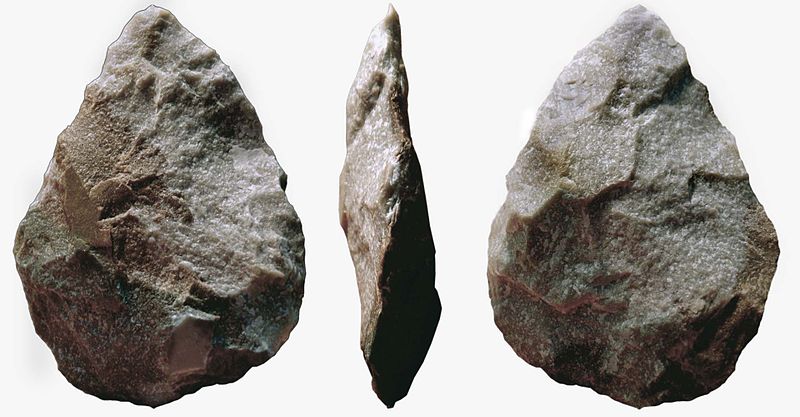
The Acheulian industry mainly has hand axes and cleavers, whereas the Sohan industry uses only choppers and chopping tools. The Sohan industry gets its name from the Sohan river valley of Pakistan.

According to the latest research, Acheulian and Sohanian are no different they are the same.

acheulian and sohanian
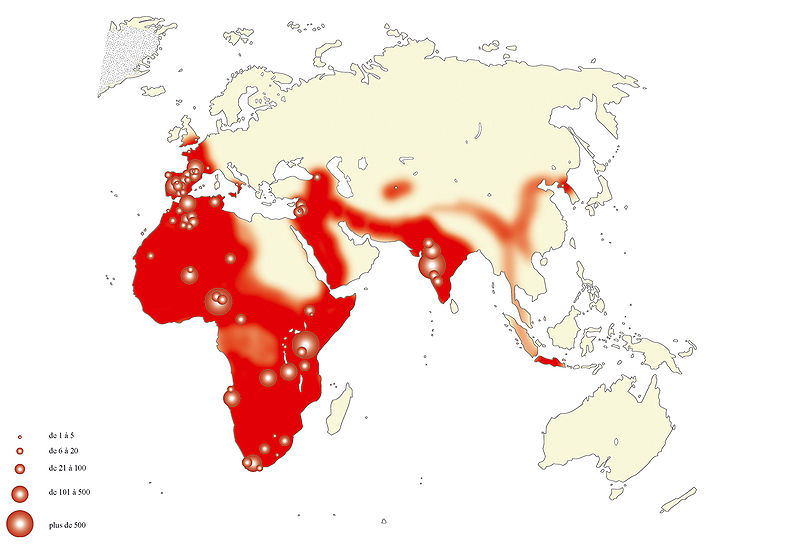
Acheulian culture distribution across Asia, Africa, and Europe By No machine-readable author provided. 120 assumed (based on copyright claims). – No machine-readable source was provided. Own work assumed (based on copyright claims)., CC BY-SA 3.0, https://commons.wikimedia.org/w/index.php?curid=652361

Sohanian Culture

Sohanian or Sohan culture is an archaeological culture that belongs to Lower Paleolithic. It is located in and around the Siwalik Hills.

Sohar sites are found in today’s India, Pakistan, and Nepal. The artifacts from Sohanian Culture were made of quartzite pebbles, cobbles, and boulders.

This raw material was derived from various fluvial sources found on the Siwalik landscapes. The things comprise choppers, discoid, scrapers, cores, and flakes of different types.

Acheulian culture in India

It is a lower Palaeolithic tool culture including the hand axe.

The Acheulian sites in India are densely found in central India and the southern part of the Eastern Ghats.

Sites are found in India are Western Rajasthan, Mewar Plain, Chota Nagpur Plateau, Saurashtra, and the Eastern Ghats near the north of Cauvery river.

FAQ

Where is the Acheulian culture site located?

This culture is found mostly from the Siwalik hills in North to near Chennai in the south in the coastal region, northeast India, and in the Gangal plains.

What is the Acheulean tradition?

This culture is the first standardized tradition of toolmaking of the Early Humans. These tool kits differ in tool types, which reflects the changing environment.

What is the typical tool of Soan culture?

The early soan main uses pebble tools. It is made of rounded pebbles. Also, minimum flaking is found on them to get the shape of a chopper.

Who were the makers of the Acheulian handaxes?

These were produced by two extinct species i.e H.Erectus and H.Heidelbergensis.

How long were Acheulean Handaxes used?

These were used between 1.6 million years ago to 100,000 years ago. This makes these Handaxes the most advanced technology developed by early humans.

How did the Acheulean toolmaking tradition get its name?

It got its name from a site named Saint-Acheul in northern France, which refers to a range of Lower Paleolithic tool-making traditions across Africa-Europe-Asia.

* * All the Notes in this blog, are referred from Tamil Nadu State Board Books and Samacheer Kalvi Books. Kindly check with the original Tamil Nadu state board books and Ncert Books.