I've done a Master of Engineering in Computer Science and B.Tech in Information Technology . Worked in a private IT company for 5 years. Currently preparing for the Civil Services Exam. My hobby is blogging in different Niches, especially technologies.
Goods and Services Tax replaced all the Centre and State indirect taxes to make Tax that is applicable Pan-India.
Concept and Nature
Goods and Services Tax (GST) is a single, comprehensive indirect tax levied on the supply of goods and services right from the manufacturer/service provider to the consumer.
It is a destination-based consumption tax, meaning the tax accrues to the taxing authority with jurisdiction over the place of consumption (place of supply).
GST is levied at all stages of supply; credit for taxes paid at previous stages is available as a set-off (Input Tax Credit / ITC).
Only value addition is taxed at each stage, and the ultimate burden of the tax is borne by the final consumer.
Constitutional and Legislative Background
In 2016, the Indian Constitution was amended to empower both the Union Government and State Governments to enact laws to impose GST.
Specifically, the 101st Constitution Amendment Act received Presidential assent on 8 September 2016 and introduced Article 246A, cross-empowering Parliament and State Legislatures to make laws regarding GST.
Following the amendment, the CGST Act, SGST Acts, and UTGST Act were enacted.
GST was rolled out at midnight on 30 June / 1 July 2017 during a special midnight session of Parliament, covering the Centre, 28 states, and 7 Union Territories.
Dual GST Structure and Components
In keeping with India’s fiscal federalism, GST operates as a dual model where the Centre and States simultaneously levy tax on a common base.
Central GST (CGST): Levied and administered by the Central Government on intra-state supply, constituting Union revenue.
State GST (SGST): Levied and administered by State Governments on intra-state supply, constituting State revenue.
Integrated GST (IGST): Charged on inter-state transfers of goods and services, as well as on imports of goods and services. The revenue collected under IGST is divided between the Centre and the States as per specified rates.
Taxes Subsumed under GST
Central Taxes/Cesses Subsumed: Central Excise Duty, Additional Excise Duty, Special Excise Duty, Service Tax, Central Sales Tax (CST), and cesses such as KKC (Krishi Kalyan Cess) and SBC (Swachh Bharat Cess).
State Taxes/Cesses Subsumed: VAT/Sales Tax, Entry Tax, Luxury Tax, Octroi, Entertainment Tax, Taxes on Advertisements, Taxes on Lottery/Betting/Gambling, and State cesses on goods.
Exclusions and Special Treatments
Petroleum Products: Five petroleum products are temporarily kept outside GST and are to be subsumed over time.
Alcoholic Liquor: State Governments continue to levy VAT on alcoholic liquor for human consumption.
Tobacco and Tobacco Products: Attract both GST and Central Excise Duty.
Rate Structure
Under GST, six standard rates are applied across the country: 0%, 3%, 5%, 12%, 18%, and 28%. (Note: In the accounting text, the minimum number of floor rates is described as not exceeding two).
Objectives and Key Advantages
Single National Market: Creates “one nation, one tax, and one market” by establishing common laws, procedures, and standardized rates nationwide.
Elimination of Cascading Effect: Prevents the “tax on tax” common in the pre-GST regime by allowing comprehensive Input Tax Credit (ITC) along the entire supply chain.
Revenue and Compliance Expansion: Broadens the tax base, enhances revenue for both Centre and States, and lowers administrative costs.
Reduced Human Interface: Simplifies compliance via online digital services (registration, returns, payments) at www.gst.gov.in, enhancing transparency and ease of doing business.
Competitiveness and Growth: Lowers production and business operation costs, enhances manufacturing efficiency, increases export competitiveness globally, and is expected to boost GDP growth by about 2%.
Muslim invasion led to the establishment of the Delhi Sultanate from 1206 AD to 1526 AD. The first sultan of Delhi was Qutub-ud-din Aibak.
There are five different dynasties- The slave, Khalji, Tughlaq, Sayyids and Lodis. Their rule extended throughout north India and penetrated Deccan and south India too.
The official language of the Delhi sultanate is Persian and the language of administration under the Delhi sultans is Persian.
The last ruler of the Delhi Sultanate was Ibrahim Lodi.
Delhi Sultanate period, 1206 AD to 1526
Dynasty
Ruler
Reign (CE)
Mamluk (Slave) Dynasty
Qutb-ud-din Aibak
1206–1210
Aram Shah
1210–1211
Iltutmish
1211–1236
Rukn-ud-din Firuz
1236
Razia Sultana
1236–1240
Muiz-ud-din Bahram
1240–1242
Ala-ud-din Masud
1242–1246
Nasir-ud-din Mahmud
1246–1266
Ghiyas-ud-din Balban
1266–1287
Muiz-ud-din Qaiqabad
1287–1290
Khilji Dynasty
Jalal-ud-din Khilji
1290–1296
Alauddin Khilji
1296–1316
Qutb-ud-din Mubarak Shah
1316–1320
Khusro Khan
1320
Tughlaq Dynasty
Ghiyas-ud-din Tughlaq
1320–1325
Muhammad bin Tughlaq
1325–1351
Firoz Shah Tughlaq
1351–1388
(Later weak rulers)
1388–1414
Sayyid Dynasty
Khizr Khan
1414–1421
Mubarak Shah
1421–1434
Muhammad Shah
1434–1445
Alam Shah
1445–1451
Lodi Dynasty
Bahlul Lodi
1451–1489
Sikandar Lodi
1489–1517
Ibrahim Lodi
1517–1526
Rulers of the Delhi Sultanate (1206–1526)
Slave Dynasty
Also called the Mamluk dynasty. Mamluk is the Quranic term for Slaves. They ruled Delhi from 1206 AD to 1290 AD.
Three dynasties were established during this period: one was the Qutbi dynasty by Qutbuddin Aibak (1206-1211), the second was the IIbari dynasty by Iltutmish (1211-1266), and the third was the IIbari dynasty by Balban(1266-129.
Founder of the slave dynasty: Qutbuddin Aibak(1206-1210)
The slave of Muhammad Ghori was made the governor of the Indian possessions. He set up military headquarters at Indraprastha, near Delhi.
Then he raised an army and controlled north India during the lifetime of Ghori. After the death of Ghori in 1206, Aibak became independent.
Aibak founded the slave dynasty and Delhi sultanate and assumed the title of sultan and made Lahore as capital and his rule lasted only for four years.
Muslim scholars called him Aibak Lakh Baksh or giver of lakhs as scholars received a lot of donations.
He patronized the great scholar Hasan Nizami. Then started construction of Qutb Minar, named after Sufi saint Khwaja Qutbuddin Bakthiyar, later it was completed by Iltutmish.
Died while playing Chaugan (Horse Polo) in 1210. Aibak was succeeded by his son Aram Baksh and replaced by Iltutmish after eight months.
Iltutmish Dynasty (1211-1236)
Iltutmish belonged to the IIbari tribe and was named as Ilbari dynasty. His half-brother sold Iltutmish to Aibak as a slave.
Iltutmish made son-in-law by Aibak. Aibak appointed Iltutmish as iqtadar of Gwalior. Iltutmish defeated Aram Baksh and became sultan. Iltutmish changed Lahore and made Delhi the capital.
Temujin or Chengiz Khan, the leader of the Mongols started invading central Asia. Chengiz Khan defeated Jalaluddin Mangabarni, ruler of Kwarizam.
Mangabarni sought asylum from Iltutmish after crossing the river Indus and Iltutmish refused due to fear of Chengiz Khan.
Iltutmish was fortunate, Chengiz Khan returned, without entering India. Mongol policy of Iltutmish saved India from Chengiz Khan. Iltutmish gained control over Bengal and Bihar.
Annexed Multan and Sind. Iltutmish suppressed Ranthampur, Jalor, Ajmir, and Gwalior. Iltutmish expedition was a failure against the Paramaras of Malwa.
Iltutmish was a statement and received the Mansur, the letter of recognition from the Abbasid Caliph in 1229, and became the legal sovereign ruler of India.
Nominated Raziya as successor. Iltutmish patronized many scholars and a number of Sufi saints Nizam-ul-Mulk, Muhammad Janaidi, Malik Qutb-ud-din, Taj-ud-din, Minhaj-us-Siraj, and Fakhrul Mulk Isami.
Iltutmish completes Qutb Minar at Delhi, the mosque at Ajmer. Introduced Arabic coinage and silver tanka weighing 175 grams became standard coins in India and the basis of the Modern Indian rupee.
Iltutmish also had forty(Turkish Nobles) powerful military leaders.
Raziya (1236-1240)
The Qazi of Delhi and Wazir put Ruknuddin Feroz on the throne even though Iltutmish nominated his daughter Raziya.
Governor of Multan revolted, and Ruknuddin fought against Governor Multan using this opportunity Raziya with the support of Amirs of Delhi seized the throne of the Delhi Sultanate.
Raziya appointed Yakuth as the master of royal horses. Raziya discarded female apparel and face unveiled.
Raziya even went hunting and led the army. The activities of Raziya provoked Turkish nobles.
In 1240, the governor of Bhatinda, Altunia revolted against Raziya. Raziya went in person to suppress Altunia and Altunia killed Yakuth and took Raziya as a prisoner.
The Turkish noble Bahram put another son of Iltutmish in the thorn. Raziya married Altunia and proceeded to Delhi for the throne but Raziya was defeated and killed.
The forty became powerful after Raziya’s death. Bahram and Masud ruled Delhi for the next 6 years.
Fight for the thorn between Sultan and nobles, but in 1246 Balban put younger son Iltutmish named Nasiruddin as Delhi Sultan.
The Era of Balban(1246-1287)
Ghiyasuddin Balban (Ulugh Khan) served as Naid or regent to Sultan Nasiruddin Mahmud. Made Sultan Nasiruddin Mahmud as a son-in-law by giving his daughter.
In 1266 Nasiruddin Mahmud died and Balban ascended the throne. Faced threat from the Turkish Nobbles called the forty. Balban introduced strict court discipline and made kissing the sultan’s feet to prove his superiority.
Introduced the Persian festival Nauroz to people and nobles. Balban did not share power with other nobles. Indian Muslims did not get an important post in government.
Balban monitored the nobles using spies. Then he broke the power of forty by fair and foul means.
The governor of Badaun, Malik Baqbaq, was publicly flogged for his cruelty towards his servants.
The governor of Oudh, Haybat Khan, was also punished for killing a man who was drunk. The governor of Bhatinda, Sher Khan was poisoned. Balban paid more attention to the law and order, rather than expanding the kingdom.
He established a separate military department, Diwan-i-arz.
Mewatis, who was involved in robberies on the outskirts of Delhi was mercilessly punished and roads safe for travellers. In 1279 Tughril Khan, the governor of Bengal revolted against Balban and was killed.
Balban sent Prince Mahmud against Mongols in the northwest and Prince Mahmud was killed in the war gave a big blow to the Balban. Balban was unable to prevent the Mongols completely from India’s invasion.
Kaiqubad, one of the grandsons of Balban succeeded the throne and after four years of rule, Jalaluddin Khalji captured Delhi in 1290.
Khalji Dynasty(1290-1320)
Founded by Jalaluddin Khalji, 70 years after he came to power. Jalaluddin Khaljji allowed Malik Chhajju, nephew of Balban to be governor of Kara.
Jalaluddin Khaljji was generous and lenient, as he allowed Balban’s nephew in the governor’s post, he pardoned Chhajju who revolted against him and set the thugs(robbers) after capture.
When Malik Chhajju revolted for the second, he was replaced by his son-in-law Alauddin Khalji.
Alauddin Khalji took an expedition to Devagiri and returned to Kara. During the reception, Alauddin Khalji murdered Jalaluddin Khalji.
Alauddin Khalji(1296-1316)
Alauddin Khalji gave enormous gifts to nobles and amirs of Delhi to control them. Those who opposed were severely punished.
Framed regulations to control nobles by checking the general prosperity of nobles, intermarriages between noble families, spy system, and drinking liquor which were reasons for the rebellions.
Confiscated the properties belonged to the Nobles. An intelligent system to check the secret activities of Nobles was reported to the Sultan.
Patronized poets Amir Khusrau and Amir Hasan. Built a famous gateway known as Alai Darwaza and constructed a new capital at Siri.
Reforms of Alauddin Khalji
The public sale of liquor and drugs was prohibited. Social gatherings and festivals were subjected to the permission of the Sultan. These measures made the country free from rebellions.
Maintained a large standing army, 4,75000 cavalrymen paid them in cash from the royal treasury. Introduced branding of horses called Dagh.
Prepared a descriptive list of soldiers called Huliya. Strict reviewing of the Army was carried out to ensure maximum efficiency.
Paying salaries to the soldiers led to price regulation of market prices for commodities popularly known as Market Reforms.
Market reforms of Alauddin Khilji
Khalji established four separate markets in Delhi. The first market for grains. The second market is for cloth, sugar, dried fruits, butter, and oil. Third for horses, slaves, and cattle
The fourth market for miscellaneous commodities. Shahna-i-Mandi is the high officer to controls the market.
The grain was held in stock in Government storehouses to ensure the supply of grain in all situations. Naid-i-Riyasat was the officer to controlled a separate department called Diwani Riyasat, every merchant was registered under this market department.
Munhiyans, secret agents were sent to report the functioning of these markets and sent slave boys to check the prices of various commodities.
Harsh punishment was given to the traders who violated market regulations, cheated by false measures in quantity and quality, and sold commodities at a higher price.
Even during the famine, the price of commodities did not increase, the Sultan ensured stable prices and continuity in supply in all situations.
Market reforms were applied to the provincial capital and towns. Land reform was made by Sultan, Alauddin Khilji who was the first of the Delhi Sultans to have ordered to measure the land.
Even the big landlords paid taxes to the government. The land revenue was paid in cash to the government, which was used to pay the government officials and soldiers in cash.
The land revenue system was the basis of the land reforms of Akbar and Sher Shah Suri.
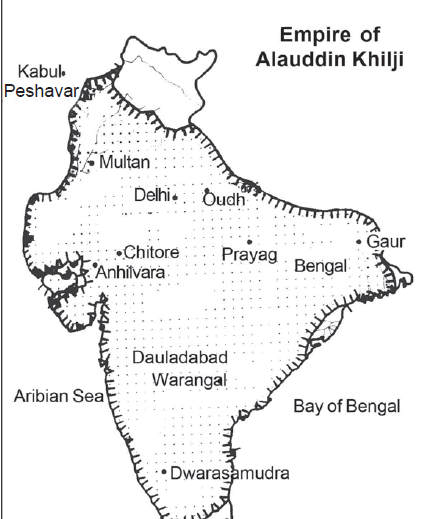
Alauddin Khilji Empire map
Military Campaigns of Alauddin Khalji
Alauddin was successful in defeating the Mongols. Alauddin Khalji sent the army six times against the Mongols, The first two times were successful.
The third time was unsuccessful but managed to defend the capital city. The next three Mongols were severely defeated and thousands of Mongols were killed.
The northwest was fortified by Gazi Malik, who was appointed as warden of Marches to protect the North-West frontier.
Sent Nusrat Khan and Ulugh Khan to capture Gujarat in 1299, and the King and his daughter escaped while the queen was captured and sent to Delhi.
Kafur, a eunuch was also taken and made the Malik Naib- Military commander. In 1301, Alauddin captured Ranthampur and after a three-month fight, Rajput women committed Jauhar or self-immolation including Rani Padmini.
Chittor Fort was captured in 1303, a powerful fort in Rajasthan after several months of fights, Raja Ratan Singh and his soldiers found and later surrendered.
Alauddin sent Malik Kafur against Devagiri ruler Ramachandra Deva but submitted rich booty.
Alauddin Khilji campaign in South India
In 1309 Malik Kafur sent against Warangal and its ruler Pratabarudra Deva was defeated and rich booty was collected.
Hoysala ruler Vira Ballala III was defeated and rich booty was taken to Delhi. Vira Pandya of Madurai was defeated, Pandya escaped from Madurai, and rich booty was taken to Delhi.
Alauddin Khalji died in 1316. The successors of Alauddin Khalji were Mubarak Shah and Khusru Shah.
Tughlaq Dynasty (1320-1414)
The governor of Dipalpur, Ghazi Malik killed Sultan Khusu Shah and ascended the throne in 1320 under the title Ghiyasuddin Tughlaq.
Ghiyasuddin Tughlaq became the founder of the Tughlaq Dynasty. He sent his son Juna Khan to fight the Pratabarudra of Warangal and returned with rich booty.
Ulugh Khan killed his father and ascended as Sultan in the name of Muhammad bin Tughlaq in 1325.
Muhammad Bin Tughlaq (1325-1351)
He was tolerant in religious matters, and an attractive character, and his ambitious schemes and experiments were ahead of time and failed miserably.
Maintained diplomatic relations with distant countries like Egypt, China, and Iran. Introduced many liberal and beneficial reforms.
He was the only Delhi Sultan who received a comprehensive literary, religious and philosophical education. Transferred his capital to make Devagiri as second capital to control South India better.
In 1327, he prepared to transfer of royal household, ulemas, and Sufis from Delhi to Devagiri which was renamed Daulatabad.
Many people died during the travel during the summer of distance 1500 km. After two years, the sultan abandoned the transfer of capital.
Token Currency
Muhammad bin Tughlaq introduced token currency in 1329-30. Due to the shortage of silver throughout the world in the 14th century, Kublai Khan issued paper currency in China.
Muhammad bin Tughlaq issued copper coins at the same value as the silver Tanka coins. Goldsmiths began to forge the token currency and soon copper was not acceptable in the market.
Then Muhammad bin Tughlaq stopped the circulation of token currency and exchanged it with silver coins. Many people exchanged copper coins for silver coins as a result the treasury became empty.
Taxation in Doab
Due to the failure of Token currency and change in capital, the treasury went almost empty.
In order to overcome the financial problems, Mohammed Bin Tuglaq increased the revenue of farmers who were between the Ganga and Yamuna rivers.
And to add fuel to the farmer’s misery, there came famine, that forced the farmer to evacuate the villages. There were even several revolts done by the farmers.
Muhammad bin Tughlaq had several harsh measures and stopped the revolt and farmers from escaping the villages.
Agriculture Reforms by Muhammad bin Tughlaq
Sultan realized that only by bringing agriculture reforms, we can improve the financial solution. He launched Takkavi loans which are loans for cultivation, for buying seeds, etc.
Diwan-i-kohi is a department for agriculture that was established. A model farm was created by the state with an area of 64 square miles, by spending 70 Lakh Tankas.
This experiment was continued by Firoz Tughlaq.
Rebellions against Mohammed bin Tuglaq
Nobles and provincial governors revolted against Muhammad bin Tughlaq’s rule. Hasan Shah a rebellion established Madurai Sultanate.
Then Vijayanagar was founded in 1336, and the Bahmini Kingdom was established in 1347. The governors of Oudh, Multan, and Sind revolted against the authority of Muhammad bin Tughlaq.
In Gujarat, Taghi rose against the sultan, Muhammad bin Tuglaq died in 1351 after his health became worse.
Firoz Tughlaq (1351-1388)
Firoz Tughlaq ascended the throne after Muhammad bin Tuglaq. He was chosen by the nobles as Sultan.
He appointed Khan-i-Jahan Maqbal as Prime Minister (Wazir), who was a converted from Telugu Brahmin. Wazir helped in administration.
Military Campaigns of Firoz Tughlaq
He tried to stop breaking the Delhi Sultanate. He concentrated his authority over the North rather than the South and Deccan. Led two expeditions to Bengal but failed.
Bengal went on to become from Delhi Sultanate. He led a military campaign against Jajnagar (Orissa) and came with rich booty from the temples.
He made the ruler of Nagarkot pay tributes. He translated 1300 Sanskrit Manuscripts to Persian which were collected from the Jawalamukhi temple library.
He crushed the revolt in the Sind region created by Thatta.
Administrative Reforms of Firoz Tughlaq
He strictly followed Ulema’s advice in administration. The Iqta system was not only revived and made hereditary. He levied taxes based on Islamic law.
Jiziya was imposed on non-Muslims. He was the first sultan to impose an irrigation tax. He dug irrigation canals and wells. There were about 1200 fruit gardens in and around Delhi yielding more revenue.
He abolished the taxon 28 items that were against Islamic law. Thousands of slaves were employed in royal factories called Karkhanas. And 300 new towns were built.
The famous one among them was Fizozabad near Red Fort in Delhi now called Firoz Shah Kotla. He repaired Jama Masjid and Qutb-Minar.
To take care of widows and orphans he created a new department called Diwan-i-Khairat. He also established free hospitals and marriage bureaus for poor Muslims.
He patronized scholars like Barani and Afif and was intolerant towards Shia and Sufis.
He was the precursor of Sikander Lodi and Aurangazeb, as he treated Hindus as second-grade citizens and imposed Jiziya. He increased slaves and reportedly had one lakh eighty thousand slaves.
He died in 1388, in the following year Delhi Sultanate disintegrated. Then Malwa and Gujarat declared their independence.
After the Timur invasion in 1398 worsened the situation, as there was no opponent, he looted Delhi for three days and murdered thousands. Timur’s invasion gave a death blow to the Tughlaq dynasty.
Sayyids
Timur appointed Khizr Khan as governor of Multan before leaving India. Khizr Khan captured Delhi and founded the Sayyid dynasty in 1414.
He tried to consolidate the Delhi Sultanate but failed. Khizr Khan died in 141 and was succeeded by his Mubarak Shah.
Muhamad Shah lost control over his nobles. Buhlul Khan Lodi dominated everything. Muhammad Shah died in 1445 and was succeeded by his son Alam Shah (1445-1451), the weakest of Sayyid kings.
He handed over the throne to Buhlul Lodi and retired to Badaun.
Lodis (1451-1526)
Lodis were Afghans. Buhlul Lodi was the first Afgan ruler while his predecessors were all Turks.
Buhlul Lodi died in 1489 and his son Sikander Lodi ascended the throne.
Sikander Lodi (1489-1517)
He was the greatest among the three Lodi sovereigns. He defeated Rajput chiefs and brought the whole of Bihar under his control.
He defeated the Bengal ruler and forced him to sign a treaty and extend the empire from Bihar to Punjab.
Sikander Lodi was a good administrator. He built roads, and irrigation facilities, and provided benefits to the farmers.
He was a bigot, he destroyed temples and imposed restrictions on Hindus. He made the Sultanate powerful.
He was succeeded by Ibrahim Lodi, his son.
Ibrahim Lodi
He was arrogant and insulted nobles openly in court. Also killed the nobles who revolted against him. Then own uncle Alauddin revolted. Daulat Khan Lodi, governor of Punjab was insulted.
The Daulat Khan Lodi invited Babur to invade India. Babur went to Delhi and killed Ibrahim Lodi in the first battle of Panipat (1526). The last ruler of the Lodi dynasty of the Delhi Sultanate was Ibrahim Lodi.
The Afghan Kingdom lasted only 75 years.
Impact of the Mongol invasions on the Delhi Sultanate
Mongols attacked Delhi during the rule of Alauddin Khalji and Muhammad Tughluq. To tackle this, the Mongol Delhi Sultanate founded new Garrison towns and had to maintain a large standing army.
The agricultural produce from the Ganga and Yamuna regions is collected as tax to feed the army. The soldiers were also fed with salaries.
This drained the Delhi Sultanate’s salary and eventually weakened the Delhi Sultanate.
Conclusion
The Delhi Sultanate, a legacy spanning over three centuries, marked a significant chapter in Indian history. Established by Qutub-ud-din Aibak in 1206, this period witnessed a fascinating blend of Islamic and Indian cultures. The dynasty saw a succession of rulers, each leaving their unique imprint on the subcontinent. From the architectural marvels of Qutub Minar and the administrative reforms of Alauddin Khilji to the religious tolerance of Firoz Shah Tughlaq, the Delhi Sultanate left a lasting impact on India’s socio-political landscape. However, the dynasty’s decline began with the eccentric rule of Muhammad bin Tughlaq, leading to its eventual dissolution in 1526 with the advent of the Mughal Empire. The Delhi Sultanate, though brief, remains a crucial period in Indian history, shaping the course of events that followed
Gupta empire is one of the earliest empire of India, have managed to rule almost the entire sub continent. During their people art, culture, science reach its zeneit.
The Imperial Guptas, the founder of this dynasty, Srigupta c, 260 AD and his son Ghatotkaca. The coins start in the reign of the third member of the dynasty, Chandragupta I, who was the first to use the imperial title maharajadhiraja, who was known as the actual founder of the Gupta era, the first year of which is 319-20 AD.
The Gupta era, the period of Gupta supremacy in Northern India, starts with 319-20 AD and ends with the death of Skandagupta in 480 AD.
After the death of Skandagupta, the Hunas attacks started, and probably also internal conflicts led to divisions of the Empire. The later Gupta period comes to an end in 606 AD, when Harsavardha of Kannuj gained supreme power over the whole of Northern India.
Sources of the Guptas and the Rise of the Gupta Empire
The rise of the Guptas is provided by the literary work Devichandraguptam and the Mudhrakshasam written by Visakadatta. Chinese traveller Fahien visited during Chandragupta II and wrote about the social, economic, and religious conditions of the Gupta Empire.
The achievement of Chandragupta I is found in the inscriptions from the Mehrauli Iron Pillar Inscription and the Allahabad Pillar Inscription.
Iron pillar of Gupta period -Image By Sujit Kumar – Own work, CC BY-SA 3.0, https://commons.wikimedia.org/w/index.php?curid=2770523
The personality and achievements are written in classical Sanskrit using Nagari script, which consists of 33 lines composed by Harisena on the Asokan Pillar. The Asokan pillar inscription says about Samudragupta’s accession and relationship with the ruler, Samudragupta as a poet and scholar, and his military campaigns in North India and the Deccan.
Gupta era coins contain legends and figures, thus providing details about titles and sacrifices.
Iron Pillar of the Gupta Period
It is made of 98% wrought iron, and it is considered an achievement in metallurgy as it has not been destroyed due to rusting and still stands strong for more than 1600 years.
This pillar was erected during Chandragupta II for the God Vishnu in the 4th century AD. Its height is 7.2 meters, its diameter is 40.64 cm, and its weight is over 6 tonnes. It is located in the Qutb complex at Mehrauli in Delhi, and it has inscriptions of the time of Gupta rule.
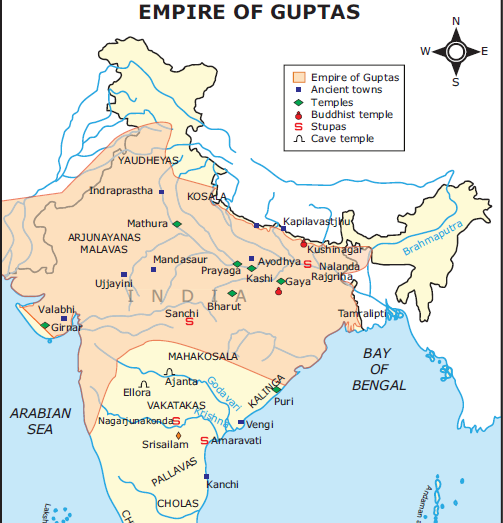
Map of the Empire of the Guptas
Chandragupta I (320-330 A.D)
“Sri Gupta” is the founder of the Gupta Dynasty and was succeeded by Ghatotkacha, and these two were called Maharajas. The next ruler was Chandragupta I, and he was called Maharajadhiraja (The great king of Kings) due to his extensive conquests.
He married Kumaradevi, Princess of Licchavis, and strengthened his position. Mehrauli Iron Pillar inscriptions are important as they mention the details of his conquest. Chandragupta is considered the founder real founder of the Gupta dynasty due to the extensive conquest that started in 320 AD.
The original capital of the Gupta empire seems to be Pataliputra, and the inscription Licchavayah, which occurs on Gold coins together with the name of his queen Kumaradevi, may denote that she belonged to the royal family of Licchavis.
Samudragupta(330-380 AD)
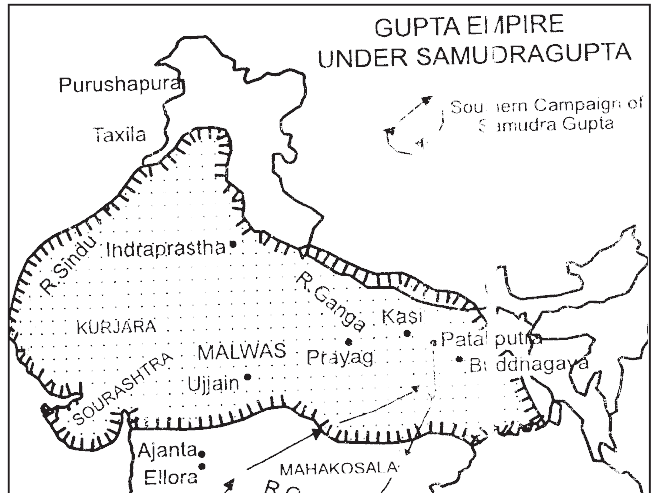
Samudragupta empire map
The greatest ruler of the Gupta Dynasty. The Allahabad pillar inscription of samudragupta provides his detailed account. His military conquest was divided into three stages, as mentioned in the Allahabad inscription.
The first one is against some rulers of North India, the second one is his Dakshinapatha expedition, which is against southern rulers, and the third one is against other rulers of North India. First Campaign of Samudragupta – Samudragupta defeated Achyuta and Nagasena. Achyut, a Naga ruler and Nagasena, ruled the upper Gangetic valley and belonged to the Kota family.
The policy of Samudragupta for the south is different; he insisted on authority in the south and did not annex it into his kingdom. The Third Campaign- His third campaign was to eliminate the remaining north India rivals. He annexed 9 kingdoms of the North; most of these kings were of the Naga family.
After victories, Samudragupta performed the Ashwamedha sacrifice and issued gold and silver coins with the legend ‘restorer of the Ashwamedha. Samudragupta is also called the Indian Napoleon. The extent of Samudragupta’s Empire:
Upper Gangetic Valley, the modern Uttar Pradesh, part of central India, and the Southwest part of Bengal were directly under the administration of Samudragupta.
Saka and Kushana of the west and northwest were under the influence of Samudragupta. The Pallava kingdom, the east coast of the Deccan, was under Suzerainty.
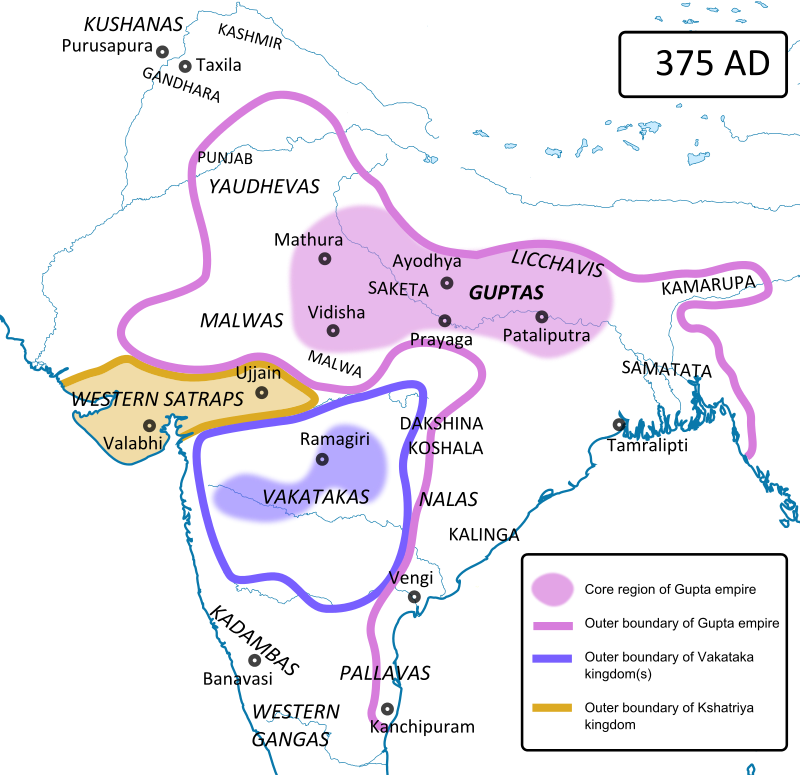
Gupta Empire map
Estimate of Samudragupta
Samudragupta’s military achievements and his accomplishments were described in the Allahabad inscriptions. Called “Kaviraja” for his ability in composing, intellect, poetry, and skill in music.
Coins depicting Samudragupta with a veena were issued. Harisena was a famous poet and scholar during Samudragupta’s period and also a patriot of many scholars and poets.
Followed Vaishnavism and was tolerant of other religions, and also a patron of Buddhist scholar Vasubandhu.
Chandragupta II(380-415 A.D)
Son of Samudragupta. According to some scholars, Ramagupta, the elder brother of Chandragupta II, was the immediate successor to the throne.
Chandragupta II was a military genius and extended the Gupta empire through the combination of warfare and diplomacy.
Chandragupta II married Kubernaga, a Naga princess of central India, and gave his daughter Prabhavati to Rudrasena II, prince of Vakataka.
Vakataka had a strategic position in the Deccan. Through the matrimonial alliance with Vakataka, Chandragupta II had the conquest of Western India against the Sakas.
Achievement of Chandragupta 2
Rudrasimha III, the last ruler of the Sakas satrap of Western India, was killed by Chandragupta II and his territories in western Malwa and Kathiawar were annexed.
After the victory, Chandragupta II performed a horse sacrifice and assumed the title Sakari( Destroyer of Sakas). Chandragupta II called himself “Vikramaditya”.
The western boundary got extended up to the Arabian Sea, Broach, Sopara, Cambay, and other seaports got under its belt. The empire controlled trade with Western countries.
Ujjain became an important city and an alternative capital. Fine cotton clothes of Bengal, scents of the Himalayas, Indigo from Bihar, spices, and sandals from the south were traded in return for Roman Gold from these ports.
The Gupta empire issued a variety of gold coins. Chandragupta II defeated the chiefs in Vanga, crossed the river Sindh and conquered Bactria; the Kushanas were subdued.
The territories reached western Malwa, Gujarat and Kathiawar, and the Hindukush up to Bactria in the northwest. Even eastern Bengal and south of the Narmada River were boundaries.
Contributed to cultural progress and patronised great scholars such as Kalidasa. His age is considered a Golden age in cultural progress. Chinese traveller and pilgrim, Fahien visited during the Chandragupta II period.
Fa Hien Gupta Empire: Chinese traveller Fa Hien visited India during the reign of Chandragupta II
Fa Hien visited during the Chandragupta II period. Stayed 9 years in India, and spent 6 years in the Guptas empire.
Through Khotan, Kashgar, Gandhara, and Punjab, India was reached by land route. The other places visited are Bodh Gaya, Kasi, Peshawar, Mathura, Kanauj, Sravasti, Kusinagara, Pataliputra, and Kapilavastu.
Returned via sea route after visiting Ceylon and Java. The purpose of the visit was to collect Buddhist manuscripts and to see the land of Buddha.
He stayed in Pataliputra for three years to study Sanskrit and copy Buddhist preaching for his texts. Fa Hien provided valuable information on the social, religious, and economic conditions of the Gupta empire.
According to Fa Hien, Buddhism was great in North-Western India, and the Gangetic Plain was the “Land of Brahmanism”. Mentions holy places such as Kapilavastu and Kusinagara were in an unsatisfactory state for Buddhism.
According to Fa Hien, the Gupta empire’s economy was satisfactory. Fa Hien characterises Gupta’s administration as mild and benevolent.
No state interference in the public’s life, and people enjoyed freedom and no restriction on their movement. No severe punishments, only fines were imposed, and there was no spy system.
The state was generally prosperous, and crimes were negligible. Fa Hien also appreciated the administration, as the roads were generally safe for travellers and the administration was better than that of the Mauryas.
Fall of the Gupta Empire
Kumaragupta was the son of Chandragupta II, who was his successor. His government was generally marked by peace and prosperity. He also performed the Asvamedha sacrifice and issued many coins.
Kumaragupta laid the foundation of Nalanda University. At the end of his reign, “Pushyamitras“, a wealthy trib,e defeated Gupta’s army.
Huns from central Asia crossed the Hindukush mountains to invade India. Skandagupta fought successfully and saved the empire from the Huns. This war led to a lot of wastage of the empire’s resources.
Skandagupta’s death, his successors Purugupta, Narasimhagupta, Buddhagupta, and Baladitya were defeated by the Huns and were unable to save the empire from the Huns. The empire completely fell due to the Huns’ invasion and by Yasodharman in Malwa.
Administration of the Gupta Empire
Gupta kings assumed titles such as Samrat, Chakravartin, Parameswara, Paramabhattaraka, and Maharajadhiraja.
The kings were assisted by the chief minister, Senapati (Army chief or commander), and other officials. Sandivigraha, a high official, is probably the minister of foreign affairs.
Maintained provincial administration through officials called Kumaramatya and Ayuktas. Provinces were known as Bhukti,s and provincial governors were called Uparikas.
The Uparikas were chosen among the princesses. Bhuktis were divided into Vishyas or districts and governed by Vishyapatis.
The officers of the city administration were called Nagara Sreshtis. Gramikas control villages in the districts.
Literature during the Gupta Empire period
Sanskrit was patronised during the Gupta period. The Nagari script evolved from the Brahmi script.
Great works of Sanskrit in the written form of epic, lyrics, drama, and prose belonged to the Gupta period. The court of Chandragupta II was filled with Navratnas.
The navratnas of Chandragupta 2 are as follows:
The foremost Navratna was Kalidasa, who wrote Shakuntala, which is considered one of the hundred best books in the world and also wrote two plays, Malavikagnimitra and Vikramorvasiya. His epics are Raghuvamsa and Kumarasambhava, and his lyrics are Ritusamhara and Meghaduta.
Visakadatta, author of two Sanskrit dramas, Mudrarakshasa and Devichandraguptam. Sudraka was the poet of Mrichchakatika, which is rich in humour and pathos.
Bharavi’s Kritarjuniya is the story of the Siva and Arjun conflict. Kavyadarsa and Dasakumaracharita were written by Dandin.
Vasavadatta was written by Subhandhu. Vishnusarma composed Panchatantra stories. Amarakosa, a lexicon by Buddish author Amarasimha. Puranas were composed during this period. There were eighteen Puranas, the most important were Bhagavata, Vishnu, Vayu, and Matsya Puranas.
The present form of Mahabharatha and Ramayana was composed during this period.
Science Development during the Guptas Empire Period
Aryabhatta, a great mathematician and astronomer wrote the book in 499 AD that deals with maths and astronomy, which explains solar and lunar eclipses.
Aryabhatta was the first to declare earth was spherical and rotates on its axis, this observation was later rejected by Varahamihira and Brahmagupta.
Varahamihira composed Pancha Siddhantika (Five astronomical systems) and his work Brihadsamhita is a great Sanskrit literature work that deals with weather, astronomy, geography, architecture, animals, marriage, astrology, and omens.
Varahamihira’s Brihadjataka is considered a standard for astrology.
Vagbhata, a great physician lived during the Gupta period and was the author of Ashtangasamgraha which is eight branches of medicine. Another great medical scholars such as Susruta, and Charaka lived before the Gupta age.
Gupta EmpireCulture, Caste and Women Status during the Guptas Empire Period
Foreign residents made permanent residents. The caste system became rigid. Brahmins occupied the top of society and were given enormous gifts by the rulers and wealthy people.
The practice of untouchability slowly began to rise. Fahien mentions Chandalas, low caste people separated from society and their conditions were miserable.
The status of women was miserable and they were prohibited from studying Vedic texts and Puranas. Women were made inferior to men, they started practising during this period.
The practice of Swyamvara was given up and early marriage for girls was done as suggested by Manusmriti. Brahmanism reached supreme status during the Gupta period. Brahmanism has two branches Vaishnavism and Saivism. The Guptas were mostly Vaishnavaites and they period horse sacrifices known as Aswamedha.
Brahmanism’s progress caused the decline of Buddhism and Jainism in the Gangetic Valley. In western and southern India, Buddhism and Jainism flourished. The great Jain council was held at Valabhi and the Jain holy book Swetambras was written.
The above article is taken from the Old Tamil State Board book, which is extremely helpful TNPSC exam. Also can be referred for UPSC and other service commission exams.
Some Extra Facts of the Gupta Empire
The Allahabad pillar inscription was composed by Harisena, court poet and minister of King Samudragupta. These inscriptions were called Prashasti, a Sanskrit word that means “in Praise of”.
Gupta’s empire culture
The Hindu epic’s final touches were during the Gupta period, and the Hindu religion flourished and moved to the rest of the sub-continent during this period.
The evil Caste system grew during the period of the Guptas. The Guptas patronised Vaishnavism and were also tolerant toward Buddhism and Jainism.
Gupta patronised Buddhist art. The Shakti cult rose in the period of the Guptas. The sacrifice practice of Vaishnavism or Hinduism was replaced by Bhakti and pooja.
Tantrism practice also emerged during this period . Chaturanga, meaning four-division, now called the Chess game, also emerged during the Gupta period.
Extent of the Gupta Empire
The greatest extent the Gupta empire seems to have comprised the whole of Northern India, with the exception of the Panjab, which continued to be ruled by the Kusanas.
* * All the Notes in this blog, are referred from Tamil Nadu State Board Books and Samacheer Kalvi Books. Kindly check with the original Tamil Nadu state board books and Ncert Books.