Social justice in Indian Constitution Upsc

Article 38(2) states “The State shall, in particular, strive to minimize the inequalities in income, and endeavor to eliminate inequalities in status, facilities, and opportunities, not only amongst individuals but also amongst groups of people residing in different areas or engaged in different vocations”.

This was kept in mind by the planners in formulating each of the plans. Ensuring social justice has gone hand in hand with economic planning.

Along with measures for development, it is also important to give equal opportunities to all with regard to education and employment.

The establishment of a socialistic pattern of society ensured that there will be no concentration of wealth in the hands of a few so that exploitation and oppression could be ended.

Historically, the Indian society has fostered exploitation and suppression of one section by another.

It was a challenge to the constitution-makers to tackle all these traditional forces and social evils so that social and economic justice could be realized.

The justiciable rights under Part III of the constitution dealing with Fundamental rights enable the citizens to get protection for all the rights required to live a complete life.

The non-justiciable rights under Part IV on Directive Principles of State Policy ensure that the system functions in such a way that the inequalities of income among people are reduced and egalitarian society is established.

Water resource management in India

Since there is a declining availability of fresh water and increasing demand, the need has arisen to conserve and effectively manage this precious life-giving resource for sustainable development.

Given that water availability from sea/ocean, due to the high cost of desalination, is considered negligible, India has to take quick steps and make effective policies and laws, and adopt effective measures for its conservation.

Besides developing water-saving technologies and methods, attempts are also to be made to prevent pollution. There is need to encourage watershed development, rainwater
harvesting, water recycling, and reuse, and conjunctive use of water for sustainable water supply in long run.

Recycle and Reuse of Water

Another way through which we can improve freshwater availability is by recycling and reusing. The use of water of lesser quality such as reclaimed wastewater would be an attractive option for industries for cooling and fire fighting to reduce their water cost.

Similarly, in urban areas, water after bathing and washing utensils can be used for gardening. Water used for washing vehicles can also be used for gardening.

This would conserve the better quality of water for drinking purposes. Currently, the recycling of water is practiced on a limited scale. However, there is enormous scope for replenishing water through recycling.

Watershed Management

Watershed management basically refers to the efficient management and conservation of
surface and groundwater resources. It involves the prevention of runoff and storage and recharge of groundwater through various methods like percolation tanks, recharge wells, etc.

However, in broad sense watershed management includes conservation, regeneration and judicious use of all resources – natural (like land, water, plants, and animals) and the human within a watershed.

Watershed management aims at bringing about a balance between natural resources on the one hand and society on the other. The success of watershed development largely depends upon community participation.

The Central and State Governments have initiated many watershed development and management programmes in the country. Some of these are being implemented by non-
governmental organizations also.

Haryali is a watershed development project sponsored by the Central Government which aims at enabling the rural population to conserve water for drinking, irrigation, fisheries, and
afforestation. The Project is being executed by Gram Panchayats with people’s participation.

Neeru-Meeru (Water and You) programme (in Andhra Pradesh) and Arvary Pani Sansad
(in Alwar, Rajasthan) have taken up constructions of various water-harvesting structures such as percolation tanks, dug out ponds (Johad), check dams, etc., through people’s participation.

Tamil Nadu has made water harvesting structures in the houses compulsory. No building can be constructed without making structures for water harvesting.

Watershed development projects in some areas have been successful in rejuvenating environment and economy.

However, there are only a few success stories. In majority of cases, the programme is still in its nascent stage.

There is a need to generate awareness regarding the benefits of watershed development and management among people in the country, and through this integrated water resource management approach, water availability can be ensured on a sustainable basis.

Rainwater Harvesting

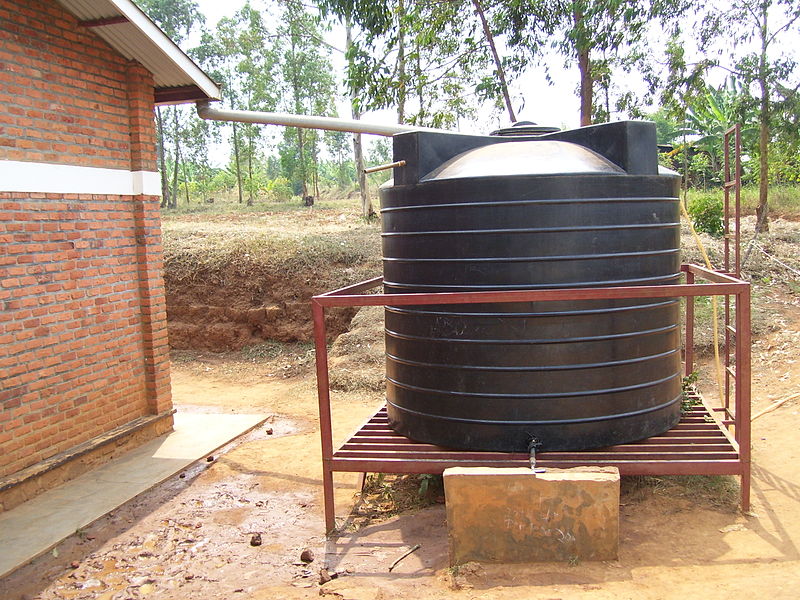
Rainwater harvesting is a method to capture and store rainwater for various uses. It is also
used to recharge groundwater aquifers. It is a low-cost and eco-friendly technique for preserving every drop of water by guiding the rainwater to borewells, pits, and wells.

Rainwater harvesting increases water availability, checks the declining groundwater table, improves the quality of groundwater through dilution of contaminants, like fluoride and nitrates, prevents soil erosion, and flooding and arrests saltwater intrusion in coastal areas if used to recharge aquifers.

Rainwater harvesting has been practised through various methods by different communities in the country for a long time.

Traditional rainwater harvesting in rural areas is done by using surface storage bodies, like lakes, ponds, irrigation tanks, etc.

In Rajasthan, rainwater harvesting structures locally known as Kund or Tanka (a covered underground tank) are constructed near or in the house or village to store harvested rainwater.

There is a wide scope to use rainwater harvesting techniques to conserve precious water resources. It can be done by harvesting rainwater on rooftops and open spaces.
Harvesting rainwater also decreases the community dependence on groundwater for
domestic use.

Besides bridging the demand-supply gap, it can also save energy to pump
groundwater as recharge leads to a rise in the groundwater table. These days rainwater harvesting is being taken up on a massive scale in many states in the country.

Urban areas can specially benefit from rainwater harvesting as water demand has already outstripped supply in most of the cities and towns.

Apart from the above mentioned factors, the issue desalinisation of water particularly in coastal areas and brackish water in arid and semi-arid areas, transfer of water from water surplus areas to water deficit areas through interlinking of rivers can be important remedies for solving the water problem in India (read more about interlinking of rivers).

However, the most important issue from the point of view of individual users, households, and communities is the pricing of water.
General Scientific Laws for Tnpsc pdf

Archimedes law

Archimedes’ principle states that the upward buoyant force that is exerted on a body immersed in a fluid, whether fully or partially, is equal to the weight of the fluid that the body displaces. Archimedes’ principle is a law of physics fundamental to fluid mechanics.

Snell’s law

To describe the relationship between the angles of incidence and refraction, when referring to light or other waves passing through a boundary between two different isotropic media, such as water, glass, or air.

Snell’s law states that the ratio of the sines of the angles of incidence and refraction is equivalent to the ratio of phase velocities in the two media, or equivalent to the reciprocal of the ratio of the indices of refraction:

n1/n2 = sin α2/sin α1

Law of floatation

Any object, totally or partially immersed in a fluid or liquid, is buoyed up by a force equal to the weight of the fluid displaced by the object.

Newtons 3 Laws

Newtons First Law

Every object continues its state of rest or state of motion until an external force acts on it.

Newtons Second Law

The Rate of Change of the momentum of a body is equal to the magnitude and direction of the force imposed on it.

F = ma

Newtons Third Law

For every action, there is an equal and opposite reaction.

Law of Conservation of Energy

The law of conservation of energy says that “Energy is neither created nor destroyed“. The energy changes from one form to another form.

Boyle’s Law

Boyle’s Law is gas law, “The absolute pressure exerted by a given mass of an ideal gas is inversely proportional to the volume it occupies if the temperature and amount of gas remain unchanged within a closed system“.

Charles’ Law -1

The volume occupied by a fixed amount of gas is directly proportional to its absolute temperature and if the pressure remains constant.

That is the volume of a gas at constant temperature is directly proportional to its absolute temperature.

Charles law-2

Dobereiner law of triads

Law of Octaves

“If the Chemical elements are arranged as per increasing atomic weight, those with similar physical and chemical properties occur after each interval of seven elements“

Mendeleev’s periodic law

Kepler’s law

Kepler’s First Law

“The orbit of every planet is an ellipse with the sun at one of two foci.”

Kepler’s Second Law

“A line joining a planet and the Sun sweeps out equal areas during equal intervals of time.”

Kepler’s Third Law

“The ratio of the square of an object’s orbital period with the cube of the semi-major axis of its orbit is the same for all objects orbiting the same primary.”

The universal law of gravitation

Newton’s universal law of gravitation states that ” Every particle attracts every other particle in the universe with a force that is directly proportional to the product of their masses and inversely proportional to the square of the distance between their centers“.

Bernoulli’s Principle

Bernoulli’s Principle states that, In fluid dynamics, “an increase in the speed of a fluid occurs simultaneously with a decrease in static pressure or a decrease in the fluid’s potential energy“.

Lens formula

If the distances from the object to the lens and from the lens to the image are S1 and S2 respectively, for a lens of a negligible thickness (thin lens), in air, the distances are related by the thin lens formula.

1/f = 1/S1 + 1/S2

Coulomb’s law

“The force of attraction or repulsion acting along a straight line between two electric charges is directly proportional to the product of the charges and inversely to the square of the distance between them“

Ohms Law

“The current flowing through a conductor between two points is directly proportional to the voltage across the two points and inversely proportional to the Resistance“.

I = V/R

Pascal’s Law

“In a fluid (gas or liquid) at rest in a closed container, a pressure change in one part is transmitted without loss to every portion of the fluid and to the walls of the container.“

Avogadro’s Law

Under the same conditions of temperature and pressure, equal volumes of different gases contain an equal number of molecules.

The specific number of molecules in one gram-mole of a substance, defined as the molecular weight in grams, is 6.02214076 × 10²³, a quantity called Avogadro’s number, or the Avogadro constant.

Brownian motion

“It is a random motion of particles suspended in liquid or gas, that results with the fast-moving atoms or molecules in the gas or liquid. Example: Motion of pollen grains on still water and motion of dust particle in-room seen in sunlight.

Raman effect

Raman scattering or the Raman effect is the inelastic scattering of photons by matter, meaning that there is both an exchange of energy and a change in the light’s direction.

General Scientific Law for Tnpsc Pdf

References

To a millionaire poem Tnpsc

The world in gloom and splendour passes by,
And thou in the midst of it with brows that gleam,
A creature of that old distorted dream
That makes the sound of life an evil cry.
Good men perform just deeds, and brave men die,
And win not honour such as gold can give,
While the vain multitudes plod on, and live,
And serve the curse that pins them down: But I
Think only of the unnumbered broken hearts,
The hunger and the mortal strife for bread,
Old age and youth alike mistaught, misfed,
By want and rags and homelessness made vile,
The griefs and hates, and all the meaner parts
That balance thy one grim misgotten pile.

Be glad your nose is on your face poem Tnpsc

Be glad your nose is on your face,
not pasted on some other place,
for if it were where it is not,
you might dislike your nose a lot.

Imagine if your precious nose
were sandwiched in between your toes,
that clearly would not be a treat,
for you’d be forced to smell your feet.

Your nose would be a source of dread
were it attached atop your head,
it soon would drive you to despair,
forever tickled by your hair.

Within your ear, your nose would be
an absolute catastrophe,
for when you were obliged to sneeze,
your brain would rattle from the breeze.

Your nose, instead, through thick and thin,
remains between your eyes and chin,
not pasted on some other place—
be glad your nose is on your face!

Dont quit poem Tnpsc

When things go wrong, as they sometimes will,
And the road you’re trudging seems all uphill,
When the funds are low and the debts are high,
And you want to smile, but you have to sigh,
When care is pressing you down a bit,
Rest if you must, but don’t you quit.

Life is queer with its twists and turns,
As every one of us sometimes learns.
And many a failure turns about
When he might have won had he stuck it out.
Don’t give up though the pace seems slow,
You may succeed with another blow.

Often the goal is nearer than it seems
To a faint and faltering man.
Often the struggler has given up when he
Might have captured the victor’s cup,
And he learned too late when the night slipped down,
How close he was to the golden crown.

Success is failure turned inside out,
The silver tint of the clouds of doubt,
And you never can tell how close you are.
It may be near when it seems afar.
So stick to the fight when you’re hardest hit.
It’s when things seem worst that
You musn’t quit.

A sonnet for my incomparable mother poem Tnpsc

I often contemplate my childhood, Mom.
I am a mother now, and so I know
Hard work is mixed together with the fun;
You learned that when you raised me long ago. -4

I think of all the things you gave to me:
Sacrifice, devotion, love and tears,
Your heart, your mind, your energy and soul-
All these you spent on me throughout the years. -8

You loved me with a never-failing love
You gave me strength and sweet security,
And then you did the hardest thing of all:
You let me separate and set me free. -12

Every day, I try my best to be
A mother like the mom you were to me. – 14

About

This poem is written by F.Joanna. The poet is from the UK (United Kingdom).

Line 1 to 4

I often contemplate my childhood, Mom.
I am a mother now, and so I know
Hard work is mixed together with the fun;
You learned that when you raised me long ago
.

‘I’ here is referred to the poet, F.Joanna. The poet contemplates her childhood in this poem. The poet thinks of her mother and the hard work done by her mother in raising the poet.

Line 5 to 8

I think of all the things you gave to me:
Sacrifice, devotion, love, and tears,
Your heart, your mind, your energy, and soul-
All these you spent on me throughout the years.

Line 5 to 8 discusses the things done by her mothers such as sacrifice, devotion, love, and tears. Also, her mother spent her heart, mind, energy, and soul in raising the poet (F.Joanna).

Line 9 to 12

You loved me with a never-failing love
You gave me strength and sweet security,
And then you did the hardest thing of all:
You let me separate and set me free.

Line 9 to 12 discusses the love of her mother towards her (F.Joanna). She says that her mother loved her, that never failed. Also, say that her mother gave her strength and security. The poet also says that the hardest thing done by her mother is the separation and setting her (poet) free.

Line 13 and 14

Every day, I try my best to be
A mother like the mom you were
to me.

In the last two lines, the poet (F.Joanna) tries her best to be like her mother. That Joanna is a good mother to her children like her own mother.

Figures of Speech

Simile, Alliteration, Anaphora, Assonance, and Repetition are used in the poem

Rhyming words from the poem

  • Line 6 and 8 – Tears and Years.
  • Line 12, 13 and 14 – Free, Be and Me
  • Line 7 and 11 – Soul and all

Alliteration in Poem

  • Contemplate-Childhood
  • Work-With
  • Learned-Long
  • Think-the things
  • These-Throughout
  • Loved-Love
  • Strength-Sweet security
  • Then-Thing
  • Separate-Set
  • Best-Be
  • Mother-Mom

Simile

A mother like the mom you were to me

Anaphora

I often contemplate my childhood, Mom.
I am a mother now, and so I know

You loved me with a never-failing love

You gave me strength and sweet security.

Repetition

Your heart, your mind, your energy and soul

The apology poem Tnpsc

Think me not unkind and rude,
That I walk alone in grove and glen;
I go to the god of the wood
To fetch his word to men.

Tax not my sloth that I
Fold my arms beside the brook;
Each cloud that floated in the sky
Writes a letter in my book.

Chide me not, laborious band,
For the idle flowers I brought;
Every aster in my hand
Goes home loaded with a thought.

There was never mystery,
But ’tis figured in the flowers,
Was never secret history,
But birds tell it in the bowers.

One harvest from thy field
Homeward brought the oxen strong;
A second crop thine acres yield,
Which I gather in a song.

The flying wonder poem Tnpsc

“Said Orville Wright to Wilbur Wright,
“These birds are very trying.
I’m sick of hearing them cheep-cheep
About the fun of flying.
A bird has feathers, it is true.
That much I freely grant.
But must that stop us, W?”
Said Wilbur Wright,”It shan’t.”
And so they built a glider, first,
And then they built another.
-There never were two brothers more
Devoted to each other.
They ran a dusty little shop
For bicycle repairing.
And bought each other soda-pop
And praised each other’s daring.
They glided here, they glided there,
They sometimes skinned their noses.
-For learning how to rule the air
Was not a bed of roses-
But each would murmur, afterward,
While patching up his bro.
“Are we discouraged, W?”
Of course we are not, O!”
And finally, at Kitty Hawk
In Nineteen-Three (let’s cheer it!),
The first real aeroplane really flew
With Orville there to steer it!
-And kingdoms may forget their kings
And dogs forget their bites,
But not till Man forgets his wings,
Will men forget the Wrights.

Earth Poem Tnpsc

How beautiful you are, Earth, and how sublime!
How perfect your obedience to the light and how noble is your submission to the sun.

I have walked over your plains,
I have climbed your stony mountains
I have descended into your valleys;
I have entered into your caves.
On the plains, I have discovered your dreams,
On the mountains, I have admired your splendid presence.
And in the valleys, I have observed your tranquility;
In the caves, I have touched your mysteries.

We pierce your bosom with swords and spears.
And you dress our wounds with oil and balsam
We plant your fields with skulls and bones.
And from them, you rear cypress and willow trees,
We empty our wastes in your bosom and you fill
Our threshing floors with wheat sheaves,
And our winepresses with grapes.

We extract your elements to make
Cannons and bombs but out of
Our elements you create lilies and roses
How patient you are Earth, and how merciful!
Are you an atom of dust raised by
The feet of God when He journeyed from
The East to the West of the Universe?

Who are you, Earth, and what are you?
You are “I”, Earth!
You are my sight and my discernment.
You are my knowledge and my dream
You are my hunger and my thirst.
You are my sorrow and my joy.
You are the beauty that lives in my eyes
The longing in my heart, the everlasting life in my soul!
You are ”I” Earth,
Had it not been for my being,
You would not have been!

* * All the Notes in this blog, are referred from Tamil Nadu State Board Books and Samacheer Kalvi Books. Kindly check with the original Tamil Nadu state board books and Ncert Books.