Armed Forces Special Powers Act Upsc

Armed forces (Special Powers Act)

It is stringent law that allows the armed forces to use maximum powers in certain regions which are declared as “Disturbed”.

Disturbed area

When a state or part of it is at continued unrest such as cases of militancy and insurgency and especially its borders are threatened. By Act 7 of 1972, the power to declare an area as disturbed was extended to the central government.

In Such areas, the Officer of Armed forces has powers to:

The officer can use Firing or any other means against a person, even it may cause death when that person is acting against the law. This is done to restore the public order in that disturbed area after giving an early warning.

Also, An Officer can arrest anyone without any warrant, who has committed cognizable offences or is reasonably suspected. The officer may use force if needed for the arrest.

Also, An Officer can enter and search any premises to make such an arrest, recover any arms and ammunition.

Also, An officer can stop and search any vehicle, that is reasonably suspected to carry weapons or such persons.

States under Armed Forces Special Powers Act

Most parts of North Eastern States. The whole of Assam and Nagaland. Whole Manipur with an exception of Imphal Municipal area.

In Arunachal Pradesh, disturbed areas are districts of Tirap, Changlang, Longding, and areas of Namsai and Mahadevpur police station bordering Assam.

Jammu and Kashmir have a separate J&K Armed forces (Special Powers) Act 1990.

Demand of Repeal of AFSPA

Several sections of civil society and Human rights organizations argue that this Act encourages impunity. Also, this causes excess atrocities by armed forces under its protective cover, argued by Human rights activists.

Irom Chanu Sharmila, an activist sat on an indefinite fast in 2000 and ended her fast in August 2016.

By this Government appointed a committee headed by retired Supreme Court Judge, B.P. Jeevan Reddy. The committee recommended the repeal of AFSPA. Also suggested it could be replaced with the Unlawful Activities (Prevention) Act.

Ukraine Russia conflict summary Upsc

Ukraine Russia conflict summary

Ukraine Russia conflict summary Upsc

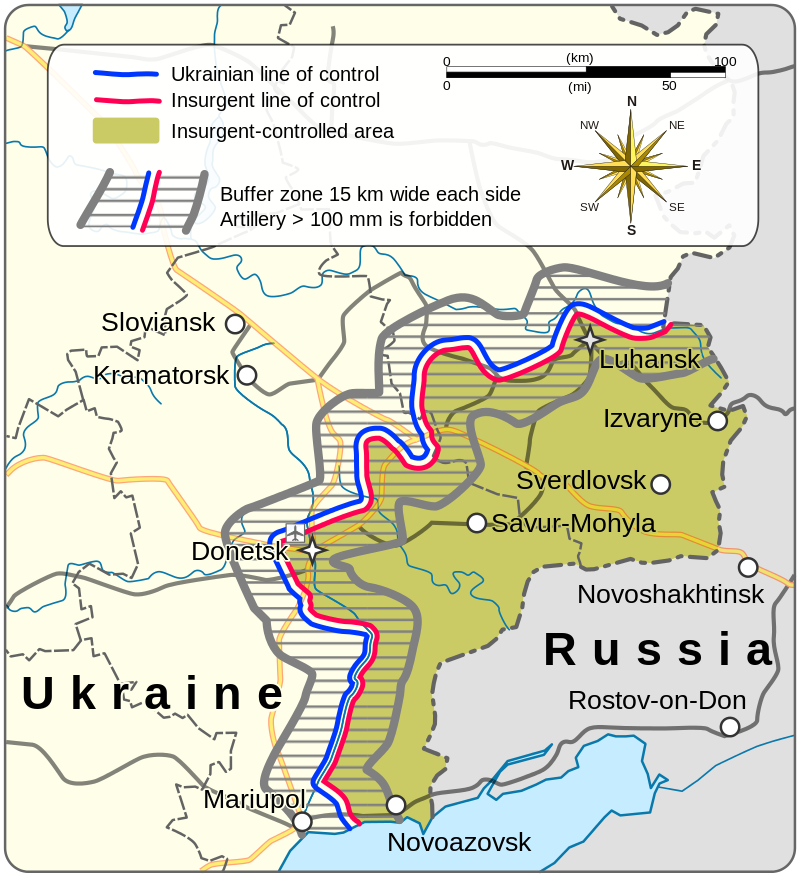
A Small region in eastern Ukraine known as Donbas adjoins the Russian border. This region has frequent Military conflicts. In region was incorporated into the newly created Ukrainian People’s Republic in 1918, after the fall of the Russian Empire.

After this Bolsheviks were fighting the civil war against the remnants of the old regime. After this Donbas became part of the Ukrainian Soviet Socialist Republic.

World War-2

During World War-2, the Nazis took control of the Donbas region. During this conflict 3,00,000 civilians of the Donbas were killed. After World War-2, the Red Army took over the control of Donbas.

The disintegration of Soviet Union

The Soviet Union of Russia was disintegrated during 1991. As a result, the Soviet Union was broken into several countries. As the result the regions such as Donetsk, Luhansk Oblast went to the Ukrainian nation.

But today, Donetsk, Luhansk became self-declared republics run rebels. These rebels were backed Russian Federation.

Ukraine Russia conflict overview

The Ukraine Russian conflict started in 2013 with a Euromaidan protest in Ukraine. The Pro-western protesters forced President Viktor Yanukovych to resign. Finally, he resigned in 2014. After, this counter-protest broke in the Crimean Peninsula and Donbas.

In Crimea and Donbas regions, the majority of people speak Russian.

Russia annexation of Crimea

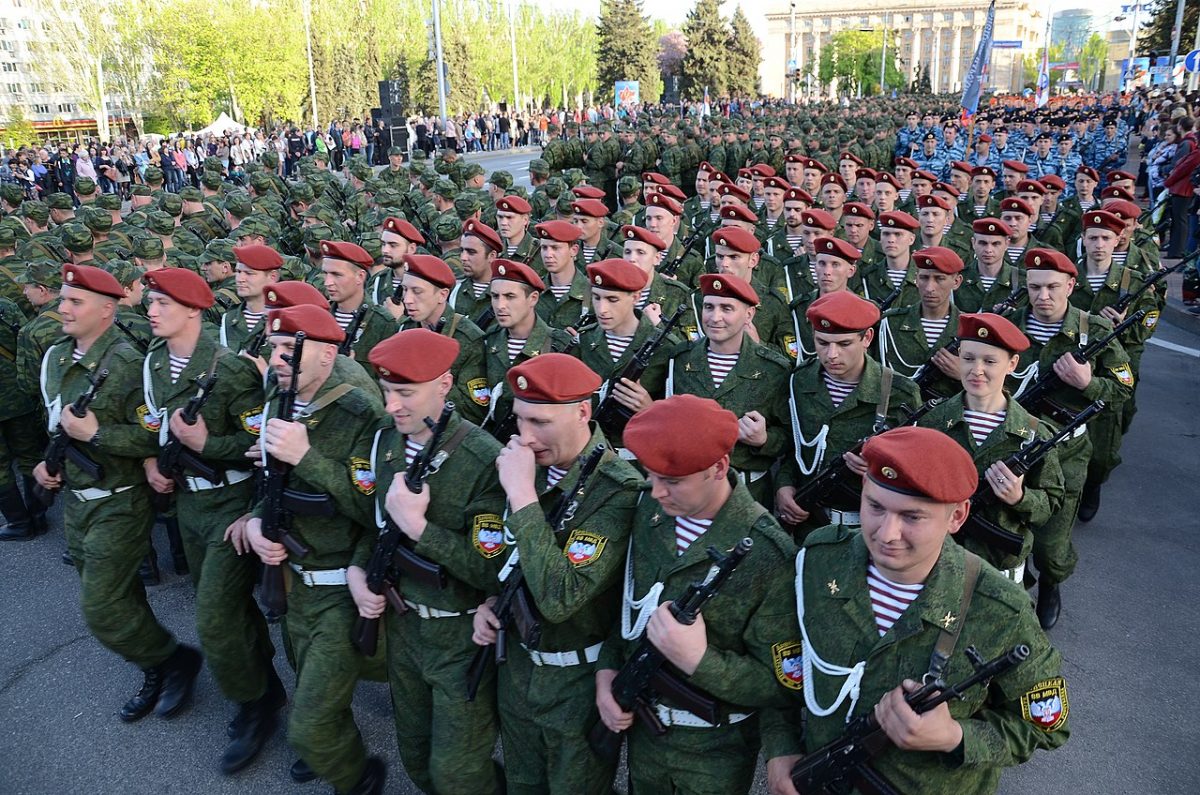
Russia annexed Crimea in 2014. Immediately after the annexation, protests were started in Donbas. These protests become Armed rebellions. Also in 2014, separatists declared self-rule in Donetsk and Luhansk.

The western countries and Ukraine accused Russia of supplying Arms and Weapons to the region to fight against Ukraine’s Military personnel.

Pro Russian Rebels in Donetsk

Russia’s Statement on Insurgency

But Russian said that they have nothing to do with Insurgency.

“Was forced to defend the Russian speaking population in the Donbas”

Vladimir Putin

The largest minority in Donbas is Russian language speaking people. But the largest people in Ukraine are ethnic Ukrainians. Also, 70% of the population across different ethnic groups speaks Russian.

The Russian Official statement said that “Post Yanukovych regime in Kiev or Kyiv is discriminatory to Russian-speaking people in the east.

Minsk Protocol

Ukraine Military was unable to defeat the Russian-backed rebels. As a result, Ukraine agreed to the Minsk Protocol 2014. This Protocol earlier had talks between Ukraine, Rebels, and Russia. Minsk protocol was mediated by France and Germany.

This agreement called for an Immediate Ceasefire in the region. But this agreement collapsed. After the collapse of the Minsk protocol, the Ukraine Trilateral Contact Group comprised of representatives of Russia, Ukraine, and OSCE called for another summit.

This summit was organized in the Belarusian capital in 2015, February and was called Minsk-II.

Minsk-II Protocol

As per Minsk-II, protocol the rebellion has to cease fire immediately and hold talks with Ukraine regarding the local elections. Also, Ukraine has given more powers to the Donbas republic by decentralization and through constitutional reforms. Also to announce an amnesty to rebellions.

The Rebels have to allow the Ukraine troops to take control over the Donbas region that shares the border with Russia.

But these terms were never implemented.

USA Assistance to Ukraine

The War Conflicts continued in this region. But Ukraine started to advance its military to fight against the Russians. The US and other western countries provided financial aid and training to Ukraine Military. Also in 2014, the US has committee over 2.5 billion USD to Ukraine.

Russia’s Move

Russia changed its approach to the crisis, as the Minsk protocol was unsuccessful and Volodymyr Zelensky, the president of Ukraine became closer to the West. The west continued to assist Ukraine. Also, the Russian troops were backed away from the region, after the presence of NATO, in the Black sea.

Also, Russian senses the great threat as Ukraine joined NATO and got advanced weapons from the west.

Conclusion

Donbas region with roughly 4 million people under great threat as the rivalry between the great powers in Europe is unfolding. This happens to be the most dangerous situation between Russia and US since the Cold War.

References

Activity to verify laws of reflection

Light Introduction

Light is a kind of energy and electromagnetic waves. Optics is a science branch that deals with features and uses of light.

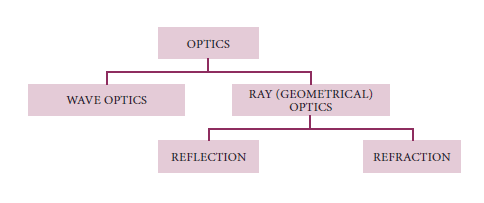
Ray optics or geometrical optics is the branch of optics that treat light as rays. Wave optics is the branch of optics where the wave nature of light is considered.

Classification of optics into wave optics and Ray or Geometrical optics.

Further Ray optics is classified into reflection and refraction
Classification of Optics

Reflection of light introduction

Light is a form of energy that travels in all directions from the source and direction which it travels is called Ray of Light.

A bundle of rays constitutes a beam of light. Light falls on the polished surface, reflects back, and follows certain principles.

Laws of Reflection

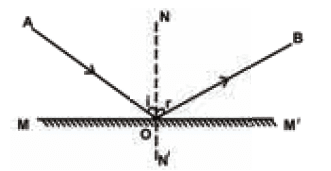
Ray diagram of Plane Mirror, with reference to the laws of reflection
Ray Diagram of Plane Mirror

Plane Mirror

Ray AO is Incident Ray. Ray OB is reflected by Ray. Line ON perpendicular to MM’ is called Normal. Angle made by incident rays with normal (i= angle AON) is called the Angle of Incidence.

Reflected ray OB make and angle r=angle NOB with normal is called the angle of reflection. From the above scenario the Laws of Reflections are:

  • The incident ray, the reflected ray and the normal, all lie in the same plane.
  • The angle of incidence is equal to the angle of reflection.

Lateral Inversion

Lateral Inversion of Mirror, where the position of the image is inversion to the observer
Lateral Inversion in Mirror

Lateral Inversion means sidewise inversion that is the inversion of left and right that occurs in the mirror. Mirror inverts left and right not up and down due to optical illusion and our perception of vision.

Mirror Equation

1/f = 1/u + 1/v

The Mirror equation is the relationship between focal length f, the distance of image v, and distance of object u.

Linear Magnification (m)

An object magnified concerned to object size by a spherical mirror is known as Magnification. Magnification equation is given by m = hi / ho = -v/u

Where hi, is the height of the image, and ho is the object, u is object distance and v is image distance. When there is a negative sign (-) then the magnification that the image is real.

When there is a positive sign (+) then the magnification is virtual.

Types of radio modulation

Modulation

  • Transmission of data for short ranges does not need any complex procedures.
  • Example an audio frequency of range 20 to 20,000 Hz when transmitted over long distances some techniques are used to transmit the information without any loss.
  • “For long-distance broadcast, the low-frequency baseband signal (input signal) is superimposed onto a high-frequency radio signal by a process called modulation”. (Tamil Nadu Text Book Corporation #)
  • Carrier signal or radio signal which is a high-frequency signal is employed to carry the baseband signal in the modulation process.
  • Carrier signal’s frequency is very high as a result it can be transmitted very long with less attenuation.
  • The carrier signal is mostly a sine wave.
  • In the Modulation process, three characteristics of the carrier signal are modified by the baseband signal.
  • Frequency of radio waves and its characteristics are mentioned below:
  • Those three characteristics of radio waves or signals are Amplitude, Phase, Frequency.

Amplitude Modulation (AM)

  • “If the amplitude of the carrier signal is modified according to the instantaneous amplitude of the baseband signal, then it is called amplitude modulation.” (Tamil Nadu Text Book Corporation #).
  • In AM, the phase and frequency are constant and amplitude is modified.
  • AM is used in Radio transmission and also in TV broadcasting.
Frequency of radio waves

Advantages of AM

  • Transmission and Reception is easy
  • Requires lesser bandwidth
  • The operating cost is less.

Disadvantages of AM

  • High noise level
  • The operating range is small
  • Low efficiency

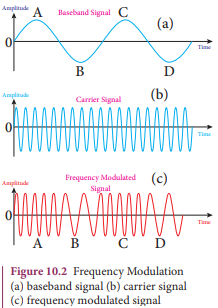
Frequency Modulation(FM)

  • In FM, the frequency of the carrier signal is modified as per the instantaneous amplitude of the baseband signal.
  • In FM the amplitude and phase of the carrier signal remain constant.
  • When the baseband amplitude has increased the frequency of the carrier also gets increase and vice versa. 

Advantages of FM

  • The noise level is decreased and increases in signal-noise ratio.
  • The operating range is high.
  • As all the transmitted power is used, the efficiency of the transmission is high.
  • FM reproduces better audio quality as the FM utilizes the entire frequencies in the human audible range.

Disadvantages of FM

  • A wider channel is required for FM
  • The transmitter and receivers of FM are expensive
  • The area coverage is less compared to AM

Phase Modulation

  • “The instantaneous amplitude of the baseband signal modifies the phase of the carrier signal keeping the amplitude and frequency constant is called Phase Modulation”. (Tamil Nadu Text Book Corporation #).
  • The phase modulation is similar to FM, except the phase of the carrier signal is modified.
  • The frequency shift in carrier wave frequency subsists in phase modulation as well.
  • The frequency shift depends on the amplitude of the modulating signal and the frequency of the signal.

Advantages of PM

  • FM signal produced from PM signal which is very stable.
  • It is extremely stable.
  • Phase modulation provides high transmission speed on a given bandwidth.

Electromagnetic waves in free space: Ground, Sky, and Space Wave Propagation

The modulated signal is transmitted by the antenna. It is received at the other end.  2kHz to 400 GHz Frequencies are transmitted with wireless communication.

While the signal travels from the transmitter to the receiver, the strength of the electromagnetic wave keeps decreasing. Three modes by which EM waves are transmitted. They are:

  • Ground wave propagation or surface wave propagation (nearly 2 kHz to 2 Mhz)
  • Skywave propagation or ionospheric propagation nearly 3 MHz to 30 MHz.
  • Space wave propagation nearly 30 MHz to 400 GHz.

Ground Wave Propagation

“If the electromagnetic waves transmitted by the transmitter glide over the surface of the earth to reach the receiver then the propagation is called ground wave propagation” and the waves used are called surface waves or ground waves.

Both the transmitting and receiving antennas are to the earth. The efficiency of the radiation of the signal is decided by the size of the antenna. The signal gets attenuated during transmission over a long distance.

Causes for Attenuation are:

Increasing Distance – The attenuation of the signal directly depends on the transmitter’s power, frequency of the transmitter, and nature of the earth’s surface(Hill, plateau, Water bodies, etc).

Absorption of energy by the Earth – When the transmitted Electromagnetic wave comes in contact with the earth, it causes changes in the earth and form a current.

Due to this, the earth acts as a capacitor that leads to the attenuation of the wave.

Tilting of the wave – As the wave advances, the wavefront starts slowly tilting as per the curvature of the earth.

This increase in the tilt decreases the electric field strength of the wave (Tamil Nadu Text Book Corporation #).

Finally, at some distance, the surface wave dissolves out due to energy loss.

The frequency of the ground wave is essentially less than 2Mhz because the high-frequency waves experience more loss of energy in the earth’s atmosphere.

Ground wave propagation is mostly used in local broadcasting, radio navigation for the ship to ship, ship to shore communication, and mobile communication.

Sky-Wave Propagation

“The mode of propagation in which the electromagnetic waves radiated from an antenna, directed upwards at large angles gets reflected by the ionosphere back to earth is called skywave propagation or ionospheric propagation”. (Tamil Nadu Text Book Corporation #)

The corresponding waves are called sky waves. For Skywave propagation, the frequency range must be 3 to 30 MHz.

Electromagnetic waves of frequency greater than 30 Mhz can easily penetrate the ionosphere and do not suffer from reflection. Skywave propagation is used in short wave(SW) radio services.

Medium and high frequencies are used for long-distance radio communication. As the skywave propagation uses a high frequency that undergoes multiple internal reflections between the earth and ionosphere it can be used for extremely long-distance communication.

A single reflection makes the radio waves travel a distance of approximately 4000 km. The Ionosphere serves as a reflecting surface. The ionosphere is at a distance of approximately 50 km and spreads up to 400km above the earth’s surface.

The air molecules in the ionosphere get ionized due to UV rays, cosmic rays, alpha rays, beta rays, etc.

This ionized molecule helps in reflecting the radio waves back to the earth’s surface. This phenomenon of bending the radio waves back to earth is internal reflection.

This is the reason EM waves are transmitted at a critical angle to ensure the waves get total reflection and reach the ground without escaping into space.

“The shortest distance between the transmitter and the point of reception of the skywave along the surface is called the skip distance”. (Tamil Nadu Text Book Corporation #)

“When the angle of emission increases, the reception of ground waves decreases”. (Tamil Nadu Text Book Corporation #)

At one point there will be no reception due to ground waves. “There is a zone in between where there is no reception of electromagnetic waves neither ground nor sky called as skip zone or skip area”. (Tamil Nadu Text Book Corporation #)

“The higher the frequency higher is the skip distance and for a frequency, less than the critical frequency skip distance is zero”. (Tamil Nadu Text Book Corporation #)

Space wave Propagation

The Process of sending and receiving a signal via space is called space wave communication. The electromagnetic waves of very high frequencies above 30 MHz are called space waves.

Travel in a straight line and used for line of sight communication (LOS). Space wave propagation used television broadcast, satellite communication and RADAR are based on space wave propagation.

Satellite Communication

The mode of communication using the satellite above the earth is called Satellite communication.

The message signal from the Earth station is transmitted to the satellite by an uplink (frequency band 6 GHz) amplified by a transponder and then retransmitted to another earth station via a downlink frequency band 4 GHz.

Application of Satellite Communication

  • Weather Satellites
  • Communication Satellites
  • Navigational satellite

Fibre optic communication system working principle and advantages

The communication of information in the form of light pulses by optical fibre is called fibre optic communication. Light has a frequency of 400 THz to 790 THz. Which is higher than the microwave radio system.

The fibre is made of silica glass or silicon dioxide. Now it is succeeded with chalcogenide glasses, fluoro aluminate crystalline materials as they provide larger infrared wavelength and better transmission capability.

Fibre Optic communication is not electrically conductive.

Working principle of Optical Fibre

The Optical fibre used an optical principle called ‘Total Internal Reflection’.

Applications of Fibre Optic Communication

  • International communication.
  • Intercity communication
  • Data links
  • Traffic control 
  • Defence application.

The merit of Fiber Optic Communication

Very thin and lighter weight than copper cables. Has larger bandwidth, can be used to transfer a large capacity of information.

It is immune to electrical interference. It is cheaper than copper cables.

The demerit of Fiber Optic Communication

  • Fragile than copper wire.
  • Expensive technology

Radar and its applications

  • Radar stands for Radio Detection and Ranging System.
  • Used to detect and locate objects like an aeroplane, missile, ships, etc.
  • Radar uses electromagnetic waves radiated by an antenna in all directions when a signal strikes an object, it gets reflected. 
  • This reflected signal is received by a radar antenna and fed to the receiver.
  • The range is calculated by time taken to reflect from the target object.

Application of Radar

  • Used in the military to detect the target.
  • Used in navigation systems such as ship-borne surface search, air search and weapons guidance systems.
  • To measure precipitation rate and wind speed in meteorological observations.
  • Employed to locate and rescue people in emergency situations.

Generation of mobile communication technologies

Mobile communication introduction

Mobile communication is the technology that makes us connect with others (person, devices, etc.), without using physical connections or wires. The first mobile was demonstrated by Martin Cooper and John F. Mitchell of Motorola in 1973.

Also, the first commercial cellular network was introduced by Nippon Telegraph and Telephone in 1979 in Japan.

Mobile communication is used to communicate without the use of any physical connection. It is also a kind of wireless communication that does not use wire or cables. It also provides communication access to remote areas. It provides a facility for roaming, that is the user may move from one place to another without the need for compromising on the communication.

Generation of mobile communication technologies

1G technology

1G technology is the first generation of mobile communication technology. It is the analogue telecommunication which was introduced in the 1980s. Then it was replaced by 2G mobile technology.

As said above, the first commercial 1G mobile network was launched by Nippon Telephone and Telegraphy Company (NTT) in Tokyo on December 1, 1979.

The ‘1G Technolgy’ worked by transmitting voice signals over the radio waves. But this technology has a major advantage, that these radio waves are easily blocked by obstacles such as buildings, concrete walls etc.

This made them unsuitable for most users, particularly indoor users.

2G Technology

The 2G Cellular network was commercially launched on the GSM standard by Radiolinja in 1991 in Finland.

The Technology used in 2G was TDMA(Time division multiple access) base GSM. This technology was first used in Europe and also it is used in Japan and North America. The 2G has several advantages over the 1G mobile technology such as SMS Text messaging, Internet Data, use of digital signals, better voice quality etc.

3G Technology

3G is the third generation of mobile communication technology, which is upgraded over 2G, 2.5G, GPRS, and 2.75G Edge networks. It has several advantages over the 2G Technology such as Faster Internet, and better voice quality.

In 3G technology, internet speed is the greatest upgrade. As the internet speed of 3G Technology almost matched the speed of broadband internet.

Application of Mobile Communication

  • Used for personal communication and cellular phones offer voice and data connectivity.
  • Internet of Things (IoT), is used to control various devices from a single device.
  • Online education.
  • Evolution of mobile communication is 2G, 3G, 4G, 5G, WiMax, Wibro, EDGE, GPRS etc.

Internet

  • The Internet is the largest computer network globally connects millions of people through a computer, cellular devices etc.

Application of Internet

  • Search Engine – It is a web-based service tool used to search for information on World wide web (WWW).
  • Communication – Million of people connect with social networking, email, instant messaging services and social networking tools.
  • E-Commerce – Online buying and selling of goods and services using the internet.
  • Electronic Fund Transfer – Transfer of money from bank one account to another online.

Global Positioning System (GPS)

  • “It is a global navigation satellite system that provides geolocation and time information to GPS receiver anywhere or near the earth”. (Tamil Nadu Text Book Corporation #)
  • GPS works with the assistance of a satellite network.
  • Each of these satellites broadcasts a precise signal like an ordinary radio signal.
  • The software can recognize the satellite, its location and the time the signal takes to travel from each satellite.
  • The software then processes the data from the satellite to estimate the location of the receiver.

Application of Information and communication technology(ICT)

Information and Communication technology is used in areas such as Medicine, Defence, e-governance, Banking, etc. With the advances in computing infrastructure and communication got automated in recent times.

Application of Information and communication technology

Agriculture

  • Widely used in increasing food productivity.
  • Optimize the use of water, seeds and fertilizers.
  • Use of robots, temperature, moisture sensors, aerial images and GPS are used in agriculture.
  • A geographic information system is extensively used in farming to decide the suitable place for the species to be plated.

Fisheries

  • Satellite vessel monitoring system used to identify fish zones.
  • Use of barcodes, identifiers time and date of catch, species name, quality of fish.

Mining

  • ICT in mines increases operational performance, remote monitoring and disaster locating system.
  • Information and communication technology provides an audio-visual warning to the trapped miners.
  • It helps to connect remote sites.

Sharing your stories has never been easier

Nunc id sapien finibus faucibus odio vitae aliquam eros. Ante ex mauris a mus lobortis, urna elit odio nibh ac aliquet ipsum leo commodo quam. Proin semper leo ligula aenean utt erat non quam amet. Morbi fames tempor purus, at semper velit sapien vel in blandit ante. Etiam feugiat ligula turpis enim pulvinar mollis sed. Maecenas in ornare justo in magna.

Proin purus purus dapibus eget lacus nec, placerat aliquam mauris. Nulla vel ante ullamcorper, mattis massa nec suscipit risus. In suscipit luctus gravida. Nulla faucibus quis nulla sed faucibus, nunc malesuada est sed diam porta posuere. In hac habitasse platea dictumst. Pellentesque elementum sit amet dui id fringilla. Lorem ipsum dolor sit amet, consectetur adipiscing elit.

Venenatis elit vel luctus. Nulla venenatis libero at sem semper, id ultricies ipsum mollis. Phasellus vitae consequat urna. Suspendisse gravida velit magna vitae euismod libero vulputate ut. Vestibulum eu dignissim nisl sed lobortis diam in tellus.

Vivamus eleifend malesuada scelerisque. Sed dignissim sapien sit amet nunc pharetra malesuada. Phasellus ut dolor ultricies dolor laoreet finibus id sit amet nisl. Morbi porttitor imperdiet congue etiam enim, finibus interdum elit malesuada.

Suspendisse id faucibus elit eget euismod neque. Donec tortor velit sagittis non ante sit amet, semper vehicula diam. Donec faucibus ipsum sed mauris cursus, ac placerat nulla pharetra. Morbi id velit vitae augue efficitur elementum. Nulla id ante lacinia commodo est nec aliquet sapien. In hac habitasse platea dictumst. Class aptent taciti sociosqu ad litora torquent per conubia nostra, per inceptos himenaeos.

* * All the Notes in this blog, are referred from Tamil Nadu State Board Books and Samacheer Kalvi Books. Kindly check with the original Tamil Nadu state board books and Ncert Books.