Value Added Tax (VAT) is categorized as an indirect tax levied by State Governments.
It fell under the state-level tax structure along with other local levies such as entry tax, octroi, and luxury tax.
Government and regulatory agencies rely on accounting and financial information of enterprises to verify and enforce the payment of taxes, including VAT.
Pre-GST Role and Limitations
Prior to GST, VAT was associated with the sales tax regime (often referred to as VAT/Sales Tax).
In the pre-GST framework, taxes were imposed on the total value of commodities/services rather than purely on the value added at each stage, as there was minimal facility for utilizing Input Tax Credit (ITC).
Because the total taxable value included taxes already paid on intermediate goods and services, the system resulted in the cascading of taxes (tax-on-tax).
Subsumption under GST
Under the indirect tax reforms, state-level VAT/Sales Tax was subsumed and replaced by the Goods and Services Tax (GST).
Under the dual GST structure, state-level taxes including VAT were merged into State Goods and Services Tax (SGST).
This reform aimed to eliminate cascading tax effects, extend the principles of value-added taxation across all goods and services, and establish parity in nationwide taxation.
Post-GST Status and Exceptions
State Governments continue to hold the power to levy VAT specifically on alcoholic liquor for human consumption.
Five petroleum products were temporarily kept out of the GST regime (to be subsumed over time), continuing under existing tax structures.
It is a pre-announced price, where the farmers are paid for their crops. It is set by the Government of India to procure crops directly from the farmers.
It is not enforceable by law. MSP rate is only to safeguard the farmer to get at least minimum profit for their harvest.
The government of India set the price for 23 commodities twice a year based on the recommendation of the Commission for Agricultural Cost and Prices (CACP) since 2009.
Msp calculation upsc
The MSP is calculated based on the cost of production, demand, supply, price fluctuation, market price trends, different cost and international market prices and agricultural wage rate.
23 Commodities Under Msp
Rice
Wheat
Maize
Sorghum
Millet
Barley
Ragi
Tur
Moong
Chickpea
Urad
Lentil
Peanut
Rapeseed
Sesame
Sunflower
Safflower
Niger seed
Copra
Sugarcane
Cotton
Jute
Soybean
Cacp Upsc
Cacp full form is Commission for Agriculture Costs and Price. It was set up in 1965 and it is a decentralised agency of the Central Government. It is a statutory body that is part of the Ministry of Agriculture & Farmers Welfare.
Its current chairmen was Vijay Paul Sharma.
This agency is the body that recommends the MSP (Minimum Support Price). CACP recommends MSP of 23 commodities.
It is a stock of foodgrains such as wheat, rice, etc. These are procured by the government of India by the Food Corporation of India (FCI).
The FCI procures the foodgrains from the farmer in states where there is surplus production and at the preannounced price which is called Minimum Support Price (MSP).
The minimum support price is declared by the government every year before the sowing season so as to provide incentives to the farmers for raising the production of such crops.
The procured food grains are stored in Granaries.
Why does the government usually maintain a buffer stock?
To distribute the food ration to people in deficit areas and to the poor people at the price lower the market price. This price is also known as the Issue Price.
Buffer stock also helps the problem of shortage of food during famine or natural disaster. Another advantage is its helps farmer income as the government directly procures and gives incentives to the farmer, it helps to stabilize the market prices, and also it helps to reduce food inflation.
Food Security
Food security, as defined by the United Nations’ Committee on World Food Security, means that all people, at all times, have physical, social, and economic access to sufficient, safe, and nutritious food that meets their food preferences and dietary needs for an active and healthy life.
https://www.ifpri.org/topic/food-security
The purpose of food security is to increase the productivity of food and to ensure access to food for all people. This also increases the opportunities for income generation, improvement of nutrition values, and improvement in quality of life by way of community development.
There are four levels of food security, identified by the Food and Agriculture Organization of the United Nation or FAO. These are called the Four Pillars of food security and they are Availability, access, utilization, and Stability.
Need of Food Security
Food security is needed to ensure that each person in a country has access to food that is healthy and safe to consume throughout the year.
It is important, especially during a drought, disaster, etc. Because during this time the supply of food gets decreased. Consequently, the price of food increases several times.
This makes accessibility to food, mainly to poor people gets difficult. But Food security guaranteed the food grains distribution at cheap rates to the poor people.
Example: Ration Shops, School Meal Programmes, Soup Kitchens, etc.
Food Security in India is still a major issue in India. India attained food self-sufficiency by the late 1980s. It means the availability, accessibility, and affordability of eatable commodities to all people at all times. Whenever there is a problem in food production or distribution of food, the poor people are the most vulnerable.
Food security depends on the government actions and vigilance and the Public Distribution System.It has three dimensions they are availability, accessibility, and affordability.
Availability
The availability of food means that there are enough edible commodities in government hands such as grains such as rice, wheat, etc stored in government granaries, agriculture production within the country is self-sufficient and food imports are good enough.
Accessibility
The accessibility to food, everyone has reached to food easily or within his reach.
Affordability
The edibles should be available at cheap, affordable prices so that every individual has enough finance to buy them.
Importance of food security in India
India has a huge ratio of poor population in the world. This section of the society is always food insecure while the person above the poverty line might face food insecurity at times, during calamity, drought, flood, failure of crops, famine, etc.
Due to such incidents, agriculture production decreases and creates a shortage of agricultural commodities, and the prices also go up. Due to high prices, one might be able to afford it. If such a situation is stretched over a longer time period it might cause starvation and in turn, lead to famine.
These famines in turn cause the spread of disease and even epidemics or pandemics may occur to a decrease in the intake of nutrients. India has had such experiences in the past such Famine of Bengal in 1943 which killed 30 lakh people in the Province of Bengal.
The people who died the most in such famine are poor people such as labourers, fishermen, farmers, etc.
Famines also existed in Kalahandi, Kashipur in Orissa, starvation deaths were reported in Baran Districts of Rajasthan, Palamau district of Jharkhand during recent times.
Therefore food security is important in India.
Schemes for food security in India
Integrated Child Development Scheme (ICDS)
It covers all children under six, pregnant women, and lactating mothers. Targeted Public Distribution System such as ‘free rice scheme in Tamilnadu by Antyodaya Anna Yojana family cards.
Annapurna
Free 10kg of free grains such as rice, wheat, etc for the destitute poor. In employment schemes such as Mgnrega(Mahatma Gandhi National. Rural Employment Guarantee Act 2005) by this act, a job is guaranteed for 100 days a year with minimum wages.
National Food Security Act
It is an act of Parliament that has an objective to provide subsidized food grains to almost two-thirds of countries with 1.2 billion people. This law was signed on 12 September 2013. This is to ensure that all people should get access to food all the time.
Also to ensure food and nutritional security in human life by ensuring adequate access to quality food and reasonable place.
Role of public distribution system in food security in India
It plays an important role in increasing food security and also distributing other rations such as Kerosene, Relief compensation, etc to the poor people. The major commodities are distributed such as rice, wheat, sugar, etc through a chain of shops at a fair price or subsidized price.
It also acts as a key instrument to make the availability of essential commodities at affordable prices throughout the year. The central and state government share the prices of the commodities. Mostly centre procures the commodities from the farmer at MSP(Minimum Support Price) and sells them to the states.
In some states like Tamil Nadu, etc, the state itself procures and sells it to the beneficiaries at subsidized prices.
Issues in food security in India
Due to inflation, the government has to spend more money on PDS. Also, MSP is increasing every year, the government has to spend additional resources to ensure food security. The Public distribution system in Tamil Nadu, Kerala, and other southern states performs significantly better than in the Northern states. This gap needs to be addressed.
High storage cost, storing grains in granaries above the specified level deteriorates the quality and also long the storage time, more damage is done to grains in terms of quality. There are enough storage granaries in the country which leads to huge wastage of grains to pests, rains, and to the Sun.
Conclusion
Indian government must ensure that the essential commodities such as rice, wheat, etc reach everyone should ensure Food security which is a part of Social Justice.
The green revolution in India is a period when agriculture in India was converted into an industrial system by adapting to modern technology and techniques. The Father of the green revolution in India is MS Swaminathan.
Green revolution definition in economics
The green revolution is defined as using various techniques such as HYV Seeds, Chemical fertilizers, Irrigation, etc, to increase the yield of crops such as Rice, Wheat, etc. It made food grains cheap, ensured food security, and made a lot of countries’ food self-sufficient.
Hyv definition
It is expanded as High Yielding Variety. These seeds are better than normal seeds, as they are generally genetically modified that give high yields, disease resistant and resistant against insect or pest.
Also, it had some bad effects on the environment. Initially in India, it was introduced in Haryana, Punjab, and Western Uttar Pradesh. After its success, it was introduced to other states.
The food Producing industry and also its allied industry improved a lot. As more than 60% of the population of India is dependent on Agriculture, directly or indirectly.
The father is this revolution is Norman Borlaug and India, in India, it is M.S. Swaminathan.
Green revolution in India’s year
The Green Revolution spread during 1967-68 to 1977-78. This revolution changed India’s status from a food-deficient nation to one of the world’s leading agricultural nations.
The second Green Revolution is the latest word coined. It is a change in agricultural production to feed a growing population on the earth.
Also in India, The second Green revolution is encouraging the use of organic methods for agriculture.
Green Revolution in India
It is associated with agriculture with the introduction of new techniques. This become popular in early 1960. This technique was first applied to wheat and then to rice.
This method completely changes the traditional methods of food production, as it increased the yield to more than 250%.
The method around this type of agriculture is the use of HYV seeds which are also called High Yielding Variety seeds. HYV seeds were developed by Norman Borlaug and US Agriculture Scientist in his research at British Rockefeller Foundation in early 1960.
The new wheat seed called Vivo claimed to have increased the yield up to 200%. These seeds were successfully tested in food-deficient countries such as Mexico, Taiwan, etc in 1965.
Farming techniques
The farming technique used HYV Seeds, Chemical fertilizers, Irrigation, Chemical Pesticides, or Germicides.
Green revolution fertilizer
Since using HYV seeds requires greater nutrients from the soil. The natural nutrients available in the soil are sufficient to provide nutrition to these seeds. Also, natural fertilizer is enough to provide nutrients.
As a result, chemical fertilizers used in these revolutions are Urea (N), Phosphate (P), and Potash (K).
HYV Seeds
HYV seeds are popularly known as Dwarf varieties of seeds. After repeated mutation, Norman Borlaug made the plant Dwarf and the Grain Heavier.
These seeds are non-Photosynthetic thereby it does not depend on sunray for targeted yields.
Irrigation
For the controlled growth of crops using HYV seeds and chemical fertilizer, it needed a controlled supply of water.
The controlled supply of water means, the land should be free from floods, and water runoff. As a result, this needs an artificial water supply. This demanded the development of Irrigation.
Pesticides and Germicides
Since these seeds were new to the habitat, they were prone to attack by Pests and various germs. As a result, It needs chemical pesticides and germicides to secure the yield.
Green revolution pros and cons
The green revolution definition in economics is its advantages over traditional methods of farming. The Food deficient countries went on to become self-sufficient. Also started to export food grains to other countries.
A good example of this is India. India was earlier important wheat from the USA, USSR, etc. After the success of the Green revolution, India started exporting food grains.
The green revolution started in India in the 1960s. The success was tasted as early as the 1970s. The green revolution definition in economics also had a bad face. Yes, It has disadvantages too.
This disadvantage we mainly on the ecological side. It required more land as a result several acres of forest were destroyed, and the use of chemicals degraded the soil and poisoned the food chain.
The increased use of water made the water table down.
Impact of the Green revolution on India
It resulted in a record output of 131 Million Tonnes in 1978-1979. This made India one of the largest producers of food in the world. The total yield improved by 30% compared to 1947 to 1979.
By this, the production of rice and wheat doubled but the production of other crops declined considerably.
Due to the green revolution, certain measures were taken such as increasing the area under farming, double cropping, use of chemical/inorganic fertilizers and pesticides, also use of HYV seeds.
Another impact is there is a great improvement made by the government in inland irrigation all around the country. This helped commercial cropping and there improved the economy of people and also India’s economy.
Conclusion
Green Revolution has made several countries’ food self-sufficient. But it has a devastating effect on the environment due to the increased use of chemicals and more water supply.
As general prices rise, the purchasing power of consumers decreases. The measure of inflation over time is referred to as the rate of inflation or the inflation rate.
Inflation is the decline of purchasing power of a given currency over time.
A quantitative estimate of the rate at which the decline in purchasing power occurs can be reflected in the increase of an average price level of a basket of selected goods and services in an economy over some period of time.
Types of inflation in economics
Demand-Pull Inflation.
Cost-Push Inflation.
Open Inflation.
Repressed Inflation.
Hyper-Inflation.
Creeping and Moderate Inflation.
True Inflation.
Semi-Inflation.
In india inflation is measured by wholesale price index (Wpi) and the consumer price index (cpi).
Cpi Inflation
India CPI Inflation Rate February 2021, IIP Growth Rate January 2021: The retail inflation, measured Consumer Price Index (CPI) rose to 5.03 percent in February.
The country’s retail inflation, measured by the Consumer Price Index (CPI), rose to 5.03 percent in the month of February.
Cost inflation index 2020
cost inflation index Fy 2020-21
The Cost Inflation Index (CII) for the financial year (FY) 2020-21 has been notified as 301 by the Ministry of Finance. The notification is dated June 12, 2020. For the previous financial year, CII was 289.
Current inflation rate in India 2020
2020*
4.95%
2019
4.76%
2018
3.43%
2017
3.6%
current inflation rate in india 2020
Inflation in India 2020
The inflation rate in India 2020 is 4.95%. In 2019, the inflation rate in India was around 4.76 per cent compared to the previous year.
Cost inflation index (Cii) for fy 2020-21
Sl. No.
Financial Year
Cost Inflation Index
1
2017-18
272
2
2018-19
280
3
2019-20
289
3
2020-21
301
Cost Inflation Index (Cii) Table upto Financial Year 2017-21
According to the Securities Contracts (Regulation) Act 1956, a stock exchange means any body of individuals, whether incorporated or not, constituted for the purpose of helping, regulating, or controlling the buying, dealing, and selling of securities.
A Stock Market or Stock Exchange is an institution that provides a platform for buying and selling existing securities.
As a market, the stock exchange helps the exchange of a security (share, debenture, etc) into money and vice versa.
Stock exchanges help the company to raise funds, provide liquidity and safety of investment to the investors.
It also helps to enhance the creditworthiness of individual companies.
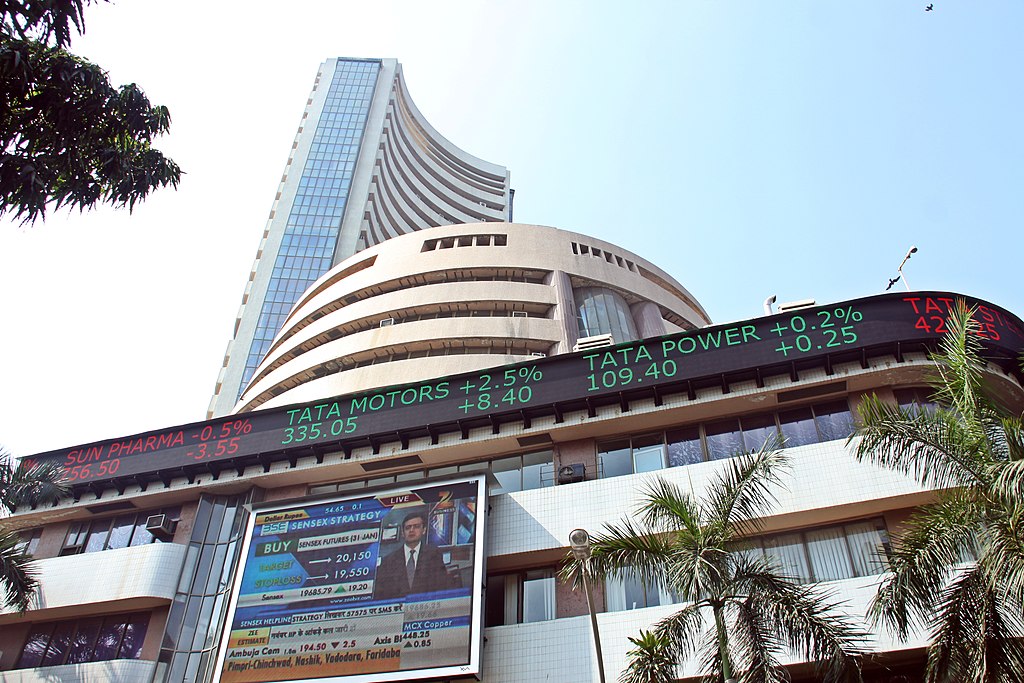
Stock Exchange By BSEINDIA – Own work, CC BY-SA 3.0, https://commons.wikimedia.org/w/index.php?curid=31126278
Functions of a Stock Exchange
Providing Liquidity and Marketability to Existing Securities.
Creation of a continuous market where securities are bought and sold.It provides the investor to dis-invest and reinvest.
It provides both liquidity and easy marketability to already existing securities in the market.
Price of Securities
Share prices on a stock market are determined by the forces of demand and supply. The stock exchange is the mechanism of constant valuation by which the prices of securities are determined.
It provides instant information to both buyers and sellers in the market.
Safety of Transaction
The membership of a stock exchange is well regulated and its dealings are well defined according to the already existing legal framework. It makes sure that the investing public gets a safe and fair deal on the market.
Economic Growth
The process of disinvestment and reinvestment savings get channelized into their most productive investment avenues. This leads to capital formation and economic growth.
Spreading of Equity Cult
It plays an important role in ensuring wider share ownership by regulating new issues and taking effective steps in educating the public about investment.
Scope for Speculation
It provides sufficient scope within the provisions of law for speculative activity in a restricted and controlled manner.
It is generally accepted to a certain degree of healthy speculation is necessary to ensure liquidity and price continuity in the stock market.
SDR Full form is Special Drawing Rights. It is an international reserve asset, which is created by the IMF in 1969 to supplement its member country’s official reserves.
By now $204.2 billion have been allocated to its members. This includes $182.6 billion allocated in 2009 during the global financial crisis.
The value of SDR is based on five currencies basket that includes USD, Euro, Chinese Renminbi, Japanese Yen, and GBP. This is called the SDR currency basket.
It is also called Paper Gold as it is represented as an asset that could be used to offset the balance of payment deficits similar to gold or reserve currencies.
Sdr currency
Currency
Weights determined in the 2015 Review
Fixed Number of Units of Currency for a 5-year period Starting Oct 1, 2016
U.S. Dollar
41.73
0.58252
Euro
30.93
0.38671
Chinese Yuan
10.92
1.0174
Japanese Yen
8.33
11.900
Pound Sterling
8.09
0.085946
A basket of currencies determines the value of the SDR
1 SDR to USD – Initially, the value of One SDR is defined as equivalent to 0.888671 grams of fine gold, which is equivalent to 1 dollar.
XDR
USD
1
1.41
5
7.09
10
14.18
20
28.37
50
70.94
100
141.89
250
354.74
500
709.48
1000
1418.97
Current Special Drawing Rights to US Dollar
SDR allocation
Sdr is allocated to the member nations by IMF. A nation’s IMF quota is the maximum amount of financial resources that is obligated to contribute to the fund.
Any new allocation is must be voted on XDR department of IMF and should pass with an 85% majority. All IMF countries are part of the XDR department. There is no one country, one vote system.
For example, the USA has 16.7% of the votes. Power. Allocation happened only on rare occasions.
For IMF provided an allocation of XDR of 182.6 billion, to provide liquidity to the global economic system and supplement members country’s official reserves during the global financial crisis of 2009.
The low-income member countries received allocations in 2011.
Reserve tranche position Indian economy
Reserve tranche IMF – Reserve tranche is the portion of a member country’s quota with the IMF, which is in the form of gold or foreign currency.
Example: India’s reserve tranche – India pays some amount to IMF as its quota. This can be used for its own purpose without a service fee or economic reform condition.
For any member country, out of the total quota, 25% must be paid in the form of foreign currency or gold.
Hence this is called Reserve Tranche or Gold Tranche. The remaining 75% can be paid in domestic currencies and it is called credit tranche.
Consider a person going to London from India for vacation. She needs tourist services in London. For getting services in London, she will have to pay in Pounds. As Pounds is the official currency in London.
For getting pounds, the Indian tourist has to know where to get pounds (GBP) and at what price. This price is known as Exchange Rate. That is the number of Indian rupees needed to buy One GBP.
The Foreign exchange participants are Commercial Banks, Foreign exchange brokers, and other authorized dealers and monetary authorities. The forex market is also called the Foreign exchange market.
A forex market is a market where different currencies are bought and sold. The economy determines the exchange rate of the currencies, out of the trades in different currencies.
Foreign exchange is an institutional framework for the exchange of one countries currency for another countries currencies. This is particularly correct either in the case of a free-float exchange regime such as floating currency or is a managed or hybrid exchange rate system.
Importance of Foreign exchange reserves of India
Foreign exchange rate or Forex rate is the price of one currency in terms of another currency. This links the currencies of different countries and compares different international costs and prices.
For example in the forex market in India, if we have to pay Rs 75 for $1, then the exchange rate is Rs 75 per dollar.
Demand for Foreign exchange
The People in India demand foreign exchange as they want to purchase goods and services from other countries such as the USA, UK, etc. Also, they send gifts to relatives and friends abroad.
Supply of Foreign Exchange
Foreign currency flows into the home country by exports, services by the foreigners such as making the transfer into India or send gifts, or foreigner buy assets such as Home, land in India. A rise in the price of Foreign exchange will reduce the foreigner’s cost.
This increases India’s exports. (Example earlier $1 = 50, now rise in the price of Foreign exchange means, for example, $1 = 80 foreigner can get more services, thereby it increase India’s exports).
Hence the supply of foreign exchange may increase (Based on the Elasticity of demand for exports and imports).
Determination of Exchange Rate
Different countries have different methods of determining their currency exchange rate.
It can be determined by Flexible Exchange Rate, Fixed Exchange Rate, or Managed Floating Exchange Rate.
Flexible Exchange Rate
The exchange rate is determined by the market forces of demand and supply. It is also known as the Floating Exchange Rate.
In a completely flexible system, the Central Banks do not intervene in the foreign exchange market.
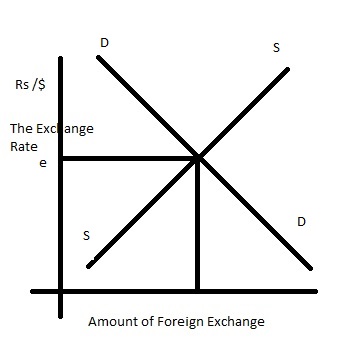
Equilibrium under Flexible Exchange Rates
As shown in about figure, the exchange rate is determined when the demand curve intersects with the supply curve at point e on the Y-Axis.
At point q on the x-axis determines the quantity of US dollars that have been demanded and supplied on the e-exchange rate. In a completely flexible system, the Central banks do not interfere in the foreign exchange market.
The increase in demand for foreign goods and services results in a change in the exchange rate.
When e0=50, Rs 50 for one dollar.
Then e1=75 which means for Rs 75 = 1$.
It indicates that the value of rupees has fallen in terms of dollars or the value of dollars has risen in terms of rupees. This is called Depreciation of domestic currency/rupees in terms of foreign currency (dollars).
Similarly, in a flexible exchange rate regime, when the price of domestic currency in terms of foreign currency increases, it is called Appreciation of domestic currency. This means the value of rupees has increased, we need to pay fewer rupees in exchange for the dollar.
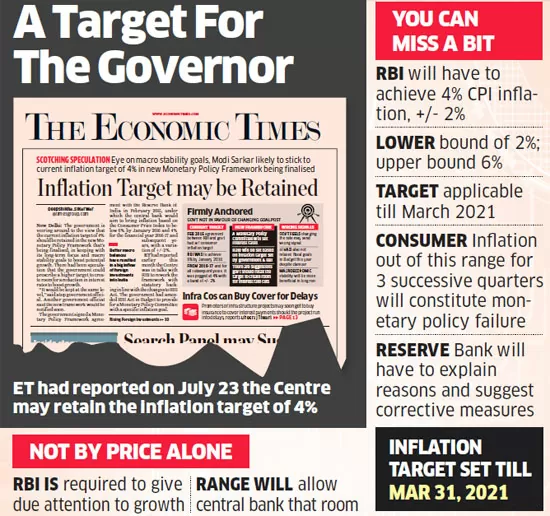
Inflation targeting in India is the current inflation target band (4% +/-2%) is appropriate for the next 5 years. It is a monetary policy where the Reserve Bank (Central Bank of any country) follows an explicit target for the inflation rate for the medium term.
It announces this inflation target to the public. Price stability is the best thing that monetary policy can do to support the long-term growth of the economy.
Price stability is achieved by controlling inflation. The reserve bank of India uses its main short-term monetary instrument.
The RBI will raise or lower the interest rate based on the target inflation rate. The common belief is that raising the interest rates usually economy to rein in inflation and lowering interest rates usually accelerates the economy, thereby boosting inflation.
It is also believed to be supporting economic growth and stability. The first countries to implement the fully-fledged inflation targeting were New Zealand, Canada, and Uk.
When did India adopt inflation targeting?
India adopted flexible inflation targeting (FIT) in June 2016 to place price stability. It is defined in terms of a target CPI (Consumer Price Index) inflation, as the prime objective of the monetary policy.
Why does the 4% inflation target?
If the inflation expectation fall, the interest rates would decline too. By seeking inflation that averages 4% over time, it will help to ensure longer-run inflation expectations remain well-anchored at 4%.
By keeping the inflation rate low and stable at 4%, helps everyone to plan for the future. If inflation is too high or is hard for Businesses to set the right prices. Also, it is hard for people to plan their spending.
Who decides the inflation target in India?
As per the Amendment of the RBI Act, the inflation target is set by the Government of India in consultation with the Reserve Bank once in Five Years.
Does inflation targeting work?
Inflation targeting lowers the unemployment rate and keeps the prices stable. In order for Inflation targeting to work, the RBI must clearly signal its intentions to raise or lower interest rates.
* * All the Notes in this blog, are referred from Tamil Nadu State Board Books and Samacheer Kalvi Books. Kindly check with the original Tamil Nadu state board books and Ncert Books.