Thangka paintings are commonly practiced in the states of Sikkim, Himachal Pradesh, Ladakh, and Arunachal Pradesh.
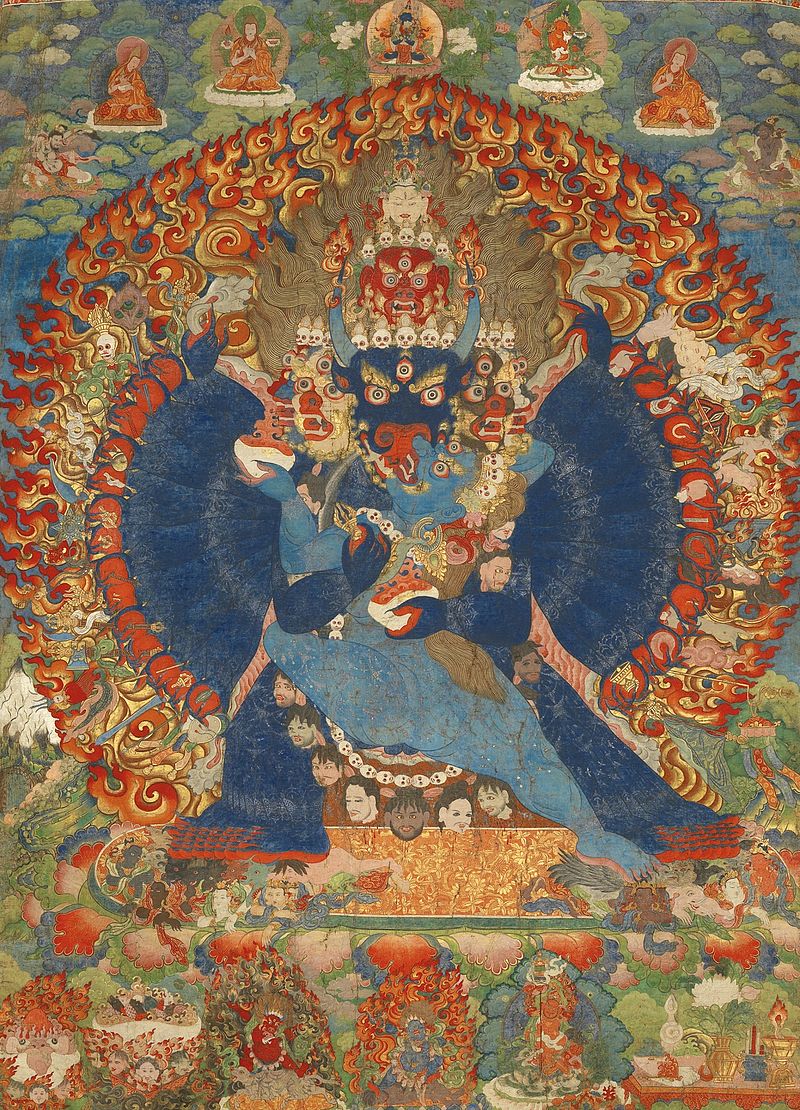
Thangka painting plays a significant role in showcasing the artistic traditions of the region. Thangka paintings in Arunachal Pradesh often depict various aspects of Buddhist iconography, including representations of Buddha, Bodhisattvas, and other deities.
These intricate paintings are created using a combination of vibrant colors, intricate details, and precise brushwork. The process of creating a Thangka painting in Arunachal Pradesh follows a traditional method that has been passed down through generations.
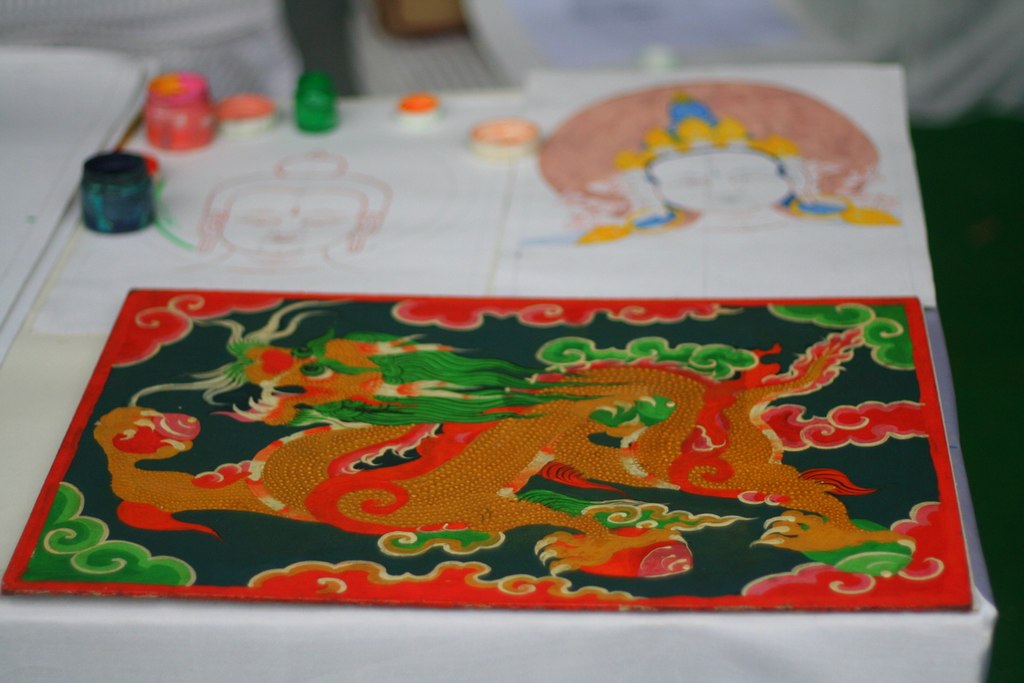
The artists start by preparing the canvas, which is typically made of cotton or silk. They carefully sketch the design using charcoal or pencil, ensuring accuracy and proportionality.
Once the sketch is complete, the artists outline the design using black ink, creating a clear and defined composition. They then fill in the colors using mineral pigments, which are mixed with water and applied with great precision. Gold leaf and other embellishments may also be added to enhance the aesthetic appeal of the painting.
Thangka painting in Arunachal Pradesh is not just a form of artistic expression but also holds deep religious and spiritual significance. These paintings are often used as visual aids during meditation and serve as a means of transmitting Buddhist teachings and philosophies.
Types of Thangka Paintings
Padmasambhava Thangka
This thangka depicts Padmasambhava, the founder of Tibetan Buddhism. Padmasambhava is also called Guru Rinpoche, meaning “Precious Guru” in Tibetan language. He is shown sitting in a lotus position, surrounded by his eight manifestations.
This eight manifestion signifies, eight different forms he took to teach the dharma in Tibet. The thangka is typically painted on cotton or silk and is adorned with elaborate borders.
This Thangka paintings are mostly used as aids in meditation and also believed that these paintings have protective and sacred powers.
Guru Rinpoche Thangka: This thangka depicts Guru Rinpoche, another important figure in Tibetan Buddhism. He is shown seated on a lotus throne, surrounded by his disciples. The thangka is typically painted in bright colors and features intricate details.
Mandala Thangka: This thangka depicts a mandala, a geometric figure with symbolic meaning. Mandalas are often used as aids in meditation and are believed to represent the universe. The thangka is typically painted in vibrant colors and features complex patterns.
Buddha Thangka: This thangka depicts the Buddha, the central figure of Buddhism. He is shown seated in a lotus position, surrounded by his disciples. The thangka is typically painted in serene colors and features simple lines.
What is the purpose of Thangka Paintings?
It was originally used as a medium of reverence which evoked the highest ideals of Buddism. These paintings are divided into three types based on their deception and meaning. The first type shows the life of Buddha from birth to the attainment of enlightenment.
The second type shows the “Wheel of life”, which represents the Buddist beliefs of life and death.
The third one is paintings which are used for offerings to gods/deities or meditations.
Thangka Painting Making By Ramesh Lalwani – https://www.flickr.com/photos/ramesh_lalwani/13136017583/, CC BY 2.0, https://commons.wikimedia.org/w/index.php?curid=100402393
What do thangka paintings depict?
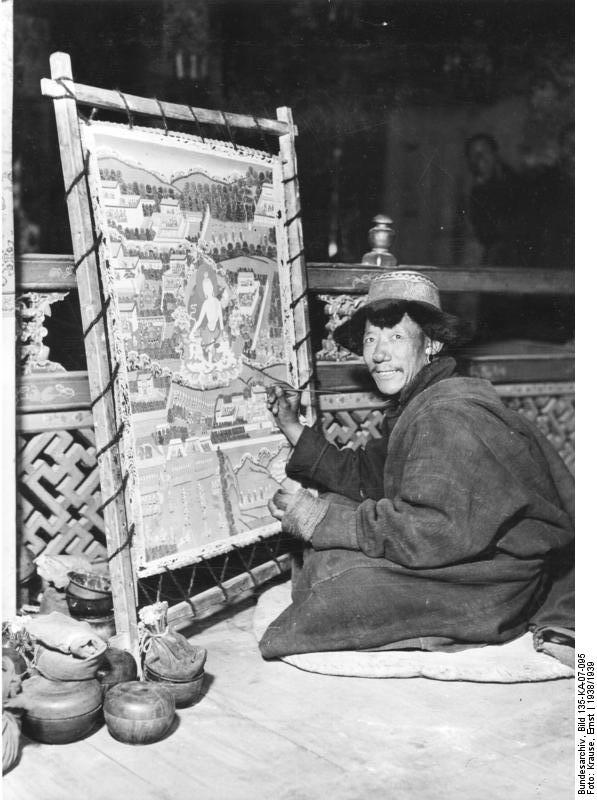
Lhasa, Lama beim Bemalen eines Gebetsteppichs (Tangka), Potala By Bundesarchiv, Bild 135-KA-07-095 / CC-BY-SA 3.0, CC BY-SA 3.0 de, https://commons.wikimedia.org/w/index.php?curid=5337885
Thangka painting is art depicting the life of Buddha and other deities. It also influences the mythological event relating and concerning to Lamas.
How is thangka painting made?
Thangkas are painted on canvas. The canvas is strung on a bamboo frame, which is then stretched onto a frame made of wood.
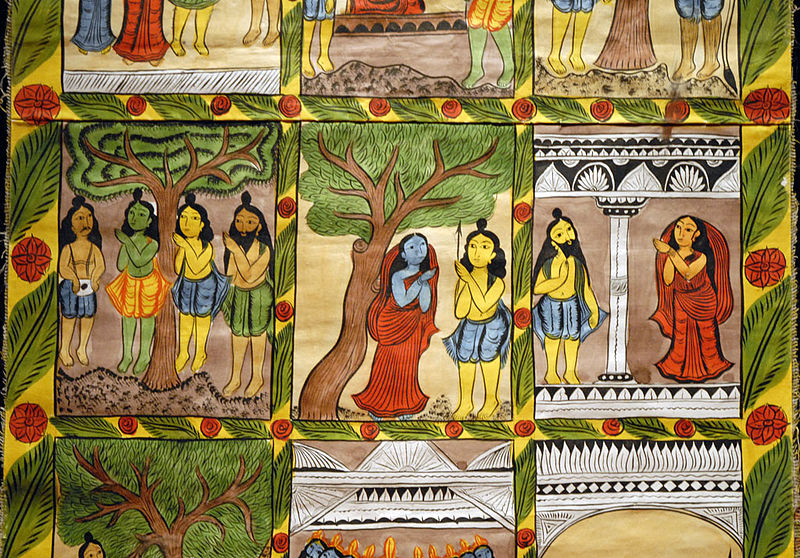
It is traditional paintings of Odisha, where no pencil or charcoal is used but rather a brush is used to draw the outlines.
These paintings have themes that are inspired by the Jagannath and the Vaishnava cult.
Pattachitra By Jean-Pierre Dalbéra from Paris, France – Extrait de Ramayana de Hazra Chitrakar (Naya / Bengale), CC BY 2.0, https://commons.wikimedia.org/w/index.php?curid=24674077
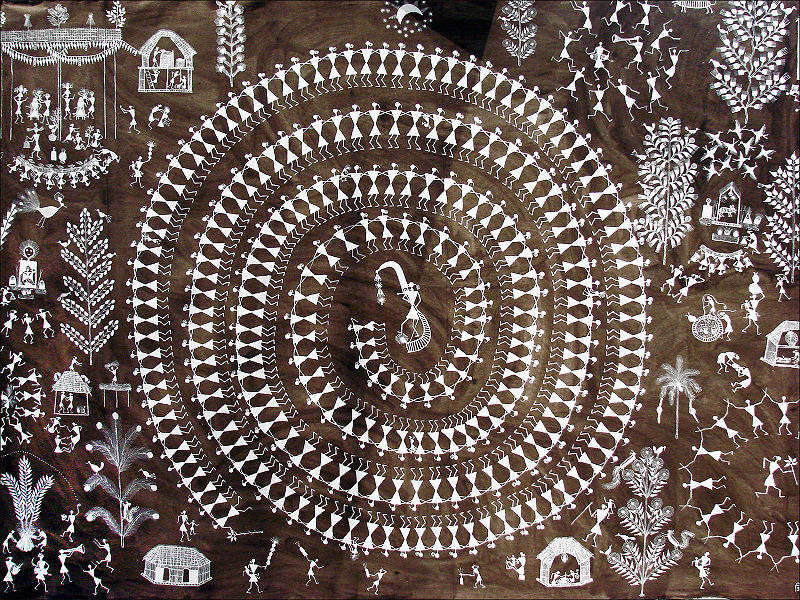
Warli Painting
These paintings are by the indigenous people who live in Gujarat and Maharashtra knowns as Warli.
Warli painting has a resemblance to the Bhimbetkas Mural paintings.
The painting is ritualistic, which features a central motif of Chaukat or Chauk, which is an open place in the middle of the house.
Warli Painting By [https://www.flickr.com/people/72746018@N00 Jean-Pierre Dalb�ra] from Paris, France – [https://www.flickr.com/photos/72746018@N00/4489190461/ Jivya Soma Mashe (Mus�e du Quai Branly)], CC BY 2.0, https://commons.wikimedia.org/w/index.php?curid=10052344
Saura Paintings
Saura Paintings are also from Odissa and are made by Tribes called Saura of Odissa/Orissa.
It is traditionally made on the red or brown clay walls of homes. The dyes are made of rice, white stones, etc. The only colors used by Sauras are Geru(Red Earth) and White (Rice Paste).
These are which are visually much the same as the Warli Painting.
It is a style of wall mural painting that is done by the Saura tribes of Odisha. These paintings are also called Ikons or Ekons. These paintings are meant to appease the deity, Edital.
By tradition is this artwork is done only by the priest and they would explain its meanings to the village folk and pass their customs in oral tradition.
As per local folks, Savari who is a women devotee of Lord Rama, and Jara, who is a hunter who wounded Lord Krishna belong to these tribes.
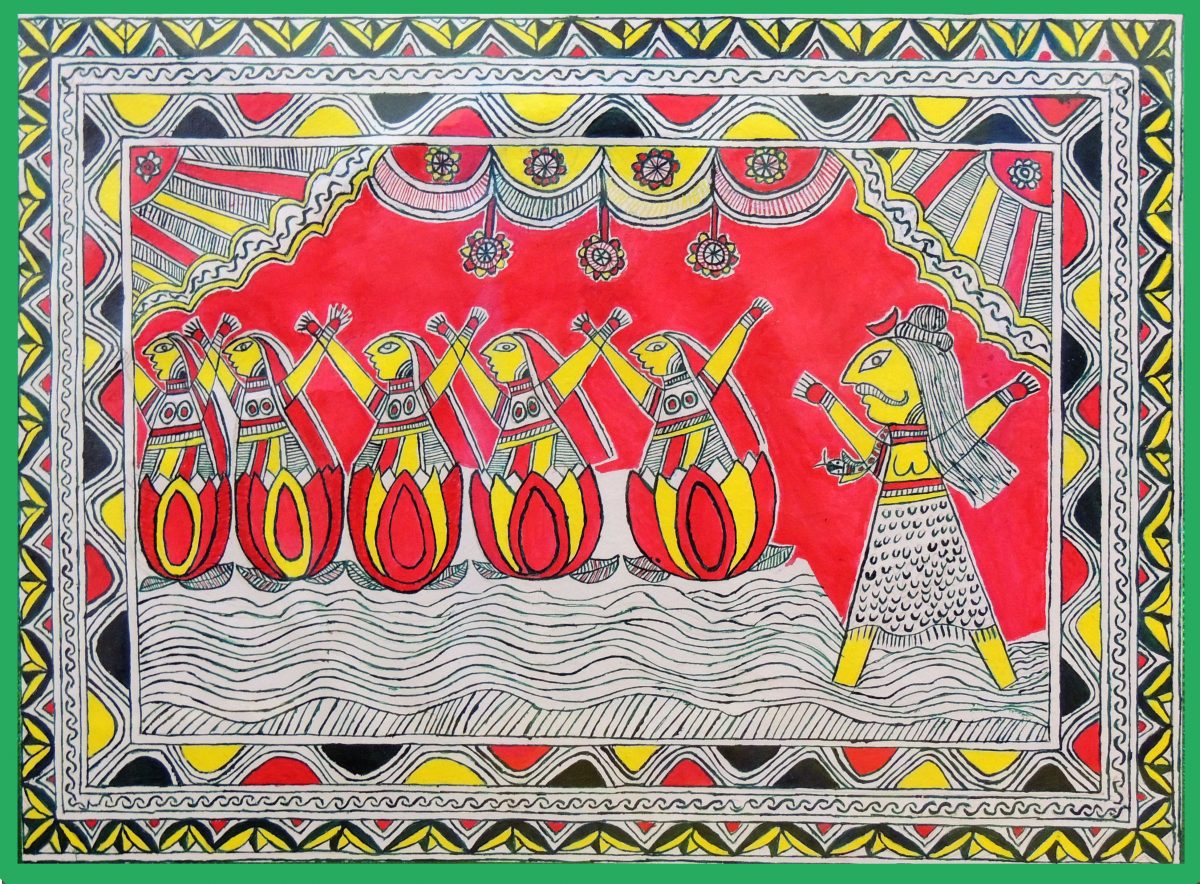
Manjusha Paintings
Manjusha means box, these paintings were executed on the boxes made of Jute and paper.It originates in Bihar, Bhagalpur region and this painting is also known as Angika Art.
It is also called Snake paintings since the snake motifs are present in it.
Pithora Paintings
Pithora paintings are done by tribes who live in communities in the states of Gujarat and Madya Pradesh. In these paintings the common features in the depiction of animals and especially the horses.
These paintings are folk art culture of Gujarat done on the walls. Pithora paintings are more ritual than art, that are performed by tribes like Rathwas, Bhilalas, etc.
This painting is historically derived from the cave, wall, and rock paintings and has spiritual and mythological relevance.
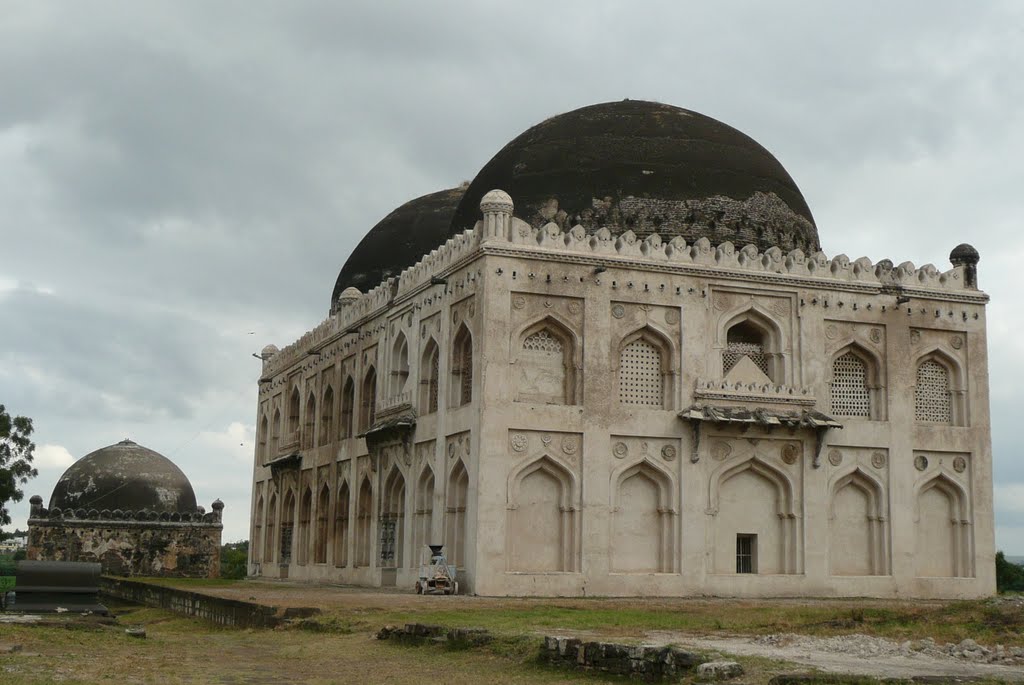
The Bahmani ruler believed that they were the descendants of Iranian legend “Bahman” and also had Persian as their mother tongue.
They patronized the culture, literature, language of the Persians, or the Persian way of life.
The Alauddin Bahman Shah converted thousands of women and children to Islam who were captured from Carnatic rules.
These girls were mostly sex slaves, dancing girls of Hindu temples. Bidri, craftwork from the Bahmani capital Bidar, is inlay craftwork on copper and silver.
The citizens of the Bahmani Kingdom were mostly Hindus, even though the rulers were of Shia Islam. Sometimes the people practiced Islamic customs for the Muslim rulers.
India is a vibrant and complex tapestry of cultures, traditions, and social dynamics that make it one of the most unique societies in the world. Let’s explore the remarkable salient features that define the Indian social landscape.
Diversity: The Cornerstone of Indian Society
India is a living testament to unity in diversity. The society is characterized by an extraordinary blend of multiple dimensions:
Multi-Ethnic Composition: Home to hundreds of ethnic groups with distinct identities
Multilingual Culture: Over 22 official languages and 500+ dialects coexisting harmoniously
Religious Pluralism: A melting pot of religions including Hinduism, Buddhism, Islam, Christianity, Sikhism, and many more.
Social Structure and Dynamics
Caste and Class Interplay
The traditional caste system continues to evolve, with modern economic reforms creating new avenues for social mobility. While historical hierarchies persist, there’s a gradual transformation towards a more class-based social structure.
Patriarchal Traditions
Indian society remains predominantly patriarchal, with deep-rooted gender roles and challenges:
Male dominance in social and economic spheres
Persistent gender wage gaps
Ongoing struggles against discriminatory practices like dowry and female infanticide.
Cultural Equilibrium
Tradition Meets Modernity One of the most fascinating aspects of Indian society is its ability to balance traditionalism and modernism. This is evident in:
Fusion of western and traditional clothing styles
Coexistence of modern gym culture with ancient yoga practices
Adaptation of global cuisines with local flavors.
Unique Social Characteristics
Kinship and Family: Strong emphasis on family bonds and extended family structures
Tolerance and Mutual Respect: Acceptance of diverse cultural and religious practices
Collective Values: Prioritizing community welfare over individual achievements.
Evolving Social Landscape
The Indian society is not static but dynamically adapting. Social media and technological advancements are playing crucial roles in:
Preserving traditional cultural practices
Providing platforms for social discourse
Challenging existing social norms.
Conclusion
Indian society represents a complex, resilient, and continuously evolving social system. Its ability to accommodate diverse identities while maintaining a sense of collective unity makes it truly exceptional on the global stage.
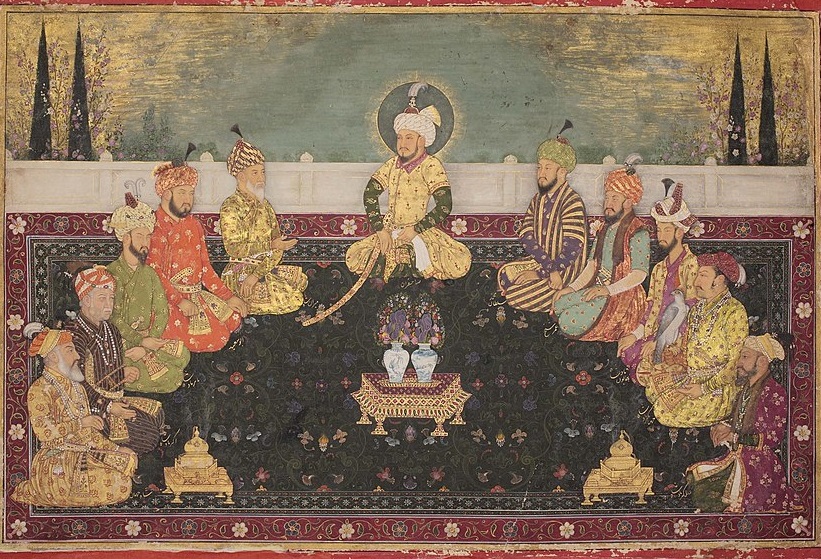
The term “Shaikhzadas” generally refers to the descendants of the Prophet Muhammad in Islamic contexts. In the Mughal Empire, where the rulers and a significant portion of the population were adherents of Islam, including many descendants of the Prophet Muhammad, the term could be used to refer to individuals belonging to the Sayyid or Shaikh community, emphasizing their lineage tracing back to the Prophet.
Sayyids and Shaikhs held a special status in the Mughal society due to their lineage. They were often respected for their supposed religious purity and were sometimes accorded privileges or given positions of authority. Here are some key points about the role and status of Shaikhzadas in the Mughal Empire:
Religious Prestige:
Sayyids and Shaikhs were considered to be of noble descent due to their genealogical connection to the Prophet Muhammad. This lineage bestowed upon them a certain level of religious prestige within the Mughal society.
Educational and Religious Leadership:
Many Sayyids and Shaikhs were involved in religious education and scholarship. They often played key roles as religious leaders, scholars, and teachers, contributing to the religious and intellectual landscape of the Mughal Empire.
Court Positions:
Some Shaikhzadas held positions of influence and authority within the Mughal court. Their lineage often played a role in their appointment to administrative or advisory roles, emphasizing the symbolic and religious legitimacy they brought to their positions.
Land Grants and Privileges:
In certain instances, the Mughal emperors granted land and other privileges to Sayyids and Shaikhs, acknowledging their esteemed lineage. This practice was part of a broader system of rewarding loyalty and seeking the blessings of those considered descendants of the Prophet.
Cultural and Social Contributions:
Beyond their religious roles, Shaikhzadas also made cultural and social contributions. They were patrons of art, literature, and architecture, contributing to the rich cultural tapestry of the Mughal Empire.
Integration into Society:
While Sayyids and Shaikhs had a special status, they were part of a diverse and dynamic society. The Mughal Empire encompassed people from various religious, ethnic, and social backgrounds, and the Shaikhzadas were one component of this diverse tapestry.
Conclusion
In conclusion the status and roles of Shaikhzadas varied over time and were influenced by the policies and attitudes of individual Mughal rulers. The Mughal Empire, known for its syncretic culture, accommodated a range of religious and cultural identities, and the Shaikhzadas played a unique part in this multifaceted society.
Religion is a relation of all the members of a community to a power that has the good of the community at heart and protects its law and moral order.
Religion is not vague fear or unknown fear, nor it is an unknown power not the child of terror.
Religion produces a distinct attitude towards life which affects the further development of society.
Classification of Religion
Religion is classified based on a belief in god.
Monotheistic
Belief in Single God. Ex: Christianity, Islam, etc.
Polytheistic
Belief in multiple Gods. Ex: Hinduism.
There is another classification on the basis of areas of origin such as Eastern religion, western religion, far east religion, African religion, Indian religion, etc.
The Universal religions classified by the Geographers are Christianity, Islam, Buddhism. Ethnic Religions such as Hinduism, Shintoism in Japan, Chinese Faiths, Judaism.
Tribal or Traditional religions such as Animism, Shamanism, and secular that is Non-religious and Atheists.
Major Religions In the World
Christianity
Christianity is a universal religion that has the largest number of followers in the world.
They have over 2 billion followers and their faith centers on beliefs regarding the birth, life, death, and resurrection of Jesus Christ.
Christianity originated with the ministry of Jesus, who is a Jewish teacher and healer who proclaimed the imminent kingdom of God and was crucified between c. AD 30–33 in Jerusalem in the Roman province of Judea.
Followers of the Christian religion base their beliefs on the life, teachings, and death of Jesus Christ.
Christians believe in one God that created heaven, earth, and the universe. The belief in one God originated with the Jewish religion. Christians believe Jesus is the “Messiah” or savior of the world.
Its book is the Bible – New Testament, Old Testament, etc
Islam
Islam is the second-largest religion in the world. The large Islam population is in South West Asia, Central Asia, South Asia, and South-East Asia, North Africa.
Shia and Sunni are two of its main section.
Its sacred book is Kuran.
Hinduism
Hinduism is the oldest ethnic religion in the world which was founded about 3000 BC in India. This Polytheistic religion has 8 million followers in the world.
But this religion is concentrated mostly in India and Nepal. But it has sizable numbers in Northern America and Western European countries.
99% of the Hindu population is concentrated in South Asia.
Its sacred book is Vedas, Upanishads. Also, it has Epics such as Ramayana and Mahabharata, Bhagavad Gita.
Buddhism
Buddhism is one of the oldest Religions in India founded by Gautama Buddha, a Kshatriya prince from the Shakya clan around 525 BC.
This religion spread in several Asian countries such as China, Myanmar, India, Sri Lanka, Japan, Mongolia, Korea, and South-East Asian Countries.
It is spread due to its liberal policy and its two main sections are Hinayana and Mahayana.
Judaism
Judaism is one of the oldest monotheistic faith considered as a parent of Christianity. It is originated around 4000 years ago in the Middle East.
There are 14 Million followers living in the USA, Europe, and Asia.
Chinese Religion
Chinese Religions include two sections, namely Confucianism and Taoism. Confucianism was established by Confucious from around 551 to 479 BC.
Taoism was established by Lao Tse around 604 to 517 BCE.
Jainism
Jainism is also born in India as a reaction to orthodox Hinduism.
It is founded by Lord Mahavir who was a contemporary of Lord Buddha. Its followers mostly concentrated in India.
Sikhism
Sikhism is an offshoot of Hinduism and Islam. It is established in the 15 century by Guru Nanak. It is confined to the Punjab state. It has accepted Gurumukhi as its language.
Tribal Religion
It is a special form of ethnic religion. The tribal people are generally in the Neolithic stage of social development.
Each tribal religion has different cultures, social and economic life. Also, they maintain a close relationship between land and the natural environment.
Tribals are engaged in food gathering, hunting, fishing, primitive agriculture, etc. It is estimated that there are about 300 million indigenous people worldwide.
These numbers constitute 4% of the total population in the world and live in over 60 countries.
Over 90% of the population of Greenland is tribal people. The tribal population is 66% in Bolivia and 40% in Peru.
In India, the tribal population is 8.2%. They are categorized as ST ( Scheduled Tribes) in India. They follow their own tribal deities.
Classical dances of India are recognized by Sangeet Natak Akademi. It includes Bharatanatyam, Katak, Kuchipudi, Odissi, Kathakali, Sattriya, Manipuri and Mohiniyattam. These mentioned dances are major classical dances of India.
Also, the Culture Ministry of the Government of India includes Chhau in its classical list.
These dances represent a unity of core ideas in different styles, costumes, and diversified expressions. Indian classical dance, which is Shastriya Nritya, is a term that covers the various performance arts which are rooted in the Hindu religious, musical theatre styles.
The practice of these arts can be traced to the Sanskrit text, Natya Shastra. Natya Shastra, is the rule or foundation for classical dances in India, and this text is attributed to the ancient scholar “Bharata Muni“.
8 Classical dances of India are:
Bharatanatyam dance upsc
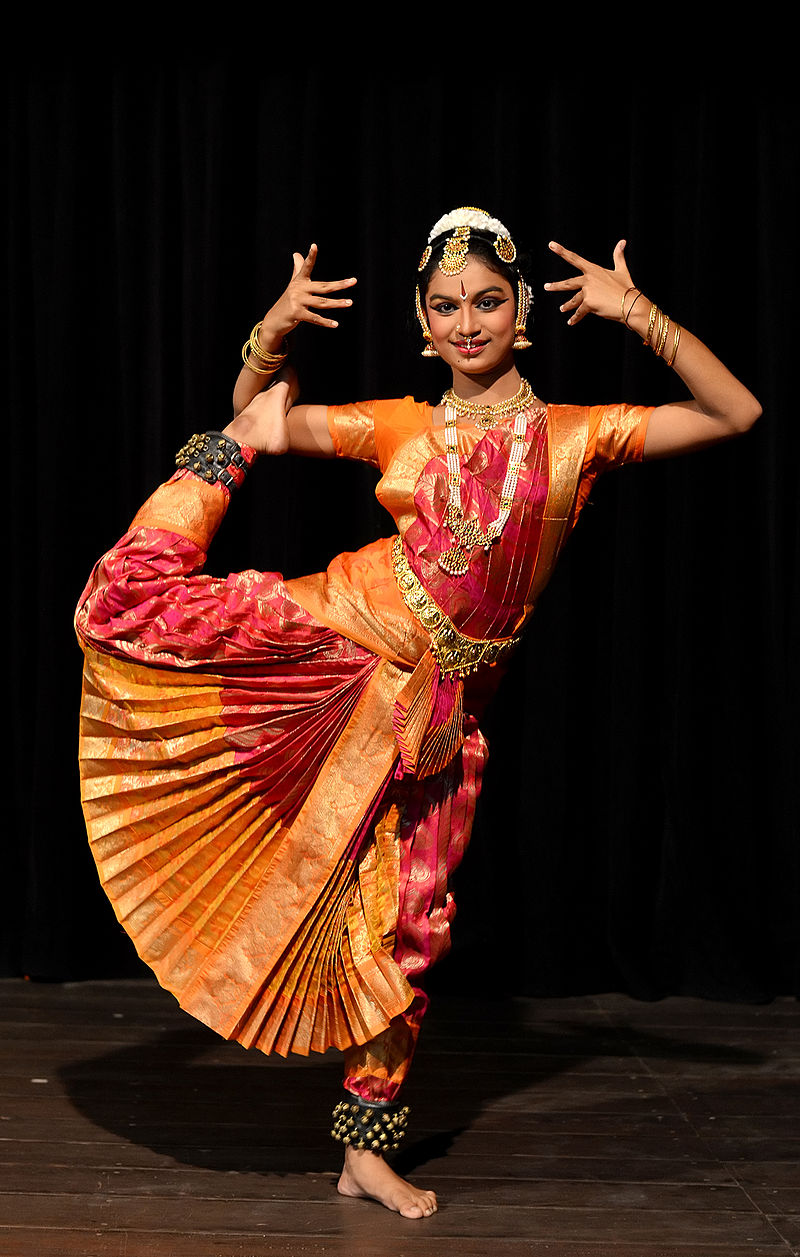
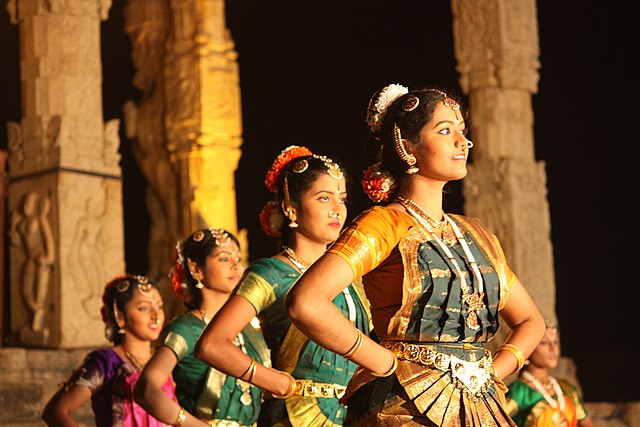
Bharatanatyam By Arian Zwegers – Thanjavur, Brihadishwara Temple, dance, CC BY 2.0, https://commons.wikimedia.org/w/index.php?curid=24487525
It is the oldest classical dance form. It gets its name from the ancient scholar “Bharata Muni” and the word “Natyam”, which means Dance in the Tamil Language. Bharatanatyam’s origins can be traced to the solo dance performance of Devadasi, which means temple dancer in the Tamil Language.
Today, the modern stage production of Bharatnatyam has incorporated, technical performance with pure dance that is based on non-religious ideas and fusion themes. Bharatanatyam, dance was revived as mainstream dance by Bhatanatyam artists Rukmini Devi Arundale, Bala Saraswati, and Yamini Krishnamurthi.
Bharatanatyam features and styles Upsc
Like all major classical Indian dance forms, there are three performance categories in the Natya Shastra. They are Nritta(Nirutham), Nritya(Niruthiyam), and Natya (Natyam).
Styles of Bharatanatyam
Pandanallur, Vazhavoor, Melathoor and Kalakshetra style.
Kerala kathakali dance upsc
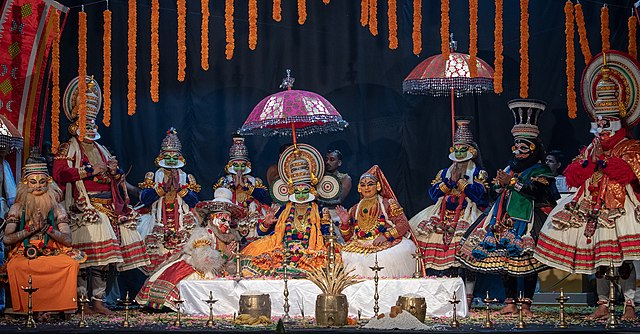
Kathakali dance from Kerala By AdvaithNair – Own work, CC BY-SA 4.0, https://commons.wikimedia.org/w/index.php?curid=94980841
This is a Hindu performance art in Kerala. Katha means story and Kali means Drama. The themes of Kathakali include folk mythologies, religious heroes, legends, and religious, spiritual ideas from Hindu Puranas/epics.
In most of its presentations, Kathakali depicts the conflicts between good and evil. It is performed in Sanskritised Malayalam and performed in open-air theatre or temple premises.
A brass lamp is used for lighting. The most remarkable feature of Kathakali is a representation of Rasa through the movement of eyes and eyebrows.
Kuchipudi dance form upsc
Kuchipudi By Yunji23asdfg – Own work, CC BY-SA 4.0, https://commons.wikimedia.org/w/index.php?curid=69734494
It originated from a village named Kuchipudi, in the state of Andra Pradesh. It is developed as a Hindu God, Krishna oriented to Vaishnavism tradition. Its recital is based on Bhagavata Purana, but it has a secular theme.
The traditional Kuchipudi was performed by all-male troupes.Lasya and Tandava are important in Kuchipudi dance.
Carnatic music instruments and vocal in the Telugu language accompanies the performance. The musical instruments used as Mridangam, Cymbals, veena, flute, and the tambura. Lakshmi Narayan Shastri bought renown to this dance form.
Kathak dance upsc
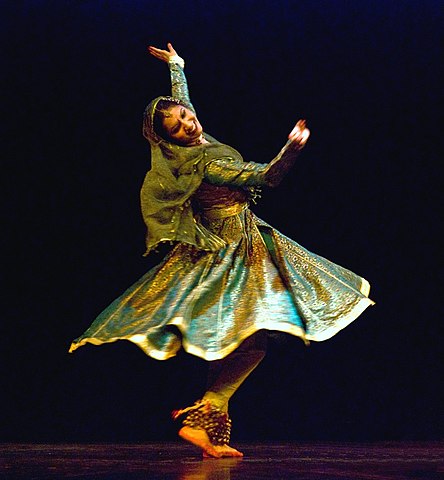
Kathak By https://www.flickr.com/photos/payalam/ – https://www.flickr.com/photos/payalam/3511900193/sizes/l/, CC BY 2.0, https://commons.wikimedia.org/w/index.php?curid=8284588
The origin of Kathak is from traveling bards of ancient northern Indian known as Kathakars or Story tellers. Kathak is a traditional dance form of Uttar Pradesh state. During the Mughal Empire, it was influenced by Islamic features, especially in its costumes and dancing style.
Kathak is commonly identified with the court tradition in North India. It is found in three distinct forms called Gharanas. It is named after the cities Jaipur, Banaras, and Lucknow, where the Kathak dance traditions evolved.
One of the main features of the Kathak recital is Jugulbandi, where it shows a competitive play between dancer and tabla player. This dance form is based on Hindustani music also accompanied by Dhrupad music.
The main proponents of Kathak are Lachha Maharaj, Shambu Maharaj, and Birju Maharaj.
Odissi
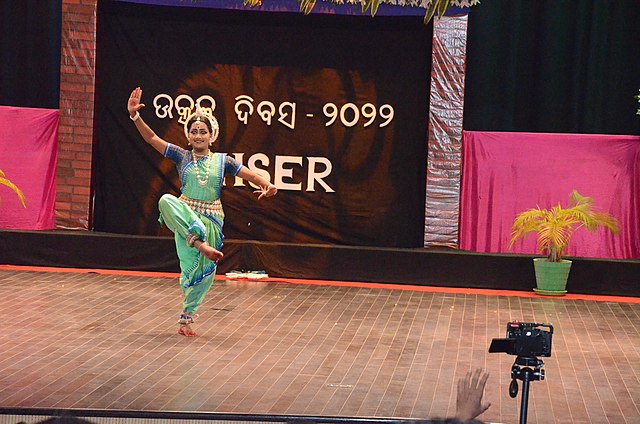
Odissi Nritya By Amiwins – Own work, CC BY-SA 4.0, https://commons.wikimedia.org/w/index.php?curid=116715757
It derives its name from Odra Nirtya, which is mentioned in Natya Shastra. Mudras and Postures express emotions similar to Bharatnatyam. The three-bent form of dance is called Tribanga posture is an important feature in Odissi.
This dance expresses religious stories and ideas of spirituality, most commonly Vaishnavism, where Vishnu is Jagannath. Odissi dance accompanied by Hindustani music.
Elements of Odissi include Mangalcharan, Batunirtya, Pallavi, Tarijham.
Mangalcharan – Beginning of the dance.
Batu Nirtya – It comprises dancing.
Pallavi – It includes the facial expression and representation of the song.
Tarijhan – It is pure dance before the conclusion.
Sattriya
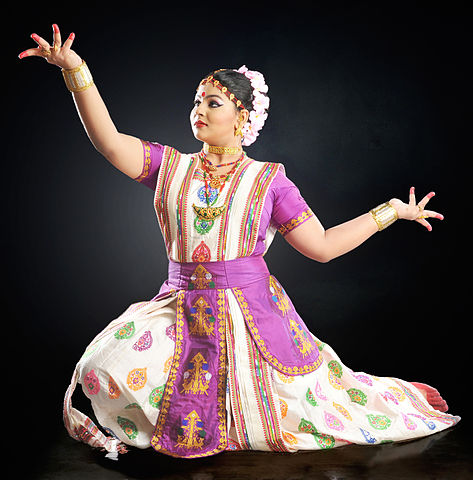
Sattriya dancer – अपना काम, CC BY-SA 3.0, https://commons.wikimedia.org/w/index.php?curid=25927682 द्वारा
Sattriya or Sattriya Nritya originated in the eastern state of Assam. It is a dance-drama performance. The art with origins in the Krishn-centered Vaishnavism monasteries in Assam.
It attributes to the 15th-century, Bhakti movement. Its scholar and Saint Mahapurush Srimata Sankardev. It focuses more on the devotional aspects of dance. Also, it narrates the mythological stories of Vishnu.
This dance is performed by a group of Male monks known as Bhokots. It is part of their daily rituals. The main musical instruments used are Khol and Flute.
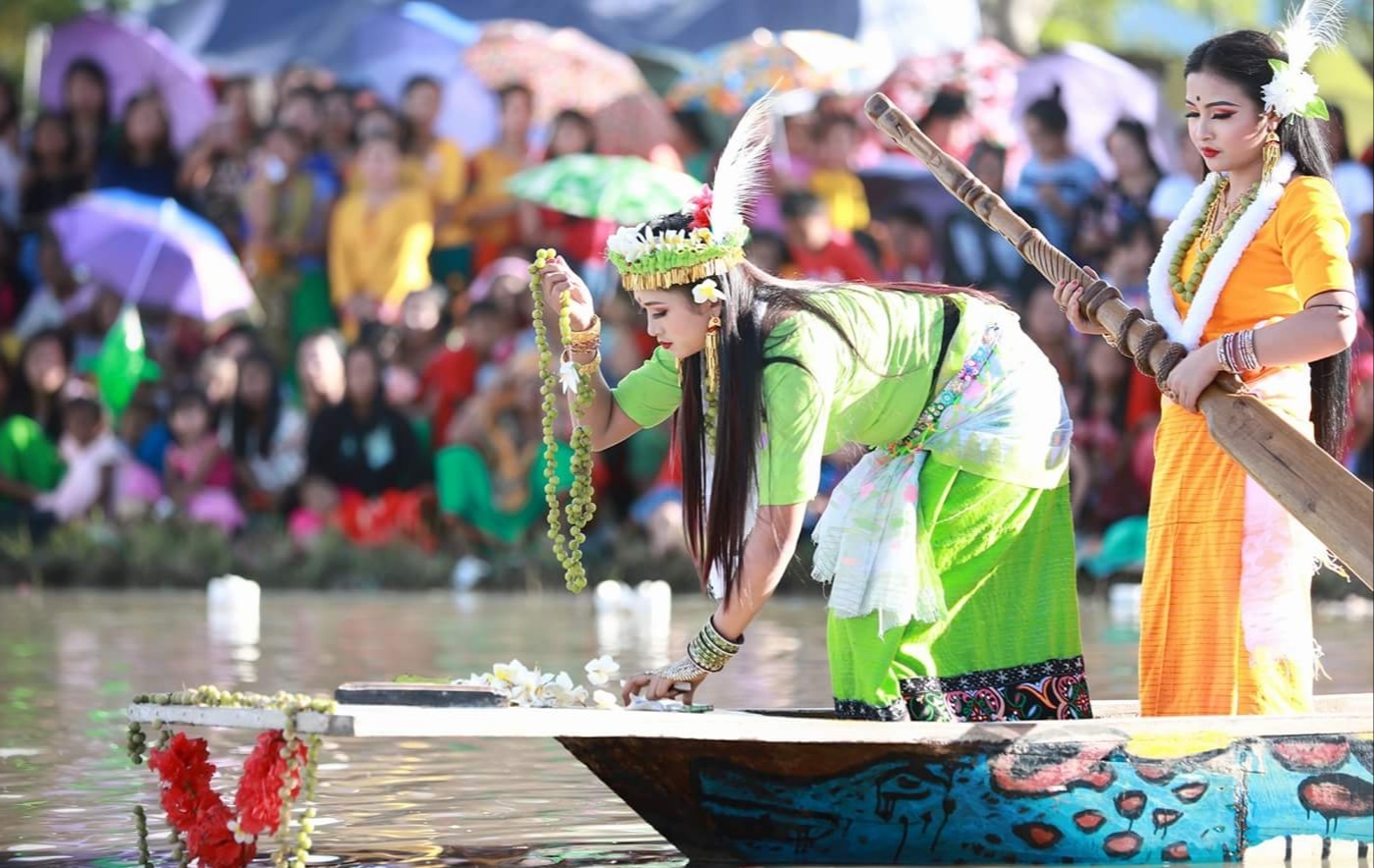
Manipuri dance upsc
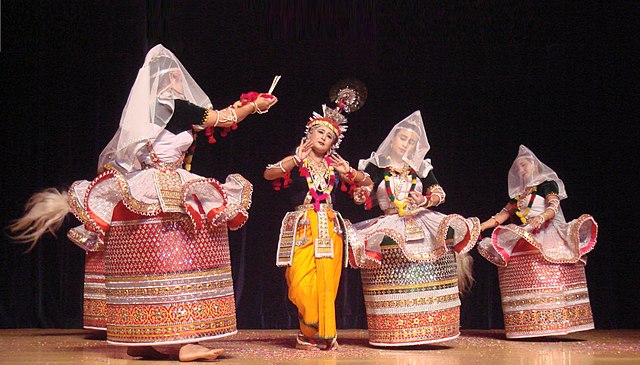
Manipuri dance By https://www.flickr.com/photos/matsukin/ – https://www.flickr.com/photos/matsukin/486353380/, CC BY 2.0, https://commons.wikimedia.org/w/index.php?curid=4517518
It is also known as Jagoi. It is one of the major classical dance forms and it is named after the region Manipur. This dance is known for its Hindu Vaishnavism Themes. It exquisite performance of a love-inspired dance drama of Radha-Krishna called Raslila.
Mohiniyattam dance upsc
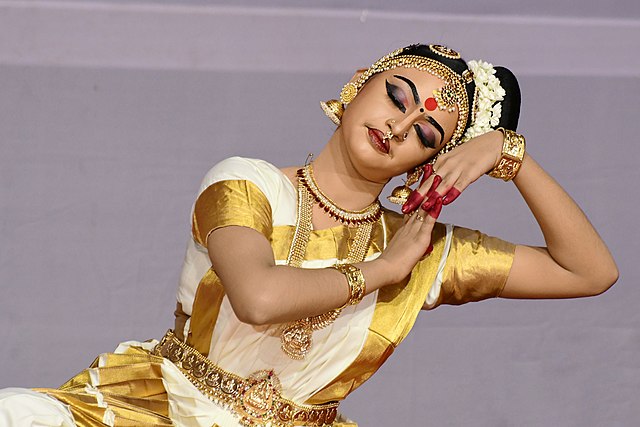
By Shagil Kannur – Own work, CC BY-SA 4.0, https://commons.wikimedia.org/w/index.php?curid=85542877
It is a traditional dance form of Kerala. The Mohiniattam comes from the word Mohini which means beautiful and Attam which means dance.
Mohiniattam is essentially a solo dance performance that incorporates Lasya and Tandava style. It generally narrates the story of the feminine dance of Vishnu.
This post is written for the topic “Effect of British rule on socio-economic factors Tnpsc“.
The Social and Cultural impact includes the abolition of evil social practices such as Sati, Child Marriage, Infanticides, Human sacrifices etc. Also, western ideas such as Human rights, Freedom, Equality, and Liberty were the cultural effect that came along with Britishers.
Also, Britishers introduced Railways, telegraphs, and posts for the masses. Also introduced Western Sciences and Western Education in India.
But their economic policy drained the wealth from India.
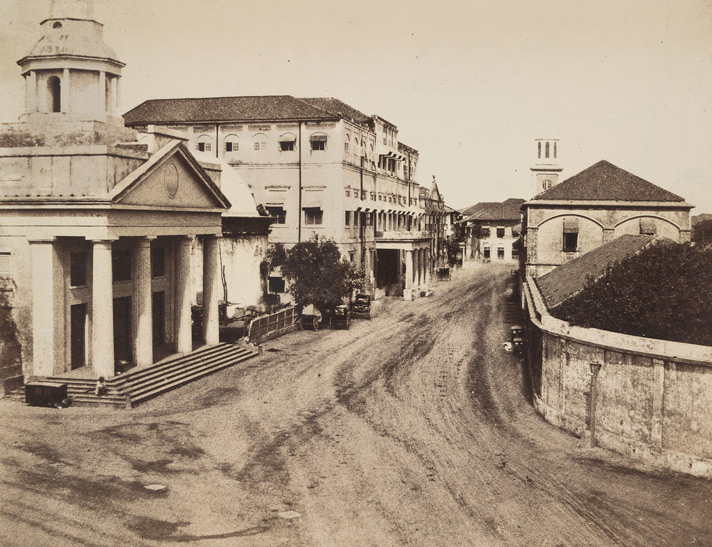
By William Powell Frith – Scanned from J. Anderson Black and Madge Garland: A History of Fashion, Morrow, 1975. ISBN 0-688-02893-4, Public Domain, https://commons.wikimedia.org/w/index.php?curid=1739612
Economic Effect
The English traders accumulated wealth and capital from Africa, Asia and America. This is due to the Industrial Revolution in Europe.
The English used their enormous wealth by setting up trade and industries with India. They invested a lot in India for mass production by setting up factories, and machines that they pioneered during the Industrial Revolution during the late 18th and early 19th centuries.
These produced large finished products and the East India Company financed and expanded its industrial base. During this period, a certain class of Manufactured minted a great profit.
This Manufacturing class has made more profit than the trader. This is because they got raw materials from India at a cheaper price and sold their finished products to the Indians at a higher price.
Example: They purchased raw cotton from India at cheaper prices and sold finished products such as clothes at a higher price in India. Note: The clothes made in Britain are cheaper than the clothes made in India. As clothes were mass-produced by the use of machines in the large factories.
Pressure from other Companies
During 1793 and 1813, the British manufacturers campaigned against the East India Companies’ monopoly in trade with India and the privileges it enjoyed.
These have successfully abolished the monopoly of East India Company with Indian Trade. But now India has become an economic colony of England’s Industries. India is now the biggest market for British manufactured goods.
//draft
Textile Industry and Trade
Earlier, Indian handloom had a big market in Europe. Indian textiles such as cotton, linen, silk, and woolen goods already had markets in Asia and Africa.
With the coming of industrialization in England, the textile industry there made important headway.
There was now a reverse of the direction of the textile trade between Britain and India.
There was a massive import of machine-made clothes from English factories to Indian markets. This import of a large number of products manufactured by mechanical looms in England led to an increased threat for the handicraft industries as the British goods were sold at a much cheaper price.
The British succeeded in selling their goods at a cheap price as foreign goods were given free entry in India without paying any duty.
On the other hand, Indian handicrafts were taxed heavily when they were sent out of the country. Besides, under the pressure of its industrialists, the British government often imposed a protective tariff on Indian textiles.
Therefore, within a few years, India from being an exporter of clothes became an exporter of raw cotton and an importer of British clothes.
This reversal made a huge impact on the Indian handloom weaving industry leading to its virtual collapse. It also created unemployment for a large community of weavers.
Many of them migrated to rural areas to work on their lands as agricultural laborers. This in turn put increased pressure on the rural economy and livelihood.
This process of uneven competition faced by the Indian handloom industry was later dubbed by the Indian nationalist leaders as de-industrialization.
The main aim of the British was to transform India into a consumer of British goods. As a result, textile, metalwork, glass, and paper industries were soon out of work.
By 1813, the Indian handicrafts lost both their domestic as well as foreign market.
Indian goods could not compete with the British factory-made products where machines were used. These markets were now captured and monopolized by Britain by means of war and colonization.
From an exporter, India became an importer of these goods. They extracted money from the Indian rulers, merchants, zamindars, and even the common people.
Added to this drain was the profit made through trade and also the salaries of the officials. It was evident that their economic policies were meant to serve the interests of the East India Company and later the British Empire.
Land Revenue Policy and Land Settlements
Permanent Settlement
Mahalwari Settlement
Ryotwar Settlement
Commercialisation of Agriculture
Another major economic impact of the British policies in India was the introduction of a large number of commercial crops such as tea, coffee, indigo, opium, cotton, jute, sugarcane, and oilseed.
Different kinds of commercial crops were introduced with different intentions. Indian opium was used to balance the trade of Chinese tea with Britain in the latter’s favor.
The market for opium was strictly controlled by British traders which did not leave much scope for Indian producers to reap profit.
Indians were forced to produce indigo and sell it on the conditions dictated by the Britishers.
Indigo was sent to England and used as a dyeing agent for cloth produced in British towns.
Indigo was grown under a different system where all farmers were compelled to grow it on the 3/20th part of their land.
Unfortunately, the cultivation of Indigo left the land infertile for some years. This made the farmers reluctant to grow it.
In the tea plantations ownership changed hands quite often. The workers on these plantations worked under a lot of hardships.
Commercialization of agriculture further enhanced the speed of transfer of ownership of land thereby increasing the number of landless laborers.
It also brought in a large number of merchants, traders, and middlemen who further exploited the situation.
The peasant now depended on them to sell their produce during harvest time. Because the peasants now shifted to commercial crops, food grain production went down.
So, less food stock led to famines. It was therefore not surprising that the peasants revolted.
There was an enormous drain of wealth from our country to Britain due to the various economic policies.
The additional financial burden was placed on India due to expenditures on salaries, pensions, and training of military and civilian staff employed by the British to rule India.
If this wealth was invested in India it could have helped enormously improve the economy in this country.
The economic policies implemented by the British changed the social structure of Indian society.
Rise of the New Money-lending Class
Time-bound and excessive demand of revenue by the British government forced the peasants to take loans from the moneylenders.
These moneylenders often exploited the peasants by charging high-interest rates. They often used unfair means like false accounting, forged signatures, and thumb impressions.
The new legal system and the policy introduced by the British only helped the moneylenders who were either local merchants or landlords. In most cases, the peasants failed to pay back the loan with full interest.
Thus, their lands gradually passed into the hands of the money-lending class.
Rise of the New Middle Class
A major impact of the British rule in India was the beginning of a new middle class.
With the rise of the British commercial interests, new opportunities opened to a small section of the Indian people.
They often acted as the agents and intermediaries of the British traders and thus made huge fortunes. The new landed aristocracy, which came into being after the introduction of Permanent Settlement, also formed a part of this new class.
A major section of the old landowning aristocracy lost ownership of their land and in many cases were replaced by a new class of landowners.
These people got some English education and became the new elite. With the spread of British power, new job opportunities were also created.
Indian society witnessed the introduction of new law courts, government officials, and commercial agencies.
The English educated people naturally got the necessary patronage from their colonial rulers. Thus, a new professional and service-holding middle class were also created by the British, apart from those with landed interests.
Transport and Communication
The means of transport in India at that time were bullock carts, camels, and pack animals.
England on the other hand needed railways that connected the raw material producing areas with the exporting ports and to facilitate the movement of British goods to different parts of the country as well as bring raw materials to the ports.
The vast network of railways that you witness today was pioneered during the latter half of the 19th century.
This opened an avenue for British bankers and investors to invest surplus wealth and material in the construction of railways.
Railways benefited the British capitalists in two important ways. First, it made trading in commodities much easier and profitable by connecting the internal markets with the ports.
Secondly, the rail engines, coaches, and the capital input for the building of rail lines came from Britain.
The British capitalists who invested in railways were also guaranteed a minimum profit of 5% by the government.
These companies were also given free land with a lease of 99 years.
Although the railways were set up for the advantage of British trade, they also played an important role in the national awakening of the country.
Though the British had never anticipated, the extensive transport network and improved education brought people and ideas closer.
During British rule, India took ideas of liberty, equality, human rights, science, and technology from the West.
Educational and Social Reforms
Language and Education Policy
Initially, the East India Company did not evince any particular interest in matters of education. Although the British had captured Bengal in 1757, yet the responsibility of imparting education remained only in Indian hands.
The study of ancient texts written in Arabic, Persian, and Sanskrit still continued. In 1781, Warren Hastings established a Madrasa in Calcutta to encourage the study of Muslim laws along with Arabic and Persian languages.
A decade later in 1791 due to the sincere efforts of the British resident, Jonathan Duncan, a Sanskrit College was established to promote the study of Hindu laws and philosophy in Banaras.
Therefore, it must be contended that during the first three decades of the 19th century, the development of education took place only through traditional institutions.
It is apparent from the government and Church records that the state of oriental learning at the time of the establishment of the Company’s rule in Bengal, there were about 80,000 traditional institutions of learning in Bengal alone, which means that there was at least one institution for every four hundred people in that province.
Different educational surveys of Madras, Bombay, and Punjab also demonstrate similar facts. There was at least one school in every village of India at that time.
The East India Company began to adopt a dual policy in the sphere of education. It discouraged the prevalent system of oriental education and gave importance to western education and the English language.
The Charter Act of 1813 adopted a provision to spend one lakh rupees per annum for the spread of education in India.
Although there was a prolonged debate pertaining to education during the course of a general discussion on the Act of 1813 in the British Parliament, yet the matter continued to generate debate for the next 20 years.
Consequently, not even a single penny out of the allocated funds could be spent on education.
The contemporary British scholars were divided into two groups on the issue of the development of education in India.
One group, called the Orientalists, advocated the promotion of oriental subjects through Indian languages.
The other group, called the Anglicists, argued the cause of western sciences and literature in the medium of the English language.
In 1828, after assuming the office of the Governor-General of India, Lord William Bentinck, emphasized the medium of the English language in Indian education.
At the beginning of 1835, the 10 members of the General Committee of Public Instruction were clearly divided into two equal groups.
Five members including the Chairman of the committee Lord Macaulay were in favor of adopting
English as a medium of public instruction whereas the other five were in favor of oriental languages.
The stalemate continued till 2 February 1835 when the Chairman of the committee, Lord Macaulay announced his famous Minute advocating the Anglicist point of view.
Consequently, despite fierce opposition from all quarters, Bentinck got the resolution passed on 7 March 1835 which declared that henceforth, government funds would be utilized for the promotion of western literature and science through the medium of the English language.
In 1854, Sir Charles Wood sent a comprehensive dispatch as a grand plan on education.
The establishment of departments of public instructions in five provinces and the introduction of the pattern of grants in aid to encourage private participation in the field of education were recommended.
Besides, the dispatch also laid emphasis on the establishment of schools for technical education, teacher and women education.
Over and above all these, the dispatch recommended the establishment of one University each in Calcutta, Bombay, and Madras, on the model of the London University. Consequently, within the next few years, Indian education became rapidly westernized.
Social Policies and Legislation
In the beginning, the British interest was limited to trade and earning profits from economic exploitation. Therefore, they did not evince any interest in taking the issue of social or religious reforms.
They were apprehensive of interfering with the social and religious customs and institutions of the Indians because of the fear that they might lose trade advantage.
Thus, they adopted the policy of extreme precaution and indifference towards social issues in India. The one reason why they indulged in criticizing the customs and traditions of India was to generate a feeling of inferiority complex among the Indians.
However, in the mid-19th century the social and religious movements, launched in India, attracted the attention of the Company’s administration towards the country’s social evils.
The propaganda carried out by the Christian missionaries also stirred the minds of the educated Indians. Western thought and education and views expressed in different newspapers and magazines had their own impact.
Some of the British administrators like Lord William Bentinck had evinced personal interest in the matter.
There were primarily two areas in which laws were enacted, laws pertaining to women’s emancipation and the caste system.
Social Laws Concerning Women
The condition of women, by the time the British established their rule, was not encouraging. Several evil practices such as the practice of Sati, the Purdah system, child marriage, female infanticide, bride price, and polygamy had made their life quite miserable.
The place of women had come to be confined to the four walls of her home. The doors of education had been shut for them.
From an economic point of view also her status was miserable. There was no social and economic equality between a man and a woman.
A Hindu woman was not entitled to inherit any property. Thus, by and large, she was completely dependent on men.
During the 19th and 20th centuries, some laws were enacted with the sincere efforts of social reformers, humanists, and some British administrators to improve the condition of women in Indian society.
The first effort in this direction was the enactment of a law against the practice of Sati during the administration of Lord William Bentinck.
Female Infanticide
Female infanticide was another inhuman practice afflicting 19th-century Indian society. It was particularly in vogue in Rajputana, Punjab, and the North-Western Provinces.
Colonel Todd, Johnson Duncan, Malcolm, and other British administrators have discussed this evil custom in detail.
Factors such as family pride, the fear of not finding a suitable match for the girl child, and the hesitation to bend before the prospective in-laws were some of the major reasons responsible for this practice.
Therefore, immediately after birth, the female infants were being killed either by feeding them with opium or by strangulating, or by purposely neglecting them.
Some laws were enacted against this practice in 1795, 1802, and 1804 and then in 1870. However, the practice could not be completely eradicated only through legal measures.
Gradually, this evil practice came to be done away with through education and public opinion.
Widow Remarriage
There is much historical evidence to suggest that widow remarriage enjoyed social sanction during the ancient period in India.
In course of time, the practice ceased to prevail increasing the number of widows to lakhs during the 19th century.
Therefore, it became incumbent on the part of the social reformers to make sincere efforts to popularize widow remarriage by writing in newspapers and contemporary journals.
Prominent among these reformers were Raja Rammohan Roy and Iswar Chandra Vidyasagar.
They carried out large-scale campaigns in this regard mainly through books, pamphlets, and petitions with scores of signatures.
In July 1856, J.P. Grant, a member of the Governor-General’s Council finally tabled a bill in support of the widow remarriage, which was passed on 13 July 1856 and came to be called the Widow Remarriage Act, 1856.
Child Marriage
The practice of child marriage was another social stigma for women. In November 1870, the Indian Reforms Association was started with the efforts of Keshav Chandra Sen.
A journal called Mahapap Bal Vivah (Child marriage: The Cardinal Sin) was also launched with the efforts of B.M. Malabari to fight against child marriage.
In 1846, the minimum marriageable age for a girl was only 10 years.
In 1891, through the enactment of the Age of Consent Act, this was raised to 12 years. In 1930, through the Sharda Act, the minimum age was raised to 14 years. After independence, the limit was raised to 18 years in 1978.
Purdah System
Similarly, voices were raised against the practice of Purdah during the 19th and 20th centuries.
The condition of women among the peasantry was relatively better in this respect.
Purdah was not so much prevalent in Southern India.
Through the large-scale participation of women in the national freedom movement, the system disappeared without any specific legislative measure taken against it.
Struggle against the Caste System and the related Legislation
Next to the issue of women’s emancipation, the caste system became the second most important issue of social reforms.
In fact, the system of caste had become the bane of Indian society.
The caste system was primarily based on the fourfold division of society viz. Brahmins, Kshatriya, Vaishyas, and Shudras. On account of their degradation in their social status, the Shudras were subjected to all kinds of social discrimination.
At the beginning of the 19th century, the castes of India had been split into innumerable sub-castes on the basis of birth.
In 1937 elections were held under the provisions of the Government of India Act of 1935. Congress Ministries were formed in seven states of India.
On 1 September 1939, the Second World War broke out. The British Government without consulting the people of India involved the country in the war. The Congress vehemently opposed it and as a mark of protest, the Congress Ministries in the Provinces resigned on 12 December 1939.
The Muslim League celebrated that day as Deliverance Day. In March 1940 the Muslim League demanded the creation of Pakistan.
Individual Satyagraha
During the course of the Second World War in order to secure the cooperation of the Indians, the British Government made an announcement on 8 August 1940, which came to be known as the ‘August Offer’.
The August Offer envisaged that after the War a representative body of Indians would be set up to frame the new Constitution. Gandhi was not satisfied with his offer and decided to launch Individual Satyagraha.
Individual Satyagraha was limited, symbolic, and non-violent in nature and it was left to Mahatma Gandhi to choose the Satyagrahis. Acharya Vinoba Bhave was the first to offer Satyagraha and he was sentenced to three months imprisonment.
Jawaharlal Nehru was the second Satyagrahi and was imprisoned for four months. The individual Satyagraha continued for nearly 15 months.
Cripps Mission (1942)
In the meantime, the Viceroy, Lord Linlithgow expanded his Executive Council by including five more Indians into it in July 1941.
However, in the midst of the worsening wartime international situation, the British Government in its continued effort to secure Indian cooperation sent Sir Stafford Cripps to India on 23 March 1942.
This is known as Cripps Mission.
The main recommendations of Cripps were:
The promise of Dominion Status to India, Protection of minorities, setting up of a Constituent Assembly with representatives from the Princely States along with those of the British Provinces.
Also, there would be provision for any Province of British India not prepared to accept this Constitution, either to retain its present constitutional position or frame a constitution of its own.
The major political parties of the country rejected the Cripps proposals. Gandhi called Cripp’s proposals a “Post-dated Cheque”.
They did not like the rights of the Princely States either to send their representatives to the Constituent Assembly or to stay out of the Indian Union.
The Muslim League was also dissatisfied as its demand for Pakistan had not been conceded in the proposal.
Quit India Movement (1942-1944)
The failure of the Cripps Mission and the fear of an impending Japanese invasion of India led Mahatma Gandhi to begin his campaign for the British to quit India.
Mahatma Gandhi believed that an interim government could be formed only after the British left India and the Hindu-Muslim problem was sorted out. The All India Congress Committee met at Bombay on 8 August 1942 and passed the famous Quit India Resolution. On the same day, Gandhi gave his call of ‘do or die’.
On 8th and 9th August 1942, the government arrested all the prominent leaders of Congress.
For once, this pre-planned action of the government left the Indian people without leadership. Mahatma Gandhi was kept in prison at Poona. Pandit Jawaharlal Nehru, Abul Kalam Azad, and other leaders were imprisoned in the Ahmednagar Fort.
At this time, leadership was provided by Ram Manohar Lohia, Achyuta, and S.M. Joshi. The role of Jayaprakash Narain in this movement was important. A large number of students also left their schools and colleges to join the movement.
The youth of the nation also participated in this movement with patriotism. Strikes, demonstrations, and public meetings were organized in various towns and cities. Slowly the movement reached the rural areas. In 1943, as the movement gained further momentum, there were armed attacks on government buildings in Madras and Bengal.
In 1944 Mahatma Gandhi was released from jail. The Quit India Movement was the final attempt for the country’s freedom. The British Government ordered 538 rounds of firing. Nearly 60,229 persons were jailed. At least 7,000 people were killed.
This movement paved the way for India’s freedom. It aroused among Indians feelings of bravery, enthusiasm, and total sacrifice.
Indian National Army
During the course of the Second World War, armed revolutionary activities continued to take place. The role of Subhas Chandra Bose towards such activities is incomparable.
On 2 July 1943, Subhas Chandra Bose reached Singapore and gave the rousing war cry of ‘Dilli Chalo’. He was made the President of the Indian Independence League and soon became the supreme commander of the Indian National Army.
He gave the country the slogan of Jai Hind. The names of the INA’s three Brigades were the Subhas Brigade, Gandhi Brigade, and Nehru Brigade.
The women’s wing of the army was named after Rani Laxmibai. The Indian National Army marched towards Imphal after registering its victory over Kohima. After Japan’s surrender in 1945, the INA failed in its efforts. Under such circumstances, Subhas went to Taiwan. Then on his way to Tokyo, he died on 18 August 1945 in a plane crash.
The trial of the soldiers of INA was held at Red Fort in Delhi. Pandit Jawaharlal Nehru, Bhulabhai Desai, and Tej Bahadur Sapru fought the case on behalf of the soldiers.
Cabinet Mission (1946)
After the Second World War, Lord Atlee became the Prime Minister of England. On 15 March 1946 Lord Atlee made a historic announcement in which the right to self-determination and the framing of a Constitution for India were conceded.
Consequently, three members of the British Cabinet – Pathick Lawrence, Sir Stafford Cripps, and A. V. Alexander – were sent to India. This is known as the Cabinet Mission. The Cabinet Mission put forward a plan for a solution to the constitutional problem. Provision was made for three groups of provinces to possess their separate constitutions.
The Cabinet Mission also proposed the formation of a Union of India, comprising both British India and the Princely States. The Union would remain in charge of only foreign affairs, defense, and communications leaving the residuary powers to be vested in the provinces.
A proposal was envisaged for setting up an Interim Government, which would remain in office till a new government was elected on the basis of the new Constitution framed by the Constituent Assembly.
Both the Muslim League and Congress accepted the plan. Consequently, elections were held in July 1946 for the formation of a Constituent Assembly. The Congress secured 205 out of 214 General seats. The Muslim League got 73 out of 78 Muslim seats.
An interim government was formed under the leadership of Jawaharlal Nehru on 2 September 1946.
Mountbatten Plan (1947)
On 20 February l947, Prime Minister Atlee announced in the House of Commons the definite intention of the British Government to transfer power to responsible Indian hands by a date not later than June 1948.
Thus, to effect the transference of that power Atlee decided to send Lord Mountbatten as Viceroy to India. Lord Mountbatten armed with vast powers became India’s Viceroy on 24 March 1947. The partition of India and the creation of Pakistan appeared inevitable to him.
After extensive consultation, Lord Mountbatten put forth the plan of partition of India on 3 June 1947. Congress and the Muslim League ultimately approved the Mountbatten Plan.
Indian Independence Act 1947
The British Government accorded formal approval to the Mountbatten Plan by enacting the Indian Independence Act on 18 July 1947. The salient features of this Act was:
The partition of the country into India and Pakistan would come into effect from 15 August 1947. The British Government would transfer all powers to these two Dominions. A Boundary Commission would demarcate the boundaries of the provinces of the Punjab and Bengal.
The Act provided for the transfer of power to the Constituent Assemblies of the two Dominions, which will have full authority to frame their respective Constitutions. The Radcliff Boundary Commission drew the boundary line separating India and Pakistan.
On 15th August 1947 India, and on the 14th August Pakistan came into existence as two independent states. Lord Mountbatten was made the first Governor-General of Independent India, whereas Mohammad Ali Jinnah became the first Governor-General of Pakistan.
The most tragic incident occurred on 30 January 1948, when Mahatma Gandhi – the father of the nation- on his way to a prayer meeting was assassinated by Nathuram Godse.
The First World War came to an end in 1918 and the Paris Peace Conference was held in 1919. Many treaties including the Treaty of Versailles were signed at the conference. One of the important features of this conference was that only the victorious nations alone were invited. The conference turned out to be a meeting of the victors to share the spoils of the war. The defeated countries were badly treated.
They also discussed the establishment of permanent peace in the world. In order to solve mutual problems among the nations, under the initiative of the U.S. President Woodrow Wilson, the League of Nations had been established. However, the League failed to maintain the expected international peace.
This ultimately led to the rise of dictatorships in Germany, Italy, and Japan. The formation of Rome, Berlin, and Tokyo Axis led to the Second World War.
The “World War 2 causes and consequences” are a complex web of historical events that shaped the 20th century. The war’s roots can be traced back to the harsh Treaty of Versailles, economic instability, and the rise of extremist ideologies like fascism and Nazism. The conflict led to devastating loss of life, widespread destruction, and the emergence of superpowers like the United States and the Soviet Union. Its consequences included the formation of the United Nations, the Cold War, and the decolonization of many nations. Understanding this pivotal period is crucial for comprehending contemporary global politics and international relations.
Causes of the Second World War
1.Treaty of Versailles
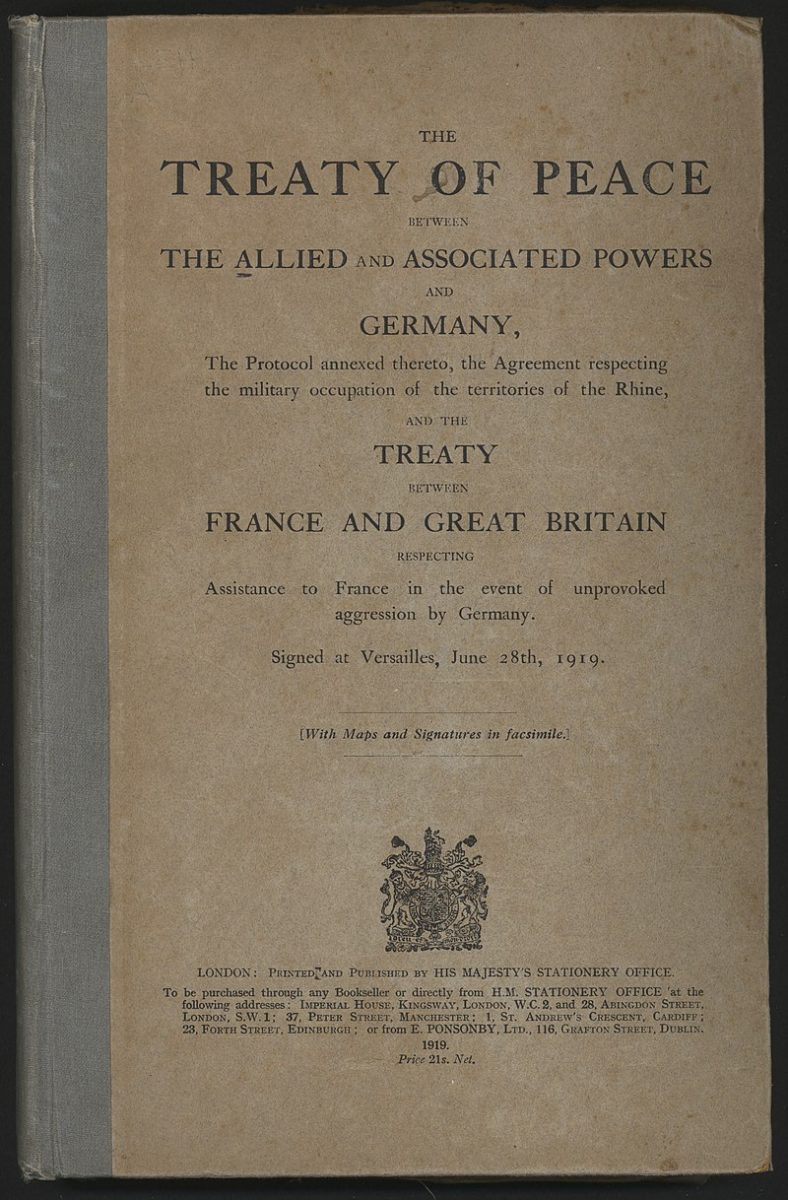
The Treaty of Versailles was a peace treaty signed on June 28, 1919, at the Palace of Versailles, exactly five years after the assassination of Archduke Franz Ferdinand, which led to the war. It ended the state of war between Germany and most of the Allied Powers.
The treaty was the result of months of negotiations at the Paris Peace Conference, attended by representatives of the victorious Allied Powers. Germany was not allowed to participate in the negotiations, and the treaty was imposed on them without their consent.
The Treaty of Versailles was a complex document that addressed a wide range of issues, including territorial adjustments, reparations, disarmament, and the creation of the League of Nations. Some of the key provisions of the treaty included:
1.1.War Guilt Clause (Article 231)
Germany was declared solely responsible for the war and forced to accept full blame. This clause was seen as a harsh and unfair punishment by many Germans, as it ignored the complex causes of the war and placed all the blame on a single nation. It also had a profound impact on German national pride and contributed to the rise of extremist political parties in the interwar period.
The war guilt clause was also controversial because it required Germany to accept responsibility for the war without any opportunity to defend itself. Germany was not allowed to participate in the negotiations that led to the treaty, and the clause was simply imposed on them without their consent. This led to a sense of injustice and resentment among many Germans, who felt that they had been unfairly treated.
The war guilt clause also had a significant impact on the German economy. Germany was forced to pay huge reparations to the Allied Powers for war damages. The final amount was set at 132 billion gold marks, a staggering sum that crippled the German economy and led to hyperinflation and widespread poverty.
1.2.Territorial Losses
Germany lost significant territories to neighbouring countries, including:
France: Alsace-Lorraine, Eupen-Malmedy
Belgium: Eupen-Malmedy
Poland: West Prussia, Upper Silesia, Posen
Denmark: Northern Schleswig
Czechoslovakia: Hultschin
Lithuania: Memel
Danzig became a free city under the protection of the League of Nations.
1.3.Military Restrictions
Germany’s military was severely limited in size and power. Its army was reduced to 100,000 men, its navy was drastically curtailed, and it was forbidden to have an air force. These restrictions were designed to prevent Germany from ever becoming a military threat again. However, they also had the unintended consequence of making Germany feel humiliated and resentful, which would later contribute to the rise of Adolf Hitler and the Nazi Party.
1.4.Reparations
Germany was ordered to pay huge reparations to the Allied Powers for war damages. The final amount was set at 132 billion gold marks, a staggering sum that crippled the German economy.
1.5.Consequences of the Treaty
1.5.1.Economic Hardship
The reparations payments and territorial losses devastated the German economy, leading to hyperinflation, widespread poverty, and a sharp decline in living standards for millions of Germans.
1.5.2.Political Instability
The harsh terms of the treaty fueled resentment and anger in Germany, contributing to the rise of extremist political parties like the Nazis. The German government was weak and unstable, and it struggled to cope with the economic and social problems facing the country. This instability created an opportunity for extremist groups to gain power, and the Nazis were able to exploit the situation to their advantage. The Nazis promised to restore Germany’s national pride and economic prosperity, and they were able to win the support of many Germans who were desperate for change.
Treaty of Versailles
Germany was defeated in the First World War. Germany was not invited to the Paris Peace Conference. Germany was forced to sign a harsh and humiliating treaty. German territories were taken away from was deprived of their colonies. The German navy was completely disbanded.
The German army was reduced considerably. The Weimar Republic was not in a position to solve the post-war problems. The German people decided to take revenge for their humiliation. The Second World War was a war of retaliation. Therefore, the Treaty of Versailles had in itself the seeds of the Second World War.
Rise of Dictatorships
Rise of Dictatorships
The inter-war period witnessed the rise of dictatorships in Europe. The inter-war period is otherwise called the period of dictators. Germany, Italy, Spain, and Japan witnessed the rise of dictators.
Dictatorship in Germany
In Germany, the Weimar Republic was weak. Hitler, the leader of the Nazi Party took full advantage of the weakness of the Republican Government and brought the government under his control.He started aggression. He captured Austria and Czechoslovakia. At last, he attacked Poland and World War II started.
Dictatorship in Germany
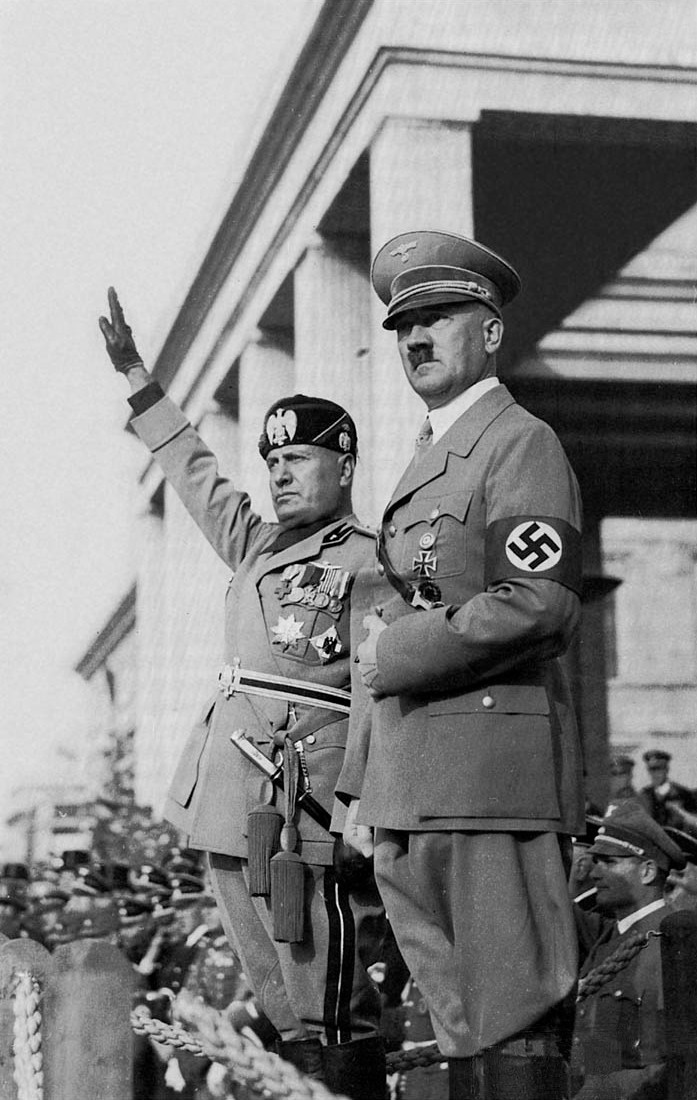
The same condition prevailed in Italy also. Italy felt that it was deceived in the Paris Peace Conference. Mussolini started the Fascist Party.
In 1922 he captured power and became a dictator. He also followed an aggressive foreign policy. The spirit of dictatorship arose in Spain and Japan also.
Dictatorship in Spain
In Spain, General Franco defeated the Republican Government and established his dictatorship. In this effort, he was assisted by the armies of Hitler and Mussolini.
Dictatorship in Japan
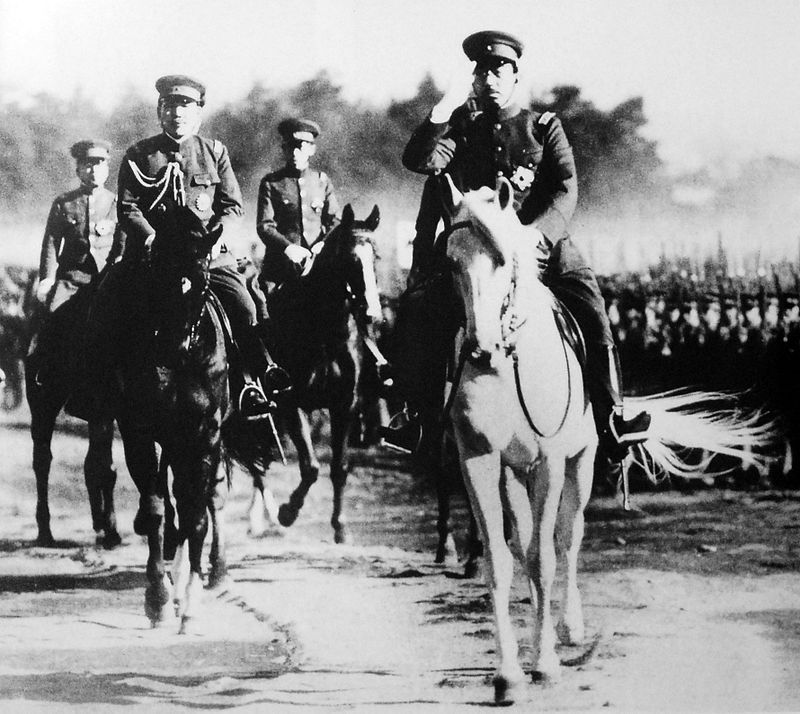
Hirohito was emperor during Japan’s militaristic period from the early 1930s to 1945, the end of World War II.
Japan became a partner of Hitler and Mussolini by signing the Rome- Berlin -Tokyo Axis. This alliance disturbed world peace and the Second World War started.
2.Militarism
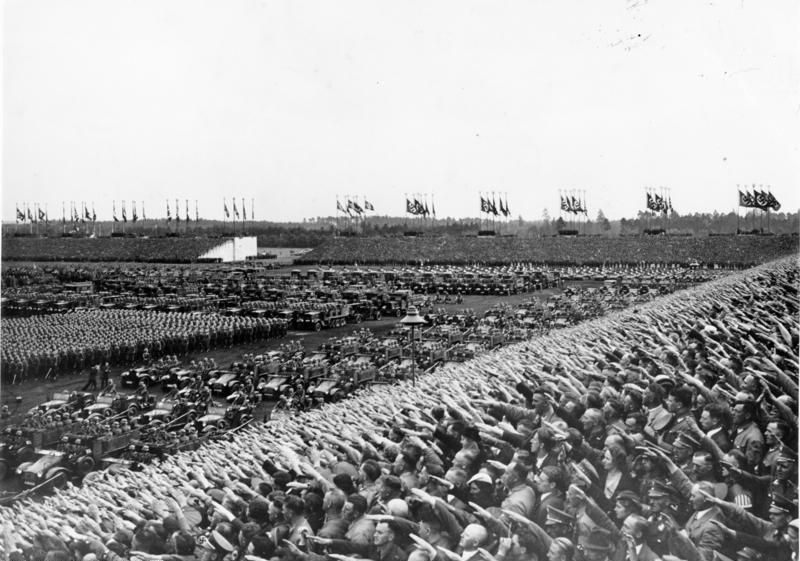
Nazi Party Rally By Bundesarchiv
The failure of the disarmament efforts after the First World War was a major reason for the outbreak of a new War.
In the Paris Peace Conference, Germany was forced to disarm itself. The German Government demanded the disarmament of the victorious powers, in the same way as she had been disarmed.
As they refused, Germany under the dictatorship of Hitler increased its military strength. Owing to the immense increase in armaments and the development of militarism, the Second World War became inevitable.
3.Imperialism
Emperor Shōwa
The policy of imperialism was one of the causes of the Second World War. It was this same feeling of imperialism that played a dominant role during the First World War.
Germany and Japan, who were more imperialistic than the Allied powers, simply ignored the decisions of the Paris Peace Conference.
They made their efforts to expand their respective territories. Hitler occupied Rhineland, Austria, Memel, and Czechoslovakia and incorporated them into German territory. Japan attacked Manchuria and captured it from China.
Mussolini occupied Abyssinia and launched a series of aggressive activities.
4.Colonialism
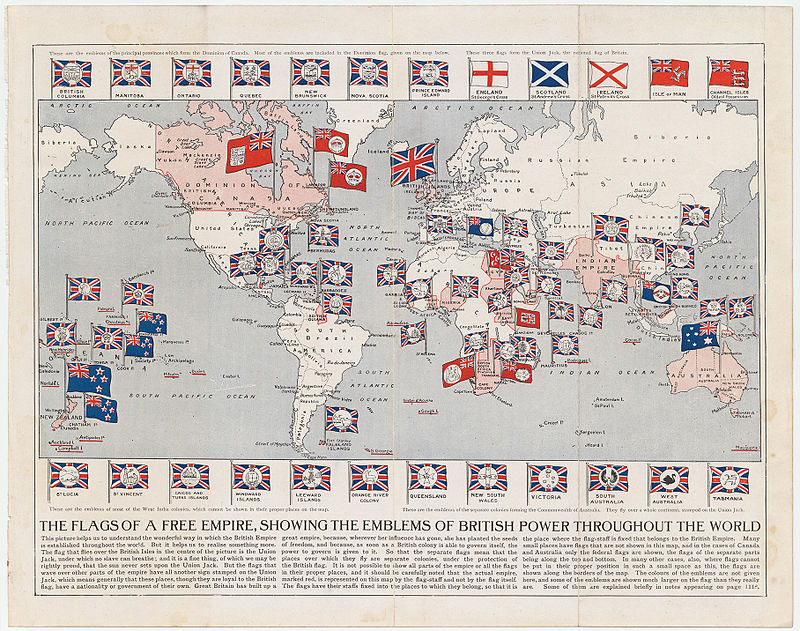
British Colonialism
There was also a race for colonies among the European countries to obtain raw materials and markets for their industrial growth. This trend continued among these powers even after the First World War.
Germany was deprived of all its colonies at the Paris Peace Conference. Italy was dissatisfied with the treatment of the Allied Powers.
Japan, a powerful Asian country wanted to have colonies to enrich its resources. It is in these circumstances Germany, Italy, and Japan decided to follow aggressive foreign policy.
These aggressive actions ultimately led to the Second World War.
5.Failure of the League of Nations
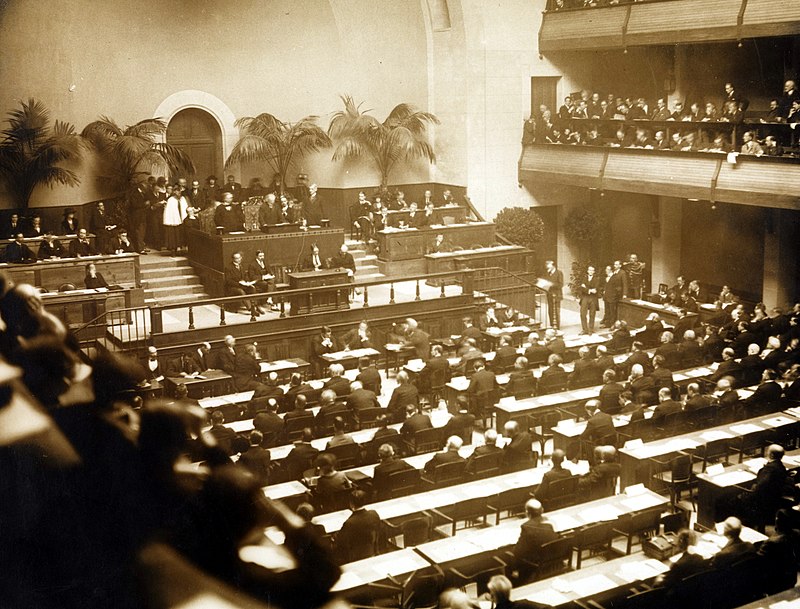
League of Nations
After the First World War, the League of Nations was established to solve controversies among the nations and to maintain permanent peace and order in the world.
Even the members of the League failed to respect the provisions of the covenant of the League. Those who violated the provisions simply walked out of the League, without any punishment.
The League could not contain the Japanese annexation of Manchuria and the Italian invasion of Abyssinia.
Hitler’s activities posed a challenge to the League. Thus, the failure of the League of Nations to control aggressive countries was a major cause of World War II.
6.The dissatisfaction of National Minorities
The Allied powers though posed themselves as the champions of the principle of self-determination, in actual practice that principle was not followed by them.
In some parts of Central Europe, the problem of national minorities existed. It is these minority groups that became the hotbeds of discontent and dissatisfaction.
German annexation of Austria and Sudetenland and attack on Poland was based on this policy of reunion of National minorities.
7.Mutual differences of the Allies
There was no collective cooperation among the Allies. England followed policy appeasement towards Germany.
France’s fear of Germany was opposed by England. The U.S.A., the architect of the League of Nations, did not join the League.
These differences among the allies failed to check the increasing strength of the dictators.
8.The course of the War
According to the decisions taken in the Paris Peace Conference, Poland had been made an independent kingdom. East Prussia was separated from Germany.
Now, Hitler wanted to unite East Prussia with Germany. Hitler invaded Poland on September 1, 1939. Great Britain declared war against Germany on September 3.
The second World War started.
In April 1940, Germany captured Denmark and Norway. In May 1940, Holland and Belgium were conquered. Germany attacked France and captured it in June 1940.
Italy fought against the British forces in North Africa. Mussolini attacked Greece and captured it with German support. Yugoslavia and Crete were occupied by the Germans.
After the fall of France, Britain was left alone. Hence, Hitler wanted to attack England by air.
There was a continuous air force attack on Britain. But the dynamic leadership of Prime Minister Churchill saved England. Germany could not conquer Britain.
Germany made the mistake of invading the Soviet Union, despite a nonaggression pact. One of the important battles was the Battle of Stalingrad.
For five months the battle went on. It involved 2 million men, 2000 tanks, and 2000 aero-planes. The invading German army was driven back.
In February 1943, about 90,000 German soldiers surrendered. This was a turning point in the war.
In December 1941, Japan attacked Pearl Harbour. This tragedy dragged the U.S.A. into the war. General MacArthur was made the supreme commander of the Pacific region.
Lord Mountbatten, the Commander of South East Asia drove the Japanese from Burma.
In Africa, Abyssinia was conquered by the U.S.A. from Italy. The Italian Somaliland was also conquered.
The British General Montgomery captured Libya from the Germans. He also conquered Tripoli and entered Tunisia. In 1942 Algeria fell.
In 1943 Sicily was captured by the British and U.S. troops. North Africa was cleared of Italian and German troops.
The mainland of Italy was attacked. There was a revolt in Italy and Mussolini was arrested, but he managed to escape with German help.
In September 1943, Italy surrendered unconditionally. Mussolini was captured and killed by his own people in April 1945.
In 1944 the Allied forces entered France and expelled the German army from France. After that, the Allied forces attacked Germany from the Southwest.
Russia invaded Germany from the East. On 2 May 1945, Russian army entered Berlin. Hitler committed suicide and Germany surrendered.
Even after the surrender of Germany, Japan continued the war. The USA dropped two atomic bombs on Hiroshima (6th August) and on Nagasaki (9th August).
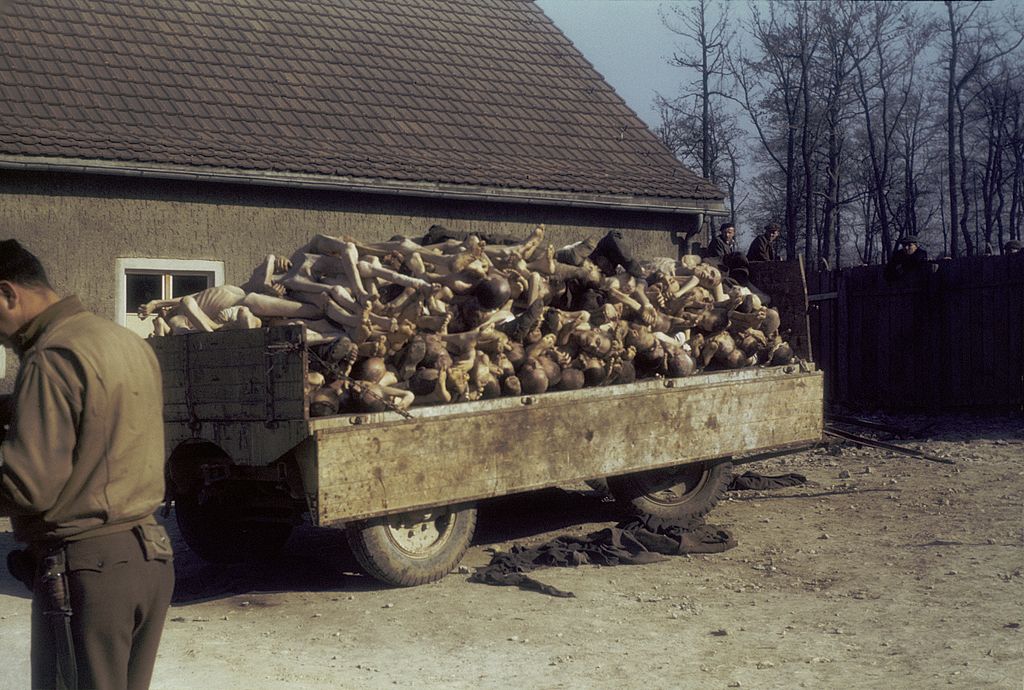
Following this Japan surrendered on 14th August 1945. The Second World War was over. At the end of the war, some 13 million
Europeans were killed and 17 million civilians died as a result of the fighting. All major cities were in ruins. Agriculture was ruined. People of the entire world had to face untold miseries, directly or indirectly.
Results of the Second World War
In this war, about 15 million soldiers and 10 million civilians lost their lives. An important result of the Second World War was that it brought to an end the colonial Empire of the European countries in Asia and Africa.
The multi-polar world became the bi-polar world. The USA and USSR emerged as superpowers. Cold War started as an ideological war between the USA and the USSR.
World war 2 causes and consequences Timeline of Events
A Timeline of World War II (1939-1945)
Pre-War Tensions and Aggressions
1919: Treaty of Versailles: Imposed harsh terms on Germany, leading to resentment and economic instability.
1933: Adolf Hitler becomes Chancellor of Germany: Rise of the Nazi Party and aggressive expansionist policies.
1938: Anschluss: Germany annexes Austria.
1938: Munich Agreement: Britain and France appease Germany by allowing annexation of Sudetenland.
Outbreak of War
1939: Invasion of Poland: Germany invades Poland, leading Britain and France to declare war.
World War II Begins
1940: Blitzkrieg: Germany invades Denmark, Norway, Belgium, Netherlands, and France.
1940: Battle of Britain: Germany fails to defeat Britain through aerial bombardment.
1941: Operation Barbarossa: Germany invades the Soviet Union.
1941: Attack on Pearl Harbor: Japan attacks the U.S. naval base at Pearl Harbor, bringing the U.S. into the war.
Global Conflict
1942: Battle of Stalingrad: Soviet victory halts German advance in the East.
1942: Battle of Midway: U.S. naval victory turns the tide in the Pacific.
1944: D-Day: Allied invasion of Normandy, opening a Western Front in Europe.
1945: Battle of Berlin: Soviet forces captured Berlin, leading to Germany’s surrender.
1945: Atomic bombings of Hiroshima and Nagasaki: U.S. uses atomic weapons, forcing Japan’s surrender.
The War’s End and Its Legacy
1945: End of World War II: The Allied victory leads to the formation of the United Nations.
Post-War Era: Cold War tensions between the U.S. and the Soviet Union emerge. Global Impact: The war reshaped the world order, leading to decolonization and the rise of new nations.
Conclusion
Understanding this timeline is crucial for comprehending the “World War 2 causes and consequences” and their lasting impact on global history.
* * All the Notes in this blog, are referred from Tamil Nadu State Board Books and Samacheer Kalvi Books. Kindly check with the original Tamil Nadu state board books and Ncert Books.