It is located in Karnataka, in the Yadgir district, this place has a number of early Paleolithic sites. On this site, many stone tools, and weapons that are made of reddish-brown chert are found.
The tools found include longish blades and many other instruments for multi-purpose usage. In some sites there were a large number of tools were found, which shows there is the possibility that factories existed.
In Hunsgi Paleolithic sitemost of the tools were made of limestone found locally. About 15000 stone tools were found on this site. This site is said to be the oldest site in India and older than Pallavaram in Tamil Nadu.
Hunsgi lies in the northwestern part of Karnataka, India.
FAQ
Hunsgi in which state?
Hunsgi, is situated in Yadgir district in Karnataka state in India.
2. Why is Hunsgi famous in history?
Hunsgi is famous due to the presence of a number of early palaeolithic sites.
3. Is Hunsgi is a factory site?
Different tools are found on Hunsgi site. This makes us understand that the Hunsgi is a habitation-factory site. Also, most of the tools were found near springs and water bodies which gives us evidence that people lived there.
4. Is Hunsgi a Paleolithic site?
As said, earlier Hunsgi has a number of early Paleolithic sites. Many stone tools and weapons made of reddish-brown chert are found.
5. What are the main findings of Hunsgi short answer?
Researchers have found several tools and weapons that might be used to scrape bark, cut mean, chop fruits etc.
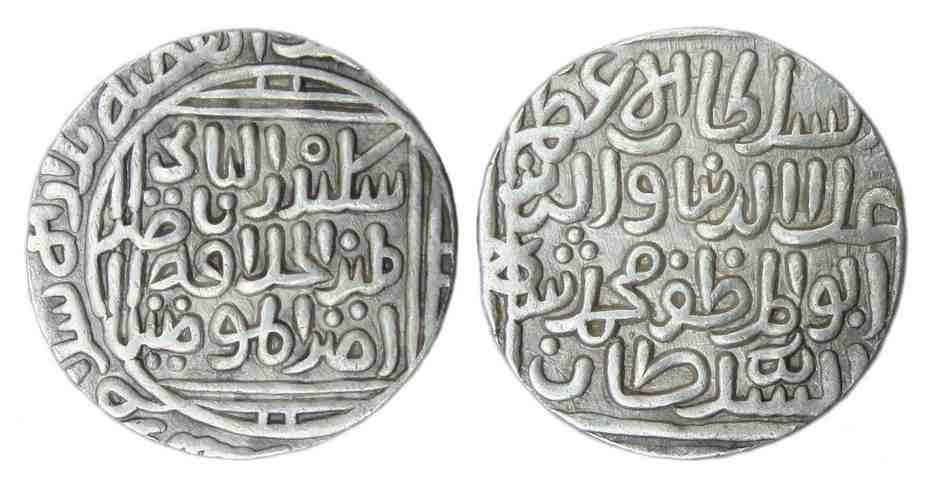
Khalji established four separate markets in Delhi.
The first market for grains and the second market for cloth, sugar, dried fruits, butter and oil. Third for the horse, slaves and cattle, and the fourth market for miscellaneous commodities.
Officer Who Controlled Market are: Shahna-i-Mandi, Naid-i-Riyasat, Munhiyans etc.
Shahna-i-Mandi is the highest officer to control the market.
The grain was held in stock in Government storehouses to ensure the supply of grain in all situations.
Naid-i-Riyasat was the officer to control a separate department called Diwani Riyasat, every merchant was registered under this market department.
Munhiyans, secret agents were sent to report the functioning of these markets and sent slave boys to check the prices of various commodities.
Severe punishment was given to the traders who violate market regulation, cheat by the false measure in quantity and quality, sell commodities at a higher price.
Even during the famine, the price of commodities did not increase, the Sultan ensured stable price and continuity in supply in all situations.
Market reforms were applied to provincial capital and towns.
Land reform was made by Sultan, Alauddin Khilji who was the first of the Delhi Sultans to have ordered to measure the land.
Even the big landlords paid taxes to the government.
The land revenue was paid in cash to the government, which were used to pay the government officials and soldiers in cash.
The land revenue system was the basis of the land reforms of Akbar and Sher Shah Suri.
Seals of Indus valley civilization found by Archaeologists are in thousands in numbers. Also referred to as ‘seals of Harappan civilization‘ are mostly made of steatite and sometimes made of agate, chert, copper, faience, and terracotta with figures of animals.
Animals on the seal include the Unicorn bull, rhinoceros, tiger, elephant, bison, goat, buffalo, etc. These seals have a remarkable rendering of animals in different moods. Seals of Indus valley civilization are made mainly used for commercial purposes. These are used as amulets by persons of their such as modern-day Identity cards.
The standard Harappan seals are of size 2×2 square inches and are made of steatite and every seal is engraved in a pictorial script which is not deciphered yet.
Some of these were made from Ivory. The seal has pictures of animals and also some kinds of monsters and sometimes human figures, trees, etc also were engraved in it.
Also, two Antelopes were seen below the seat of the human figure. These Seals of the Indus valley civilization are dated between 2500 to 1900 BCE and are found in Mohenjodara, Pakistan.
Also, square or rectangular copper tablets are found on one side there is a human or animal figure and on the other side, there are inscriptions. This tablet appears to Amulet.
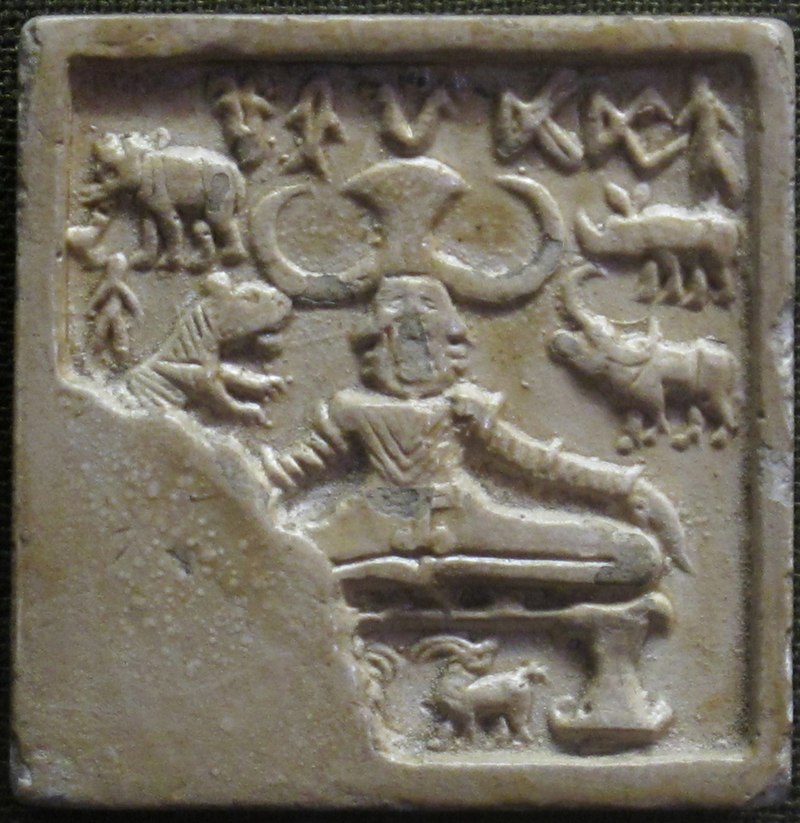
Pashupati Seal
Delhi Pashupati Seal with Erected Male Organ By Ismoon (talk) 18:08, 21 February 2012 (UTC) – Own work, CC0, https://commons.wikimedia.org/w/index.php?curid=18453945
The Pashupati seal is a famous one, some scholars call it a female deity. This has a human figure in a seated position – cross-legged, on the right side of the human figure there is an elephant and a tiger and on the left side there buffalo and rhinoceros are engraved.
Significance of Pashupati Seal
The Pashupati seal is identified as an early version of Shiva (Hindu God) or his predecessor Rudra. Pashupati is described in Vedas as guardians of cattle that have been domesticated.
But this Pashupati seal which is 4000 year old, show a man or woman surrounded by wild such as a tiger or rhino.
There are two seals of Pasupathi available. One is a famous one in Delhi and the other is a less popular Pasupathi seal in Islamabad. The Delhi Pashupati, seal depicted above has an Ithyphallic (Erected Male organ).
This erected male organ is similar to the form of Lakulish, a Tantrik form of Shiva.
The Islamabad Pashupati seal has horns and tree branches on the headdress and shows a downward-pointing triangle that might be representing a Female organ. Also, this seal does not have any animal.
The Lord we are familiar with does have horns on his head. Some researchers speculated that this became the crescent moon in Shiva’s Head.
Also, the Pashupati seal found in Delhi and Islamabad, shows the Pashupati deity wearing bangles on both arms. So this image is male, female or transgender is a question mark yet to be answered.
Animals on Pashupati seal
An elephant and a tiger are on the left side of pasupathi while a rhinoceros and a buffalo are seen on the right side.
Unicorn Seals
Unicorn Seals of Indus valley civilisation
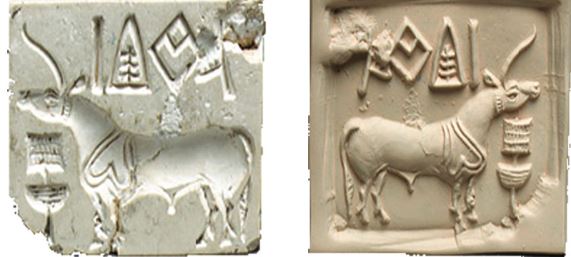
The Unicorn seal is one of the most common motifs on the Indus seal. This unicorn represents a mythical animal of greek and roman sources, that has a connection to the Indian subcontinent.
There are up to eight symbols on the top of the seal. These unicorns have elongated bodies and slender arching necks with tails and bovine hooves.
There is a pipal leaf-shaped blanket over the unicorn. A collar encircles the throat of the animal. Also in front of the unicorn, there is water or sacred liquid along the bottom of the bowl to offer some rituals.
Bull seal of Indus valley civilization
Bull seal of Indus valley civilization
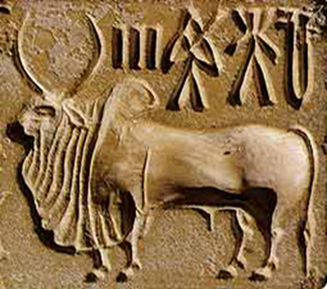
The bull seal is one of the most impressive motifs found in the Indus. This majestic zebu bull is carved on a large seal with short inscriptions. This humped bull has appeared on painted pottery and figurines.
This zebu bull may symbolise the leader of the herd for its strength or a sacrificial animal. It is mainly found or almost exclusively at Mohenjo-Daro and Harappa.
Mother goddess terracotta Indus Valley civilisation
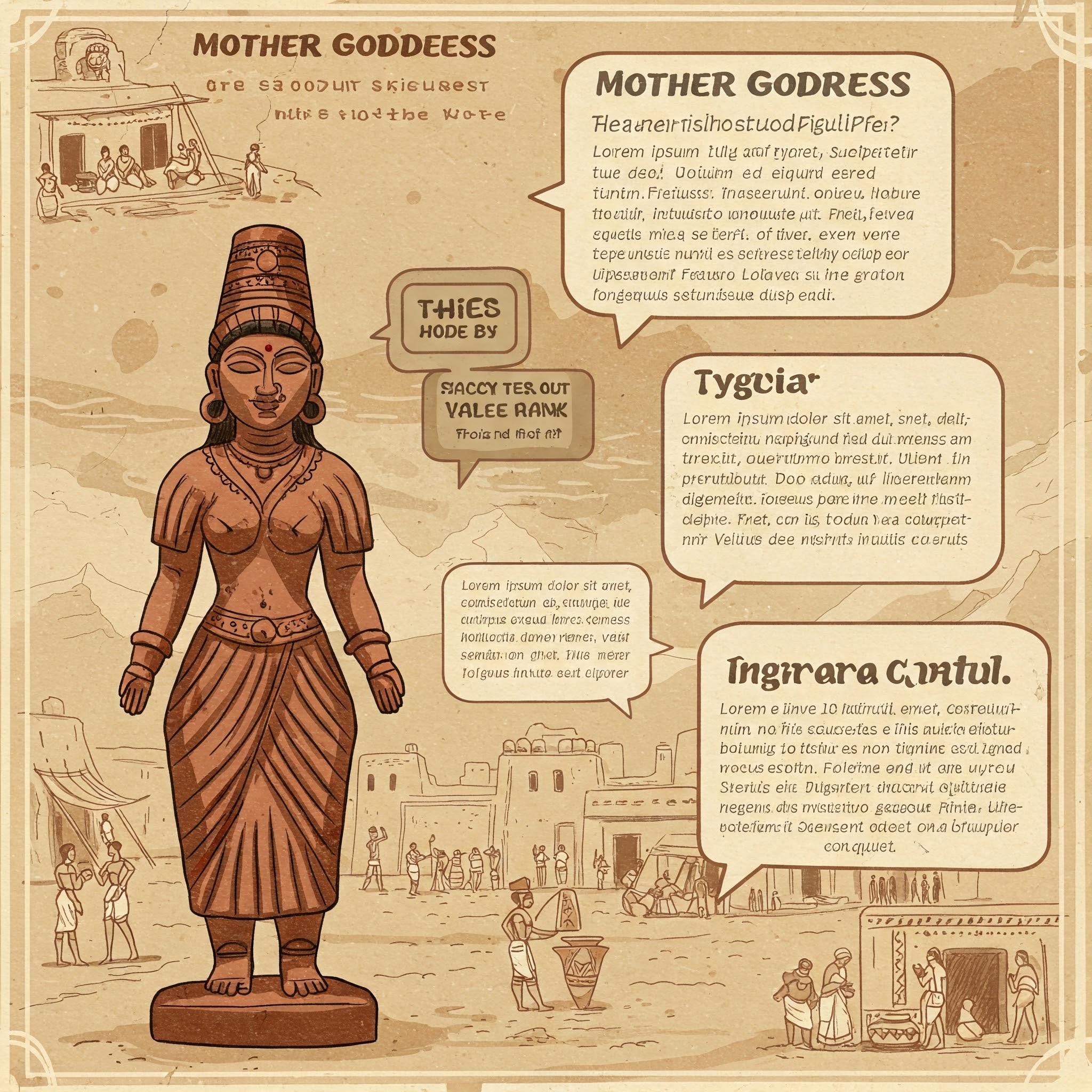
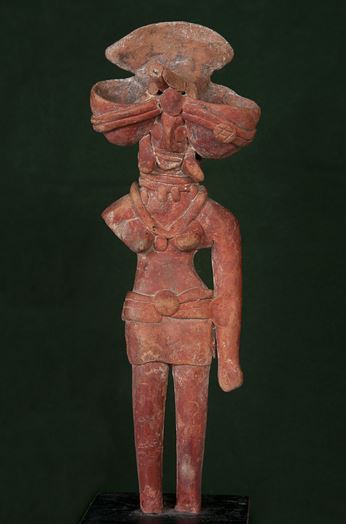
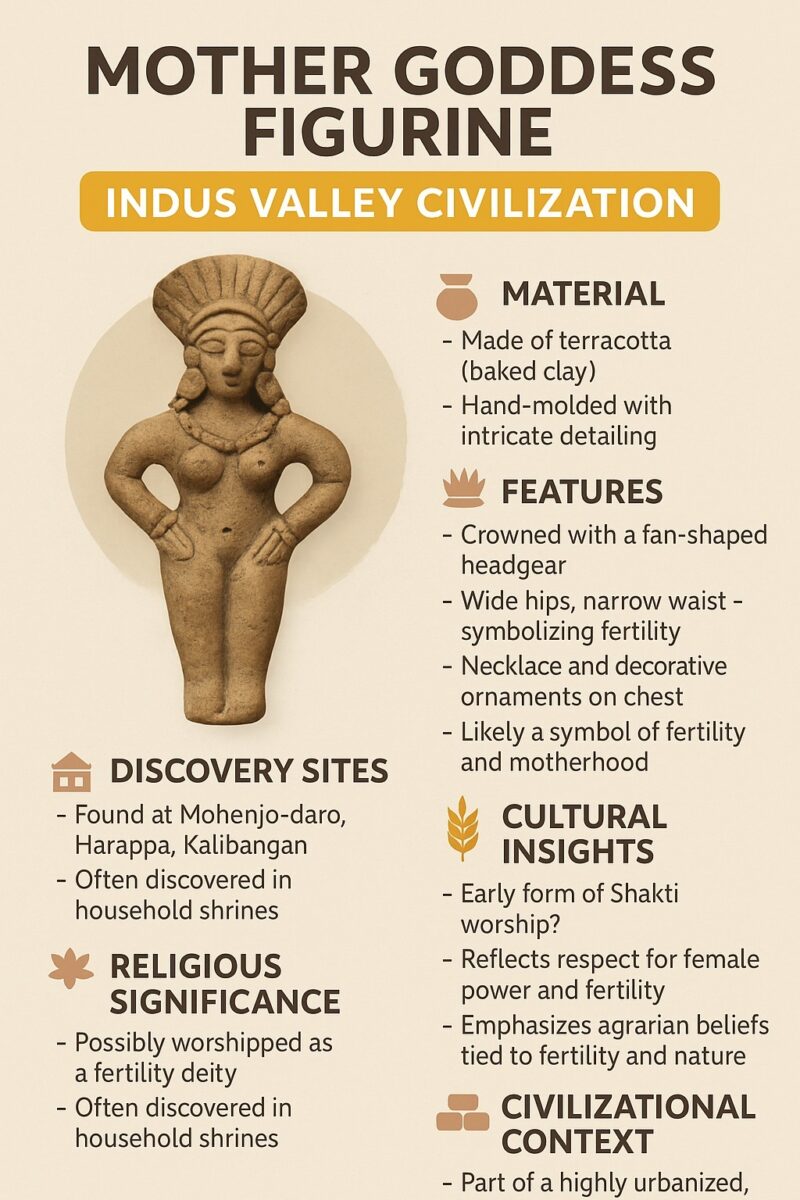
It is one most exciting sculptures found from the Indus Valley Civilisation. This is titled Mother Goddess, it symbolises fertility.
It is made up of terracotta, it is made by hand, and dates back to 2500 BCE, and its origin is Mohenjo-Daro, Pakistan.
Its dimensions are 22 cm Height, 8.5 cm width, and 3.4 cm depth, and it is displayed in the National Museum, Delhi.
The Divine Feminine of the Indus Valley Civilisation
The Indus Valley Civilisation (c. 3300–1300 BCE) is one of the world’s oldest urban cultures, known for its advanced city planning, trade networks, and unique artistic expressions. Among its many fascinating artefacts, the terracotta figurines of the Mother Goddess stand out as powerful symbols of spirituality, fertility, and feminine divinity.
Discovery of the Mother Goddess Figurines
Archaeologists have unearthed numerous terracotta figurines across major Indus sites like Mohenjo-Daro, Harappa, and Mehrgarh. These small, handcrafted statues depict a female deity with exaggerated features—wide hips, prominent breasts, and ornate headdresses—suggesting a connection to fertility and nature worship.
Features of the Mother Goddess Terracotta
Exaggerated Feminine Attributes – The figurines emphasise fertility symbols, possibly representing a goddess associated with creation and abundance.
Ornate Headdresses & Jewellery – Many figures wear elaborate headdresses, necklaces, and waistbands, indicating high status or divinity.
Handmade from Terracotta – These figurines were moulded from baked clay, showcasing the craftsmanship of Indus artisans.
Possible Ritual Use – Some scholars believe they were used in household shrines or community worship.
Significance of the Mother Goddess in Indus Culture
The prominence of these figurines suggests that the Indus people revered a mother goddess, a common theme in ancient agrarian societies. Similar deities appear in later Hindu traditions (like Shakti or Devi), indicating possible cultural continuity.
Theories About Her Role
Fertility & Harvest – She may have been invoked for good crops and healthy offspring.
Protective Deity – Some believe she guarded homes and families.
Precursor to Later Goddesses – Parallels exist with the Mesopotamian Inanna and the Hindu Mother Goddess traditions.
Debates & Interpretations
While many scholars associate these figurines with a mother goddess, some argue they could represent:
Priestesses or Noble Women
Symbols of Domestic Worship
Toys or Decorative Items
However, the sheer number of such figurines found across different sites strengthens the theory of a widely worshipped female deity.
Legacy of the Mother Goddess
The Indus Valley’s terracotta goddess figurines provide a glimpse into the spiritual life of one of history’s earliest civilisations. They reflect a deep reverence for the feminine principle, linking ancient traditions with later religious developments in South Asia.
Why Does She Matter Today?
Cultural Heritage – She connects modern South Asia to its ancient roots.
Feminine Divinity – Highlights the importance of goddess worship in early societies.
Artistic Marvel – Demonstrates the skill and creativity of Indus Valley artisans.
Conclusion
The Mother Goddess terracotta figurines of the Indus Valley remain an enduring mystery, offering insights into the beliefs and values of a civilisation that thrived thousands of years ago. Whether as a symbol of fertility, protection, or divine power, she remains a testament to the timeless reverence for the sacred feminine.
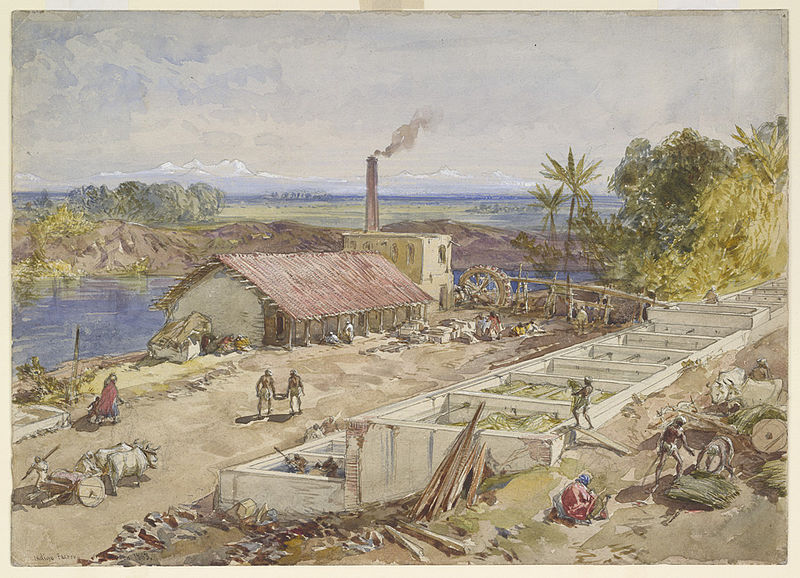
Before the introduction of Chemical Dyes, there was natural Indigo Dye. These Dye had high value around the world.
As a result, Many European traders tried to become Indigo Planters in India. By that, the Europeans employed the local farmer to grow the Indigo crop.
After harvesting, these crops it was processed into dye at the planter’s factories and exported to various European countries.
Then India went on to become the highest supplier of Indigo to Great Britain in the 19th century. The system of Indigo cultivation is very oppressive as the peasant was forced to grow Indigo crops rather than food crops.
The British planter gave the cultivators, a cash advance to pay rent for the land and other expenses in farming. And these cash expenses have to repay with interest.
The farmers earned from the Indigo cultivation is very less but the planter got great profit. As a result, the farmers fell into debt.
To clear the debts the farmers were forced to enter into another contract to grow Indigo by that the farmer was never able to recover the loans.
The loans and debt were passed on to father and son. This made the farmers to revolt against the planters.
The Indigo Revolt started in 1859. The revolt started as a strike, as the farmers of a village in Nadia District in Bengal refused to grow Indigo plants and this news spread to the other indigo-growing districts of Bengal.
The Indigo revolt then became Violent and farmers from the Hindu and Muslim religion, along with the women participated in the revolt. The Indian journalists in Calcutta wrote about the brutality of the planters.
The play Nil Darpan (Mirror of the Indigo) by Dina Bandhu Mitra drew attention in India and Europe. The indigo industry quickly declines in Bengal. By the end of the 19th century, chemical blue dyes came into use as a result of natural Indigo dye declining.
Result of indigo revolt
Due to the indigo revolt, the English government appointed the Indigo Commission in 1860.
Then a notification was issue stating, that the farmers should not be forced to Indigo.
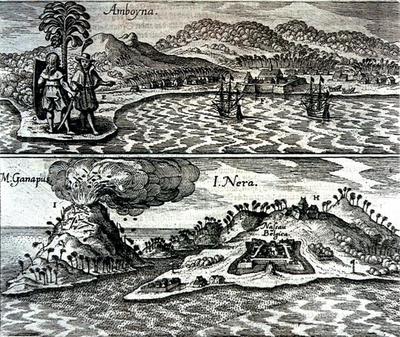
It was brutal torture and murder of twenty men that including ten men who were in service of the English East India Company in Ambon Island in 1623. Apart from the Ten men others were Japanese and Portuguese traders.
They were murdered by the people who worked for the Dutch East India Company. The reason for this Massacre is the result of the intense rivalry between English East India and the Dutch in the spice trade.
The Dutch East India Company (VOC) tried to monopolize the spice trade in the Indonesian Islands using the force of Arms. But it annoyed the English East India Company.
Despite several treaties, the rivalry intensified and Amboyna Massacre happened.
Pallavas era was the great age of temple building. They actually introduced the art of excavating temples from the rocks.
Also, the Dravidian style of Architecture was actually started by the Pallavas. The Dravidian architecture had a gradual evolution that started from cave temples to monolithic rathas and finally to structural temples.
Their history is documented from the 6th to the 8th century. They are mostly Shaivite but several Vaishnava temples survived during their rule. Also, they are influenced by long Buddhist traditions in the Deccan.
The Pallava’s early buildings were generally rock-cut and later ones were structural. The early buildings were generally attributed to the rules of Mahendravarman -I. Narasimhavarman-I inaugurated most of the building works at Mahabalipuram. Mahabalipuram is known after him, as he was called Mahabali after defeating Pulakesin-II.
The shore temple at Mahabalipuram was built during Narasimhavarman-II, which is also known as Rajasimha.
Three are three shrines, two to Shiva. One shrine faces east and the other shrine faces west. The middle shrine is dedicated to Vishnu who is depicted as Anantashayana.
The development of temples by Pallavas can be seen in four stages.
Pallavas art and architecture: First Stage
The first stage is rock-cut temples which were introduced by Mahendravarman -I. The rock-cut temples are seen at Mandagappattu, Mahendravadi, Mamandur, Dalavanur, Tiruchirappalli, Vallam, Siyamangalam, and Tirukalukkunram.
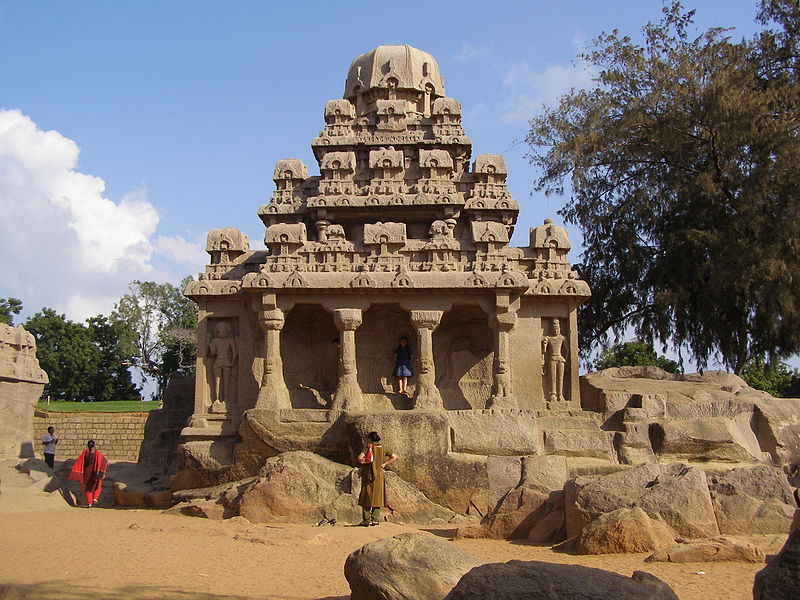
Five Rathas Mahabalipuram By Av.kumar85 at English Wikipedia – Own work Av.kumar85 at English Wikipedia, Public Domain, https://commons.wikimedia.org/w/index.php?curid=22781964
Second Stage
The second stage is represented by Monolithic rathas and Mandapas that are found at Mamallapuram. This stage was founded by Narasimhavarman – I.
The five rathas or Panchapanadava Rathas show five different styles of temple architecture. These mandapas at Mahabalipuram contain beautiful sculptures on their walls.
Mahishasuramardhini, Tirumurthi, and Varaha Mandapa are the most famous ones.
Third Stage
The third stage is structural temples introduced by Rajasimha. The structures were built by soft sand rocks.
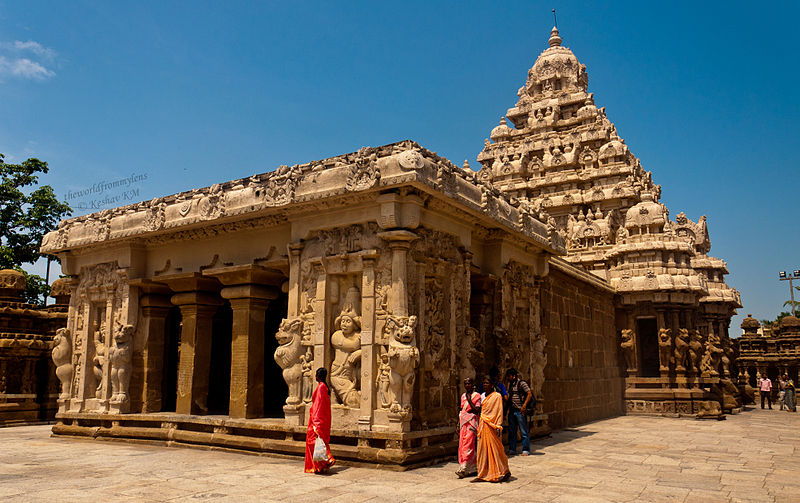
An example of the earliest structural temples was Shore temple at Mamallapuram and Kailasanatha temple at Kanchipuram.
The greatest masterpiece of Pallavas art and architecture is the Kailasanatha temple at Kanchi.
Kailasanatha temple at Kanchi By Keshav Mukund Kandhadai – Flickr: Kailasanathar Temple, CC BY 2.0, https://commons.wikimedia.org/w/index.php?curid=27443395
Last Stage of Pallavas art and architecture
It is also represented by structural temples built by later Pallavas. The temple that belonged to this stage is Vaikundaperumal, Muktheeswara, and Matagenswara temples at Kanchipuram.
Apart from temples Pallavas also developed Sculptures. The ‘Open Art Gallery’ at Mamallapuram is an important example.
Fine Arts
Music, dance, and painting also developed under the patronage of the Pallavas. The Mamandur inscription contains a note on the notation of songs. The Kudumianmalai inscription mentioned musical notes and instruments.
The Alwars and Nayanmars composed their hymns in various musical notes. Dance and drama also developed during this era. The sculptures of this era depict many dancing postures.
The Sittannavasal paintings belonged to the present period. The commentary called Dakshinchitra was compiled during the reign of Mahendravarman I, who had the title Chittirakkarapuli.
Conclusion
This article is written Upsc exam for the “Art and Architecture of Pallavas”. This note is prepared from Ncert Book. The article is about the Pallavas architecture, the best examples are Kailasanathar Temple at Kanchi, Pancha Rathas, and Shore Temple at Mahabalipuram.
The Administration of Pallavas were well organized. The state was divided into Kottams. The Kottam were administrated by the officers whom were appointed by the King.
The king was the supreme power and was the fountain of justice. The King provided land grants to the temple called Devadhana.
The King also provided land grants to Brahmin known as Brahmadeya. The Devadhana and Brahmadeya were exempted from tax.
The duty of the king is to provide irrigation facilities to the land. The king constructed several tanks to provide irrigation. The irrigation tanks at Mahendravadi and Mamandoor were constructed during the rule of Mahendravarman-I.
The land tax was the main source of revenue. The brahmins were excempted from paying and non brahmins such as Traders, Artisans, Capenters, Washer men, weavers etc paid taxes.
The village assemblies were called as Sabhas. The Sabhas maintained record of land, local affairs and aalso managed the temples of villages.
The date of the Mesolithic culture varies in different parts of the world. We assign this culture to pre-agricultural times in certain areas. In the Levant (Eastern Mediterranean), they are dated between 20,000 and 9500 BCE.
In India, Mesolithic cultures appeared around 10,000 BCE. In certain parts of India including Kerala and Tamil Nadu, it continued up to 1000 BCE, till the beginning of the Iron Age. In Sri Lanka, the microliths appeared about 28,500 years BP.
Mesolithic Sites in India
The Mesolithic culture is found in all eco-zones from the coast to the hills: sand dunes, rock shelters, deltaic regions, lake areas, forested territories, mountainous areas, rocky terrains, and coastal environments.
The Mesolithic sites in India are found in:
Paisra (Bihar)
Langhnaj (Gujarat)
Baghor II
Chopani Mando
Sarai Nahar Rai
Mahadaha, and Damdama (all in Uttar Pradesh)
Sankanakallu and Kibbanahalli (Karnataka)
Rock shelter sites are found in:
Lekhakia
Baghai Khor
Adamgarh
Bhimbetka
The coastal sites are found at:
Mumbai
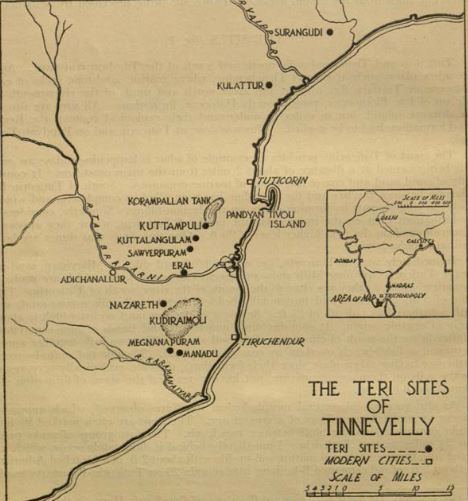
Teri sites of Thoothukudy in Tamil Nadu
Vishakapatnam, which have microlithic evidence.
Teri-A coastal landscape caused by sand dunes. These soils may have originated in the Pleistocene epoch of the Quaternary period.
Teri sites are a group of 11 sites related to the Mesolithic period that are present in the Thoothukudy and Tirunelvelli districts of Tamil Nadu and are associated with dunes of reddened sand. The 11 Teri sites are:
Megnanapuram
Kuttampuli
Kuthankuli
Sawyerpuram(Sayapuram)
Kattalankulam
Kulattur
Puttan Taruvai
Surangudi
Nazareth
Manadu
Kayamoli
teri sites mesolithic Source: https://asi.nic.in/Ancient_India/Ancient_India_Volume_12/article_1.pdf
Climate
After the Ice Age, with global warming, human groups became highly mobile and occupied various eco-zones. The monsoon pattern had already emerged. Some regions witnessed higher rainfall.
At Didwana in western Rajasthan, fresh-water lakes were known to exist between 10,000 and 3500 BP. The animal bones from this period suggest a dry deciduous type of forest during the Mesolithic period.
Chronology
The date of the Mesolithic culture varies in different parts of the world. We assign this culture to pre-agricultural times in certain areas. In the Levant (Eastern Mediterranean), they are dated between 20,000 and 9500 BCE.
In India, Mesolithic cultures appeared around 10,000 BCE. In certain parts of India including Kerala and Tamil Nadu, it continued up to 1000 BCE, till the beginning of the Iron Age. In Sri Lanka, the microliths appeared about 28,500 years BP.
Economy
Hunting wild animals gathering plant food and fishing were people’s major occupations during this age. Agriculture was not practised in the early stages.
At the end of the Mesolithic period, humans domesticated animals and paved the way for the Neolithic way of life. The rock paintings of Central India depict hunting, trapping, fishing, and plant food collection.
The faunal evidence from this period shows that people belonging to this period hunted cattle, gaur, buffalo, barasingha, porcupines, sambar, chital, gazelle, hog deer, nilgai, jackal, turtle, fish, wild hare, lizard fox, and monitor lizard.
We have also found bones of rhinoceros and elephants. They used spears, bows and arrows, and traps. The paintings of Bhimbetka show various animals were hunted and these men and women went together. The people used fire and perhaps roasted food.
At the Mesolithic sites of Loteshwar, Kanewal, Ratanpur, adamgarh, and bhimbetka in Madhya Pradesh, domestic animals such as sheep, goats, pigs, and dog’s bones were found. We have found camel bones from Kanewal.
Camps and Houses
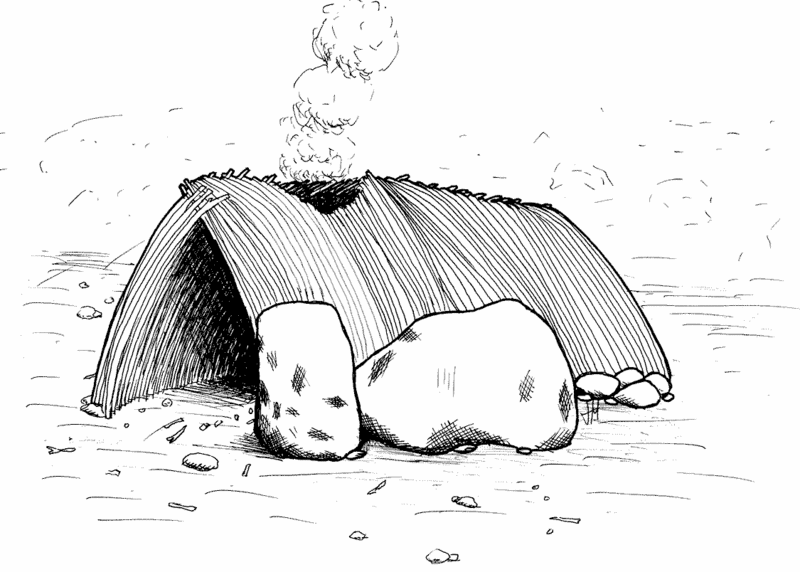
The Mesolithic people were highly mobile and they moved in search of animals and plants for food and made temporary huts and used caves and rocks shelters. We have found circular huts with postholes and burnt clay lumps bearing reed impressions.
Many of the caves and shelters feature paintings. We see circular huts in rock paintings. They built the temporary huts using perishable materials.
We find traces of oval and circular huts and wattle daub in Chopani Mando and Damdama in Uttar Pradesh and Bagor, Tilwara in Rajasthan.
Tilwara mesolithic site
It is historically known as Khedgarh and it is a village in Pachpadra tehsil of Barmer district of Rajasthan. It is located on the Luni River near to Jodhpur-Balotra railway route. This village is famous for the Cattle fair also called the Mallinath fair that March/ April of every year.
Evidence of Cattle distribution found on this site is Zebu(Bos indicus L), Sheep, Goat, Pig, Jackal, etc.
Bagor mesolithic site
Bagor is also present in Rajasthan state in India. It is a town located with a sub-tehsil in Mandal Tehsil of Bhilwara district. The largest Mesolithic site in India is Bagor, which is on the river Kothari.
The earliest settlers at Bagor were hunters and gatherers and there is also evidence of food production in Phase II.
Evidence of Cattle distribution found on this site is Zebu(Bos indicus L), Buffalo, Sheep, Goat, Pig, Wild Boar, Jackal, Fox, etc
Burials
The Mesolithic people buried the dead which suggests their beliefs and humane relationships. We have found human skeletons in Mahadaha, Damdama, and Sarai Nahar Rai in Uttar Pradesh.
Sarai Nahar Rai
It is a village in Uttar Pradesh where the earliest human remains belong to the late stone age site in the Indian Subcontinent. At Mahadaha, a man and a woman were buried together. One burial had an ivory pendant as the grave good.
Art
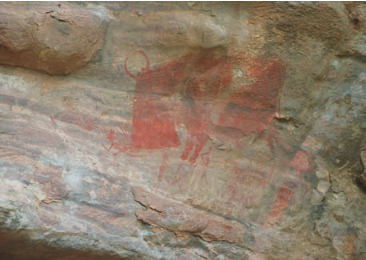
Paintings of man being hunted by a animal, Bhimbetka
Art is an integral part of human existence. While we find evidence of art in Europe in large volumes, we find them only at a few sites in India. A chert stone used as a core had geometric engravings from Chandravati in Rajasthan, bone objects from Bhimbetka, and human teeth engraved with geometric designs.
We find rock paintings in the rock shelters of Madhya Pradesh and Central India. They show people hunting, trapping animals, fishing and dancing.
Bhimbetka near Bhopal, Raisen, and Pachmarhi in Madhya Pradesh and South Mirzapur in Uttar Pradesh are some sites.
Haematite, an iron-rich stone with traces of rubbing, has been found. These people might have decorated themselves with flowers and leaves.
Hunter and gatherers of the Historical Period
The hunter and gatherers using microlithic tools continued to live in the later period, even after the development of the Neolithic, Iron Age, and historical periods. Perhaps they became part of the marginalized communities when the people who lived in the cities gained more wealth.
Some people who live in the forests even today in some remote areas and also in the Andaman region could be considered as those people who prefer to live by hunting and gathering.
Many such groups lived in the 19th and 20th centuries, as recorded in Edgar Thurston’s Castes and Tribes of Southern India.
Describing them as primitive is incorrect. We should consider them as people who preferred to live by hunting and gathering. When the Indus Civilization was at its peak, Tamil Nadu had microlithic hunter-gatherers.
The Andhra–Karnataka region had the Agro-pastoralists of the Neolithic period.
Characteristics of the Mesolithic Cultures
The Mesolithic people lived in semi-permanent and temporary settlements. They occupied caves and open grounds. They buried the dead and had artistic skills. Also, they were spread over wider geographical regions.
Cultural continuity is noticed in many parts of India from this period. Their microlithic tools enabled them to hunt smaller animals and birds.
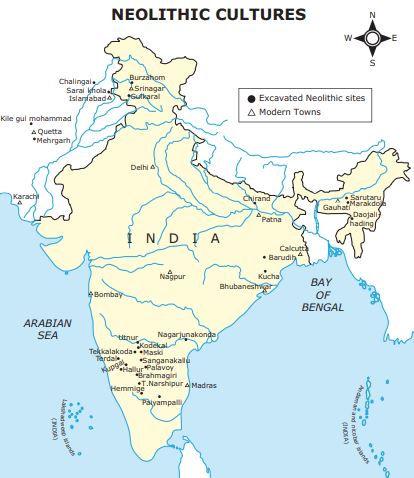
The Neolithic Age means the New Stone Age and the last part of the Stone Age. It spanned around 7000 BC. There are four main groups of sites found in India. The Neolithic settlement was found in northwest India, South India, and North-Eastern India.
The important sites were found in Kashmir, Karnataka, Tamil Nadu, Andhra Pradesh, Meghalaya, Bihar, and Odisha. The earliest Neolithic settlements were developed in the west of the Indus River. Example: Mehrgarh’s neolithic culture started around 8000 BC.
Neolithic sites in India map
North-Western India
The Neolithic culture of North-Western Indian is the earliest to have animals and plant domestication. The Neolithic sites in ancient India are Mehrgarh, Rana Ghundai, Sarai Kala, and Jalilipur.
Currently, these sites are in Pakistan. The neolithic site in Mehrgarh has evidence dating to 7000 BCE.
Plants and Animals
Domesticated animals are Sheep, goats, etc. The cultivated crops found in these Neolithic sites are einkorn Wheat, six-row Barley, emmer, jujube, ilanthai, and dates.
This Neolithic culture is the one that is previous to the Indus Valley Civilisation. The neolithic culture at Mehrgarh Period-I date from 7000 to 5000 BC. The people of this did not use pottery. The neolithic people were semi-nomadic, pastoral groups.
Art and Culture
People of this age built their houses with mud and buried the dead. The ornaments used by them are made of seashell, limestone, turquoise, lapis lazuli, and sandstone. The period-II dates from 5500 to 4800 BC.
Period-III dates to 4800 to 3500 BC. There is evidence of pottery in Period-I and Period-II. We found terracotta figurines and glazed faience beads. We also found women ornaments.
From Lapis Lazuli that is available only in Basakshan, we come to know that long-distance trade was practiced. After the rise of the mature phase of Indus Valley Civilisation, they abandoned these towns.
Kashmir
Neolithic culture in the Kashmir region was contemporary to the Harappan civilization. Burzahom, an important site of this culture, provides evidence for the Megalithic and Early Historic Periods.
In this place, people lived in pit houses (about four meters in depth) in order to escape the cold weather. The houses were oval, wide at the bottom, and narrow on the top.
Plants and Animals
The Neolithic period of Kashmir had domestic sheep, goats, and cultivated plants. The Neolithic people of Burzahom traded with the people of the Harappan Civilisation.
Art and Culture
We found post holes used for constructing a thatched structure around the pit houses. They used handmade pottery. They use tools such as stone axes, chisels, adzes, pounders, mace-heads, points, and picks. We used awls for stitching skins into clothes to beat the weather. We used scrapers for working the skins.
We have identified two phases of Neolithic culture. We term them aceramic and ceramic phases. The aceramic phase did not have evidence of ceramics.
The ceramic phase shows evidence for the existence of pottery. In the ceramic phase, people built mud houses. They used copper arrowheads.
They also used blackware pottery, beads of agate and carnelian, and painted pottery. A burial at this site produced wild dog bone and antler horn. An engraving of a hunting scene is depicted on a stone here with a dog and sun.
Seeds of wheat, barley, common pea, and lentil have been recovered from the excavations. People, domesticated animals include cattle, sheep, goats, pigs, dogs, and fowl. Bones of wild animals such as red deer, Kashmir stag, ibex, bear, and wolf suggest they hunted animals.
There is evidence of menhirs and the use of redware pottery and metal objects in the megalithic culture. Using lentils suggests they had established contacts with Central Asia. These people had interactions with Harappan Civilisation.
Ganges Valley and Central India
In the Ganges Valley, and in Central India Neolithic sites are found at Lehuradeva, and Chopani Munda. The site of Lehuradeva has produced ancient evidence of rice cultivation dated to c. 6500 BCE.
These sites are characterized by cord-marked pottery. Koldiwa, Chirand, Senuwar, and Mahagara are important Neolithic sites in this region.
These sites also have evidence of pottery and plant and animal domestication. Evidence for the cultivation of hulled and six-rowed barley, several types of wheat, rice, pea, green gram, and gram/chicken, pea, mustard, flax/linseed, and jackfruit have been found at the sites of Central India.
Sheep, goat, and cattle bones have been found besides bones of wild animals. The Neolithic people used a type of pottery with cord impression on the surfaces. They used microliths, bone and antler tools, and terracotta objects.
These sites perhaps flourished till about the middle of the second millennium BCE.
Eastern India
We find the Neolithic sites at many sites in Bihar and West Bengal. Birbhanpur and Chirand are some prominent Neolithic sites in this region along with Kuchai, Golbaisasan, and Sankarjang.
These cultures show similarities with the Neolithic complexes of east and Southeast Asia. Pointed butt celts, chisel, and shouldered axes have been found in the region from the Neolithic era.
South India
The Neolithic cultures of South India are found mainly in Andhra Pradesh and Karnataka and the north-western part of Tamil Nadu. These sites have ash mounds in the centre with settlements around them.
We have identified over 200 Neolithic sites as part of the Neolithic complex. We find these sites near the granite hills with water sources.
There are sites in the river valleys of Godavari, Krishna, Pennaru, Tungabhadra, and Kaveri. Sanganakallu,Tekkalakota, Brahmagiri, Maski, Piklihal, Watkal, Hemmige and Hallur in Karnataka, Nagarjunakonda, Ramapuram and Veerapuram in Andhra Pradesh and Paiyyampalli in Tamil Nadu are the major Neolithic sites in South India.
Some early Neolithic sites have ash mounds. Utnur and Palvoy in Andhra Pradesh and Kodekal, Kupgal, and Budihal in Karnataka feature ash mound sites. We also find soft ash and decomposed cow dung layers at this site. We find evidence of habitation as houses and burials around the ash mounds.
Conclusion
This article discussed the important neolithic site in India, and their life and culture.
* * All the Notes in this blog, are referred from Tamil Nadu State Board Books and Samacheer Kalvi Books. Kindly check with the original Tamil Nadu state board books and Ncert Books.