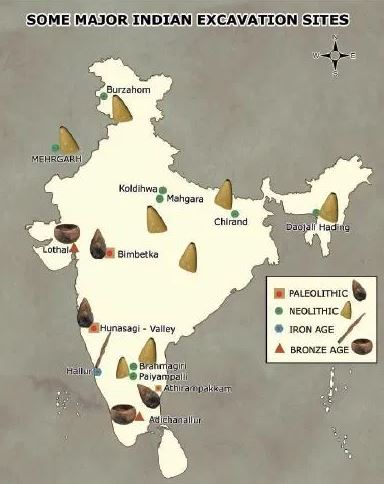
Lower Paleolithic sites in India Upsc

Lower Palaeolithic Culture

During the lower Palaeolithic times, Upright man is believed to have lived in the Indian Subcontinent.

To add more strength to this theory, we found the first Palaeolithic tools in Pallavaram in Chennai, India, identified by Robert Bruce Foote in 1863, and then many Palaeolithic sites were discovered in India’s subcontinent.
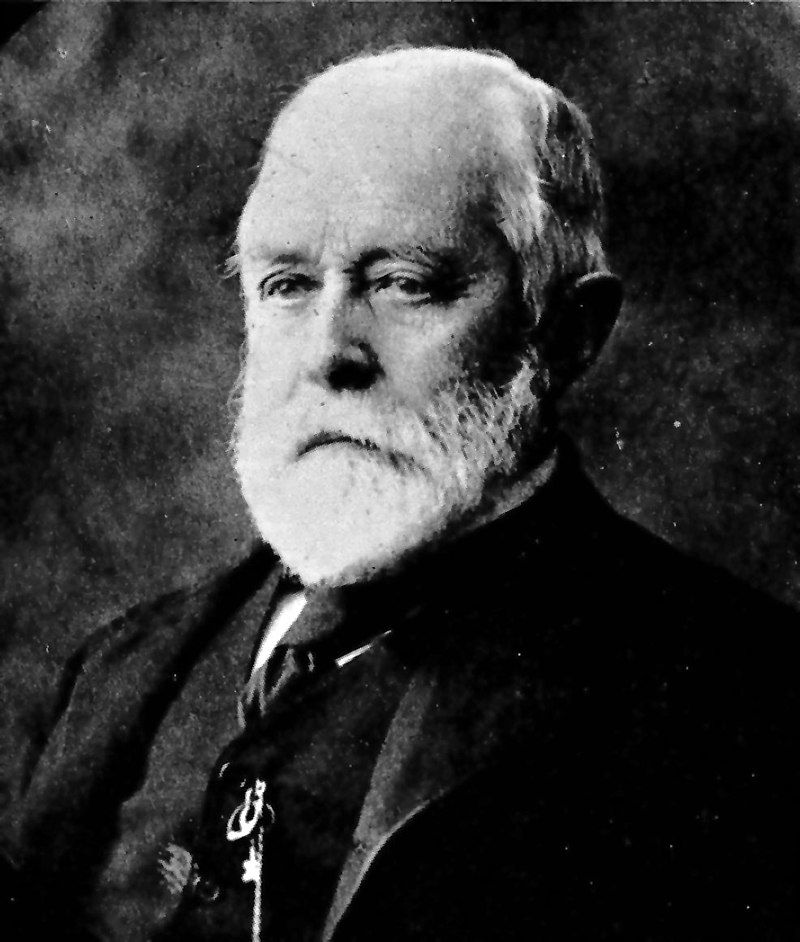
Robert Bruce Foote
Robert Bruce Foote By Unknown author – Madras Government Museum, Public Domain, https://commons.wikimedia.org/w/index.php?curid=61733127

Lower Paleolithic sites in India

  • Athirampakkam, Pallavaram (Tamil Nadu)

  • Bhimbetka (Madya Pradesh)

What are some Paleolithic tools?

The prehistoric study depends upon lithic tools.

Upright man-made enormous stone blocks, pebbles, and chipped tools out of other sturdy stones. Tools such as axes, cleavers, choppers are designed by flaking off the chips. They designed the tools which show the skill set of Prehuman. The tools were intended for hunting, butchering, skinning of animals, and processing food.

We divide the industries of Stone Age cultures into the early, middle, and late Acheulian industries. Early Acheulian tools include polyhedron, spheroids, hand axes, cleavers, and flake tools.

This tradition is absent in the Western Ghats, north-eastern India, and coastal areas, the reason might be Heavy rainfall in these areas and also lack of raw materials and Uncongenial conditions also prevented the occupation in the Western Ghats, north-eastern India, and coastal areas.

We find the Palaeolithic sites more in Central and in south-eastern India as these regions receive good rainfall, possess thick green cover, and are rich in resources. Some important areas where the Acheulian tools are found are Athirampakkam, Pallavaram, Gudiyam, Hunsgi valley, Isampur, and Bhimbetka.

Athirampakkam, Pallavaram (Tamil Nadu Formerly Madras, India) Hunsgi valley and Isampur(Karnataka, India) Bhimbetka (Madhya Pradesh, India)

Lower Paleolithic era

According to the latest research, the lower Palaeolithic began around two million years ago and this culture lasted up to 60,000 years ago.

Hominin and Animal Fossils of the Lower Palaeolithic

Hominin(ancestor of Humans) is rare in India and it is a very common fossil in Africa. The only known Hominin fossil of India is in Hathnora near Hoshangabad in Madhya Pradesh. The cranium is named Narmada human.

We found a partly preserved hominid skull cap in 1982 in a basal conglomerate deposit that represents Archaic Humans.

In Narmada valley, Elephas namadicus(Giant tusked Prehistoric elephant), Stegodon ganesa (a giant prehistoric elephant), Bos namadicus (wild cattle) and Equus namadicus (extinct great horse-like animal).

In Attirampakkam, Tamil Nadu –Teeth of Equus, evidence of water buffalo and nilgai and 17 animal hoof prints were found. These hoof prints suggest an open, wet landscape near the Chennai region during the prehistoric period.

The Way of Life of People in Lower Paleolithic

They fed on animals, nuts, fruits, and roots and lived in open-air, caves, valleys, and rock shelters as seen in Painting on the caves of Bhimbetka in Madhya Pradesh and Gudiyam near Chennai. The upright man had a complex language system like Humans, and they might have used sounds or few words or sign language.

They were intelligent enough to select stones as raw materials and use hammer stones to flake the rocks and design tools.

Middle Palaeolithic Culture

Lithic technology and species of humans diverged after 4,00,000 years BP (Before Present). Upright man existed in this period and they modernized middle Palaeolithic tools.

Around 3,00,000 years ago modern humans emerged. H.D. Sankalia identified the Middle Palaeolithic phase in India on the Pravara river at Nevasa. Several Middle Palaeolithic sites have been identified and recently Athirampakkam is identified which dates back to 3.85-1.72 lakh year B.P.

Indian Middle Palaeolithic and African Middle Palaeolithic cultures are probably of the same period.

Industries and Tool Types of Middle Palaeolithic

The Flake industry was the most in the Middle Palaeolithic period, and tools such as scrapers, borers, and points were made. For wood and skin, they used working scrappers.

The other tools of this period are hand axes, cleavers, choppers, chopping tools, projectile point, shouldered point, knives, etc.

Chronology of the Middle Palaeolithic

Middle palaeolithic is between 3,85,000 and 40,000 BCE. While we associate the European middle stone with Neanderthals, in Africa it is Humans. In India, there is we found no hominin fossils.

Distribution of the Middle Palaeolithic

Narmada, Godavari, Krishna, Yamuna, and other river valleys are some of the Middle Palaeolithic sites.

Life and Culture of the Middle Palaeolithic

The people lived in caves, rocks, and in the open air. They were hunters and gatherers. The tools became less and decreased the use of hand axes regarding other tools.

Stone tool preparation production using core preparation techniques. The raw materials used were chert, chalcedony, quartz, and jasper.

Upper Palaeolithic Culture

The phase that followed the Middle Palaeolithic phase is Upper Palaeolithic. The Upper Palaeolithic phase is marked by the increased cognitive capability of humans and tool technology innovations.

About 300,000 years ago, modern humans who first developed in sub-Saharan Africa migrated to various parts of Asia around 60,000 years ago. These populations from Africa replaced the previous population and handled the Upper Palaeolithic culture in India.

Lithic Tools and Industries

The lithic industry of the Upper Palaeolithic period is based on blade and bone tool Technologies. Microliths (tiny stone tools) were introduced in the Upper Palaeolithic Period and they made these tools using different varieties of silica-rich raw Materials.

We have found bone tools and faunal remains in Kurnool caves in Andhra Pradesh.

Chronology

The Upper Palaeolithic culture is represented in India at several sites. A time bracket of c. 40,000 years to 10,000 years BP is suggested For this period.

Distribution

Some Upper Palaeolithic sites are Meralbhavi, Kurnool caves, Godavarikhani, Baghor I and Baghor III, Patne, etc. We find evidence of microliths and Hominin fossils in Sri Lanka.

Incised ostrich eggshell, shell, stone beads are found in Jwalapuram in Andhra Pradesh, Patne and Batadomba-Lena, and Fa Hein caves in Sri Lanka. They had used ostrich eggshells as beads were found in Patne dated to 25,000 BP and Bhimbetka.

Ways of Life and Main Characteristics

Evidence of art in the Upper Palaeolithic period appears as paintings. We have also found beads and ornaments of this period.

The lithic blade industry advanced in this period. Some green color paintings of Bhimbetka are dated to the Upper Palaeolithic period based on style and archaeological evidence.

Conclusion

This article is written for the topic ‘Lower paleolithic sites in India’ for Upsc and other state service exams. This article discussed Paleolithic sites in India, their Chronology, characteristics, and their distribution.
Economy of mughal empire Upsc

Economy of the Mughal Empire

The economy of Mughal empire was a forest-based agricultural economy. The craftsmen got their raw materials from the forests. The timbers from the forest were used by carpenters, woodcarvers, shipwrights, and lacquerware makers.

The wild silk was used by the reelers and Weavers. The iron miners and metal workers such as metalsmiths use Charcoal. There was a great relationship between manufacturing industries and forest products similar to the current generation.

Agriculture during the Mughal period

In rural areas, the rural population of different classes was involved in agriculture. Agriculture during the Mughal period was the chief activity in the economy. Almost a quarter of the population, are landless agricultural labourers who have no right to property.

  • The village headman and Zamindars possessed large tracts of land on which they employed the labourers and paid them. The dominant mode of irrigation was well irrigation.
  • In the book Ain-i-Akbari, there were mentions of the different crops cultivated during the Rabi and Kharif seasons.

Ain-i-Akbari

“Ain-i-Akbari” a persian word, that means Administration of Akbar. It is a 16th century document that had recorded the administration of Mughal Emperor, during the regime of Akbar was written by Abu’l Fazl ibn Mubarak.
  • Pine was introduced in India in the 16th century. The two important crops namely Maize and Tobacco were introduced in the 17th century and then came the Chilli and groundnut.
  • The Portuguese during this period developed grafted varieties of mangoes. The potato, tomato, and guava came later into India. Another important commercial crop during the Mughals was Indigo.

Indigo is primarily used as a dye for cotton yarn.

  • Sericulture underwent spectacular growth in Bengal to the extent that it became the chief supplier of silk to world trade.

Agricultural Tax Administration

  • As the farmers were compelled to pay the land tax they had to sell the surplus in the market. The land tax was a share of the actual product and was a major source of revenue for the Mughal ruling class.
  • The administration determined the productivity of the land and assessed the tax based on the total measurement.
  • Akbar promulgated the Zabt System (introduced by Todal Mal): money revenue rates were now fixed on each unit of area according to the crops cultivated.
  • The schedules containing these rates for different localities applicable year after year were called Dasturs.

Urban Economy of Mughals

  • The urban economy was based on the craft industry. The cotton textile industry employed large numbers of people as cotton carders, spinners, dyers, printers, and washers. Iron, copper, diamond mining, and gun making were other chief occupations.
  • Kharkhanas were workshops where expensive craft products were produced.
  • The royal Kharkhanas manufactured articles for the use of the royal family and nobility. The excess production of the artisans was diverted to the merchants and traders for local and distant markets.

Trade and Commerce

The political integration of the country with efficient maintenance of law and order ensured brisk trade and commerce.

The surplus was carried to different parts of the country through rivers, and through the roads on ox and camel-drawn carts. Banjaras were specialized traders who carried goods in large bulk over long distances.

  • Bengal was the chief exporting centre of rice, sugar, muslin, silk, and food grains.
  • The Coromandel coast was reputed for its textile production.
  • Kashmiri shawls and carpets were distributed from Lahore which was an important centre of handicraft production. The movement of goods was facilitated by letters of credit called hundi.

The network of sarais enabled traders and merchants to travel to various places.

The traders came from all religious communities: Hindus, Muslims, and Jains.

  • The Bohra Muslims of Gujarat, Marwaris of Rajasthan, Chettiars on the Coromandel Coast, and Muslims of Malabar were prominent trading communities.

Europeans controlled trade with West Asia and European countries and restricted the involvement of Indian traders. Moreover, the Mughal Empire, despite its vast resources and huge army, was not a naval power.

  • They did not realize that they were living in an era of expanding maritime trade. Europeans imported spices, indigo, Bengal silk, muslin, calico, and chintz.
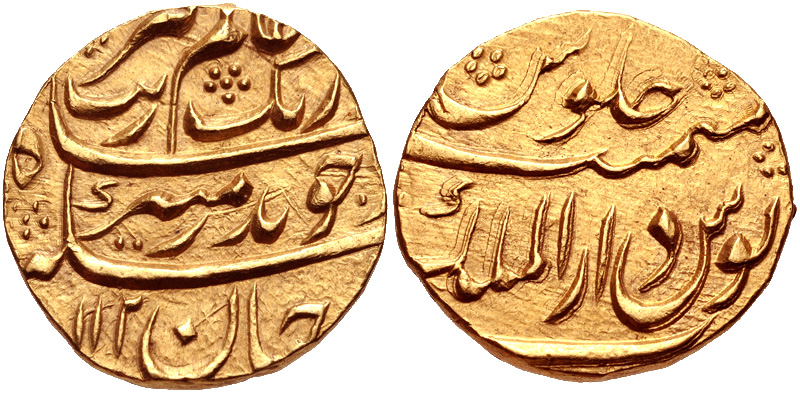
  • In return, India obtained large quantities of silver and gold. Mughal silver coinage fuelled the demand for silver.

Reference

History of Medieval India by Satish Chandra

Mughal empire religious Tolerance Upsc

Religion during Mughal empire

By SK Desai – Own work, Public Domain, https://commons.wikimedia.org/w/index.php?curid=499114

Hinduism

Mughal empire religious tolerance is the one which in recent years gained momentum. Their period saw a continuing assertion of all basic elements in puranic traditions.

As it was tough to say that Hinduism was a Single body of doctrine. It has countless faiths and a number of practices and customs. Having said that, it had developed in Mutual interaction and expressed in large part in Sanskrit.

But different sections of Hinduism shared the same idiom and similar deities. The 16th and 17th centuries were the age of Vaishnavism.

Tulsidas (Ramcharitmanas), a great supporter of the Rama Cult. He portrayed Rama as a God incarnate in his popular verses. The expression of bhakti was deeply emotional as the object of bhakti (devotion) was Krishna, an incarnation of Vishnu.

The Bhakti movement made great strides during this period. A number of poets and saints emerged from various parts of the country and were critical of rituals and criticized the caste system. They use people’s common language for their expression of devotion rather than using Sanskrit.

The radical ideas, and the easy but catchy language often set to music made them popular among the masses. Some of the major religious figures like Vallabhacharya and his son Vitthalnath propagated a religion of grace and Surdas, an adherent to this sect, wrote Sur-Saravali in the local language.

Eknath and Tukaram were Bhakti poets from Maharashtra. The Dasakuta movement, a bhakti movement in Karnataka, popularised by Vyasaraya, turned out to be a lower-class movement.

The most important figure of the Bhakti movement was Kabir. He was said to be a weaver, Kabir propounded absolute monotheism, condemned image worship and rituals, and the caste system. His popular poetry was written in a simple language was spread orally across large parts of north India.

An interesting aspect of the Bhakti poets was that they came from so-called lower castes who practised various crafts and service occupations.

Kabir was a weaver, Ravidas, a worker in hides, Sain, was a barber, and Dadu, a cotton carder. The Satnami sect in Haryana credited its origin to Kabir and his teachings.

While Sanskrit and Persian were the languages of administration and intellectual activity, the vernacular languages demonstrated their literary vitality.

Sikhism

Sikhism originated as a popular monotheistic movement and evolved into one of the recognized religions of the world.

Guru Granth Sahib, the holy book of Sikhs, contained the sayings of Muslim saint Shaikh Farid and of Bhakti poets such as Namdev, Kabir, Sain, and Ravidas.

Guru Nanak believed in one God who was formless and omnipresent and he condemned image worship and religious rituals and he also stressed ethical conduct, kindness to all human beings and condemned the caste system.

Sufism

India was fertile soil for the prevalence of Sufism or Muslim mysticism that had its origin in Iran and it was accepted by the orthodox theologians as long as it fulfilled the obligations of the shariah.

Sufism played a key role in creating religious harmony.

Christianity

Along with the European traders came the Christian missionaries like Roberto De Nobili, Francis Xavier. The early missionaries were Catholics.

The first Lutheran missionaries under Danish patronage arrived in 1706 at Tranquebar and Ziegenbalg translated the New Testament of the Bible into Tamil in 1714, and soon the Old Testament as well.

This was the earliest translation of the Bible in any Indian language.

Art and architecture of Mughal empire Upsc

Art and architecture of Mughal empire

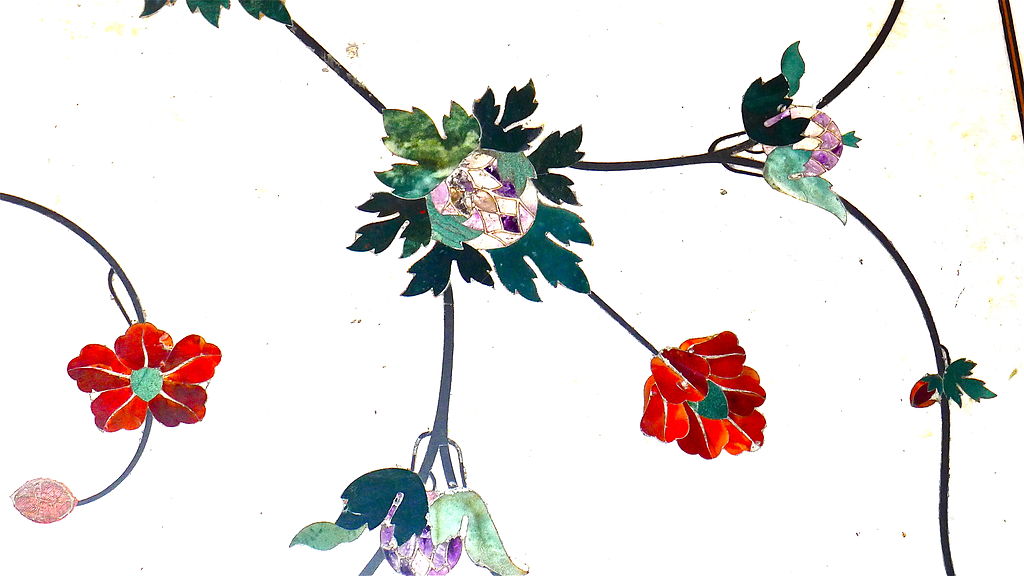
The Mughal empire’s rule is a landmark in World art and Architecture. Their buildings were known for their huge structures that are decorated with bulbous domes, minarets, cupolas at the four corners, elaborate designs, and also for pictorial mosaic work which is called Pietra Dura.

Pietra Dura Art and architecture of Mughal empire Upsc
Pietra Dura at Tomb of Jahangir, Lahore By Gajus Scheltema – Own work, CC BY-SA 4.0, https://commons.wikimedia.org/w/index.php?curid=21916508

The mosques which were during the time of Babur and Humayun were not of much architectural significance. But the Sur dynasty has left spectacular architecture in the form of Purana Qila at Delhi, tombs of Sher Shah, and Islam Shah at Sasaram in Bihar.

Where Purana Qila has raised Citadel and tombs on the terraced platform surrounded by large tanks were artistic features.

Akbar Architecture

It was during Akbar’s rule, that Humayun’s tomb was enclosed with gardens and placed on a raised platform. Built by Indian artisans and designed by Persian architects it set a pattern to be followed in the future.

The Agra fort built with red sandstone is an example where Rajput architectural styles were also used.

The new capital city of Akbar, Fatehpur Sikri enclosed within its walls several inspiring buildings.

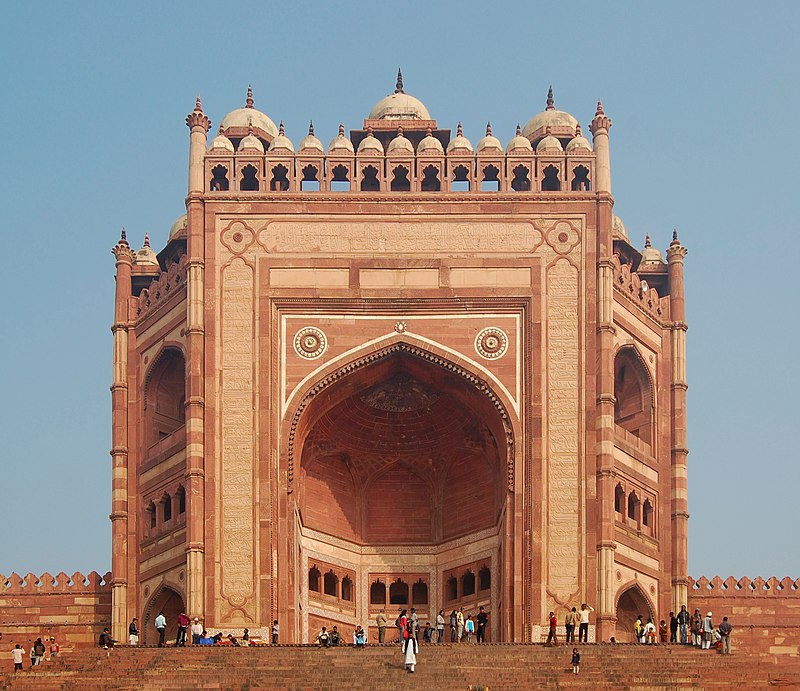
gateway to Fatehpur Sikri Buland Darwaza built by Akbar
Buland Darwaza – Image By Marcin Białek – Own work, CC BY-SA 3.0, https://commons.wikimedia.org/w/index.php?curid=14741170

The magnificent gateway to Fatehpur Sikri, the Buland Darwaza, built by Akbar with red sandstone and marble is considered to be a perfect architectural achievement.

Jahangir Architecture

The mausoleum of Akbar at Sikandra near Agra started by Akbar and completed by Jahangir includes some Buddhist architectural elements.

The tomb of Itimad-ud-daula, father of Nurjahan, built by Jahangir was the first Mughal building built completely with white marble.

 Jahangir Architecture
Tomb of Itimad-ud-daula By Muhammad Mahdi Karim – Own work, GFDL 1.2, https://commons.wikimedia.org/w/index.php?curid=20150525

Shah Jahan Architecture

Mughal architecture reached its apex during the reign of Shah Jahan.

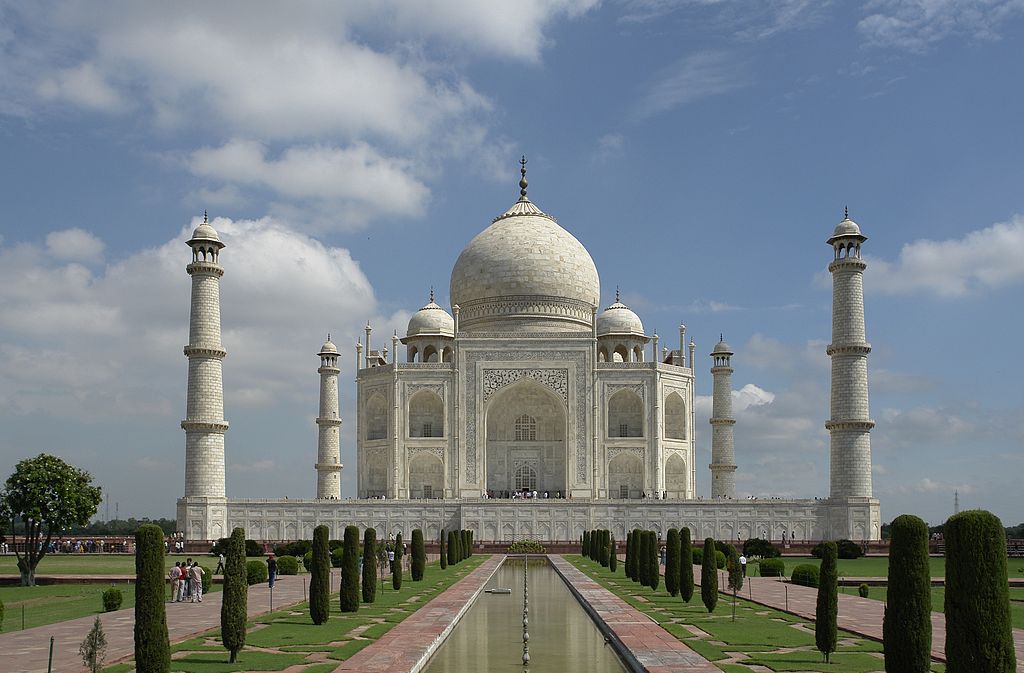
The Taj Mahal is a marble structure on an elevated platform, the bulbous dome in the center rising on a recessed gateway with four cupolas around the dome and with four free-standing minarets at each of its corners is a monument of universal fame.

The Red Fort in Delhi, encompassed by magnificent buildings like Diwan-i Aam, Diwan-i-Khas, Moti Mahal, and Hira Mahal reflect the architectural skills of the times of Shah Jahan.

The Moti Masjid inside the Agra Fort is made exclusively of marble, and the Jama Masjid in Delhi, with its lofty gateway, series of domes, and tall and slender minarets are the two significant mosques built by Shah Jahan.

He also established a new township, Shah Jahanabad (present-day Old Delhi) where Red Fort and Jama Masjid are located.

Aurangzeb’s Architecture

Aurangzeb’s reign witnessed the construction of Badshahi mosque in Lahore and the marble tomb of Rabia-ud-daurani, known as Bibi-ka-maqbara (Tomb of the Lady) at Aurangabad.

Other Mughal Architecture

The Shalimar Gardens of Jahangir and Shah Jahan are showpieces of Indian horticulture.

The Mughals contributed to many civil works for the public works, of which the greatest is the bridge over the Gomati river at Jaunpur, West Yamuna Canal which provides water to Delhi.

Mughal architecture influenced even temple construction in different parts of the Indian subcontinent.

The temple of Govind Dev at Vrindavan near Mathura and Bir Singh’s temple of Chaturbhujat Orchchaa (Madhya Pradesh) display Mughal influence.

Paintings

Mughals was known for their paintings worldwide, and their miniature is kept at museums worldwide.

Their painting traditions were kept alive in Malwa and Gujarat provinces along with central Asian influences.

During the Humayun period, the master of miniature painting, Abdu’s Samad and Mir Sayyid Ali came to India from central Asia and they inspired many Indian painters.

The primary idea of these paintings is to illustrate literary works. Examples are Persian translations of Mahabharata and Akbar Namah were illustrated through painting by different paintings.

In the Mughals court, European paintings were introduced by Portuguese priests.

Animal painting and time portraits were developed during Jahangir’s period. Mansur was great in time portrait painting and animal painting.

The Mughal miniatures also influenced the great Dutch painter Rembrandt. These painting traditions were continued this Shah Jahan.

But Aurangzeb had a difference in opinion towards painting, which led to the dispersal of the painters to different parts of the country. This has led to the promotion of painting in the provinces.

Music and Dance

According to Ain-i-Akbari, Tansen of Gwalior was credited with composing many ragas, and these were patronized by Akbar along with 35 other musicians.

Jahangir and Shah Jahan were great patrons of music. There was a misconception that Aurangzeb was against music but a large number of books on Indian classical music were written during his rule.

The later Mughal, Muhammad Shah was instrumental in inspiring important developments in the field of music.

Paintings in Babur Namah and Padshah Namah show a woman dancing with musical instruments.

Literature

Persian, Sanskrit, and other regional languages grew during the Mughals. The language of administration of Mughal and Deccan states was Persian.

The Persian language also influenced Rajput state administration. Abul Fazal wrote Akbar’s history in Akbar Nama, Mughal administration in Ain-i-Akbari. Ain-i-Akbari also had science, statistics, culture, and geography.

Abdul Hamid Lahori and Muhammad Waris wrote together Padshah Nama, which is a biography of Shah Jahan. Muhammad Kazim wrote Alamgir Nama, describing the first decade of the ruling of Aurangzeb. 

Abdur Rahim Khan-e-Khanan translated Babur’s Autobiography which was written in Chaghatai Turkish into Persian. Dabistan is an impartial work on religious belief.

Several Sanskrit works were translated into Persian. Abul Faizi, a court poet of Akbar and brother of Abul Fazal, translated Mahabharata into Persian.

Dara Shukoh translated Upanishads titled Sirr-I-Akbar (the great secret). The Masnawis of Abul Faizi, Utbi, and Naziri enriched Persian Poetry in India.

There are also several Sanskrit produced during the Mughals. A kavya, named Rajavalipataka was written by Prajna and concluded that the entire history of Kashmir belonged to Akbar.

Several Graeco-Arabic were brought to India via Persian works through Sanskrit translations. Tajika Neelakanthi, is an astrological work written by Akbar’s astronomer Nilakantha.

Rasagangadhara was written by Shah Jahan’s court poet Jaganath Panditha. The greatest achievement of the Mughals is their contribution to literature and making Urdu a common language for various people speaking different dialects.

Abdur Rahim Khan-e-Khanan composed bhakti poetry with a Persian blend, in Brij form of Hindi.

Tulsidas wrote in Awadi, the Hindi dialect spoken in the eastern UP, which was famous for his devotional ideals. Marathi literature was raised during Eknath, Tukaram, Ramdas, and Mukteshwar.

Eknath questioned the superiority of Sanskrit over other languages. Tukaram preached Monotheism. Mukteshwar translated Ramayana and Mahabharata into Marathi.

In the Assamese language, Bhakti poetry was popularised by Shankara Deva. Assamese works were produced in the fields of astronomy, arithmetic, and the treatment of elephants and horses.

Ramayana and Mahabharata are also translated into Assamese. Chaitanya cult also portrayed the love of Krishna and Radha in Bengali literature. The Guru Granth Sahib, the holy book of Sikhs written by Guru Arjun and Shaikh Farid and other monotheists contributed to Punjabi literature.

During the Mughal period, Tamil literature was dominated by Saivite and Vaishnavite. Kumaraguruparar, A Saiva poet composed Meenakshiammai Pillai Tamil and Neethineri Vilakkam.

Thayumanavar wrote devotional poems to brides in various Saivite Sections. Christian missionaries like Roberto de Nobili and Constantine Joseph Beschi also contributed to the Tamil language.

Conclusion

This is an article upsc exam for the topic ‘Art and Architecture of Mughal Emperor’. This note is taken from Ncert’s books.

Ryotwari settlement in land law – Introduction, Features, and History Tnpsc

Ryotwari settlement in land law

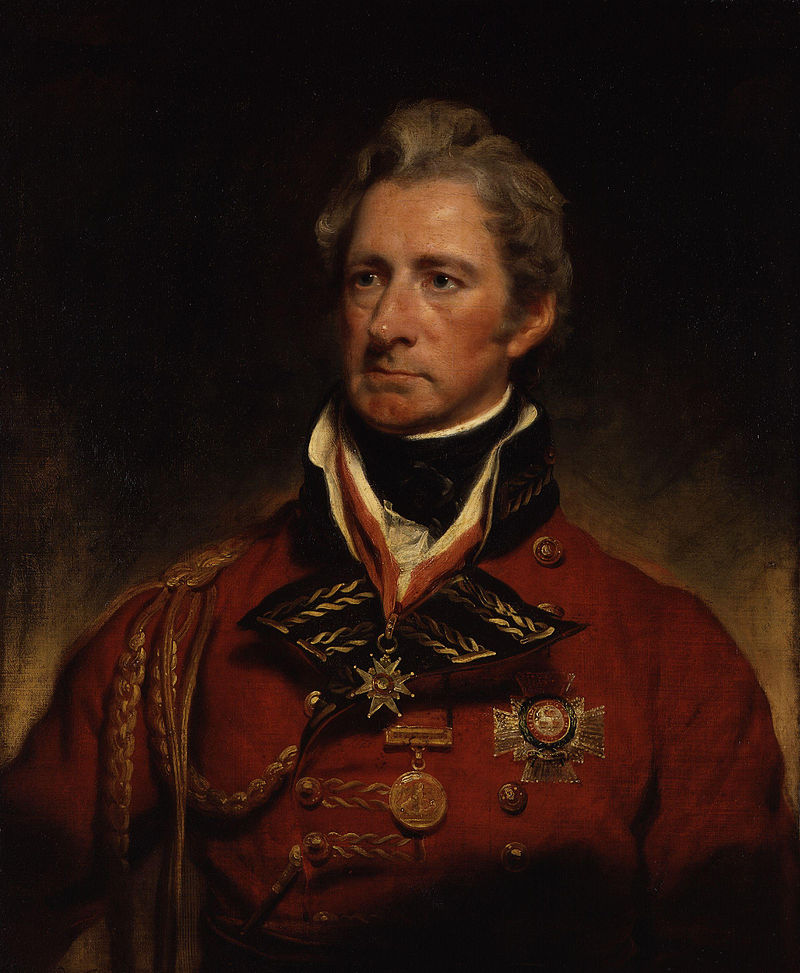
The Ryotwari System in land law (also called Rayotwari System or Raiyatwari Vyavastha) was a land revenue system in India during the British Raj. It was first devised by Captain Alexander Read and later developed to its full form by Sir Thomas Munro. The Ryotwari System’s year of introduction is generally taken as 1820 when Munro implemented it extensively as the Governor of Madras. This system is particularly important for UPSC preparation (ryotwari system UPSC) as it was one of the three main revenue systems in British India, alongside the Zamindari System and the Mahalwari System.

The ryotwari system in India was primarily used in the Madras Presidency, the Bombay Presidency, Coorg, and parts of Assam. The word “Ryot” (also called raiyat or rayat) refers to the individual peasant cultivator.

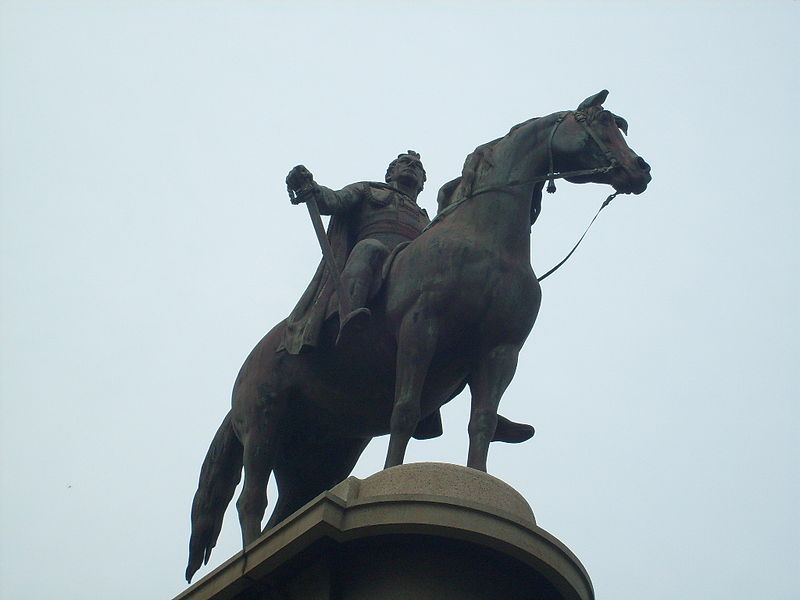
Ryotwari settlement in land law -Thomas Munro Statue in Chennai
Thomas Munro Statue in Chennai

What is the Ryotwari System?

It was a system where the British government collected land revenue directly from the ryots (peasants) without intermediaries like zamindars. The ryotwari settlement system gave peasants legal ownership of the land, provided they paid the fixed revenue to the state.

The ryotwari system was introduced in the Madras Presidency first, and the year of introduction was 1820. In Hindi, it is often referred to as “Raiyatwari Vyavastha kya hai” for competitive exams.

Who introduced the Ryotwari settlement?

The person who devised the Ryotwari settlement in land lawCaptain Alexander Read (Alexander Read UPSC fact). Who started the Ryotwari System? Sir Thomas Munro developed and expanded it between 1820–1827 (Thomas Munro Ryotwari System).

The Ryotwari System was first implemented in: Baramahal district under the Alexander Read. The Ryotwari System was introduced in which state? Initially in Tamil Nadu (Madras Presidency).

Main Features of the Ryotwari Settlement in Land Law

The Ryotwari Settlement UPSC notes should include these points:

  1. Ownership of Land – Every registered ryot was recognised as the owner of his land. (Ryotwari System founder – Thomas Munro).
  2. Direct Payment – Revenue was paid directly to the government.
  3. Freedom of Transfer – The ryot could sell, gift, mortgage, or lease the land.
  4. Security of Tenure – The ryot could not be evicted as long as revenue was paid.
  5. Annual Choice – The ryot could expand, reduce, or abandon land annually.
  6. Revenue Assessment – Fixed in money terms, not in kind; remission possible in case of crop failure.
  7. No Intermediaries – Unlike the Zamindari System, there were no middlemen.
Ryotwari settlement in land law compared with other systems

Ryotwari System vs. Mahalwari System

While the Mahalwari System was introduced by Holt Mackenzie and Robert Merttins Bird (mainly in North-Western Provinces), the Ryotwari System focused on individual peasants rather than villages.

Ryotwari System UPSC Quick Facts

  • Ryotwari System was also known as: Munro System, Rayotwari System, Raiyatwari System.
  • Ryotwari System introduction year: 1820 (Ryotwari System 1820).
  • The Ryotwari System was introduced by Captain Alexander Read, developed by Thomas Munro (Thomas Munro UPSC).
  • Ryotwari Settlement was introduced in Madras, later Bombay, Coorg, and Assam.
  • The Ryotwari land revenue system was first launched in which presidency? Madras Presidency.
  • When was the Munro System introduced? 1820–1827.
  • English meaning: Direct settlement between the state and the peasant.
  • Who are ryots? Individual cultivators or peasants.
  • The Thomas Munro statue in Chennai still commemorates his role in implementing this system.

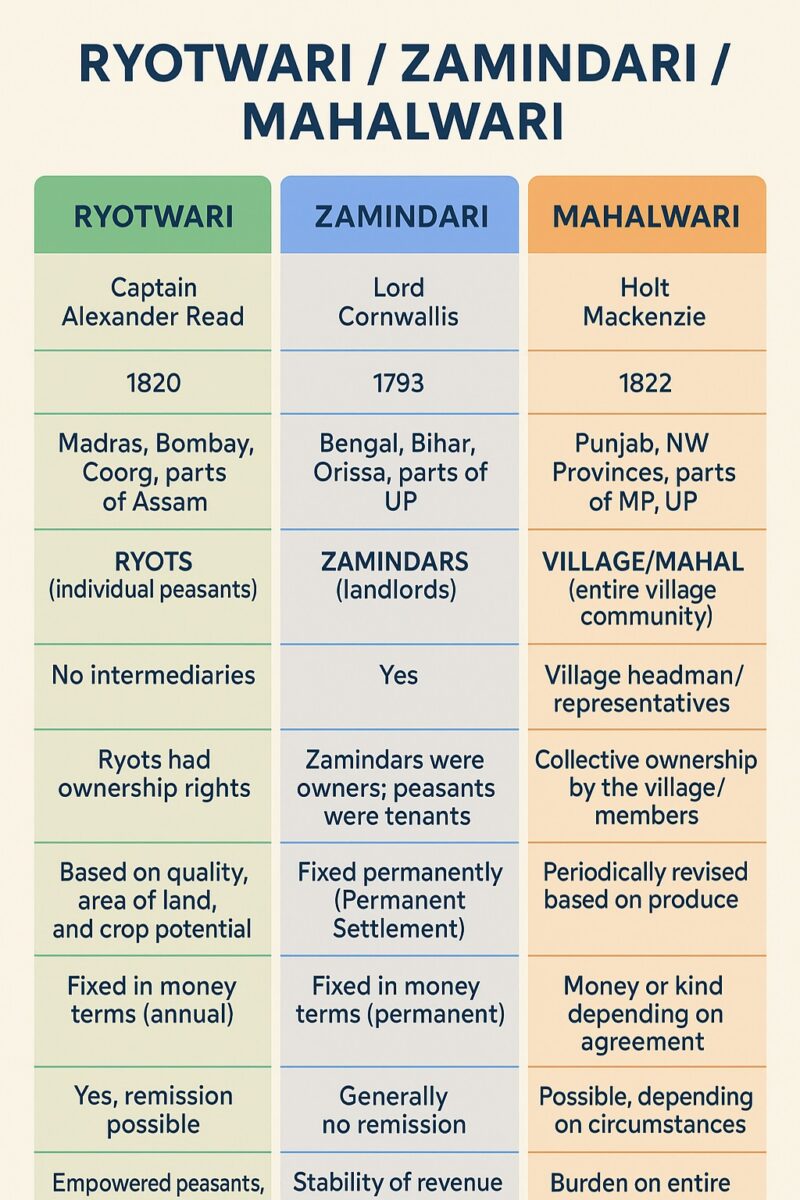
Ryotwari settlement in land law features compared with the Zamindari, Mahalwari Systems

Feature / SystemRyotwari SystemZamindari SystemMahalwari System
Introduced ByDevised by Captain Alexander Read, developed by Sir Thomas MunroLord Cornwallis (Permanent Settlement, 1793)Holt Mackenzie (1822) and Robert Merttins Bird (1833)
Year of Introduction1820 (Madras Presidency)1793 (Bengal Presidency)1822 (North-Western Provinces)
Areas ImplementedMadras, Bombay, Coorg, parts of AssamBengal, Bihar, Orissa, parts of UPPunjab, NW Provinces, parts of MP and UP
Revenue Collected FromRyots (individual peasants)Zamindars (landlords)Village/Mahal (entire village community)
Role of IntermediariesNo intermediaries – direct contact with cultivatorsYes – Zamindars collected and paid revenue to the BritishPeriodically revised based on production
Ownership of LandRyots had ownership rightsZamindars were owners; peasants were tenantsCollective ownership by the village/members
Assessment BasisBased on quality, area of land, and crop potentialFixed permanently (Permanent Settlement)Yes, remission is possible
Payment ModeFixed in money terms (annual)Fixed in money terms (permanent)Money or kind, depending on the agreement
Remission in Bad SeasonsStability of revenue for the BritishGenerally no remissionPossible, depending on circumstances
AdvantageEmpowered peasants, flexible holdingVillage headmen/representatives dealt with the BritishBalanced community responsibility
DisadvantageHeavy burden if crops failedExploitation by zamindarsBurden on the entire village if the crop failed
UPSC TipRemember Ryotwari → Ryot = PeasantZamindari → Zamindar = LandlordVillage headman/representatives dealt with the British

Conclusion

The Ryotwari Settlement in land law was a major shift from the Zamindari System, empowering ryots with land ownership but also binding them to fixed monetary revenue demands. For UPSC, it is crucial to remember who introduced this System in India (Alexander Read, developed by Thomas Munro), where it was introduced first (Madras Presidency), and the Ryotwari System year (1820).

FAQ

  1. The Ryotwari system was introduced by?

The Ryotwari system was devised by Capt. Alexander Read and later by Sir Thomas Munro at the end of the 18th century. Then-Governor of Madras Sir Thomas Munro, during 1820-1827, introduced the Ryotwari system to its full effect. This was the main revenue system in South India that included Madras, Bombay, Coorg and also in parts of Assam.

Mirasdari system Upsc

Mirasdari system

Mirasdari system
Mirasdari system

The Mirasdari system has once existed in the Madras Presidency. In the Madras Presidency, the Palegar system was present during the early 19th Century.

The Palegar were the landlords, who had judicial powers and also military powers. The British allowed them to collect the land taxes at 50% of the land’s annual produce.

In 1855, Sir Thomas Monroe, Governor of Madras abolished the Palegar system. He reduced the Palegar, Military, and Judicial power and made them mere tax collectors.

These tax collectors were called Mirasdars. Mirasdars were not necessarily the owners of the land.

The farmers were actual landowners called Mirasdari and had to pay regular taxes. The farmers who failed to pay the revenue, even due to famine, or disaster, etc were penalized and their lands were auctioned.

After 30 years of the Mirasdar system, it was replaced by a much friendlier Ryotwari system.

Neil statue satyagraha Upsc

neil statue satyagraha
Neil Statue

Neil statue satyagraha Upsc

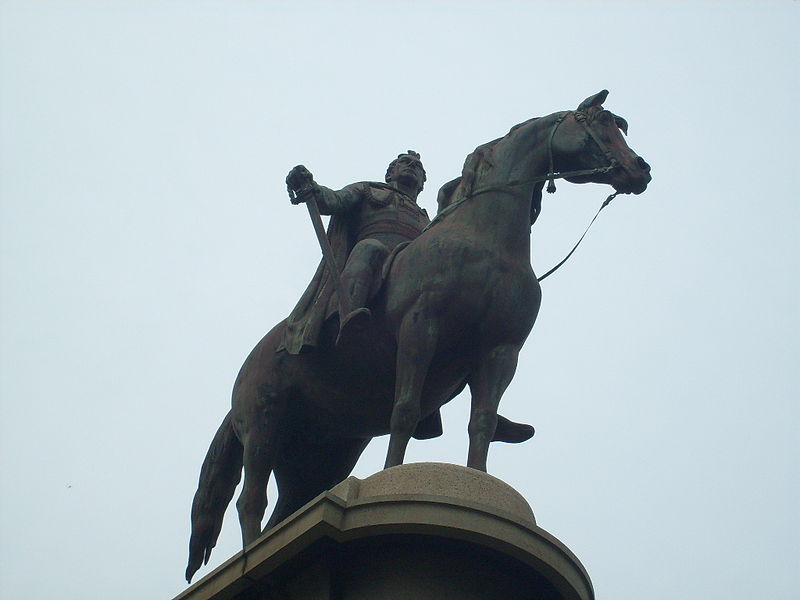
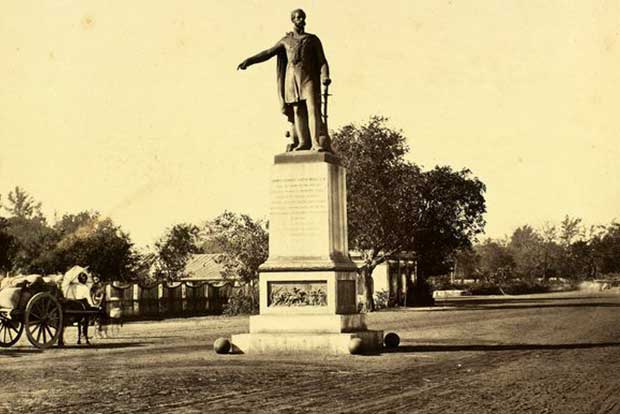
It is the protest or satyagraha that took place in Madras Presidency in 1927 for the removal of Colonel James Neil statue which was erected at the Mount Road, Madras.

Who is James Neil?

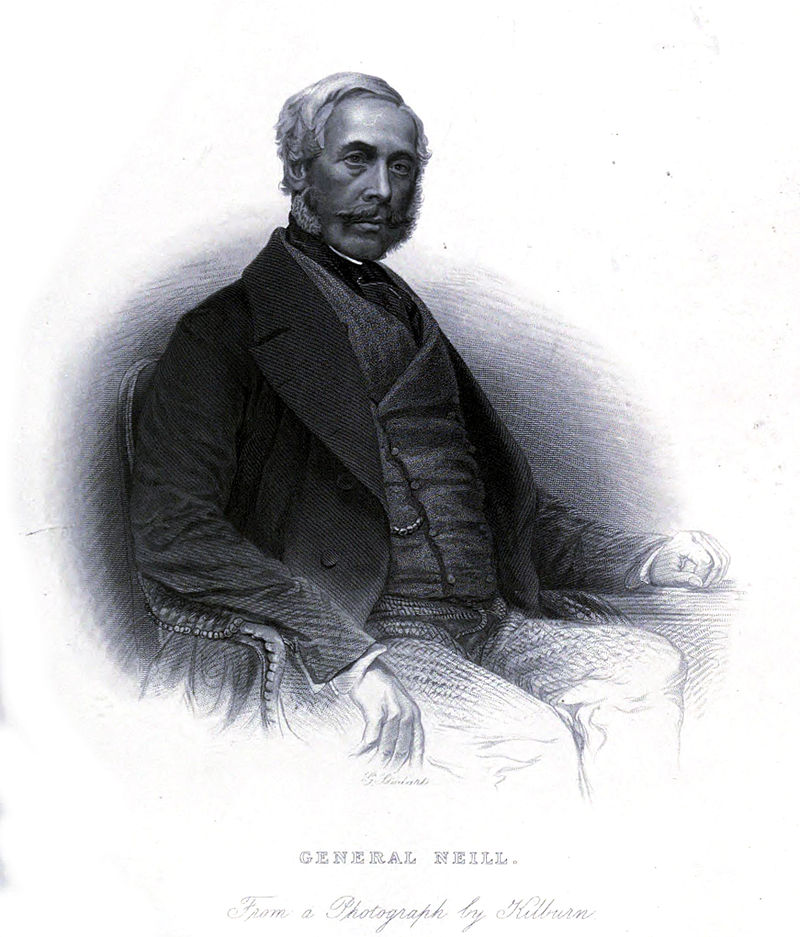
He was a colonel of Madras Fusileers regiment and played an important role in putting down the Revolt of 1857. James Neil was called as “Butcher of Allahabad”.

He was killed during the siege of Lucknow. To remember him a statue was placed in Mount road, Madras.

Neil statue satyagraha

The Madras provincial committee which is part of the Indian National Congress and Madras Mahajana Sabha passed a resolution, demanding the removal of the statue.

They demonstrated agitation across Madras’s Presidency. The agitator all over Madras Presidency was led by S.N.Somayajulu.

Several agitations were imprisoned for a few weeks to rigorous imprisonment for years. Also, S.N.Somayajulu and Swaminatha Mudaliar were arrested.

Then after their arrest, K.Kamaraj led the agitation during September 1927. Mahatma Gandhi gave his support to Neil statue satyagraha during his visit to Madras.

The Madras Legislature also passed the resolution demanding the statue removal. The agitation was lost in fire due to the Simon Commission boycott.

Another important personality who participated in Neil statue satyagraha in 1927 is Ammapon alias Leelavathi who was 11 years old when she took part in it. She was later arrested and kept in a children’s home.

Reference

  • https://en.wikipedia.org/wiki/Neil_Statue_Satyagraha
  • Samacheer Kalvi Book

Satyagraha movement of Gandhiji and Growth of Satyagraha Upsc

Advent of Gandhi

Satyagraha movement of Gandhiji

Gandhi returned to India in the year 1915. He earlier fought against inequalities imposed by the South Africa Government. Gandhi came to India with the idea of holding forces of nationalism in India. Then came into contact with congress members for Mobilizing support for the South African Indian Cause.

He was inspired by Gopala Krishna Gokhale and acknowledged as his political guru. By the advice given by Gopan Krishna Gokhale, he came to India, nearly after two decades. Then he travelled all over the Indian Subcontinent to learn about different people.

After travelling all over the country, he established an Ashram near the Sabarmati river in Ahmedabad. He did not immediately take part in the Political movement including the Home rule movement.

Satyagraha movement of Gandhiji

During his stay in South Africa, he gained the knowledge or technique of Satyagraha means Truth and Non-Violence to fight the Racist South African Government. As per Gandhi is “Even while fighting evil and wrong a Satyagrahi had to be in peace with himself and not hate the wrongdoer“.

A satyagrahi would accept the suffering willfully during resistance, and there is no place of hatred during this exercise.

For Gandhi, Truth and Non-Violence are the weapons of the brave and fearless and not cowards. Satyagraha Movement of Gandhiji is an iconic movement for India’s Struggle for Independence.

Champaran Satyagraha (1917)

In Champaran in Bihar, the Indigo planters were exploited by European planters. The peasants were forced to grow Indigo on lease on 3/20 of their fields and sell it at the rate fixed by the planters. This system made farmers poor.

Gandhi conducted a detailed study on the situation with help of Rajendra Prasad, Mazharul Huq, Acharya Kripalani, and Mahadeva Desai. Gandhi and Others mobilized the Champaran Movement. It was the first satyagraha in India and also Gandhiji first satyagraha in India.

The British official ordered Gandhi to leave but he refused and warned them about the consequences. Then British government formed an inquiry committee adding Gandhi as its member.

Gandhi convinced the British officials by showing difficulties faced by the peasants. The report was accepted by British officials, eventually, the British broke the bondage of European Plants. The Champaran Satyagraha was successful and European planters left Champaran.

Ahmedabad Satyagraha (1918)

After the Successful campaign in Champaran, Gandhi mobilized Ahmedabad Satyagraha which was famously known as Ahmedabad Mill Strike. There was a dispute between, Mill owners and textile workers. Initially, Gandhi met both the parties and when the Mill refused the demands of workers.

Then Gandhi asked workers to go on strike demanding a 35% increase in their wages. Gandhi went on Fast to bolster the morale of the workers. Gandhi’s fast forced the Mill owner to accept the demands.

Kheda Satyagraha (1918)

The peasants faced the failure of monsoons and were also affected by the plague epidemic. As a result, peasants appealed to authorities for the remission of land revenue during 1918. As per the government’s Famine Code, in the event of crop yield being under 25% of the average, the cultivators were entitled to total remission.

But the Authorities demanded Full payment and harassed them. Then the peasant approached the Servant of India Society, Gandhi was also a member of it. Gandhi along with Vallabhai Patel intervened.

Asked the Peasants to withhold payment and fight unto death. Vallabhai Patel and Indulal Yagnik joined Gandhi and asked the farmers to be firm. The Government even went on to Auctioning the cattle, lands.

As the protest went strong, the government authorities passed instructions to collect the revenue only from Ryot who can afford to pay. Then Gandhi Withdrew the struggle. The Champaran, Ahmedabad, and Kheda Satyagraha, Gandhi demonstrated a great fighting spirit without violence.

He gave voice to all classes, peasants, mill workers, and all castes. He confronted both the colonialist and Indian exploiters and forced them to enter into a dialogue. Gandhi demonstrated, that he could also mobilize the masses and oppressed, also enter a dialogue with the oppressors.

Gandhi inspired several others to take Satyagraha as a mode of agitation.

Growth of Satyagraha

Bardoli Satyagraha

In 1925, Bardoli, a taluka in Gujarat suffered from financial troubles. The Bombay Presidency raise the tax rate by 22%. Despite several petitions, the government refused to give up. The farmers affect so badly and they have got anything left to pay the taxes or to feed their families.

Vallabhai Patel led the Bardoli Satyagraha and made it a success. This success rises Vallabhai Patel as the main leader of the Independent movement.

Rowlatt Satyagraha

The British government enacted the Anarchical and Revolutionary Crimes Act of 1919 called as Rowlatt Act. By this act, revolutionists can be arrested without trial and judicial review.

In response to the Rowlatt Act, Gandhi called a countrywide protest against the Act. This movement is called Rowlatt Satyagraha.

Dandi Satyagraha

Dandi Satyagraha is also called Salt March or Dandi March. It was a nonviolent civil disobedience movement led by Gandhi.

The goal of Dandi Satyagraha was against the British Salt Monopoly. Gandhi marched 390 km from Sabarmati Ashram to Dandi to collect the salt at end of his march that broke the Salt Laws.

Vaikom Satyagraha

This Satyagraha took place in South India. Vaikom Satyagraha aimed to provide freedom to pass through the public roads passing through the Sri Mahadeva Temple.

The movement was led by several leaders. The prominent leader was T.K.Madhavan, E.V. Ramasamy (Periyar) etc.

Individual Satyagraha

Gandhi decided on a strategy of Individual Satyagraha to fight the fascist government. The Individual Satyagrahis were handpicked by Gandhi. The chosen Satyagrahi were to inform the District Magistrate of the time and place of protest. Satyagrahi on reaching the place has to declare publicly, “It is wrong to help the British War effort with men or money”.

This movement started on October 17, 1940, with Vinobha Bhave near Paunar Ashram in Maharastra. Gandhi suspended this satyagraha in December 1941.


Expansion and consolidation of British rule Upsc

Battle of Plassey to Annexation of Punjab in 1849. They used several methods apart from war, like the Subsidiary Alliance and the doctrine of Lapse to expand and consolidate their rule in India.

European Trading Centre's in India Map
European Trading Centre’s in India

Conquest of Bengal

Siraj-ud-daullah (Nawab of Bengal)

In 1717, the East India company got Farman from Mughal emperor Farrukh Siyar. This Farman Granted English East India Company, the freedom to export and import without paying tax in Bengal.

This Farman created a huge loss of revenue for the Nawab of Bengal and created conflicts with the East India Company.

This Royal Farman also gave East India Company other rights such as levying Heavy taxes on Indian Goods entering Calcutta (Bengal).

Also, the East India Company built Fortification, which created a rivalry between Nawab of Bengal and the East India Company.

The East India Company planned to overthrow the Nawab of Bengal, Siraj-ud-Daulla by joining hands with several members inside the Nawabs court.

Example: Mir Jafar, Mir Bakshi, Manik Chand (officer in charge of Calcutta), Amir Chand (Big Banker in Bengal), and Khadim Khan (One of Commander in Nawab in Bengal).

Battle of Plassey (1757)

Nawab of Bengal and East India Company fought in the Battle of Plassey. Mir Jafar and Rai Durlabh took no part in the fighting and left the battlefield.

Nawab Siraj-ud-Daulla was captured and killed. Mir Jafar was made Nawab of Bengal. Then Mir Jafar was deposed in 1760, as he did not fulfil the demands of English.

Then Mir Qasim, son-in-law of Mir Jafar was made Nawab of Bengal.

Battle of Buxar (1764)

Mir Qasim too was not loyal to the East India Company. War broke out between East India Company and Mir Qasim.

Mir Qasim went to Awadh and formed an alliance with Nawab of Awadh, Shuja-ud-Daula, and Mughal Emperor Shah Alam. This alliance fought together against the East India Company in1764 at Buxar.

East India Company won the battle of Buxar. The treaty of Allahabad was signed between the Mughal emperor Shah Alam-II and Rober Clive of East India Company, as a result of the Battle of Buxar on 22 October 1764.

Based on this East India Company was granted Diwani Rights. Diwani rights is the right to collect revenue in Bengal, Bihar, and Orissa. This victory gave East India Company as political masters of Bengal, Bihar, and Orissa.

Anglo-Mysore War

Next to English East India company turned toward Mysore state. Already there was a rivalry between Mysore, Nizam of Hyderabad, and Marathas.

This rivalry gave the English an opportunity to interfere and expand their political dominance. This rivalry resulted in four wars between the East India Company and the Mysore state called as Anglo Mysore Wars.

First Anglo-Mysore War (1767-69)

Haider Ali got some success against the British.

Second Anglo Mysore War(1780-1784)

Proved indecisive, ended with the treaty of Mangalore.

Third Anglo Mysore War(1789-1792)

Tipu Sultan invaded Travancore, which is an English Ally. Tipu Sultan was defeated in the Third Mysore War, forcing him to sign the Treaty of Seringapatam.

According to the treaty, Tipu had to surrender half of his kingdom to the East India Company and to its allies.

Fourth Anglo Mysore War(1799)

British Defeated Tipu Sultan. Tipu died while defending the capital. Half of Mysore Territory was divided between the British and Nizam

Conquest of Marathas

The conquest of the Maratha Empire was called as Anglo-Maratha War.

First Anglo Maratha War (1775-1782)

British were defeated and the Treaty of Salbai was signed.

British Won Second Anglo-Maratha War (1803-1806) and the third Anglo-Maratha war (1817-1818).

The reason for Maratha’s defeat is a mutual conflict between the Marathas chiefs.

The annexation of Awadh (1856)

Awadh was annexed to the English East India Company on the basis of ‘Misgovernance‘. English accused Nawab of Awadh, Wajid Ali Shah of Misgovernance.

Awadh was annexed by Lord Dalhousie in 1856. Nawab of Awadh, Wajid Ali Shah was the only ruler to be deposed on basis of ‘Misgovernance‘.

Sind Conquest (1843)

Since the 18th century, Sindh was being ruled by some Baluchi Chiefs collectively known as “Amir of Sind”.

General Charles Napier captured the Sindh province in 1843 through the battle of Miani.

Punjab Wars

With the Death of Ranjith Singh in 1839, the Conquest of Punjab was completed in 1849. There was two war fought between Sikhs and the English.

First Anglo-Sikh War (1845-1846)

British defeated Sikh troops and the treaty of Lahore was signed. To take revenge for the first Anglo-Sikh war, Sikhs created a number of revolts that lead to the second Anglo-Sikh war.

Sikhs were defeated, whole Punjab went under British Control. By this the conquest of India is complete.

Conclusion

The British were able to expand and consolidate their rule of India, main because India was not united. They were divided mainly based on religion, caste, linguistics, etc. The English signed several treaties, and military and trade alliances with many small, large, and independent states.

Also the British were very effective at infiltrating their internal affairs and gradually took control over the entire Indian subcontinent.

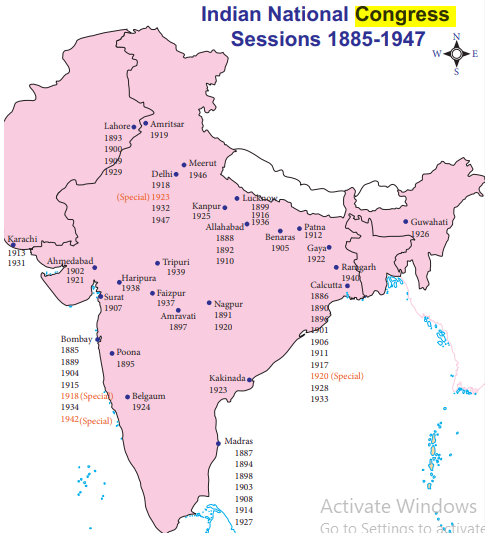
Indian national congress sessions (Inc sessions) from 1885 to 1947

Formation of Indian National Congress

Between 1875 and 1885 there were many agitations against British policies in India. In December 1884, Allan Octavian Hume, a retired English ICS officer, presided over a meeting of the Theosophical Society in Madras.

The formation of a political organization that would work on an Indian basis was discussed and the idea of forming the India National Congress emerged in this meeting. The Indian National Congress was formed on 28 December 1885 in Bombay.

Another important founding member was W.C. Bonnerjee, who was elected the first president. The activities of INC then revolved around petitions and memoranda, from the very beginning the founders of the INC worked to bring every section of the society into its ambit.

The main mission of the INC was to weld the Indians into a nation. They were convinced that the struggle against the English rule will be successful only if the Indians feel like a member of the nation.

The INC provided the space where the political workers from different parts of the country could gather and conduct their political activities under its banner. It was the beginning of the mobilization of people on an all-India basis.

Demands of Indian National Congress

Constitutional

Opportunity for participation in the government. It demanded Indian representation in the government.

Economic

It demanded a reduction in the land revenue and protection of peasants against exploitation of the zamindars.

It advocated the imposition of a heavy tax on imported goods for the benefit of swadeshi goods.

Administrative

To conduct the Indian Civil Service Exam simultaneously in India and England was the major demand of Congress.

Judicial

Due to the partial treatment of the Indian Political activist by English Judges, congress demands separation of the Executive and the Judiciary.

Early Nationalists in Congress (1885-1915)

The early nationalist in the INC came from the elite section of the society. They were Lawyers, College and School Teachers, doctors, journalists, etc represented the congress.

They came from different regions of the country. These leaders of the INC adopted the constitutional methods of presenting petitions, prayers, and memorandums and thereby they earned their name as “Moderates”.

They were developing the Indigenous anti-colonial ideology and a strategy on their own which helped leaders like M.K.GANDHI. From the late 1890s, there were differences grown within the INC.

Leaders like Bipin Chandra Pal, Bal Gangadhar Tilak, and Lala Lajpat Rai were advocating radical approaches. These advocates of radical methods came to be called Extremists.

The extremists were against the moderates. Their objective became clear in 1897 when Tilak raised the slogan “Swaraj is my birthright and I shall have it“.

Tilak and his militant followers were requesting swaraj instead of economic or administrative reforms. Both the Extremist and moderates contributed to the making of the swadeshi movement.

The method of mass mobilization and boycott of British Goods and institutions suggested by the radicals was also accepted by the moderates.

Both extremists and moderates tried to instil nationalist consciousness through various means including the press. Congress one-third of people were journalists.

Dadabhai Naoroji founded and edited two journals called Voice of India and Rast Goftar. Surendranath Banerjea edited the newspaper called Bengalee.

Bal Gangadhar Tilak edited Kesari and Mahratta. For the first time in the history of India, the Press was used to generate public opinion against the oppressive policies and acts of the colonial government.

On 27 July 1897, Tilak was arrested under section 124 A of IPC.

indian national congress sessions
Indian congress session 1885-1947

Indian national congress sessions from 1885 to 1947

SessionPlaceDatePresident
1st SessionBombayDec. 28-30, 1885Womesh Chandra Bonnerjee
2nd SessionCalcuttaDec. 27-30, 1886Shri Dadabhai Naoroji
3rd SessionMadrasDec. 27-30, 1887Badruddin Tyabji
4th SessionAllahabadDec. 26-29, 1888George Yule
5th SessionBombayDec. 26-28, 1889Sir William Wedderburn
6th SessionCalcuttaDec. 26-30, 1890Pherozeshah Mehta
7th SessionNagpurDec. 28-30, 1891P. Ananda Charlu
8th SessionAllahabadDec. 28-30, 1892Womesh Chandra Bonnerjee
9th SessionLahoreDec. 27-30, 1893Shri Dadabhai Naoroji
10th SessionMadrasDec. 26-29, 1894Alfred Webb
11th SessionPuneDec. 27-30, 1895Surendranath Banerjee
12th SessionCalcuttaDec. 28-31, 1896Rahimatullah M. Sayani
13th SessionAmraotiDec. 27-29, 1897C. Sankaran Nair
14th SessionMadrasDec. 29-31, 1898Ananda Mohan Bose
15th SessionLucknowDec. 27-29, 1899Romesh Chunder Dutt
16th SessionLahoreDec. 27-29, 1900N.G. Chandavarkar
17th SessionCalcuttaDec. 26-28, 1901Dinshaw Eduljee Wacha
18th SessionAhmedabadDec. 28-30, 1902Surendranath Banerjee
19th SessionMadrasDec. 28-30, 1903Lal Mohan Ghosh
20th SessionBombayDec. 26-28, 1903Sir Henry Cotton
21st SessionBanarasDec. 27-30, 1905Gopal Krishna Gokhale
22nd SessionCalcuttaDec. 26-29, 1906Shri Dadabhai Naoroji
23rd Session (Suspended)SuratDec. 26-27, 1907Rash Behari Ghosh
23rd SessionMadrasDec. 28-30, 1908Rash Behari Ghosh
24th SessionLahoreDec. 27-29, 1909Madan Mohan Malaviya
25th SessionAllahabadDec. 26-29, 1910Sir William Wedderburn
26th SessionCalcuttaDec. 26-28, 1911Bishan Narayan Dar
27th SessionBankiporeDec. 26-28, 1912Shri Raghunath Narasinha Mudholkar
28th SessionKarachiDec. 26-28, 1913Nawab Syed Mohammed Bahadur
29th SessionMadrasApr. 14-15, 1914Bhupendra Nath Bose
30th SessionBombayDec. 27-29, 1915Satyendra Prasanna Sinha
31st SessionLucknowDec. 26-30, 1916Ambica Charan Mazumdar
32nd SessionCalcuttaDec. 26-29, 1917Annie Besant
33rd SessionDelhiDec. 26-30, 1918Madan Mohan Malaviya
(Special Session)BombayAug. 29-01, 1918Romesh Chunder Dutt
34th SessionAmritsarDec. 26-30, 1919Motilal Nehru
35th SessionNagpurDec. 26-30, 1920C. Vijayaraghavachariar
36th SessionAhmedabadDec. 27-28, 1921Hakim Ajmal Khan (Acting President for C.R. Das)
37th SessionGayaDec. 26-31, 1922Deshbandhu Chittaranjan Das
Special SessionDelhiSep. 04-08, 1923Maulana Abul Kalam Azad
39th SessionBelgaumDec. 26-27, 1924M.K. Gandhi
40th SessionCawnporeApr. 15-17, 1925Mrs. Sarojini Naidu
41st SessionGawahatiDec. 26-28, 1926S. Srinivasa Iyengar
42nd SessionMadrasDec. 26-28, 1927M.A. Ansari
43rd SessionCalcuttaDec. 29-01, 1929Motilal Nehru
44th SessionLahoreApr. 16-18, 1929Pt Jawaharlal Nehru
45th SessionKarachiMar. 21-31, 1931Vallabbhai J. Patel
47th SessionCalcuttaSep. 12-14, 1933Mrs. Nellie Sengupta
48th SessionBombayOct. 24-28, 1934Dr. Rajendra Prasad
49th SessionLucknowJun. 18-20, 1936Pt Jawaharlal Nehru
50th SessionFaizpurJul. 12-14, 1937Pt Jawaharlal Nehru
51st SessionHaripuraFeb. 19-21, 1938Subhash Chandra Bose
52nd SessionTripuraMar. 10-12, 1939Subhash Chandra Bose
53rd SessionRamgarhMar. 19-20, 1940Maulana Abul Kalam Azad
54th SessionMeerutNov. 23-24, 1946J.B. Kripalani
Indian national congress sessions from 1885 to 1947

Indian national congress sessions from 1885 to 1947 pdf

* * All the Notes in this blog, are referred from Tamil Nadu State Board Books and Samacheer Kalvi Books. Kindly check with the original Tamil Nadu state board books and Ncert Books.