Misuse of Article 356 of the Indian constitution

Article 356 in Part XIII of the constitution provides for the proclamation of Emergency by the President in any state where there is a breakdown of constitutional machinery either based on the report of the Governor or even otherwise.

The Article emphasizes the supremacy of the constitution and national unity and integrity.

The state governments ruled by the opposition parties of the ruling party at the centre have complained against the frequent and improper use of this article by the ruling party or coalition at the centre.

More than a hundred times the Article has been used to impose emergency in states and in many instances there was a huge complaint that political and party considerations have led to the imposition of the President’s Rule.

Many regional parties have demanded the abolition of this Article.

However, since the Supreme Court’s judgment in S.R.Bommai vs Union of India case, the chances for misuse of Article 356 drastically reduced.

Legislative relations between Centre and State Upsc

Centre-State Relations (Federalism in India)

Centre-State relation revolves around distribution of powers under three major categories:

  • 🧾 Legislative Power Distribution
  • ⚙️ Executive Power Distribution
  • 💰 Financial Power Distribution

🧾 Legislative Relations

1️⃣ Territorial Distribution of Powers
Union controls entire India + extraterritorial powers
State controls only within its own territory
  • Union laws can apply to citizens abroad
  • Parliament’s jurisdiction limited in Scheduled Areas/UTs
2️⃣ Subject Distribution (3 Lists)
  • List I – Union List (100 subjects): Defense, Foreign Affairs, Banking, Currency
  • List II – State List (59 subjects): Police, Public Order, Health, Agriculture
  • List III – Concurrent List (52 subjects): Marriage, Education, Criminal Law
If conflict arises → **Parliament law prevails**
🌀 Residuary Powers

Subjects not in any list go to the Union Government.

🚨 Exceptional Legislative Situations
  • National Emergency: Parliament can legislate on State List
  • State Agreement: Parliament can legislate for agreeing states
  • International Agreements: Parliament can make laws even on State List
  • President’s Rule (Art. 356): Centre legislates for that state

⚙️ Executive Relations

  • Union: Executes Union List
  • States: Execute State List
  • Concurrent List: Shared execution; Centre can issue directions
🔁 Delegation of Executive Functions
  • Union ↔ State functions can be delegated with mutual consent
  • Union → State: Can delegate with Parliament’s consent even without state’s

💰 Financial Relations

📊 Tax Revenue Distribution

  • Union-only taxes: Corporation Tax, Customs
  • State-only taxes: Sales Tax (now GST)
  • Union levies, State collects: Stamp Duty, Excise (Alcohol-based)
  • Union collects, States get proceeds: Advertisement tax on newspapers
  • Income tax (except agriculture): Shared between Union & States

💸 Non-Tax Revenue

  • Union: Railways, Posts, Broadcasting, Industries
  • States: Forests, Irrigation, Transport, Electricity

🤝 Grants-in-Aid (Article 275)

Special assistance to states like Assam for tribal development

🧮 Finance Commission (Article 280)

  • Constituted every 5 years by President
  • Chairman + 4 members (expertise: finance, law, economics)

Functions:

  • Distribute tax revenues between Union and States
  • Recommend Grants-in-Aid
  • Support Panchayats and Urban Local Bodies
  • Handle special matters referred by President

Centre-State Relations in Indian Federal Setup

In the Indian federal setup, the Constitution divides the legislative, executive, and financial functions between the Centre and the States. It also provides for an integrated judicial system.

Three Types of Relations
  • Legislative Relations
  • Administrative Relations
  • Financial Relations

Legislative Relations (Articles 245–255)

AspectDescription
State LegislatureCan make laws for its territory
ParliamentCan make laws for whole or part of India and also outside India for Indian citizens

Distribution of Legislative Subjects

  • Union List: Centre has exclusive power (e.g., Defence, Banking)
  • State List: States have exclusive power (e.g., Police, Agriculture)
  • Concurrent List: Both can legislate (e.g., Marriage, Education); Union law prevails in case of conflict
  • Residuary Powers (Article 248): Belong to the Centre

When Centre Can Legislate on State Subjects

  • Article 249: If Rajya Sabha passes with 2/3rd majority
  • Article 250: During National Emergency
  • Article 252: If states request Parliament
  • Article 253: For international treaties
  • Article 356: During President’s Rule
Centre’s Control Over State Legislation

Article 200: Governor can reserve certain bills for the President

Administrative Relations (Articles 256–263)

  • Article 256: States must comply with Central laws
  • Article 257: Union’s control in specific cases
  • Emergency: Centre directs states during National Emergency and President’s Rule
  • Governor: Appointed by President, holds office at President’s pleasure
  • State Election Commissioner: Appointed by Governor, removed by President
  • Public Service Commissions: Centre can remove state PSC members

Financial Relations (Articles 268–293)

Taxation Powers

  • Parliament and State legislatures have exclusive power on respective list subjects
  • Residuary tax powers with Parliament

Grants-in-aid

  • Article 275(1): Grants given as per Parliament decision
  • Article 282: Grants for public purpose by Centre or State

Finance Commission (Article 280)

  • Quasi-judicial body for tax sharing, grant principles, panchayat/ULB funding

GST Amendment (101st CAA 2016)

Empowered both Centre and States to levy GST

Issues in Centre-State Relations

  • Resource allocation disputes
  • Legal challenges to central laws (e.g., CAA, NIA Act)
  • Political misuse of Article 356
  • Office of Governor seen as Centre’s tool

Recommendations for Improvement

Sarkaria Commission

  • Strengthen All-India Services
  • Limit Centre’s use of Concurrent List

MM Punchhi Commission

  • Define local body powers in Constitution
  • Five-year Governor term; removal only by impeachment

NCRWC

  • Inter-State Trade Commission under Article 307
  • Disaster management in Concurrent List

Other Measures

  • Strengthen Inter-State Council, NITI Aayog
  • Promote Fiscal Federalism
  • Revisit Seventh Schedule
  • Encourage innovation at state level
  • Power sharing & cooperation

Rajamannar Committee Report and Recommendations Upsc

Rajamannar committee related to a commission set up by the Tamil Nadu government to study the state autonomy and centre-state relations by the DMK government under its Chief Minister M. Karunanidhi.

The Tamil Nadu government established the Rajamannar committee to analyze and provide recommendations for restructuring the centre-state relations in our constitution.

The committee consisted of the retired Chief Justice of Madras High Court Justice.

P.V.Rajamannar, former Vice-Chancellor of the University of Madras, Dr. A.Lakshmanaswamy, and a former Chief Justice of Andhra, Dr.P. Chandra Reddy. It submitted its report to the government in 1971 marking a great milestone in the history of autonomy debate in the country.

Rajamannar Committee recommendations

The major suggestions of the Rajamannar committee report include:

  • Article 263 of the constitution should be implemented and the Interstate commission should be formed to promote cooperation among central and state governments.

Provisions with respect to an inter-state Council

Article 263
  • The proposed council must consist of the Chief Ministers of the states or their nominees as members and the Prime Minister as the Chairperson.

  • It should be endowed with far-reaching powers and all the major bills of the Parliament and decisions of the union government that affect the interest of one or more states must be placed and discussed in the council and its opinion should be considered in the decision-making process.

  • The committee’s made consultation with the Inter-State council is mandatory in all matters barring those related to the two subjects, namely defense and foreign affairs.

  • The committee argued that the present scheme of centre-state relations in the constitution favors center’s supremacy and erodes state autonomy and therefore recommended the elimination of Articles 256,257,399 (2) for the constitution.

Obligation of States and the Union – The executive power of every State shall be so exercised as to ensure compliance with the laws made by Parliament and any existing laws which apply in that State, and the executive power of the Union shall extend to the giving of such directions to a State as may appear to the Government of India to be necessary for that purpose.

Article 256

Control of the Union over States in certain cases – (1) The executive power of every State shall be so exercised as not to impede or prejudice the exercise of the executive power of the Union, and the executive power of the Union shall extend to the giving of such directions to a State as may appear to the Government of India to be necessary for that purpose.

(2) The executive power of the Union shall also extend to the giving of directions to a State as to the construction and maintenance of means of communication declared in the direction to be of national or military importance:

Provided that nothing in this clause shall be taken as restricting the power of Parliament to declare highways or waterways to be national highways or national waterways or the power of the Union with respect to the highways or waterways so declared or the power of the Union to construct and maintain means of communication as part of its functions with respect to naval, military and air force works.

(3) The executive power of the Union shall also extend to the giving of directions to a State as to the measures to be taken for the protection of the railways within the State.

(4) Where in carrying out any direction given to a State under clause (2) as to the construction or maintenance of any means of communication or under clause (3) as to the measures to be taken for the protection of any railway, costs have been incurred in excess of those which would have been incurred in the discharge of the normal duties of the State if such direction had not been given, there shall be paid by the Government of India to the State such sum as may be agreed, or, in default of agreement, as may be determined by an arbitrator appointed by the Chief Justice of India, in respect of the extra costs so incurred by the State.

Article 257

  • The committee was against specifically these articles as they enable the centre to issue instructions to the state governments.

  • It favored the shifting of the residuary powers of legislation and taxation from the union government to the state governments to empower the states.

  • Article 356 in Part XVIII of the constitution should be diligently used by the union government only as a measure of last resort in the event of a complete breakdown of the constitutional machinery in the state and not in a mere law and order break down the situation.

  • The committee wanted to introduce far-reaching changes in All India Services.

  • It opined that there should be only two kinds of services, central services devoted to the needs of Union administration and state services looking after the state administration.

  • It suggested the abolition of All India Services including the elite Indian Administrative Service as they are against the spirit of federalism and state autonomy.

  • It highlighted the concerns of the state governments ruled by opposition parties of the ruling party at the centre about the All India Services acting as agents of the Union Government.

  • In the domain of financial resources, the committee recommended greater devolution of powers and resources to the states.

  • For the purpose of expanding the financial capacity of the states, it suggested changes in certain taxes like corporation tax, customs, and export taxes.

  • The committee recognized the finances as the fulcrum of state rights and balanced federalism and therefore recommended the transfer of many items from Union List and Concurrent List to state list in the 7th schedule of the constitution.

  • It argued for making the Finance Commission a permanent, impartial body devoted to the priorities of national unity, development, and state rights and identities.

Punchhi Commission Recommendations Upsc

Punchhi Commission

The Union Government constituted a commission in 2007, under the leadership of Justice Madan Mohan Punchhi, the former Chief Justice of the Supreme Court 2007.

The commission also had three more members and a secretary and presented its report in 2010.

  • It recommended that the governors of the states must have fixed tenure and they should be removed only through an impeachment process akin to the President of India.
  • It wanted to introduce changes in Article 355 and 356, so that insurgency or problem afflicted areas or districts in a state rather than the entire state can be brought under emergency as a strategy to localize emergency and efficiently handle insurgency or troubles.
  • The commission also suggested that the union government must have power and authority for the suo-motu deployment of central forces without the consent of the concerned states in areas affected by communal violence.

FAQ

Which Commission is related to Centre-State Relation?

  • Sarkaria Commission, 1988
  • Rajmannar Commission, 1969
  • Punchhi Commission, 2007

Supreme Court Judgment in S.R. Bommai Case

Somappa Rayappa Bommai (6 June 1924 to 10 October 2007) was the 11th Chief Minister of Karnataka.

He was also the HRD minister in the United Front Government from 1996 to 1998 and served with both the PM H.D.Deve Gowda and I.K.Gujral.

The Supreme Court delivered a landmark judgment in the S.R.Bommai Versus Union of India case in 1994 that has protected the rights of the states greatly.

S.R.Bommai was the Chief Minister of Karnataka and his government was dismissed in 1994 by the central government leading to the filling of the case in the Supreme Court.

The judgment protected the states from arbitrary dismissal at the hands of the hostile central government.

The main features of the judgment

Article 356 is an exceptional power to the Union Government and it should be used only occasionally to meet the exigencies of special occasions.

Emergency under this article can be imposed only on certain grounds signifying constitutional breakdown.

For Example, if no party or coalition can generate majority support after the Legislative Assembly elections resulting in a hung Assembly;

If constitutional directions from the central government are disregarded by the state government or state government actively assists in internal subversion.

An emergency cannot be imposed on certain grounds as they do not constitute a constitutional breakdown.

For example, a mere law and order problem cannot be construed as a constitutional breakdown.

And, an emergency cannot be imposed if the ruling party in the state lost heavily in the Parliamentary election.

The Governor’s report on the breakdown of the constitutional machinery in the state must be placed in Parliament.

The report should be a thorough one detailing the exceptional situation in the state.

The Legislative Assembly of a state cannot be dissolved before the proclamation of the president is approved by both the houses of the Parliament.

The court has the power to determine the validity of the imposition of emergency under Article 356 of the constitution.

If the court finds the grounds of imposition unconstitutional it can and will nullify the proclamation and restore the dismissed state government to life.

To put it succinctly the Supreme Court possesses the power of Judicial Review over the imposition of Article 356.

The Supreme court delivered the Judgement that the state governments ruled by opposition parties have been protected from arbitrary dismissal by the central government with a different ruling party.

Dr Ambedkar called Article 356 to the Constitution as it neglects the federal character of the Indian Political System and the Popular Sovereignty of an elected government.

Non-Constitutional Bodies Tnpsc

  1. Niti Aayog
  2. National Human Rights Commission
  3. State Human Rights Commission
  4. Central Information Commission
  5. State Information Commission
  6. Central Vigilance Commission
  7. Central Bureau of Investigation
  8. Lokpal and Lokayuktas
  9. National Investigation Agency
  10. National Disaster Management Authority

Niti Aayog

Niti Aayog is the premier policy think tank of the Government of India. Its function is to foster cooperative federalism through support initiatives with the states on a continuous basis.

It replaced the planning commission. Niti Aayog does the job of planning the national development priorities, sectors, strategies, etc.

National Human Rights Commission (NHRC)

It is a Statutory public body constituted on 12 October 1993, under the Protection of Human rights Act 1993. NHRC investigates the grievances regarding the violation of human rights either suo moto or by receiving a petition.

State human rights commission (SHRC)

This is body is in charge of protecting Human Rights and investigating any violation that occurs in its respective state.

It is set up in every district by the state government only with the concurrence of the Chief Justice of the High court. The chairperson and its members are appointed by the Governor based on the recommendation of the Chief Minister and the home minister.

Central Information Commission

Under the provision of Section-12 of RTI Act 2005, the Central Government shall, by notification in the Official Gazette, constitute a body to be known as the Central Information Commission.

Fundamental rights of Indian constitution with articles Tnpsc

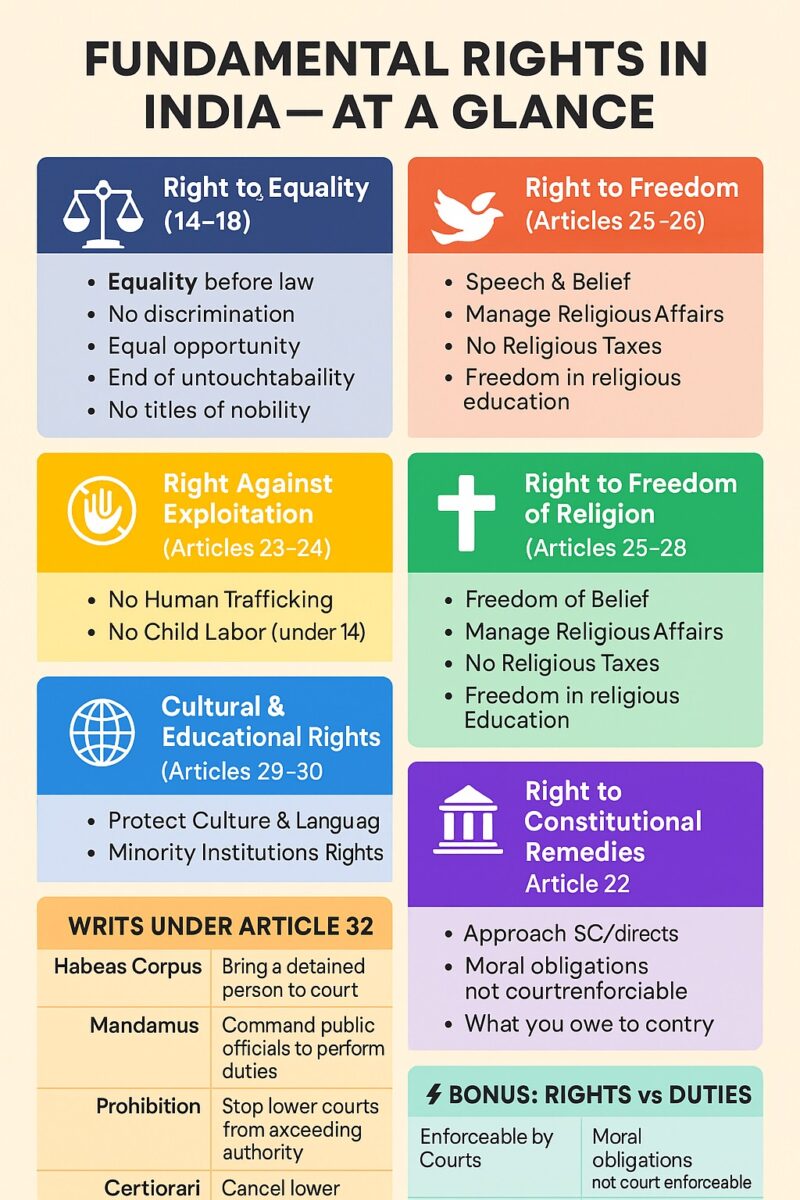
🇮🇳 Discover Your Fundamental Rights in India! 🇮🇳

Think of Fundamental Rights as your personal shield 🛡️, guaranteed by the Constitution of India. They ensure everyone gets respect, dignity, and equality, protecting you from unfair actions by the state. These are the basic human rights for every citizen, no matter their race, religion, gender, or birthplace.

Where are they found?

In Part III of the Indian Constitution, specifically Articles 12 to 35. This part is so important, it’s often called the Magna Carta of India!

Why are they important?

  • They protect your liberty and freedom.
  • They prevent the government from becoming too powerful or dictatorial.
  • They are crucial for your personal growth and the nation’s development.
  • They act as a check on the government’s actions.
fundamental rights of indian constitution upsc

The 6 Pillars: Your Fundamental Rights Explained

Here’s a breakdown of the six main categories of rights you possess:

1. Right to Equality (Articles 14-18) ⚖️

  • What it means: Everyone is equal before the law! No special treatment for anyone. The law protects everyone equally.
  • Key Guarantees:
    • Equality Before Law (Art. 14): No one is above the law.
    • 🚫 No Discrimination (Art. 15): The state cannot discriminate based on religion, race, caste, sex, or place of birth.
    • 🧑‍💼 Equal Opportunity (Art. 16): Everyone gets an equal chance in government employment matters.
    • Abolition of Untouchability (Art. 17): Practising untouchability is forbidden.
    • 🎖️ Abolition of Titles (Art. 18): No hereditary titles of nobility are allowed (like Raja, Maharaja).

2. Right to Freedom (Articles 19-22) 🕊️

  • What it means: You have essential personal freedoms!
  • Key Freedoms (Art. 19):
    • 🗣️ Freedom of speech and expression.
    • 🤝 Freedom to assemble peacefully (without weapons).
    • 👥 Freedom to form associations or unions.
    • 🚶 Freedom to move freely throughout India.
    • 🏠 Freedom to reside and settle anywhere in India.
    • 💼 Freedom to practice any profession, trade, or business.
  • Other Protections:
    • 🛡️ Protection Regarding Conviction (Art. 20): Protection against unfair punishment.
    • ❤️ Protection of Life & Personal Liberty (Art. 21): Your right to live and be free. (This is interpreted very broadly by courts!)
    • 📚 Right to Education (Art. 21A): Free and compulsory education for children (age 6-14).
    • 🔒 Protection Against Arrest & Detention (Art. 22): Rights if you are arrested or detained.

3. Right Against Exploitation (Articles 23-24) 🛑

  • What it means: Protection from being exploited or forced to work.
  • Key Protections:
    • 🙅 Ban on Human Trafficking & Forced Labour (Art. 23): Includes practices like ‘begar’ (forced work without pay).
    • 🧒 Ban on Child Labour (Art. 24): Prohibits employing children under 14 in hazardous jobs (factories, mines, etc.).

4. Right to Freedom of Religion (Articles 25-28) 🙏🕉️☪️✝️☸️✡️

  • What it means: You have the freedom to follow your faith.
  • Key Aspects:
    • ✝️ Freedom of Conscience & Religion (Art. 25): Freedom to believe, practice, and share your religion.
    • Manage Religious Affairs (Art. 26): Religious groups can manage their own affairs.
    • 💰 No Taxes for Promoting Religion (Art. 27): Freedom from paying taxes specifically to promote a particular religion.
    • 🎓 Religious Instruction Freedom (Art. 28): Rules about religious teaching in educational institutions.

5. Cultural and Educational Rights (Articles 29-30) 🎭📚

  • What it means: Protecting diverse cultures and ensuring educational rights, especially for minorities.
  • Key Rights:
    • 🌍 Protection of Interests of Minorities (Art. 29): Right to conserve distinct language, script, and culture. No denial of admission to state-aided institutions based on religion, race, caste, language.
    • 🏫 Minority Educational Institutions (Art. 30): Minorities have the right to establish and run their own educational institutions.

6. Right to Constitutional Remedies (Article 32) 🏛️💡

  • What it means: This is your master key! If any of your Fundamental Rights are violated, you can directly approach the Supreme Court (or High Courts under Art. 226) to get them enforced.
  • The Court’s Tools (Writs): The courts can issue special orders called writs:
    • Habeas Corpus: To produce a detained person before the court.
    • Mandamus: To order a public official to do their duty.
    • Prohibition: To stop a lower court from exceeding its jurisdiction.
    • Certiorari: To quash an order of a lower court.
    • Quo Warranto: To question the legality of a person holding a public office.
  • Other Related Articles (33-35): These allow Parliament to modify rights for armed forces, impose restrictions during martial law, and make laws to enforce these rights.

🤔 Fundamental Rights vs. Fundamental Duties

  • Rights: Are guaranteed to you by the Constitution and are enforceable by courts. Think of them as what the country promises you.
  • Duties: Are expected from you as a citizen (added by the 42nd Amendment, 1976). Think of them as your contribution to the country. They are not directly enforceable by courts in the same way rights are.

FAQ Spotlight: What is “Equal Protection of Laws”?

It means the law must operate equally for everyone under similar circumstances. If two people commit the same crime under similar conditions, they should face the same legal consequences, regardless of their background. It ensures fairness and prevents the government from treating people differently without a valid reason.


Understanding your Fundamental Rights empowers you as a citizen. They are the bedrock of India’s democracy! 🌟

Basic Child rights in India Upsc

Child Rights

A child is a person who has completed the age of 18, Minor as per UNO. Child rights are mentioned in Articles 25 of the Universal Declaration of Human rights.

Child rights are accepted and adopted in the UN General Assembly on 20th November 1989. Child rights are rights to Life, family environment, education, social security, against sexual exploitation and against sale or trafficking, against exploitation like child labor.

Right to Life

The child has the right to life before its birth. The right to survival also has the right to be born, the right to basic needs such as food, shelter, and clothing, and dignified living.

Right to Family Environment

Every child has the right to live a normal childhood in a family environment. Children with no family, abandoned, or destitute also have the right to live. These children can be given for adoption.

Right to Benefit from Social Security

Children should get financial support from the state or country, when their parents or guardian is not in a state to provide them with a good standard of living, due to illness, disability, or old age.

Right to Education

The right to education is an act of parliament of India enacted in 2009 for free and compulsory education for children from 6 to 14 years.

This act is based on Article 21A of the constitution. This act provides every child with compulsory elementary education. The child need not pay fees for elementary education.

Right against sale or trafficking

Children are vulnerable to sale or trafficking for various activities such as Child labour, Sex slaves, prostitution, drug trafficking, etc.

This right provides children with fundamental human rights against sale or trafficking.

Right against sexual exploitation

The government should protect children from sexual exploitation and sexual abuse, physically or mentally.

POSCO Act- Protection of Children From Sexual Offences Act

POSCO Act, 2012, is one of the most important acts as far as Child interest is concerned.

Feature of POSCO Act,2012
  • This act ensures anyone below the age of 18 to ensure health in the physical, emotional, intellectual, and social development of a child.
  • The statement is recorded as it is like the child narrates when the abuse is committed by the family member or the acquaintances.

  • “A child not to be called repeatedly to testify.”
  • The death penalty for rapist of girls under the age of 12 and stringent penal provisions for rape is added in April 2018.

  • The Criminal Law Amendment Ordinance, 2018 amended the Indian Penal code.
  • The fine imposed is used for the treatment and rehabilitation of the child victim.

Power and function of national and State human rights commission in India Upsc

National Human Rights Commission

Human rights, International Criminal Court Logo, By Original uploader was de:Benutzer:Afrank99 – http://de.wikipedia.org/wiki/Datei:ICC-Logo.svg (German Wikipedia)Description and license moved from English Wikipedia, Public Domain, https://commons.wikimedia.org/w/index.php?curid=8454614

It is an autonomous body constituted on 12 October 1993, by the protection of the Human Rights Act, 1993. National Human Rights Commission is responsible for the protection and promotion of Human Rights in India.

These human rights are guaranteed by the constitution.

Functions of NHRC

To inquire about the violation of human rights or negligence in the prevention of violation by public servants. Court proceedings are intervened that are relating to human rights.

To promote research in the field of human rights. To promote human rights education among societies. To encourage the effects of NGOs and institutions working in the field of human rights.

State Human Rights Commission (SHRC)

Every state in India has SHRC that was established with power by the state under section 21 of the protection of the Human Rights Act 1993.

The protection and promotion of human rights is the main objective of the commission.

Moreover, the procedures by the SHRC to conduct its proceeding, the Suo Moto action was taken on the complaints it receives irrespective of the sources and the proceeding transparency adds strength to the SHRC.

Function of SHRC

It enquires into Human rights violation matters, confined to state and concurrent lists. Its functions and duties are similar to the National Human Rights Commission but are confined within the state.

It has a Chairman and two members. It has the power of the civil court and can take cases by surveillance or in Suo Motu. It also recommends compensation to victims.

Indian Penal Code Upsc

The Indian Penal Code is the criminal code of India. It is a comprehensive code intended to cover all substantive aspects of criminal law. The code was drafted in 1860 on the recommendation of the first law commission of India established in 1834.

It came into force in British India during the early British Raj period of 1862. The objective of this act is to provide a general penal code for India.

The Indian Penal Code has a basic format, it is a document that lists all the cases and punishments that a person committing any crimes is liable to be charged. It covers any person of Indian citizenship. The exceptions are the military and other armed forces, they cannot be charged based on the Indian Penal Code. They have a different set of laws under the Indian Penal Code as well.

The Indian judicial system is one that has evolved into a stable and fair system of detention and penalizing, after being tested well for several years. The most important feature of the Indian Penal Code is the impartial nature of judgments promoted by the document.

The Indian Penal Code does not include any special favors for any special person in some position. Thus, the code stands alike for government employees, as for the common man, and even for a judicial officer.

This builds up the faith of the common citizens in the law-making and enforcing bodies in the country and prevents any sort of corruption or misuse on the part of the people in power. The Indian Penal Code includes all the relevant criminal offenses dealing with offenses against the State, offenses in public, offenses for armed forces, kidnapping, murder, and rape.

It also deals with offenses related to religion, offenses against property and it has an important section for offenses for marriage, cruelty from husbands or relatives, defamation, and so forth.

Indian Penal Code also provides for group liabilities that is, group liability under section 34 in the form of a rule of evidence making each member of the group liable for the final act if he has in any manner participated in action in furtherance of the common intention of all members of the group irrespective of his individual contribution which may have been very small.

Group liability under section 149 is envisaged making the members of the unlawful assembly vicariously liable for the criminal act which is in furtherance of the common object or what members of the unlawful assembly ought to have known is likely to be committed in given circumstances besides making each of them liable for punishment for being a member of an unlawful assembly.

The code also makes punishable what are described as inchoate crimes that are, amendment, attempt, and criminal conspiracy, etc.

The Indian Penal Code has been amended numerous times according to emerging needs. Concepts like sedition which was outside the purview of the Indian Penal Code was included in it after amendments. The need to revamp the criminal justice system was felt for quite some time as it has come under severe stress and strain due to changing aspirations of the citizens and the resulting social transformation.

The process of criminal investigation, prosecution, and adjudication necessarily warrant changes and transformation in tune with the developments in science and technology.

The information age has ushered in modern methods of criminal activities which need new methods of investigation and prosecution. For these, new criminal laws are needed. In view of this, the Indian government set up the V.S Malimath committee in 2000 to consider measures for revamping the criminal justice system in the country.

The committee submitted its report in 2003. This report has been examined at various levels to consider the various measures recommended by it for revamping the criminal justice system.

Some of the recommendations of the committee have been accepted by the government and have been incorporated in the criminal law of the land substantive and procedural.
* * All the Notes in this blog, are referred from Tamil Nadu State Board Books and Samacheer Kalvi Books. Kindly check with the original Tamil Nadu state board books and Ncert Books.