Age of Vijayanagaram Tnpsc

Age of Vijayanagaram

The Age of Vijayanagaram was a period of great cultural and economic prosperity in South India. It lasted from the 14th to the 17th centuries and was marked by the rise of the Vijayanagara Empire, which was the dominant power in the region for over 200 years.

The Vijayanagara Empire was founded in 1336 by Harihara I and Bukka Raya I, two brothers. The empire quickly expanded to cover much of South India, and its capital, Hampi, became a major centre of trade, commerce, and culture.

The Age of Vijayanagaram was a time of great artistic and architectural achievement. The empire was home to some of the most beautiful temples, palaces, and other structures in India. The empire also supported a thriving tradition of literature, music, and dance.

The empire’s economy was based on agriculture, trade, and commerce. The empire was a major producer of rice, cotton, and other agricultural products. It was also a major trading centre, with goods from all over India and the world being traded in its markets.

The Age of Vijayanagaram came to an end in the 17th century, when the empire was conquered by a coalition of Muslim sultanates. However, the legacy of the empire continues to be felt in South India today.

Major achievements of the Age of Vijayanagaram:

  • Political stability: The Vijayanagara Empire provided a period of political stability in South India, which allowed for economic and cultural development.
  • Economic prosperity: The empire was a major centre of trade and commerce, which led to economic prosperity for the region.
  • Cultural flowering: The empire was a major centre of art, architecture, literature, music, and dance.

Some of the most famous works of art and architecture from the Age of Vijayanagaram include:

  • Hampi: The ruins of Hampi, the former capital of the Vijayanagara Empire, are a UNESCO World Heritage Site.
  • Virupaksha Temple: This temple is dedicated to Lord Virupaksha, a form of Lord Shiva. It is located in Hampi.
  • Vittala Temple: This temple is dedicated to Lord Vishnu. It is located in Hampi.

The Age of Vijayanagaram was a golden age for South India. It was a time of great cultural and economic prosperity, and its legacy continues to be felt today.

Vijayanagar empire History

The four dynasties such as Sangama, Saluva, Tuluva and Aravidu, ruled Vijayanagar from A.D. 1336 to 1672. The sources of history and other details about the Vijayanagar Kingdom are found in the works of Krishnadevaraya’s Amukthamalyada, Gangadevi’s Maduravijayam and Allasani Peddanna’s Manucharitam.

The Moroccan traveller, Ibn Battuta, Venetian traveller Nicolo de Conti, Persian traveller Abdur Razzak and the Portuguese traveller Domingo Paes left some details of life in Vijayanagar in their works.

The achievements of Vijayanagar rulers were known from copper inscriptions such as Srirangam copper platers of Devaraya II.

Hampi and other monuments provide great evidence of their cultural contributions and coins issued are the major source of information.

Political history

The Vijayanagar empire was founded in 1336 by Harihara and Bukka of the Sangama Dynasty. Harihara and Bukka were originally served under the Kakatiya rulers of Warangal. Then they went to Kampili and they were imprisoned and were converted to Islam.

Later by the advice of saint Vidyaranya, they were converted back to Shaivism (Hindu Religion). Then they proclaimed independence and founded a new city on the southern banks of the river Tungabhadra and named the new city Vijayanagar.

They expanded the empire as the Hoysala Kingdom was declining. By 1346, they brought the Hoysala kingdom under their control.

War and Conflict

There was a struggle between the Vijayanagar Empire and the Sultanate of Madurai, which lasted for about four decades.

Kumarakampana destroyed the Madurai Sultans and the whole of South India, that is up to Rameswaram went into the hands of the Vijayanagar empire. This expedition to Madurai was described in Maduravijayam.

The conflict between Vijayanagara and the Bahmani Kingdom lasted for many years. This is due to a dispute over Raichur Doab, the region between the rivers Krishna and Tungabhadra, and the fertile Krishna-Godavari delta.

The greatest ruler of the Sangama dynasty was Deva Raya II. Even he could not have any clear win against Bahmani Sultans.

After the death of Deva Raya II, the Sangama dynasty became weak and the next dynasty Saluva Dynasty founded Saluva Narasimha reigned for only a short period (1486-1509).

Krishna Deva Raya (1509-1530)

Krishna Deva Raya belonged to the Tuluva Dynasty. This dynasty was founded by Vira Narasimha.

Krishna Deva Raya possessed great military skills, an imposing personality and with high intellectual quality. As soon as he came into power, his first task was to check the Bahmani Kingdom. But by the time he came into the Bahmani Kingdom was went into control of the powerful Delhi Sultanates.

Now ruling Bahmani armies were defeated in the battle of Diwani. Then Krishna Deva Raya invaded the Raichur Doah. This resulted in a fight with the Sultan of Bijapur – Ismail Adil Shah. Krishna Deva Raya won and captured Raichur city in 1520 and captured Bidar in the battle.

Then he defeated Gajapathi ruler Prataparudra in Orissa and conquered the whole of Telungana.

He maintained friendly relations with the Portuguese and Portuguese governor for India’s possession, Albuquerque sent his ambassadors to Krishna Deva Raya.

Krishna Deva Raya was Vaishnavaite and he respected all religions and was a great patron of literature and art and was known as Andra Bhoja.

Eight eminent scholars known as Ashtadiggajas were at his royal court.

Allasani Peddanna was the greatest and he was called Andrakavita Pitamaga his greatest works include Manucharitam and Harikathasaram. Pingali Suranna and Tenali Ramakrishna were other important scholars.

Krishna Deva Raya himself authored Telugu work, Amukthamalyadha and Sanskrit work Jambavati Kalyanam and Ushaparinayam.

Krishna Deva Raya built the famous Vittalaswamy and Hazara Ramaswamy temples at Vijayanagar and also built a new city called Nagalapuram in memory of his queen Nagaladevi and also built several large Rayagopurams.

Final Days of the Dynasty

After the death of Krishna Deva Raya, Achutadeva and Venkata succeeded to the throne. Then Rama Raya came to power.

The combined forces of Bijapur, Ahmadnagar, Golkonda and Bidar defeated Rama Raya at the Battle of Talaikotta in 1565. This battle is known as Raksasa Thangadi. Rama Raya was imprisoned and executed and then the city of Vijayanagara was destroyed.

However, the Vijayanagar Kingdom existed under the Aravidu Dynasty for about another century. Thirumala, Sri Ranga and Venkata II were important rulers of this dynasty.

The last ruler of the Vijayanagar kingdom was Sri Ranga III.

Administration

The throne was hereditary, the king enjoyed absolute authority in executive, judicial and legislative matters and the king was the highest court of appeal.

The King was assisted by a council of ministers and the empire was divided into different administrative units called Mandalams, Nadus, Sthalas and Gramas.

The governor of Mandalam was called Mandaleswara or Nayak. Besides land revenue, tributes and gifts from vassals and feudal chiefs, customs collected at the ports, and taxes on various professions were other sources of income.

Land Revenue was fixed generally one-sixth of the produce. The top-grade officers of the army were known as Nayaks or Poligars and they were given granted land in place of their services and these granted lands were called Amaram.

Soldiers were usually paid in cash.

Sometimes usurpation to the throne took place as Saluva Narasimha came to power by ending the Sangama Dynasty.

Cultural contribution

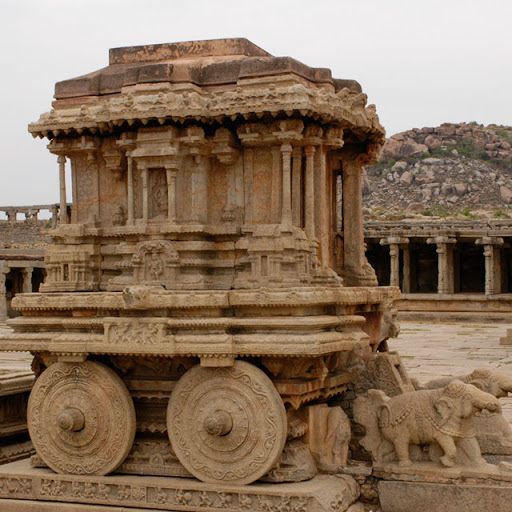
Their style of temple building is called as Vijayanagar style and it is characterized by the Dravida Style with unique features.

In the pillars of their temple, horses were the most common animal found and the temple had an open pavilion called Mandapam over a raised platform which is meant for deity seating on special occasions.

Vijayanagar temples also have Kalyana Mandapam with carved pillars. The important temples are Hampi, Vitthalaswamy and Hazara Ramaswamy are fine examples.

The presence of Raya Gopuram, or towers in different corners of the empire and as usual, Garbhagriha was the central part, where the main deity was placed.

Literature

Vijayanagar Empire literature was composed in many languages such as Sanskrit, Telugu, Tamil and Kannada. Their literature reached a zenith during the Krishna Deva Raja period.

For his contribution to the literature, he was called Andhra Bhoja.

Famous scholars are Srinatha, Pothana, Jakkama and Duggana, who translated Sanskrit and Prakrit works into Telugu.

Maduravijayam

Gangadevi wrote MaduraVijayam, during Bukka-I. Mahantaka Sudhanidhi and a commentary on the Brahmasutras of Badrayana are Sanskrit works of Devraya-II.

Point to Remember
Vijayanagar Empire
  • Manucharitam – It is written by Allasani Peddana, who was one of eight poets of Krishnadevaraya court, commonly referred to as Ashtadiggajalu. Manucharitam is one of the greatest works of Allasani Peddana, which provides us with an account of the caste system of the Vijayanagar empire.
  • Jambavati Kalyanam – It is a Sanskrit written by the king Krishna Deva Raya, is based on Jambavti daughter of Jambavan. Jambavan was a bear king who helped Lord Ram in the war against Tamil King Ravana.
  • Vijayanagar dynasty rulers
    • Harihara I (1336-1356 AD)
    • Bukka I (1356 AD- 1377 AD)
    • Harihara Raya II (1377-1404 AD)
    • Virupaksha Raya (1404-1405 AD)
    • Deva Raya I (1406-1422 AD)
    • Vira Vijaya Bukka Raya (1422-1424 AD)
    • Deva Raya II (1424-1446 AD)
    • Praudha Raya (1485 AD)

Conclusion

In this article, we have discussed the History of the Vijayanagar Empire, their religion, culture, and their art and architecture.

Download
1.Vijayanagar Empire Notes PDF Tamil Nadu state board book

Constitution of India Tnpsc notes

This is Tnpsc notes for the topic in the polity: Constitution of India

The Constitution is the fundamental law of the country. It reflects the fundamental principles on which government functions.

It is concerned with the distribution of powers between the various organs of the government and between the Union and the states. The concept of the constitution first originated in the USA.

Need for a Constitution

A constitution provides certain principles that form the basis of any kind of state that citizens desire to live in. The constitution will help fulfill the beliefs of different segments of citizens.

Making of the Indian Constitution

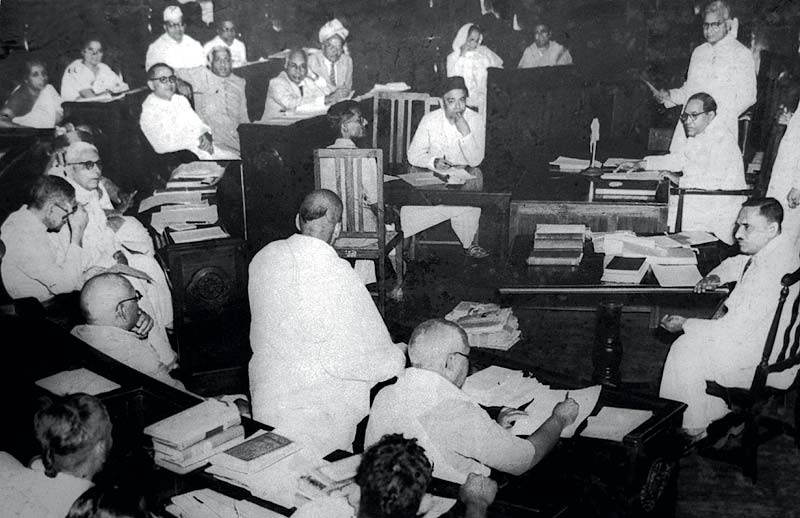
The Constitution of India was framed by a Constituent Assembly set up under the Cabinet Mission Plan, of 1946. The Assembly consisted of 389 members representing Provinces (292), the State (93), the Chief Commissioner’s provinces (3), and Baluchistan (1).

The Constituent Assembly held its first meeting on December 9, 1946. Dr. Sahchidananda Sinha, the oldest member, was elected as the temporary President of the Assembly.

Similarly, both H.C. Mukherjee and V.T Krishnamachari were elected as the Vice-President of the Assembly. The Assembly met for 11 sessions along with 166 days of meetings.

During the discussion, 2473 amendments were presented. The Assembly worked through various committees and the draft of the Constitution was prepared by the Drafting Committee under the chairmanship of Dr B.R. Ambedkar.

B.R. Ambedkar is recognized as the ‘Father of the Constitution of India‘. The Constitution was finally adopted on November 26, 1949, and contained a Preamble, 22 parts, 395 Articles, and 8 Schedules, after the draft was discussed by the people, the press, provincial assemblies, and others.

The drafted constitution came into force on 26th January 1950, this day is known as Republic day. Prem Behari Narain Raizada was the calligrapher of the Indian Constitution. The original constitution was handwritten by him in a flowing italic style.

Features of the Constitution of India

  • Longest Constitution – It is the longest Constitution with 395 articles and 12 schedules. And 90 Articles were added after 1951. It is regularly amended and so far there has 104 amendments have been made as of January 2020.
  • The Constitution of Indian is drawn from different constitutions.
  • Has Federal and Unitary features
  • Federal Structure with strong Centre
  • Independence of Judiciary
  • Directive Principles of State Policy
  • It is considered as Flexible and Rigid

Philosophy of the Constitution

Constitution has values that are guided by the freedom struggle and nurtured by it. The sacrifice from the freedom struggle is the foundation of the democracy of India. These values are in the Preamble. The Preamble is a guide for all the articles of the Indian constitution.

The idea of the Preamble is inspired by the constitution of the USA.

Institutional Design of Our Constitution

The Constitution of India is not merely a philosophy, but it embodies an institutional arrangement. As said earlier it is the longest handwritten constitution and its needs to be amended regularly. The makers of the constitution felt that it should be made in accordance with changes in society and the aspiration of the people.

Also, the Makers of the constitution did not see it as a sacred or unalterable law similar to religious texts such as Bhagvat Gita, Bible or Quran. So they made provisions to incorporate changes and these changes were known as Amendments.

Like any other constitution, the Indian constitution law down a procedure and chooses a person to rule this country by democratic means. Also, it defines how much power a person has and to take political decisions.

Also, the constitution defines the limits of the governments and provides some basic rights to its citizens that can never be violated.

Download

1. Constitution of India tnpsc notes pdf

Difference between cabinet and council of ministers upsc

Council of Ministers

difference between cabinet and council of ministers upsc

Article 74 of the Indian constitution

As per Article 74 of the Constitution, there shall be a council of ministers with the Prime Minister as the head to aid and advise the President, who shall in the exercise of his functions, act in accordance with the advice of the council of ministers.

That means there shall be a council of ministers.

The President accepts the advice of the council of ministers.

The council of ministers consists of three categories of ministers, namely, cabinet ministers, ministers of state, and deputy ministers.

While the cabinet ministers are involved in policy decision making, the other two categories have mere administrative responsibilities.

The difference between them lies in their respective ranks, emoluments and political importance.

At the top stands the Prime minister, the supreme governing authority of the country.

Appointment of the Council of Ministers

Under Article 75th of the Constitution, the Prime Minister is appointed by the President and the Prime Minister is appointed by the President and the other ministers are appointed by the President on the advice of the Prime Minister.

The ministers hold office during the pleasure of the President.

While the ministers are also appointed by the President and are said to hold office during the pleasure of the President as per the Constitution.

In actual practice, the ministers are selected by the Prime Minister and the President cannot appoint anyone not recommended by the Prime Minister.

Collective Responsibility of Council of ministers

The Constitution of India provides that the Ministers are collectively and individually responsible to the Lok Sabha.

The collective responsibility of the council of ministers means that the entire council of ministers is jointly responsible to the Lok Sabha for all the acts of the government.

It also means that the ministers must not speak in public in different voices.

All the ministers of the government are expected to be unanimous in support of policies on all public occasions and issues.

Kitchen Cabinet

A Kitchen Cabinet is a still smaller body or a cabinet within a cabinet. It is an informal body and the real centre of power. Every Prime Minister in India had a Kitchen Cabinet or Inner Cabinet.

A circle within a circle. It helps the Prime Minister in maintaining secrecy in making decisions on important political issues.

Kitchen cabinet in constitution

The kitchen cabinet does not have any constitutional status. This acts as an extra-constitutional body that takes decisions and improves the efficiency of the council of ministers.

Powers and functions of prime minister in Indian constitution Tnpsc with Mindmap

Prime Minister in the Indian Constitution

🇮🇳 Prime Minister in Indian Constitution

The Constitution provides for a collegiate executive, that is, the Council of Ministers under the leadership of the Prime Minister. It initiates, decides, and implements major policies based on the Constitution and laws.

🔵 Important Organs of Union Government

  • The Union Legislature (Parliament)
  • The Union Executive

Articles 52 to 78 in Part V deal with the Union Executive.

🔵 Key Highlights from Article 75

  • 👤 Prime Minister appointed by the President.
  • 🤝 Council of Ministers collectively responsible to Lok Sabha.
  • 📝 Ministers hold office during President’s pleasure.
  • 📜 Oaths administered by President (Third Schedule).
  • 📅 Ministers must be members of Parliament within 6 months.
  • 💰 Salaries determined by Parliament.

🔵 Nature of Indian Executive

India adopted the British Parliamentary Executive Model where the Prime Minister is the head of government and “primus inter pares” (first among equals) within the Council of Ministers.

🏛️ Appointment of the Prime Minister

👉 No direct election for Prime Minister. 👉 President appoints the leader of the majority party/coalition in Lok Sabha. 👉 If no clear majority, the President chooses the most likely candidate. 👉 No fixed tenure – serves as long as majority support exists.

⚡ Functions and Position of Prime Minister

  • Prepares the list of ministers and advises President on appointments.
  • Allocates portfolios among ministers.
  • Has discretionary power to designate Deputy Prime Ministers.
  • Can reshuffle or reorganize ministries and departments.
  • Heads the Cabinet, presides over meetings.
  • Link between President and Ministers; and Parliament and Ministers.
  • Spokesperson of the government in foreign affairs.
  • Death/resignation of PM = automatic end of the Council of Ministers.

🏢 Prime Minister’s Office (PMO)

PMO = Secretarial and advisory body assisting the Prime Minister. ➡️ Set up in 1947. ➡️ Headed by the Prime Minister (politically) and the Principal Secretary (administratively). ➡️ Extra-constitutional body with department status under Govt of India.

✅ Functions of PMO

  • Helps the Prime Minister in coordinating with ministries and state governments.
  • Assists as Chairman of Niti Aayog, National Development Council.
  • Handles public relations, media communications.
  • Processes cases for PM’s orders under business rules.
  • Maintains relations with the President, Governors, and foreign dignitaries.
  • Acts as the Prime Minister’s think tank.

Note: Cabinet matters are handled separately by the Cabinet Secretariat, though it works under the PM’s direction.

For full details, please read the below.

This is the TNPSC notes for polity for the topic: Prime Minister

The Constitution provides for a collegiate executive, that is, the Council of Ministers under the chairmanship of the Prime Minister.

The Council of Ministers is a body of persons having the authority to initiate major policies, make decisions and implement them on the basis of the Constitution and laws of the country.

Prime Minister in Indian Constitution, role, powers and Function Upsc

There are two important organs of the Union Government:

  1. The Union Legislature or the Union Parliament
  2. The Union Executive

“Articles 52 to 78 in Part V of the Indian Constitution deal with the Union Executive”.

Article 75

(1)The Prime Minister shall be appointed by the President and the other Ministers shall be appointed by the President on the advice of the Prime Minister
(2) The Minister shall hold office during the pleasure of the President
(3) The Council of Ministers shall be collectively responsible to the House of the People
(4) Before a Minister enters upon his office, the President shall administer to him the oaths of office and of secrecy according to the forms set out for the purpose in the Third Schedule
(5) A Minister who for any period of six consecutive months is not a member of either House of Parliament shall at the expiration of that period cease to be a Minister
(6) The salaries and allowances of Ministers shall be such as Parliament may from time to time by law determine and, until Parliament so determines, shall be as specified in the Second Schedule The Attorney General for India

India has adopted the British Parliamentary executive mode with the Prime Minister as the Head of the Government.

The Prime Minister is the most important political institution. But in the council of ministers (cabinet), the prime minister is primus inter pares (first among equals).

Appointment of Prime Minister

The Constitution does not contain any specific procedure for the selection and appointment of the Prime Minister. There is no direct election to the post of Prime Minister.

According to Article 75, the Prime Minister shall be appointed by the President. The appointment is not by the choice of the President.

The President appoints the leader of the majority party or the coalition of the parties that commands a majority in the Lok Sabha as the Prime minister. In case no single party gets a majority, the President appoints the person most likely to secure majority support.

The Prime Minister does not have a fixed tenure.He/she continues in power so long as he/she remains the leader of the majority party or coalition.

Functions and Position of the Prime Minister

The first and foremost function of the Prime Minister is to prepare the list of his ministers. Then He/She meets the President with this list of his minister.

After that, the Council of Ministers is formed. Very important ministers are designated as Ministers of the Cabinet rank, others are called Ministers of State.

While Ministers belong to a third rank area known as Deputy Ministers. It is one of the Discretionary powers of the Prime Minister to designate a minister as Deputy Prime Minister.

The President allocates portfolios among the ministers on the advice of the Prime Minister. The Prime Minister may keep any department or department under his control. The Prime Minister may also advise the President to reshuffle the portfolios of his ministers from time to time.

He may bifurcate or trifurcate a department or have different departments amalgamated into one department. The Prime Minister’s re Eminent Positions due to these points:

  • He/She is the leader of the party that enjoys a majority in the popular House of Parliament (Lok Sabha).
  • Has the power to select other ministers and also advise the President to dismiss any of them individually or require any of them to resign.
  • The allocation of business amongst the Ministers is a function of the Prime Minister.
  • He/ She can transfer a minister from one Department to another.
  • The prime minister is the Chairman of the cabinet, summons its meetings and presides over them. The Prime Minister is also the Chairman of many bodies like the Inter-State Council, the Nuclear Command Authority and many more.
  • While the resignation of a minister merely creates a vacancy, the resignation or death of the Prime Minister means the end of the Council of Ministers.
  • The Prime Minister is the sole channel of communication between the President and the Ministers and between the Parliament and his Ministers.
  • The Prime Minister is the Chief spokesperson of the government in foreign affairs.

Prime Minister’s Office

  • The Prime Minister is the head of the government and the real executive authority.
  • The prime minister plays a vital role in the politico-administrative realm of our country.
  • To fulfil the responsibilities, the Prime Minister is assisted by the Prime Minister’s Office (PMO).
  • The Prime Minister’s Office is an agency meant to provide secretarial assistance and advice to the Prime Minister.
  • The Prime Minister’s office is an extra-constitutional body which plays an important role in the top-level decision-making process of the Government of India.
  • The Prime Minister’s Office has the status of a department of the Government of India.
  • The Prime Minister’s Office came into existence in 1947.
  • Till 1977, it was called the Prime Minister’s Office, which was headed politically by the Prime Minister and administratively by the Principal Secretary.

The Prime Minister’s Office Performs Several Functions

  1. Assists the prime minister in his overall responsibilities as head of the government, in maintaining communication with the central ministries/departments and the state government.
  2. Help the prime minister in his responsibilities as chairman of the Niti Aayog and the National Development Council.
  3. Looks after the public relations of the prime minister, like contact with the press and the general public.
  4. Deals with all references, which under the Rules of Business have to come to the Prime Minister.
  5. Provides assistance to the Prime Minister in the examination of cases submitted to him for orders under prescribed rules.
  6. Maintains harmonious relationships with the President, Governors and Foreign representatives in the country.
  7. Acts as the think tank of the Prime Minister. It deals with all such subjects that are not allotted to any department/ ministry.
  8. It is not concerned with the responsibility of the Prime Minister as the Chairman of the Union Cabinet.
  9. The Cabinet’s cases area is directly dealt with by the Cabinet Secretariat, which also functions under the direction of the Prime Minister.

🌟 Conclusion

The Prime Minister is the real executive authority of India, guiding the government’s actions domestically and internationally, maintaining unity among ministers, and representing the voice of the nation across the world.

Vice president of India Upsc

Vice President of India Election Process

The election process for the Vice President of India is outlined in the Constitution of India (Article 66). Here are the key aspects of the election process:

  1. Eligibility:
    • To be eligible for the office of the Vice President, a candidate must be a citizen of India.
    • The candidate must have completed at least 35 years of age.
    • Other qualifications are similar to those required for a member of the Rajya Sabha (Council of States).
  2. Nominations:
    • The election is conducted by an electoral college consisting of members of both Houses of Parliament (Lok Sabha and Rajya Sabha).
    • Candidates need to be nominated by at least 20 electors as proposers and at least 20 electors as seconders.
  3. Scrutiny of Nominations:
    • The nominations are scrutinized by the Returning Officer, who is appointed by the Election Commission of India.
    • The Returning Officer examines the nominations to ensure they meet the eligibility criteria.
  4. Withdrawal of Nominations:
    • Candidates have the option to withdraw their nominations before a specified date.
    • If only one candidate is remaining after the withdrawal, that candidate is declared elected without a contest.
  5. Voting:
    • Members of the electoral college, which includes elected and nominated members of both Houses of Parliament, cast their votes.
    • Each member’s vote is weighted based on the population of the state or union territory they represent.
  6. Election Method:
    • The election is conducted through a single transferable vote system.
    • Members rank the candidates in order of preference.
  7. Quota and Distribution of Votes:
    • To win, a candidate must secure a certain quota of votes calculated based on the total number of valid votes cast and the number of candidates.
    • If no candidate achieves the required quota in the first round, the candidate with the least number of votes is eliminated, and their votes are transferred to the second preference.
  8. Declaration of Result:
    • The candidate who attains the required quota of votes is declared elected as the Vice President of India.

The Vice President of India serves a term of five years and is eligible for re-election. This election process ensures representation from across the country and reflects the federal nature of India’s political system.

Vice President of India Qualification and Eligibility

The qualifications and eligibility criteria for the office of the Vice President of India are specified in the Constitution of India, particularly in Article 66. Here are the key points regarding the qualifications and eligibility for the Vice President:

  1. Citizenship:
    • The candidate must be a citizen of India.
  2. Age:
    • The candidate must have completed at least 35 years of age.
  3. Qualifications for Membership of Rajya Sabha:
    • The Vice President is the ex-officio Chairman of the Rajya Sabha (Council of States).
    • Therefore, the candidate must qualify for membership of the Rajya Sabha.
    • The qualifications for Rajya Sabha membership include being a citizen of India, not less than 30 years of age, and possessing other qualifications as prescribed by Parliament.
  4. Disqualifications:
    • A person cannot be a candidate for the office of the Vice President if they are disqualified for being chosen as, or for being, a member of either House of Parliament under the provisions of the Tenth Schedule (Anti-Defection Law).

It’s important to note that the Vice President is elected by an electoral college consisting of members of both Houses of Parliament. The electoral college includes elected and nominated members of Lok Sabha (House of the People) and Rajya Sabha.

The Vice President serves a term of five years and is eligible for re-election. The qualifications and eligibility criteria ensure that the Vice President is an individual who meets certain basic requirements and is capable of representing the country in the capacity of the ex-officio Chairman of the Rajya Sabha.

Term of office

The term of office for the Vice President of India is five years. The Vice President is elected by an electoral college consisting of members of both Houses of Parliament, including elected and nominated members of the Lok Sabha (House of the People) and the Rajya Sabha (Council of States). The Vice President can be re-elected for additional terms if they choose to contest again and win the election.

It’s worth noting that the Vice President’s role includes serving as the ex-officio Chairman of the Rajya Sabha, one of the two houses of the Indian Parliament. The Vice President’s term aligns with the duration of each session of Parliament, and the election for the Vice President usually takes place a few months before the expiry of the term to ensure a smooth transition and continuity in the functioning of the office.

Removal and impeachment process

The Constitution of India provides provisions for the removal and impeachment of the Vice President. The removal process is outlined in Article 67, and it is distinct from the process for the removal of the President. Here are the key points regarding the removal and impeachment process of the Vice President of India:

  1. Resolution for Removal:
    • A resolution for the removal of the Vice President can be initiated in either House of Parliament (Lok Sabha or Rajya Sabha).
    • The resolution must be supported by a majority of the total membership of that House and by a majority of not less than two-thirds of the members present and voting.
  2. Joint Sitting of Both Houses:
    • If the resolution is adopted by one House, it is then sent to the other House.
    • If the second House also passes the resolution with a similar majority, the Vice President can be removed.
  3. Impeachment Proceedings:
    • The process is often referred to as impeachment, although the term “impeachment” is not explicitly used in the Indian Constitution in the context of the Vice President.
    • The process is similar to the impeachment of the President but distinct from it.
  4. Grounds for Removal:
    • The Vice President can be removed from office on grounds of violation of the Constitution or gross misconduct.
    • Unlike the President, there is no provision for the Vice President to be removed on the ground of violation of the Constitution by the process of impeachment.
  5. Role of the President:
    • The President does not have a direct role in the removal process of the Vice President.
    • The President does not have the power to suspend the Vice President during the impeachment process.

It’s important to note that the removal process for the Vice President is a serious constitutional matter and is intended to address situations where there are substantial grounds for removal based on constitutional violations or gross misconduct. The process is designed to ensure a careful and thorough examination of the charges against the Vice President.

Constitutional Role

Constitution Provisions

The constitutional provisions related to the Vice President of India are primarily outlined in Part V (The Union) of the Constitution of India. The relevant articles that specify the role, powers, and responsibilities of the Vice President include:

  1. Article 63: The Vice President of India:
    • This article establishes the office of the Vice President of India.
    • It states that there shall be a Vice President of India who shall be elected by the members of an electoral college consisting of members of both Houses of Parliament.
  2. Article 64: The Vice President to be ex-officio Chairman of the Council of States:
    • This article designates the Vice President as the ex-officio Chairman of the Rajya Sabha (Council of States).
    • It outlines the duties of the Vice President in the functioning of the Rajya Sabha.
  3. Article 65: The Vice President to act as President or to discharge his functions during casual vacancies in the office, or the absence, of the President:
    • This article stipulates that in the event of a vacancy in the office of the President or during the President’s absence, the Vice President shall act as the President.
  4. Article 66: Election of Vice President:
    • This article details the method of election of the Vice President.
    • It specifies the composition of the electoral college and the procedure for the election.
  5. Article 67: Term of office of Vice President:
    • Article 67 defines the term of office of the Vice President, stating that the Vice President holds office for a term of five years.
  6. Article 68: Time of holding election to fill a vacancy in the office of Vice President and the term of office of the person elected to fill the casual vacancy:
    • This article provides details about the timing of elections to fill a vacancy in the office of the Vice President and the term of office for a person elected to fill a casual vacancy.
  7. Article 69: Oath or affirmation by the Vice President:
    • Article 69 outlines the oath or affirmation that the Vice President is required to take before entering the office.
  8. Article 70: Discharge of President’s functions in other contingencies:
    • This article specifies the circumstances under which the Vice President can discharge the functions of the President in cases other than a vacancy or absence.

These constitutional provisions collectively define the role, election process, powers, and responsibilities of the Vice President of India within the constitutional framework of the country.

Powers and Functions

The Vice President of India has several powers and functions, and these are outlined in the Constitution of India. The primary role of the Vice President is to serve as the ex-officio Chairman of the Rajya Sabha (Council of States). Here are the key powers and functions of the Vice President:

  1. Chairman of the Rajya Sabha:
    • The Vice President is the ex-officio Chairman of the Rajya Sabha, the upper house of the Indian Parliament.
    • As Chairman, the Vice President presides over the sessions of the Rajya Sabha, maintaining order and decorum.
  2. Casting Vote:
    • In the case of a tie during voting in the Rajya Sabha, the Vice President has the casting vote. This means that the Vice President can cast an additional vote to break the tie.
  3. Presiding over Joint Sessions:
    • The Vice President presides over joint sessions of both Houses of Parliament when they are convened by the President to address certain matters, such as the President’s address or a joint sitting to resolve a deadlock between the two Houses.
  4. Appointment of Deputy Chairman:
    • The Vice President appoints a Deputy Chairman of the Rajya Sabha from amongst its members. The Deputy Chairman presides over the sessions in the absence of the Vice President.
  5. Committee on the Functioning of the Rajya Sabha:
    • The Vice President is empowered to appoint a committee to review the functioning of the Rajya Sabha and suggest improvements.
  6. Role in the President’s Absence:
    • In the absence of the President, the Vice President discharges the functions of the President. However, the Vice President cannot perform the executive functions of the President.
  7. Role in the Event of a Casual Vacancy:
    • In the event of a vacancy in the office of the President or when the President is unable to discharge their functions due to illness or any other reason, the Vice President acts as the President.
  8. Oath or Affirmation:
    • The Vice President takes an oath or affirmation before entering upon the office, as specified in Article 69 of the Constitution.

It’s important to note that the Vice President’s powers are primarily associated with the functioning of the Rajya Sabha and certain constitutional roles in the absence or temporary incapacity of the President. Unlike the President, the Vice President does not have significant executive powers.

Relationship with the President

The Vice President of India and the President have distinct roles and powers as outlined in the Constitution of India. While both positions are integral to the functioning of the government, their responsibilities are separate, and the Vice President’s role is more closely tied to the legislative branch. Here’s an overview of the relationship between the Vice President and the President of India:

  1. Succession to the Presidency:
    • In the event of a vacancy in the office of the President due to resignation, death, or removal, the Vice President assumes the role of the President until a new President is elected.
    • The Vice President, however, does not exercise the executive powers of the President while performing these duties and cannot take certain actions without the President’s concurrence.
  2. Presiding Officer of the Rajya Sabha:
    • The Vice President serves as the ex-officio Chairman of the Rajya Sabha, the upper house of the Parliament of India.
    • While the President represents the ceremonial and executive head of the country, the Vice President’s role in the Rajya Sabha is more focused on the legislative process.
  3. Distinct Powers and Functions:
    • The President has significant executive powers, including the power to appoint the Prime Minister, dissolve the Lok Sabha (House of the People), and promulgate ordinances, among other executive functions.
    • The Vice President, on the other hand, has legislative functions, including presiding over the Rajya Sabha, casting votes in the case of ties, and participating in the legislative process.
  4. Independent Offices:
    • The President and Vice President are independently elected. They are not running on a joint ticket and are elected by separate electoral colleges.
    • The Vice President is not a part of the President’s cabinet and does not have a direct role in the day-to-day executive administration.
  5. Constitutional Independence:
    • Both offices derive their powers and functions directly from the Constitution of India. While the Vice President has certain constitutional responsibilities in the legislative sphere, the President has broader constitutional duties that include the exercise of executive powers.

In summary, the Vice President and the President of India have distinct constitutional roles, with the Vice President primarily serving as the ex-officio Chairman of the Rajya Sabha and as a constitutional successor to the President in certain circumstances. Their relationship is defined by the constitutional framework and the separation of powers between the executive and legislative branches of the government.

Role in the Absence of the President

The Vice President of India plays a crucial role in the absence of the President. In such situations, the Vice President is tasked with discharging the functions of the President. The relevant constitutional provisions outlining the Vice President’s role in the absence of the President are detailed in Article 65 of the Constitution of India. Here are the key aspects:

  1. Acting as President during Temporary Absence:
    • When the President of India is temporarily unable to discharge their duties due to absence, illness, or any other cause, the Vice President is entrusted with acting as the President.
  2. Discharging Executive Functions:
    • During the President’s temporary absence, the Vice President takes on the responsibilities of the President in terms of discharging executive functions.
    • However, it’s important to note that the Vice President does not assume the title of the President; they are simply performing the functions of the President.
  3. Limited Scope of Powers:
    • While the Vice President takes on the executive functions of the President in the latter’s absence, there are certain powers that the Vice President cannot exercise without the concurrence of the President. This includes the power to pardon or commute a death sentence, the power to dissolve the Lok Sabha (House of the People), and the power to issue ordinances.
  4. Temporary Nature of the Role:
    • The Vice President’s assumption of the President’s functions during the President’s absence is temporary and is designed to ensure the smooth functioning of the executive branch even in the President’s temporary incapacity.
  5. No Automatic Succession in Case of a Permanent Vacancy:
    • It’s important to distinguish between the Vice President’s role during the temporary absence of the President and the Vice President’s role in case of a permanent vacancy in the office of the President. In the latter case, the Vice President becomes the President until a new President is elected.

The constitutional provisions ensure continuity and stability in the functioning of the executive branch by providing a designated individual, the Vice President, to step in and perform the necessary functions when the President is temporarily unable to do so.

Rajya Sabha Chairman

Ex-officio Chairman

The Vice President of India serves as the ex-officio Chairman of the Rajya Sabha (Council of States), which is the upper house of the Parliament of India. The role of the ex-officio Chairman involves presiding over the sessions of the Rajya Sabha and performing various functions related to the legislative process. Here are the key aspects of the Vice President’s role as the ex-officio Chairman:

  1. Presiding over Sessions:
    • The ex-officio Chairman presides over the sittings of the Rajya Sabha. This involves maintaining order in the house, ensuring that parliamentary procedures are followed, and facilitating discussions and debates.
  2. Casting Vote:
    • In the case of a tie during a vote in the Rajya Sabha, the ex-officio Chairman (Vice President) has the casting vote. This means that they can cast an additional vote to break the tie.
  3. Appointment of Deputy Chairman:
    • The Vice President appoints a Deputy Chairman of the Rajya Sabha from amongst its members. The Deputy Chairman presides over the sessions in the absence of the ex-officio Chairman.
  4. Committee on the Functioning of the Rajya Sabha:
    • The Vice President has the authority to appoint a committee to review the functioning of the Rajya Sabha and to suggest improvements.
  5. Role in Legislation:
    • While the ex-officio Chairman doesn’t participate in the day-to-day legislative process as a regular member, they play a significant role in guiding discussions, deciding on points of order, and ensuring the smooth conduct of business in the Rajya Sabha.
  6. Representation in Diplomatic Functions:
    • The Vice President, in their capacity as the ex-officio Chairman, may represent the Rajya Sabha and, by extension, India, in diplomatic and ceremonial functions.

It’s important to note that the ex-officio Chairman’s role in the Rajya Sabha is distinct from the Vice President’s role in the executive branch. The Vice President may also perform the functions of the President in certain circumstances, as outlined in the Constitution. However, when acting as the Chairman of the Rajya Sabha, the Vice President focuses on the legislative responsibilities associated with that position.

Role in the parliamentary system

The role of the Vice President of India in the parliamentary system is multifaceted and is primarily associated with the legislative branch. The Vice President serves as the ex-officio Chairman of the Rajya Sabha (Council of States), which is the upper house of the Parliament of India. Here are the key aspects of the Vice President’s role in the parliamentary system:

  1. Presiding Over the Rajya Sabha:
    • The Vice President presides over the sessions of the Rajya Sabha as the ex-officio Chairman. This involves maintaining order during debates, deciding on points of order, and ensuring that parliamentary procedures are followed.
  2. Casting Vote:
    • In the event of a tie during a vote in the Rajya Sabha, the Vice President, in their capacity as the ex-officio Chairman, has the casting vote. This means they can cast an additional vote to break the tie.
  3. Guiding Legislative Proceedings:
    • The ex-officio Chairman plays a crucial role in guiding the legislative proceedings of the Rajya Sabha. They facilitate discussions, decide on procedural matters, and contribute to the efficient functioning of the house.
  4. Committees and Special Powers:
    • The Vice President has the authority to appoint committees, such as the Committee on the Functioning of the Rajya Sabha, to review and suggest improvements in the functioning of the house.
  5. Deputy Chairman Appointment:
    • The Vice President appoints a Deputy Chairman of the Rajya Sabha from amongst its members. The Deputy Chairman presides over the sessions in the absence of the ex-officio Chairman.
  6. Representation in Diplomatic Functions:
    • The Vice President, in their capacity as the ex-officio Chairman, may represent the Rajya Sabha and, by extension, India, in diplomatic and ceremonial functions.
  7. Role in Joint Sessions:
    • The Vice President presides over joint sessions of both Houses of Parliament when they are convened by the President to address certain matters, such as the President’s address or a joint sitting to resolve a deadlock between the two Houses.

It’s important to note that the Vice President’s role in the parliamentary system is distinct from the President’s role in the executive branch. While the Vice President may also perform the functions of the President during the latter’s temporary absence, the primary focus is on the legislative responsibilities associated with the position of the ex-officio Chairman of the Rajya Sabha.

Tie-breaking vote

The Vice President of India, in their capacity as the ex-officio Chairman of the Rajya Sabha (Council of States), holds a crucial role when it comes to voting in the event of a tie. The tie-breaking vote is one of the distinctive powers granted to the Chairman, who is the Vice President. Here’s how the tie-breaking vote works:

  1. Casting Vote in Case of a Tie:
    • When a vote is taken on any matter in the Rajya Sabha, and the result is a tie, meaning an equal number of votes on both sides, the Chairman (Vice President) has the casting vote.
  2. Use of the Casting Vote:
    • The casting vote allows the Chairman to cast an additional vote to break the tie and determine the outcome of the vote.
  3. Importance in Decision-Making:
    • The casting vote is significant in situations where there is an even split among members on a particular issue. It ensures that a decision is reached and prevents a deadlock.
  4. Exercise of Discretion:
    • The Chairman has the discretion to exercise the casting vote as they see fit. In most cases, the Chairman may choose to maintain the status quo or vote in a way that aligns with their views on the matter.
  5. Implications for Legislation:
    • The use of the casting vote can have significant implications, especially in the context of legislation and policy decisions. It can determine whether a bill is passed or defeated.
  6. Uncommon Occurrence:
    • While tie votes are relatively uncommon, they can happen, particularly on contentious issues where opinions are divided.

It’s worth noting that the casting vote is specific to the role of the Chairman in the Rajya Sabha and is not applicable to the Vice President’s role in the executive branch. The Vice President’s position as the ex-officio Chairman allows for a balanced and decisive role in parliamentary proceedings, contributing to the effective functioning of the legislative process in the Rajya Sabha.

Legislative Functions

The Vice President of India, in their capacity as the ex-officio Chairman of the Rajya Sabha (Council of States), has important legislative functions. These functions are centered around presiding over the sessions of the Rajya Sabha and ensuring the smooth conduct of legislative business. Here are the key legislative functions of the Vice President:

  1. Presiding Over Sessions:
    • The primary legislative function of the Vice President is to preside over the sittings of the Rajya Sabha. As the ex-officio Chairman, they occupy the presiding officer’s chair and maintain order during debates and discussions.
  2. Deciding on Points of Order:
    • The Chairman has the authority to decide on points of order raised by members. Points of order relate to the interpretation of parliamentary rules and procedures.
  3. Facilitating Debates and Discussions:
    • The Chairman plays a crucial role in facilitating debates and discussions on various matters brought before the Rajya Sabha. They ensure that members have an opportunity to express their views and that parliamentary procedures are followed.
  4. Casting Vote:
    • In the event of a tie during voting on any matter, the Chairman, who is the Vice President, has the casting vote. This allows them to break the tie and determine the outcome of the vote.
  5. Appointing Committees:
    • The Vice President has the authority to appoint committees, such as the Committee on the Functioning of the Rajya Sabha, to review and suggest improvements in the functioning of the house.
  6. Joint Sessions and Special Occasions:
    • The Chairman presides over joint sessions of both Houses of Parliament when they are convened by the President. This includes occasions such as the President’s address and joint sittings to resolve disagreements between the two Houses.
  7. Dissolution of the Rajya Sabha:
    • The Vice President, as the ex-officio Chairman, does not have the power to dissolve the Rajya Sabha. Unlike the Lok Sabha, the Rajya Sabha is a permanent body, and one-third of its members retire every two years.

While the Vice President’s legislative functions are primarily associated with the Rajya Sabha, it’s important to note that the Vice President is not a member of either house and does not participate in the day-to-day legislative process as a regular member. The role is more focused on presiding over sessions, maintaining order, and ensuring the effective functioning of the Rajya Sabha.

Conclusion

In conclusion, the Vice President of India holds a significant and multifaceted role within the country’s constitutional framework. Serving as the ex-officio Chairman of the Rajya Sabha, the Vice President plays a pivotal role in the legislative process, presiding over sessions, ensuring the smooth conduct of debates, and exercising a casting vote in the event of a tie. The Vice President’s responsibilities extend beyond the legislative sphere, with the authority to appoint committees and represent the Rajya Sabha in diplomatic and ceremonial functions.

Additionally, in the absence of the President, the Vice President assumes the responsibilities of the President, performing executive functions on a temporary basis. The Vice President is an important constitutional officeholder, contributing to the checks and balances in the Indian political system. The eligibility criteria, election process, and term of office are defined by the Constitution, emphasizing the importance of experience, age, and citizenship for those aspiring to this position.

While the Vice President’s role is distinct from that of the President, the two offices are interconnected, ensuring continuity in leadership and the functioning of the government. The Vice President’s unique position as a constitutional successor to the President underscores the significance of this role in maintaining stability and efficiency in the highest echelons of Indian governance. Overall, the Vice President’s role reflects the careful design of the constitutional framework, balancing legislative and executive functions to contribute to the democratic governance of the nation.

Crack the UPSC with Our Comprehensive President of India Notes

President of India

Article 52 of our constitution lays down that there shall be a President of India.

Article 53 lays down that the executive power of the Union shall be vested in the President and shall be exercised by him directly or indirectly.

  • The President is the head of the Indian State.
  • The President is the First Citizen of India and acts as the symbol of Unity, Integrity, and Solidarity of the Nation.

Selection process for the President of India

President of India Qualification and Election

  1. No person shall be eligible for election as President unless he is
  • citizen of India
  • has completed the age of 35 years
  • Is qualified for election as a member of the Lok Sabha

2. A person shall not be eligible for election as President if he holds any office of profit under the government of India, or the government of any state, or under any local or other authority subject to the control of any of the said governments.

3. Further Article 52 provides that the nomination of a candidate for election to the office of President must be subscribed by at least 50 electors as proposers and seconded by another 50 electors of the electoral college.

4. Every Candidate has to make a security deposit of Rs 15,000/- in the Reserve Bank of India.

5. This security deposit amount will be forfeited if the candidate does not secure 1/6 of the votes polled.

The President is not elected directly by people but by members of the Electoral College consisting of:

  • The elected members of both Houses of Parliament.
  • The elected members of the legislative assemblies of the states.
  • The elected members of the legislative assemblies of the Union Territories of Delhi and Pondicherry.
  • The President’s election is held with the system of Proportional representation by means of the single transferable vote and the voting is by secret ballot.
  • This system ensures that the successful candidate is returned by the absolute majority of votes

Electoral Quota = (Total number of valid votes polled in the election / Number of electors to be elected) + 1

  • Each member of the Electoral College is given only one ballot paper.
  • The voter, while casting a vote, is required to indicate his preference by marking 1,2,3,4 etc against the names of the candidates.
  • This means the voter can indicate as many preferences as there are candidates in the fray.
  • In the first phase, the first preference votes are counted.
  • In case a candidate secures the required quota in this phase, he is declared elected.
  • Otherwise, the process of transfer of votes is carried out.
  • The ballots of the candidate securing the least number of first preference votes are cancelled and his second preference votes are transferred to the first preference votes of the other candidates.
  • This process continues till a candidate secures the required quota.

Oath by the President

Before entering office, the President has to make and subscribe to an oath or affirmation. In the oath, the president swears:

  • To faithfully execute the office;
  • To preserve, protect and defend the constitution and the law; and
  • To devote himself to the service and well-being of the people of India.

The oath of office to the President of India is administered by the Chief Justice of India and in his absence in the presence of the senior-most judge of the Supreme Court.

Entitlement to the President of India

President is entitled without payment of rent, to the use of his official residence (The Rashtrapathi Bhavan). The President is entitled to such emoluments, allowances, and privileges as may be determined by the Parliament.

The President is entitled to several privileges and immunities. President enjoys immunity from legal liability for his official acts. During his term of office, he is immune from any criminal proceedings

Term of President

Article 56 says that the President shall hold office for a term of 5 years from the date on which he enters his office. However, he can resign from his office at any time by addressing the resignation letter to the Vice President.

Further, he can also be removed from office before the completion of his term by the process of impeachment. The President can hold office beyond his term of five years until his successor assumes charge.

He is also eligible for re-election to that office.

Succession

The President’s seat can be vacant in a variety of ways:

  1. On the expiry of tenure of five years.
  2. By his resignation
  3. On his removal by impeachment
  4. By his death
  5. When he becomes disqualified to hold office or when his election is declared void.
  • If a vacancy occurs, then an election to fill the vacancy should be held within six months and the Vice President acts as the President until a new President is elected.
  • Further, if the sitting President is unable to discharge his functions due to absence, illness or any other cause, the Vice President discharges his functions until the President resumes his office.
  • In case the office of the Vice President is vacant, the Chief Justice of India or if his office is also vacant, the senior-most judge of the Supreme Court acts as the President or discharges the functions of the President.

Powers of President of India Upsc

The President has vast Power and Functions. The President convenes the Parliament, and addresses and prorogues the same. That means the President initiates the beginning of Parliament, and addresses and also postpones the parliament proceedings.

The President nominates 12 members of eminence in different fields to the Rajya Sabha and two Anglo-Indian members to the Lok Sabha. The President enjoys veto power over non-money bills of the Parliament and can send back non-money bills for reconsideration of the parliament.

The President can convene joint sessions of the Rajya Sabha and Lok Sabha. The President can promulgate ordinances for a period not exceeding six months. The President also has veto powers over certain State Legislations.

The President prompts and facilitates the institution of the Council of ministers headed by the prime minister, and ensures that the Council of Ministers enjoys the support of the Majority in the Lok Sabha. The President alone installs the ministers and distributes portfolios to them, he can also dismiss the ministry if he feels that the ministry does not enjoy majority support in the Lok Sabha.

Nominates various members to various constitutional bodies, including the Judiciary, armed forces, and diplomatic corps. The President enjoys enormous powers during the period of emergencies, can suspend any law, and can dissolve ministries and legislatures for specified periods.

The president can commute capital punishment. When a person i.e. Vice President, Chief Justice of India or Senior Most Judge is acting as President, he/she enjoys all the powers and immunities of the President as is entitled to such emoluments, allowances, and privileges as determined by the President.

The official residence of the President of India is “The Rashtrapathi Bhavan situated in Delhi“.

Impeachment of President in India

Article 61 of the constitution gives a detailed procedure for the impeachment of the President.

For the Impeachment of the President, first, an impeachment charge has to be made in either House of the Parliament by a resolution signed by at least one-fourth of the total number of members of the House and moved by giving at least 14 days advance notice.

Such a resolution must be passed by a majority of not less than two-thirds of the total number of members of the house when one House so presents a charge, it should be investigated by the other House.

After the investigation, if a resolution is passed by the other house by a majority of two-thirds of its total number of members, the President stands removed by impeachment from his office from the date of passing of the resolution.

Conclusion

This article is written for the topic “President Tnpsc”. This article describes the Importance, role, selection, powers, and function of the President of India. It is extremely useful for TNPSC, Upsc, and other government exams.

FAQ

1. Present president of India?

Droupadi Murmu is the present president of India, who is serving as the 15th president of India since 2022. Also, Droupadi Murmu is the second woman president after Pratibha Patil.

Also, the first person from the tribal community to hold the office.

References

  1. Indian Polity and Governance

Significance of Dpsp Upsc

Dpsp

The Directive Principles of State Policy (DPSP) play a crucial role in the UPSC exam. They are non-justiciable, meaning they are not directly enforceable by the courts. However, they are fundamental to understanding the Indian Constitution’s ideals and goals.

Dpsp taken from which country?

The concept of Directive Principles of State Policy (DPSP) was borrowed by the Indian Constitution from the Constitution of Ireland.

However, the idea itself originated from the Spanish Constitution, which was adopted in 1931. The Irish Constitution, adopted in 1937, incorporated this concept and further inspired its inclusion in the Indian Constitution, drafted in 1949. So, while India directly adopted the DPSPs from Ireland, the underlying inspiration comes from Spain.

Here’s how DPSP is important for UPSC:

1. Understanding the Indian Constitution:

  • DPSPs form Part IV of the Indian Constitution, providing a framework for achieving social and economic justice.
  • Understanding these principles helps you grasp the overall vision and philosophy enshrined in the Constitution.

2. Analyzing Public Policy:

  • DPSPs act as guiding principles for the government’s policies and legislation.
  • By understanding these principles, you can critically analyze various government policies and programs and assess their alignment with the Constitution’s goals.

3. Answering UPSC Questions:

  • DPSPs often form the basis of essay questions and case studies in the UPSC exam.
  • Having a strong understanding of these principles allows you to frame comprehensive and informed responses.

4. Linking DPSPs with other subjects:

  • DPSPs are interlinked with various subjects relevant to the UPSC exam, such as economics, sociology, and political science.
  • Understanding these connections helps you analyze issues comprehensively and formulate well-rounded arguments.

Here are some specific examples of DPSPs and their relevance to UPSC:

  • Article 45: Right to Education: This article forms the basis for analyzing government policies on education, such as the Sarva Shiksha Abhiyan and the Right to Education Act.
  • Article 41: Right to Work: This article helps understand government initiatives aimed at employment generation and poverty alleviation, such as the Mahatma Gandhi National Rural Employment Guarantee Act.
  • Article 48A: Protection of Environment: This article forms the foundation for examining government policies on environmental protection and conservation.
Significance of Dpsp Upsc
Right to Education

Resources for studying DPSPs:

  • Drishti IAS: Provides comprehensive materials and study guides on DPSPs, including articles, notes, and previous year’s questions.
  • Mrunal Patel: Offers video lectures and explanations on DPSPs in a clear and concise manner.
  • Indian Constitution by D.D. Basu: A comprehensive textbook that provides an in-depth analysis of DPSPs and their legal implications.

Additional Tips:

  • Focus on understanding the core principles and objectives behind DPSPs, not just memorizing the articles.
  • Practice applying DPSPs to real-world scenarios and contemporary issues.
  • Link DPSPs to other subjects relevant to the UPSC exam for a holistic understanding.

Significance of Dpsp (Directive Principles of State Policy)

The Directive Principles of State Policy (DPSP) are a set of non-justiciable principles enshrined in Part IV (Article 36 to 51) of the Indian Constitution. Though not legally enforceable, they serve as guiding principles for the state to strive toward achieving economic and social justice for its citizens.

Here’s why DPSPs are significant:

1. Aspirational Framework for Nation-building:

  • DPSPs provide a roadmap for the state to achieve socio-economic justice and establish India as a welfare state.
  • They outline the ideals and goals that the government should strive towards, encompassing various aspects like:
    • Social justice: Equality of opportunity, equal pay for equal work, elimination of untouchability, etc.
    • Economic justice: Reduction in income inequalities, promotion of cottage industries, fair wages, etc.
    • Political justice: Equal access to justice, free and fair elections, protection of minorities, etc.
    • Environmental justice: Protection and improvement of the environment, conservation of forests and wildlife.

2. Guiding Principles for Governance:

  • DPSPs serve as a valuable tool for the government to formulate policies and enact laws that are aligned with the aspirations of the people.
  • They act as a constant reminder to the government of its obligations towards its citizens.

3. Catalyst for Social Change:

  • While not directly enforceable, DPSPs can influence public opinion and create a moral pressure on the government to implement them.
  • They can inspire social movements and mobilize public support for reforms aimed at achieving social and economic justice.

4. Flexibility and Adaptability:

  • Unlike Fundamental Rights, which are rigid and legally binding, DPSPs are more flexible and adaptable to changing circumstances.
  • This allows the government to adjust its policies and priorities in response to new challenges and opportunities.

5. Link between Fundamental Rights and DPSP:

  • DPSPs provide a framework for the state to implement and realize the Fundamental Rights of its citizens.
  • They act as a bridge between individual rights and the collective good, ensuring that the pursuit of individual freedoms does not come at the expense of social justice and equality.

Here are some specific examples of the significance of DPSPs:

  • Right to Education: Article 45 of DPSPs directs the state to provide free and compulsory education for all children up to 14. This has led to the implementation of various educational programs like the Sarva Shiksha Abhiyan, which has significantly improved literacy rates in India.
  • Right to Work: Article 41 of DPSPs directs the state to provide work for all citizens. This has led to implementing various employment schemes like the Mahatma Gandhi National Rural Employment Guarantee Act, which guarantees 100 days of work per year to rural households.
  • Protection of Environment: Article 48A of DPSPs directs the state to protect and improve the environment and safeguard the forests and wildlife of the country. This has led to the implementation of various environmental protection laws and regulations, which have helped to conserve India’s natural resources.

Limitation of DPSP

The main limitation of DPSP is the state is not legally bound to implement it as it is not a law that could be enforced by the state. However, it is a set of principles that a state must follow as a part of its moral duty.

The essence of the directive principles of state policy

DPSP is contained in Part IV of the Indian constitution. But the fact is, it cannot be claimed as a matter of right nor it can be enforced by a court of law.

But its main essence is its principles that could be taken as a moral for governing the country.

Features Directive Principles of State Policy (DPSP)

Directive principles of state policy are like directives to the governments to implement them for establishing social and economic justice in India.

  • It comprises provisions for equal pay for both men and women,
  • Free and compulsory primary education,
  • Right to work etc.
  • Part IV of the Indian constitution also has provision for public assistance in case of old age, unemployment, sickness, and disablement, the organization of village Penchants,
  • Adequate means to livelihood,
  • Special privilege to the economically backward sections of the people and the distribution of wealth.
  • Most of these principles could help in making India a welfare state.
  • These principles were non-judicial.

Dpsp list

Here is the list of the Directive Principles of State Policy (DPSP) as per the Indian Constitution along with their significance for UPSC:

1. Social Justice

  • Article 38: State to secure a social order for the promotion of social welfare. Significance for UPSC: This can be linked to various government policies on welfare, poverty alleviation, and social security.
  • Article 39: Certain principles of policy to be followed by the State. Significance for UPSC: This can be linked to policies on equal pay for equal work, abolition of untouchability, and promotion of social justice.
  • Article 40: Organization of village panchayats. Significance for UPSC: This can be linked to policies on decentralization, rural development, and empowerment.
  • Article 41: Right to work, to education and to public assistance in certain cases. Significance for UPSC: This can be linked to policies on employment generation, education, and poverty alleviation.
  • Article 42: Provisions for just and humane conditions of work and maternity relief. Significance for UPSC: This can be linked to policies on labor rights, minimum wages, and workplace safety.
  • Article 43: Living wage, etc., for workers. Significance for UPSC: This can be linked to policies on minimum wages, income inequality, and social security.
  • Article 44: Uniform civil code for the citizens. Significance for UPSC: This is a controversial issue that can be debated from various perspectives.
  • Article 46: Promotion of educational and economic interests of Scheduled Castes, Scheduled Tribes and other weaker sections. Significance for UPSC: This can be linked to policies on affirmative action, reservation, and empowerment of marginalized groups.
  • Article 47: Duty of the State to raise the level of nutrition and the standard of living and to improve public health. Significance for UPSC: This can be linked to policies on food security, public health, and healthcare.
  • Article 48: Organization of agriculture and animal husbandry. Significance for UPSC: This can be linked to policies on rural development, agriculture, and food security.

2. Economic Justice

  • Article 39: Certain principles of policy to be followed by the State. Significance for UPSC: This can be linked to policies on equal pay for equal work, prevention of the concentration of economic power, and promotion of economic justice.
  • Article 43: Living wage, etc., for workers. Significance for UPSC: This can be linked to policies on minimum wages, income inequality, and social security.
  • Article 47: Duty of the State to raise the level of nutrition and the standard of living and to improve public health. Significance for UPSC: This can be linked to policies on food security, public health, and healthcare.
  • Article 48: Organization of agriculture and animal husbandry. Significance for UPSC: This can be linked to policies on rural development, agriculture, and food security.

3. Political Justice

  • Article 38: State to secure a social order for the promotion of social welfare. Significance for UPSC: This can be linked to policies on social justice, equality, and non-discrimination.
  • Article 39: Certain principles of policy to be followed by the State. Significance for UPSC: This can be linked to policies on equal pay for equal work, prevention of the concentration of economic power, and promotion of economic justice.
  • Article 40: Organization of village panchayats. Significance for UPSC: This can be linked to policies on decentralization, rural development, and empowerment.
  • Article 45: Provision for free and compulsory education for children. Significance for UPSC: This can be linked to policies on education, literacy, and human development.
  • Article 46: Promotion of educational and economic interests of Scheduled Castes, Scheduled Tribes and other weaker sections. Significance for UPSC: This can be linked to policies on affirmative action, reservation, and empowerment of marginalized groups.

4. Environmental Justice

  • Article 48A: Protection and improvement of environment and safeguarding of forests and wild life. Significance for UPSC: This can be linked to policies on environmental protection, climate change, and conservation.

5. Protection of Monuments

  • Article 49: Protection of monuments and places and objects of national importance. Significance for UPSC: This can be linked to policies on heritage preservation, cultural diversity, and national identity.

6. Peace and Security

  • Article 51: Promotion of international peace and security. Significance for UPSC: This can be linked to policies on foreign policy, international relations, and global cooperation.

It is important to note that the DPSPs are not justiciable, meaning that they cannot.

Welfare state Dpsp

The concept of the welfare state is deeply intertwined with the Directive Principles of State Policy (DPSP) enshrined in the Indian Constitution. While not directly enforceable, the DPSPs serve as guiding principles for the government to strive towards achieving social and economic justice for its citizens, thus creating a welfare state.

Here are some specific DPSPs that contribute towards the creation of a welfare state:

1. Article 38: This article directs the state to secure a social order for the promotion of social welfare. This implies a commitment to addressing issues like poverty, inequality, and lack of access to basic necessities like food, shelter, and education.

2. Article 39: This article promotes principles like equal pay for equal work, the prevention of the concentration of economic power, and the promotion of economic justice. These principles are crucial for ensuring a fair and equitable distribution of resources, which is a cornerstone of any welfare state.

3. Article 41: This article guarantees the right to work, to education, and to public assistance in certain cases. This ensures that every citizen has access to basic opportunities for livelihood, education, and social security.

4. Article 42: This article provides for just and humane conditions of work and maternity relief. This ensures that workers are protected from exploitation and have access to basic rights, contributing to a more equitable society.

5. Article 43: This article advocates for a living wage for workers. This ensures that workers are able to earn a decent living and participate meaningfully in the economy.

6. Article 46: This article promotes the educational and economic interests of Scheduled Castes, Scheduled Tribes, and other weaker sections. This addresses historical inequalities and empowers marginalized groups, promoting social justice and inclusivity.

7. Article 47: This article directs the state to raise the level of nutrition and the standard of living and to improve public health. This ensures that every citizen has access to basic necessities like food, healthcare, and sanitation, contributing to overall well-being.

8. Article 48: This article encourages the organization of agriculture and animal husbandry. This promotes rural development, food security, and economic growth, creating a stronger foundation for a welfare state.

9. Article 48A: This article emphasizes the protection and improvement of the environment and the safeguarding of forests and wildlife. This ensures a sustainable future for the nation and protects the natural resources essential for human well-being.

10. Article 51: This article promotes international peace and security. This fosters a stable and cooperative global environment, which is conducive to the development and prosperity of all nations, including India.

While the journey towards a full-fledged welfare state is ongoing, the DPSPs provide a roadmap for achieving this goal. By implementing policies and initiatives that align with these principles, the government can work towards creating a society where every citizen has the opportunity to live a dignified and fulfilling life.

In addition to the specific DPSPs mentioned above, the broader framework of the DPSPs also promotes the concept of a welfare state by:

  • Emphasizing the importance of social justice and economic equality: This ensures that the benefits of economic growth are shared equitably among all citizens.
  • Promoting the principles of democracy and inclusivity: This guarantees that all citizens have a voice in governance and are able to participate in the development process.
  • Encouraging social welfare programs and initiatives: This provides essential support to vulnerable groups and individuals, helping them to overcome poverty, inequality, and other challenges.

Conclusion

In conclusion, the Directive Principles of State Policy (DPSP) stand as a crucial pillar in the constitutional framework of India, offering a visionary roadmap for the nation’s socio-economic development. While not enforceable by the courts, these principles serve as guiding beacons for policymakers, urging them to align legislative and executive actions with the lofty ideals enshrined in the Constitution. For UPSC aspirants, a nuanced understanding of the DPSP is not just a matter of examination preparation; it is a key to comprehending the essence of the Indian democratic ethos.

As we navigate the dynamic landscape of governance and public policy, it becomes evident that the DPSP, despite its non-justiciable nature, plays a pivotal role in shaping the nation’s destiny. They embody the collective aspirations of a diverse and vibrant society, emphasizing the need for inclusive growth, social justice, and the overall well-being of citizens. As future administrators and leaders, UPSC aspirants must internalize the spirit of the DPSP, recognizing them not as mere directives but as a moral compass steering the nation toward a more equitable and just future.

In the ever-evolving narrative of India’s democratic experiment, the DPSP serves as a testament to the foresight of the framers of the Constitution, encapsulating the spirit of nation-building. As we reflect on the significance of the DPSP in the UPSC journey, let us appreciate their role in fostering a constitutional morality that transcends legal boundaries, inspiring a commitment to the principles of justice, liberty, equality, and fraternity.

Kindly refer to this link for a complete list of DPSP.

* * All the Notes in this blog, are referred from Tamil Nadu State Board Books and Samacheer Kalvi Books. Kindly check with the original Tamil Nadu state board books and Ncert Books.